16 August 2020 – Sunday – #108

I’m starting today’s entry with an awkward disclosure. August is a strange month in Spain with everyone off to the beaches or mountains, so maybe it’s appropriate just because August.

During the Covid-19 lockdown, when I completed a diary entry every day and then had to find other things to amuse myself, I searched for “how to use a bidet” videos on Youtube. I mean, yeah, I had the general concept, but I’ve never lived in a place with a bidet. It’s a search I commend to you, my dear readers. Youtubers have discovered many creative ways to explain this magic plumbing device without, well, giving it all away.

The reason I mention this is that I learned from my Youtube searches that a few people use bidets to clean a very dirty part of the body. Yesterday, that part of my body was filthy, indeed. Brad wanted to push off to see this year’s Festa Major de Grácia and I didn’t have time for a full on shower.

Remembering my lockdown videos, I grabbed a towel and closed the door. The bidet did its magic. In a matter of seconds, my feet were clean and dry. Off Brad and I went to check out the Festa.

In the spirit of Covid-19 and social distancing, this year’s Festa is virtual. Still, there were a few decorations here and there.

Festa Major de Grácia, 2020

Not too many festival attendees, though. Social distancing was in full force. I didn’t have to wait for the throngs to clear out to get this shot.

A handful of Gracia shops were open and about half the restaurants. It seems everyone has taken their Covid-19 to left town for the beaches this month. As Brad and I enjoyed lunch in a nearly deserted Plaça del Sol, an occasional fire cracker or M-80 exploded, perhaps reminders that revolutions and wars are not as distant as everyone thinks.

Speaking of which, the big news the past couple of weeks has been that Spain’s King Emeritus Juan Carlos Alfonso Víctor María de Borbón y Borbón split town for the UAE. He seemed to have financial troubles, but not so bad that he couldn’t afford a €10k per night hotel suite in Abu Dhabi. It also seems Juan Carlos I may have some of the same financial friendships in UAE and Saudi Arabia as that other royal family everyone is talking about, the Trumps.

Anyway, the point of this diary is Covid-19. The Covid-19 outbreaks have leveled off in Catalonia, but not in Spain.

Matthew Bennett compares Covid-19 post-lockdown statistics from the Spanish government and the Carlos III public health institute.

That’s clearly not helping Spanish tourism, although, along with agricultural work and family gatherings, tourism may be one of the drivers of Spain’s increase in Covid-19 cases.

“The numbers are saying that where we had good local epidemiological tracking, like [in the rural northwest], things have gone well. But in other parts of the country where obviously we did not have the sufficient local capacity to deal with outbreaks, we have community transmission again, and once you community transmission, things get out of hand.”

Rafael Bengoa, consultant and former health chief of Spain’s Basque Country region

Last week, Spain’s health ministry announced measures to reduce Covid-19 outbreaks including limiting group meetings to ten and closing bars and restaurants by 1am. How much difference these regulations will make in the middle of beach vacation season is anyone’s guess. August, as I mentioned above, is a strange month.

What I haven’t seen that I’d like to see is news that public health departments are hiring the volume of contact tracers needed to limit outbreaks. If you want to know more about the value of contact tracing, here’s a good summary of what 14 US states are learning from contact tracing.

From the US, Spain is commonly viewed as a monolithic entity. It isn’t, especially with respect to Covid-19. It’s as accurate to say Spain is having a problem with Covid-19 as saying the US is having a problem with Covid-19. The real Covid-19 story, however, is what’s happening in each Spanish region or US state.

I note this because the drivers of US Covid-19 outbreaks are similar to Spain’s.

The difference is that Spain started the summer with baseline of no Covid-19 community transmission, whereas the US has unhealthy levels of community transmission in most states. Heading into fall, the flu will join with Covid-19 to overwhelm health systems, advances in vaccines and treatments notwithstanding.

In Catalonia, I feel particularly safe because, for whatever reason, the regional public health authority has managed to keep Covid-19 cases level. At this point, unfortunately it matters which Spanish region or US state you live in. Better, for instance, to be in Catalonia than in Murcia. Better to be in New York than in Florida or Texas. Covid-19 is a dance. Choose your dance club wisely.

I want to spend a lot of time on the US, but it’s a waste of time. Trump clearly does not want to stop Covid-19. If he wanted to stop Covid-19, he would do it before the election and look like a hero. He’s missed the window of opportunity for that

My hunch is that Trump is either using Covid-19 to win the election or figuring out how to make money from it. Or both.

The USPS debacle is a clear sign that Trump thinks he can win if he confuses voters. He knows Covid-19 will scare voters from going to the polls in person. Dismantling the USPS will deter them from voting by mail. A lower vote count tends to favor Trump and Republicans.

As an example of how Trump makes money from Covid-19, he awarded a contract to a business associate to take over processing of hospital data from CDC. Now the company, TeleTracking, is refusing to answer questions about that same hospital data. The contract appears to have no value except to line the business associate’s pockets.

The US government is also letting huge contracts for Covid-19 treatments and vaccines. Not that this is necessarily bad, but in the Trump world, these are opportunities for favors or skimming. More generally, US healthcare companies are making a bundle in the middle of a pandemic. Trump likely is appeasing many US oligarchs.

At least Senator Romney is calling out Trump for letting Covid-19 deaths spiral out of control in the US. Meanwhile, the rest of conservative America is busy rationalizing the reasons the US can’t follow the EU’s example. On the school opening front, for instance, the New York Times corrected its reporting on a South Korean study of how youngsters transmit Covid-19.

What’s more important to me than the correction itself is how, in the comments section, people immediately pounce on this new information to reinforce their stand on school openings. I could say a lot more about this, but I think it boils down to the harmful effects of media, social and otherwise. This obsessive rationalization in the US is literally killing people.

What I do want to spend some time on today is science and technology (Yea!). Here’s another long and informative edition of Ground Rounds from UCSF.

UCSF Grand Rounds on Covid-19 Testing, Treatments, and Vaccines.

After watching this, I’m coming to the view that testing and behavior change are the ways the world gets back to something like normal. I’m also coming to the view that it will take another year of Covid-19 before something like normal returns. The impact of treatments and vaccines probably are 2-3 years off. You can skip to the final 10-15 minutes of the video to understand why I write this.

One cheap Covid-19 test approved this week uses saliva (spit instead of swab) and costs about $10 at retail. The virus is stable in saliva at room temperature for days and maybe weeks. The test is at least 94% as accurate as the gold standard PCR test. Here’s why it’s a game changer.

The concern about cheap tests is their accuracy, especially false negatives. If they’re not accurate, can you trust a negative result enough to socialize at home or work when you actually might be positive? It turns out that Covid-19 viral load peaks a day or two before any symptoms appear and it dissipates after about five or six days (watch Chaz’ section on testing in the video). That, in turn, means that false negatives are unlikely when someone is infectious because their viral load is so high. Testing frequently and testing those with whom you socialize also reduces the impact of a false negative.

So, a key behavior change is switching from infrequent, expensive, highly accurate PCR tests that, in a perfect world, take 1-2 days for results to frequent, cheap, less accurate spit tests that take 15 minutes to an hour for results. Lots more to come on this. It will take months to scale production and work out distribution, but it’s something that can be implemented with little risk in a year.

On the vaccine front, Russia approved the first Covid-19 vaccine. Anyone who takes it is a fool in my book. A member of the Russia Ministry of Health’s ethics committee resigned over the approval. Following Putin’s lead, Trump will announce a US Covid-19 vaccine before the election. The problem these politically motivated vaccine approvals create is distrust in vaccines, which already is a huge problem in the US.

As excited as everyone seems to be about a Covid-19 vaccine this year, the simple fact is that it takes a year to understand safety. Given reluctance to use vaccines in the US (another topic for another day), there’s no reason to think a vaccine will change Covid-19 in the US until full safety tests are completed. In addition to the UCSF video above, Vox has a good write-up on the current status of Covid-19 vaccines here.

Then there are treatments. Mortality rates are already better for Covid-19 patients because clinical practices have improved (doctors and nurses know a lot more) and because of corticosteroids. That will continue to improve incrementally as new treatments come along.

Even if a blockbuster shows up tomorrow, though, it’s a year to get through studies, manufacturing, and distribution. Speaking of blockbuster, here’s something cool from USCF (coincidentally). It’s a nasal spray called AeroNabs and here’s how it works.

AeroNabs Covid-19 treatment.

Derek Lowe provides a good third-party assessment of the AeroNabs technology here.

A related topic is Covid-19 decoys.

In a new study, published Aug. 4 in the journal Science, researchers engineered such a decoy and found that the coronavirus bound tightly to the imposter receptor, and once attached, the virus couldn’t infect primate cells in a lab dish. The decoy binds to the virus as tightly as a neutralizing antibody, a Y-shaped molecule generated by the immune system to grab the virus and prevent it from infecting cells. 

LiveScience, Decoys could trick COVID-19, keep humans safe from infection,” 10 August 2020

A developing topic of discussion with a connection to Barcelona is the study of cross-reactive T-cells. It’s much too early to know the impact of T-cells that were trained on other Coronaviruses, but there is speculation that we might be safer (as a herd) than we thought, and closer to herd immunity. That’s good news, but wait for the studies!

Okay, that’s it for this week. Except, OMG, firenados. As if the screenplay writers hadn’t thought up enough for the 2020 movie. Fires in California are turning into what are known as “firenados.”

The weather service issued its first ever firenado warning for Northern California. If you think Covid-19 is a pain in the ass, wait until the full impact of climate change.

Last, here’s why misinformation is so devastating to the eradication of Covid-19.

Covid-19 misinformation.

I write this for my sanity. If you like it, please forward to your friends. You can follow my daily Covid-19 posts on Twitter. Thanks for following along!
9 August 2020 – Sunday – #107

Brad arrived from San Francisco shortly after I posted last week’s entry. It’s great to have him back now that I remember to put on my clothes around Casa Solar.

Brad’s Barcelona sojourn was uneventful except at SFO where the gate agents didn’t recognize his Spanish visa no lucrativa. It took them about 20 minutes to determine he could board the Paris-bound flight with that unusual visa. According to Brad, who flew business class for safety, there were more flight attendants than passengers. He cleared immigration control at CDG and customs at BCN without problems.

The most dangerous point of the trip Covid-19-wise was the layover in the domestic terminal at CDG which was crowded, enclosed, and semi-masked. Most travelers I’ve spoken with are concerned about shared time in a metal tube. Safety in flight seems to be about the same as safety on the ground, namely masks and distance make a difference. Note that while airlines are enforcing their mask regulations, not all airlines are providing good distancing or cleaning practices.

After hearing Brad’s story about crowds at CDG’s domestic terminal that weren’t wearing masks wholeheartedly, I’m less inclined to fly to Algeria soon. I want to travel to Algeria to research Dear Mustafa before I finish the fifth draft, but the only way to fly there from BCN these days is via Paris. More hops means more terminal time means more Covid-19 infection opportunities, regardless of how well the airlines are managing their cabins.

Unfortunately for Brad, the summer heat is on. Not just the temperature, which is around 30C during the day. Covid-19 is heating up, too.

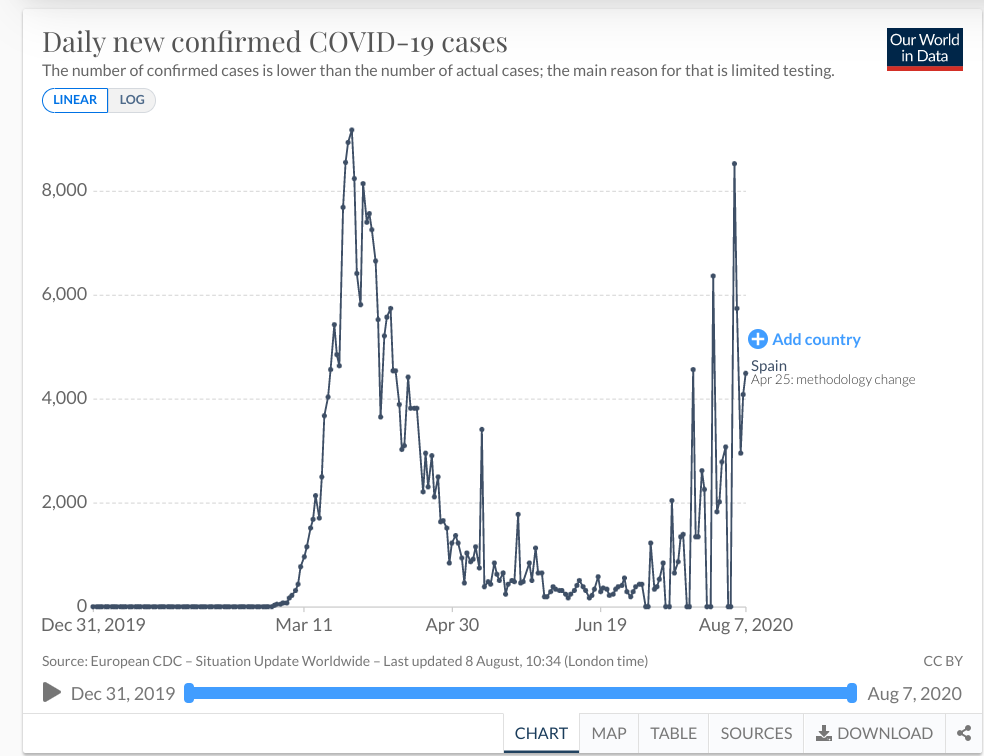
Here’s what Spanish Covid-19 cases and deaths look like. It’s got bad enough here that, in addition to the US, UK, and Germany, Switzerland now requires travelers from Spain to quarantine for 10 days.

Covid-19 cases and deaths in Spain side-by-side through 8 August 2020 (source: Our World in Data)

While conservatives in the US are claiming incorrectly that US Covid-19 deaths are not increasing as US Covid-19 cases rise again, it turns out that Covid-19 deaths in Spain actually are not increasing as cases rise.

The reason? My friend who works at a testing lab says the average age of Spaniards who tested positive for Covid-19 in his lab last week was 35. In other words, it appears that young Spaniards are partying, getting infected, but not dying. Spain’s low Covid-19 death rate is a demographic artifact of age. If Covid-19 outbreaks aren’t contained, they will spread to older Spaniards and death rates will increase again.

Since Spanish public health is managed by region, Catalonia’s statistics tell me how my local public health administrators are doing. Luckily, Covid-19 cases look a bit better here than in the country as a whole.

Catalonia Covid-19 cases before and after lockdown.

Obviously, I’d prefer if the new case numbers in Catalonia were closer to zero. However, Covid-19 outbreaks will happen and the real question is whether my local public health officials are taking the right action to contain new outbreaks. For now, it looks like Catalan officials are doing the right things and Covid-19 cases are leveling off.

My social life is booming with Brad here and I’m relaxing my standards as Covid-19 cases level off. Brad and I dined inside this week at Can Xurrades on Carrer de Casanova. On Friday evening, I had drinks inside with Ana at 14 de la Rosa in Gracia. I can recommend both places for distancing, although it still feels weird to spend time inside even when the venues aren’t crowded. I also can recommend Can Xurrades if you like beef (they grow their own) and 14 de la Rosa if you like drinks (their cocktail menu goes from sweet to sophisticated).

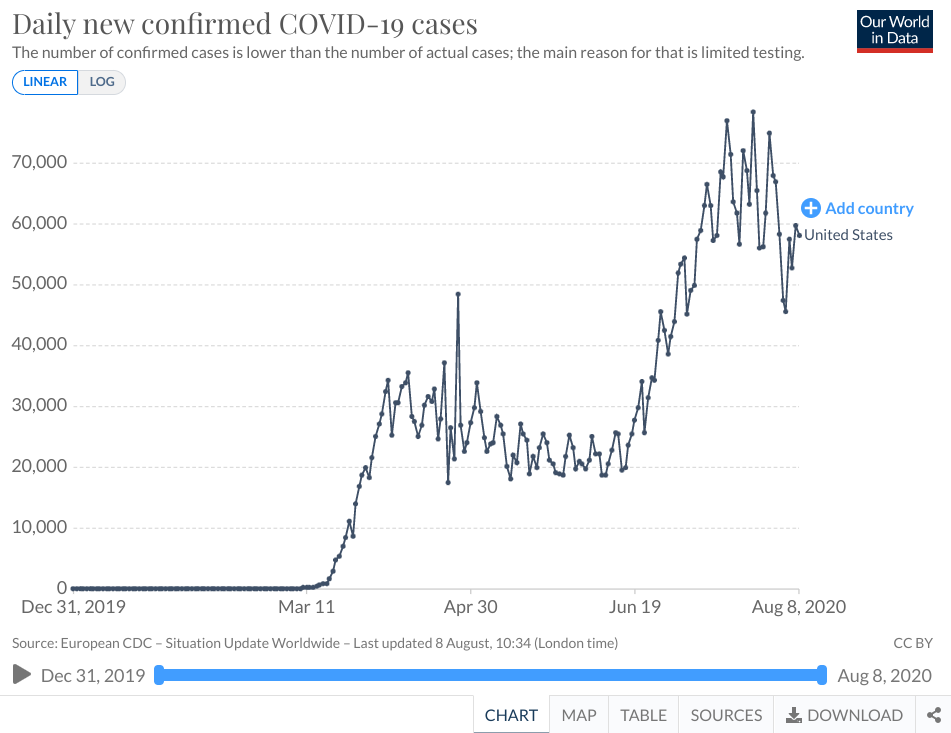
The US Covid-19 train wreck continues. A look at US Covid-19 cases and deaths shows that, indeed, Covid-19 deaths have surpassed 1,000 per day for the second time.

US Covid-19 cases and deaths side-by-side as of 8 August 2020.

At this rate, the US will have the most Covid-19 per capita deaths in the world by the November election.

How has the US failed so mightily compared to nearly every other country? There are two good post-mortems on the (lack of) US response to Covid-19, one in The Atlantic, the other in Rolling Stone. I commend both for a thorough examination. However, in a nutshell, Andy Slavin gets it right when he says it’s all about profit.

If you’re wondering what Trump is doing these days to line his pockets to stop Covid-19, here’s a possible replacement for hydroxychloroquine in his Covid-19 arsenal. Oleandrin is an oleander plant derivative that causes coronary death.

Trump reviews oleandrin for Covid-19.

Trump is practically declaring there will be a Covid-19 vaccination before the election, but scientists are concerned that his efforts to rush an ineffective vaccine to market are taking away resources needed to bring an effective vaccine to market. To win the election, Trump is willing to gamble a few more tens of thousands of lives.

In spite of the lack of Covid-19 leadership from 1600 Pennsylvania Ave, it’s heartening to know there is good science going on. Here is the most interesting scientific development I ran across last week, a man-made peptide that looks like it can beat Covid-19. Check out the embedded thread for a differentiation between this peptide antidote and vaccines from Oxford, Moderna, and others.

Peptide antidote to Covid-19.

I don’t even care if it works. It shows that scientists can put their heads together and come up with a new idea. What’s more, they disclose their economic incentives.

As I mentioned last week, though, New Zealand eradicated Covid-19 without new treatments or vaccines. The US doesn’t need great technology to solve its Covid-19 problems. It needs leadership.

Unfortunately, Covid-19 misinformation in the US is more likely to increase than decrease in front to the election. For instance, masks. Advocating against masks is like advocating against seat belts while driving at the speed you determine to be safe. Kansas announced that counties that mandated masks had lower Covid-19 infection rates than counties that did not. It took a day for conservatives to politicize the announcement.

The same is true for the back-to-school issue. Vox provided this week a useful distillation of what we know about Covid-19 and kids. The bottom line is we need more studies and, in the meantime, if community spread of Covid-19 is high, opening schools likely exacerbates the spread.

Laura Ingraham has been leading the charge at Fox News to claim that teachers and their unions are getting a special deal when schools are closed. In effect, she asserts that if doctors and nurses can work during Covid-19, why can’t teachers? She omits that doctors and nurses are dying from Covid-19. Meantime, Fox News ordered its staff to work from home.

An off-topic shout out to my Lebanese friends who are dealing with not only Covid-19, but also economic collapse and one of the worst non-nuclear explosions in history.

Beirut chemical explosion compared to other large explosions. Source: Statista.

Last of all, this is the best summary I’ve found of Trump’s position on Covid-19.

Typical Trump Covid-19 briefing.

Keep your distance, wear a mask, wash your hands, and check your sources.


I write this for my sanity. Please pass on to friends and follow me for my daily Covid-19 updates on Twitter.

2 August 2020 – Sunday – #106

On Friday, I looked at the Covid-19 new infection numbers in Catalonia. They were leveling off. Not as much as I’d hoped, but it seems that the government’s re-imposition of restrictions is keeping Covid-19 at bay for now.

I decided to go ahead with a planned visit to friends in Canet de Mar yesterday. Such are the risk assessments now associated with travel.

The Catalan health authorities seemed to agree with me. They lifted some restrictions in Barcelona and Lleida that they’d put in place to avert a second wave of Covid-19.

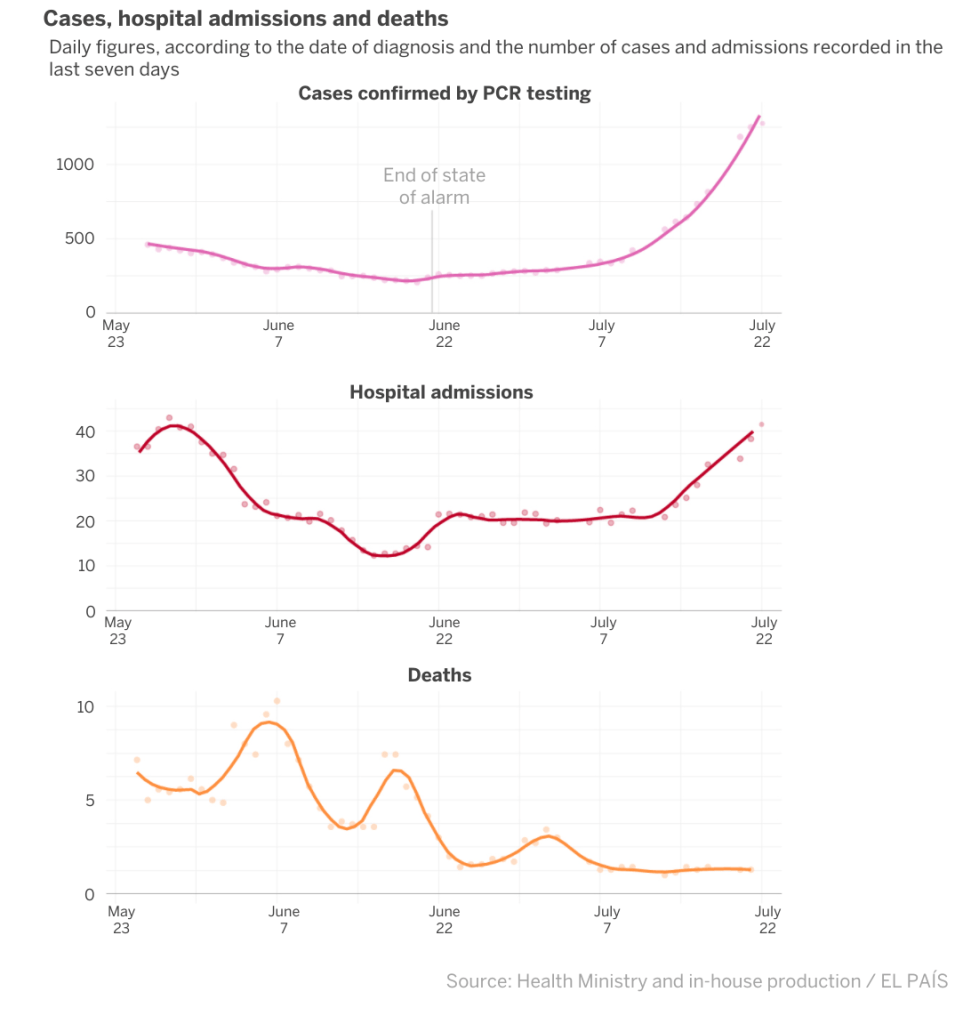
Spain, however, is not out of the woods. Between seasonal agricultural workers with poor living conditions, youthful bar hoppers, and tourists, two of the curves below are headed in the wrong direction and the third will turn up soon.

Spanish Covid-19 confirmed cases, hospitalizations, and deaths through 22 July. Source: El País,

The good news making travel decisions is that Spanish Covid-19 data should be more accurate now. Unlike three or four months ago, the healthcare system isn’t swamped and testing capacity is up. The Spanish Covid-19 death toll has been revised up to 44,868 after the government had time to comb through its data. With better data, the question is what data to use when making decisions to travel. Or even just to leave the apartment.

Brad pointed out, for instance, that there are data for each health jurisdiction. I had two reasons not to use that data when I decided to take the train to Canet de Mar. The health jurisdiction data do show local hotspots to avoid, but they are also probably at least two days out of date. So, you could decide it was safe to travel somewhere only to find out two or three days later that the safe place you visited turned into a hotspot while you were there.

Systematically, the agency that controls my Covid-19 health is the Catalan public health authority. Covid-19 outbreaks are bound to flare up here and there, so the real question is not whether I can identify the safe places to go by local data, but whether my Covid-19 health authority has the right systems in place to manage these outbreaks. In other words, since I’ll never know for sure if I’m headed towards a hotspot, looking at the Covid-19 situation in all of Catalonia is a better gauge of whether my health authority has the right systems to keep me safe.

Speaking of travel decisions, Brad is on a flight from SFO to CDG as I type. That comes with all kinds of risk assessments. He had a negative Covid-19 test last week, but it’s not clear whether that helps either clearing customs or quarantining once he arrives at Casa Solar. Both of us are pretty sure that he can clear immigrations with the long-term visa no lucrativa in his passport. His bags have been checked through to BCN, so it’s not clear whether he will clear customs in Paris (will the French honor a Spanish long-term visa?) or in Barcelona. Nicole says he clears customs in Paris and his bags clear in BCN. I’ll have updates next week. [UPDATE: Brad’s through immigrations at CDG and at the gate for his flight to BCN].

The big Covid-19 news this week are Q2 economic results. Spain’s economy contracted 18.5% quarter over quarter. The US economy contracted by 9.5%. By comparison, the EU economy contracted by 12%. The largest economy in the EU is Germany whose economy contracted by just over 10%.

Sweden is the EU country that attempted less heavy handed Covid-19 restrictions. The Swedish economy contracted by over 6%. That looks good compared to the EU, but Sweden’s neighbor Denmark, which had strict Covid-19 restrictions, is estimated to see its economy contract about the same amount.

The enormity of these economic contractions has to change the world. Things limped along in the second quarter, but I expect big ticket items like mortgage defaults and rental evictions to start breaking significantly in this quarter. The good news is that governments seem to be loosening their economic policies instead of tightening them, as was the case in the 2008 economic meltdown. The hard work is getting economies moving again.

The economic advantage the EU has over the US is that it can open up most of its economy as long as it contains Covid-19 outbreaks. The US, on the other hand, has seen the first wave of its Covid-19 epidemic rebound. US Covid-19 deaths are back above one thousand a day and, if unchecked, the US will have the worst per capita Covid-19 death rate in the world by election day. The extended first wave of Covid-19 will keep the US from fixing its economy.

Which brings me back to my Canet de Mar visit.

View of the Mediterranean Sea from the Canet de Mar train station, 1 August 2020.

I took the train from Barcelona. The ride there was less crowded than the ride back because everyone leaves the coastal beaches about the same time to return to Barcelona. As with my recent trip to El Masnou, pretty much everyone was wearing a mask. There was the couple sharing a kiss, though. That’s an awkward situation.

Part of the discussion with my Canet de Mar friends was about how much better things seem to be working in Spain right now. Everything, and I mean everything, is politicized in the US.

In Spain, people wear their masks. Occasionally, I count the people wearing masks along a random block in Barcelona. The counts this week have been well over 90% wearing masks, up from even the end of the lockdown.

In the US, people are breaking other people’s legs, stabbing each other, and peeing on the floor because they don’t want to wear masks. Even after conservative icons Bill Montgomery and Herman Cain died of Covid-19, even after Rep Louie Gohmert may have infected Rep Raúl Grijalva during a committee hearing, even after the science shows Covid-19 is spread by aerosols, conservatives cannot brook masks. “Give me liberty and give me death” seems to be the new conservative slogan.

In Canet de Mar, Tony told me, the locals made sure to support the town’s businesses during the lockdown. It looks like all the restaurants will stay open. Most of them have added abundant outside dining areas. There’s even a new place to try vermut and several new bars along the beach.

After almuerzo, back at Kim and Conie’s place, we sipped cava and surveyed the beaches, which now fly blue flags. There was speculation that the cessation of cruise ships helped the beaches qualify for blue flags this year. Natalie said the quality of the sea water was definitely better during her swims.

All of us wondered why the US can’t get its Covid-19 act together. If Trump decided tomorrow that the only thing that mattered was beating Covid-19, he could shut down the US again for four weeks and have two months to campaign on a great success.

Maybe it’s always nice in Canet de Mar, but if the only thing I have to do to earn a tasty lunch and bubbly on the terrace afterwards is wear a mask, I can wear a mask.

For my friends in the US, here’s how things look from outside.

Wear a mask, keep your distance, and wash your hands. It will go away without vaccines or treatments.


I’m blogging weekly on this page and tweeting daily here. I’m working on a mailing list and apologize for last Sunday’s pilot error sending out a blank email.