26 July 2020 – Sunday – #105

Covid-19 curtailed my travel plans for 2020. I wasn’t alone. As Covid-19 continues on and on, my travel plans continue getting smaller. I’m not alone in this, either.

In March, Mom and I were discussing when I could visit her later in the year. By the middle of the lockdown in April, it wasn’t looking so good for any 2020 travel to the US with nearly all international flights grounded. When Spain lifted lockdown restrictions, I decided my safest bet was to think smaller, to use the rest of 2020 to explore Catalonia and nearby cities like Madrid and Valencia.

To paraphrase an old saying, when you make plans, Covid-19 laughs.

Covid-19 is back in Spain. Cases rose after the restrictions were lifted. A lot. Last week Barcelona reverted to Phase 2 of the lockdown relaxation. I cancelled a trip to Sitges and reduced my 2020 travel plans once again, limited now to the exploration of my new hometown. I”m still not sure what I’ll do about a planned trip to Canet de Mar next weekend. It’s a small city where friends live about an hour by train up the coast from Barcelona.

So far the Covid-19 resurgence here doesn’t look nearly as bad as Israel’s second wave or the extended first wave in the US. It’s not clear, though, whether Spain is on the brink of a second wave or just hasn’t got its public health act together. Public health seems to know where the outbreaks are taking place, which is a big step forward from March. My opinion is that with some quick staffing of public health tracers, Spain can get the lid back on the Covid-19 jar.

The resurgence is closing the doors of hotels and restaurants before Spain’s travel industry had a chance to reopen them completely. Catalonia’s already depressed hotel reservations dropped 20% after France asked its citizens to forgo Spanish beach vacations. The UK has imposed a 14 day quarantine on travelers from Spain, effectively shutting down a fifth of Spain’s tourism

We should know next week whether the macro orders to revert to Phase 2 are compensating for the lack of case-by-case tracers. Covid-19 will let Spain know.

This week is a strange juncture of bad Covid-19 news and good Covid-19 news.

The bad news is that the US, the country with the world’s dominant economy and the world’s best science, technology, and high tech resources, has screwed up its Covid-19 response royally while smaller countries, countries Trump referred to as “shithole” countries, have had among the best responses. Think countries like Vietnam and Rwanda.

The bad news is that Covid-19 is spreading through the less developed world and overwhelming many of the largest less developed countries. Think countries like India and Brazil.

The bad news, and the reason this is a strange juncture in the Covid-19 timeline, is that all the good news probably won’t change Covid-19 outcomes meaningfully until the end of 2020 (for therapies) or the end of 2021 (for vaccines). In other words, the relentless bad news of Covid-19 will be with us for a year or more.

The good news seems very good right now. Bill Gates summarizes vaccines and, to a lesser degree, therapeutics in this interview.

Bill Gates summarized current state of Covdi-19 vaccines and therapies.

On vaccines, the good news boils down to the very low regulatory approval bar of 50% efficacy for the first Covid-19 vaccines. That moves some health benefit into the market early, but probably means multiple Covid-19 vaccine shots until a second, more effective generation of Covid-19 vaccines hit the market, presumably in 2021.

The big caveat, of course, is that even though the candidate vaccines are generating the kinds of immune system responses scientists expect from a vaccine (antibodies and T-cell), we don’t know for sure that any of the candidates provoke the right immune system response to immunize for Covid-19. With 20+ vaccines in human trial, large numbers are working in everyone’s favor.

Assuming the anti-vaxxers don’t throw a wrench in the works, that means the US and EU could have enough vaccine to achieve herd immunity later in 2021. The rest of the world probably achieves herd immunity after that. We need herd immunity everywhere to thwart Covdi-19.

On a related note, the good news is that herd immunity will happen, I’m going to note (without citation because I’m being lazy) that it looks like, regardless of what you may have seen about Covid-19 antibodies dropping off, patients’ T-cells are doing the expected things to establish long-term immunity. That means Covid-19 herd immunity is likely with vaccinations. The best proof I have for this is that immunologists aren’t running around like chickens without heads saying we can’t achieve herd immunity. They are saying the opposite.

The good news in the Covid-19 therapeutic landscape falls into two basic categories, monoclonal antibodies and repurposed drugs.

Several monoclonal antibodies for Covid-19 started phase 1 trials earlier this month. Big pharma production goals are tens of thousands or low hundreds of thousands of doses by the end 2020. Those are small numbers compared to Covdi-19 vaccine doses, but the main application is for people who are, or who are suspected of being, sick, not for the 60%+ of the population needed for herd immunity.

The repurposed drug category is much less predictable than monoclonal antibodies. In addition to the antiretroviral Remdesivir and the corticosteroid dexamethasone, which both are being used currently for Covid-19 cases, a new study shows that inhaled interferon significantly improves Covid-19 outcomes. Separately, a retrospective study shows that intravenous immunoglobulin (IVIg), a drug used for immune system disorders, improves Covid-19 outcomes in severely ill patients. I don’t mean this list to be exhaustive. UCSF, for instance, started a program in March to identify candidate drugs for re-purposing. That means there are probably many other studies coming to fruition in the next months.

So, there is the good news. It looks like the treatments and vaccines are coming. We even know about when they will arrive, which is better than my travel planning. That’s great unless Covid-19 complacency sets in. It will be easy to say, hey, why bother with lockdowns when there will be better therapeutics in six months.

Trump already gave an example of how he uses Covid-19 complacency in last week’s interview with Chris Wallace. After Wallace lists many incorrect statements Trump made about when Covid-19 would go away, the two men have this exchange.

TRUMP: I’ll be right eventually. I will be right eventually. You know I said, “It’s going to disappear.” I’ll say it again.

WALLACE: But does that – does that discredit you?

TRUMP: It’s going to disappear and I’ll be right. I don’t think so.

WALLACE: Right.

TRUMP:  I don’t think so. I don’t think so. You know why? Because I’ve been right probably more than anybody else.

Fox News, “Transcript: ‘Fox News Sunday’ interview with President Trump,” 19 July 2020.

Trump’s Covid-19 argument always has been that it’s going away, so why deal with it? It’s an excellent con because people want to believe they don’t have to change their Way of Life. Trump’s Covid-19 argument will resonate more when he notes a vaccine is around the corner. If nothing is done until the vaccine comes, he fails to mention, more people will die.

The implication of Trump’s insidious argument is that, after you’ve lost 150,000 American lives, what’s another 150,000 while we wait for a vaccine? “It’s going to disappear.”

I want to end today with a few Big Thoughts on Covid-19. What triggered this big thinking, in part, was a New York Times article in which the author describes how Covid-19 has replaced any notion he had of hope with a sense that the best he could hope for during Covid-19 is to explain what happened. Covid-19 has forced him to contemplate his death every day. That has changed his perspective on life.

Covid-19 is a truth teller. It reveals truths about our society, our morals, our institutions. As we reach this weird juncture where the end is in sight, but the Covid-19 pandemic is still raging, here is a short list of topics that Covid-19 asks us to consider.

  • Capitalism and Free Markets. Capitalism has failed in many ways during Covid-19. Here are a few examples. Covid-19 created enormous spikes in demand for PPE, ventilators, and other equipment that free markets couldn’t supply. Hospital bed supply ran out. Moving work space from office to homes created discontinuities in supply chains and shortages of not only, as everyone remembers, toilet paper, but also food. The employment discontinuity broke food and housing markets. The structure of US markets failed to allocate correctly medical care, housing, and food people need to live. If the economy isn’t working to help people live in the middle of a pandemic, who is it working for?
  • Democracy, especially US Democracy. The US democracy has a single point of failure in the executive. The executive ordered measurably among the worst Covid-19 responses in the world, a response that provided few standards, little guidance, and almost no coordination. Administration decisions consistently drove up costs by asking states to bid against each other. The allocation of responsibility for reopening to US governors didn’t come with the standards (including enforcement) they needed to make good decisions. Governors formed regional councils when the federal government failed. How did the US governmental system lead to one of the worst Covid-19 responses in the world? If the government isn’t there to protect residents during a pandemic, why is it there?
  • Media and Misinformation. I don’t have time. In a nutshell, traditional and social media are creating an epidemic of misinformation. Why?

This weird juncture between good news and bad news is a critical time to evaluate these topics. The world will face more Covid-19 type of discontinuities. Pandemics are increasing with higher human population and climate change. Then there’s climate change itself, whose scale will put the Covid-19 pandemic to shame. I don’t know how the world addresses these issues, but they are issues that we will face again soon.

19 July 2020 – Sunday – #104

I was planning to travel to Sitges this weekend. Ana recommended a paella place. I’m dying to try the different kinds of Spanish paella. A friend was all set to join me. On Friday, at the very last second, just as I picked up the phone to test my Spanish skills making a reservation at the paella place, Covid-19 laughed.

As expected, Covid-19 cases are up in Spain after the lockdown. Unfortunately, they’re up a lot in Catalonia. So, Barcelona is reverting to Phase 2 of Covid-19 restrictions. No one’s exactly sure what that means. For instance, is the beach off-limits now? But the signal is clear that we need to change our behavior. So much for my summer travel plans. I’m dying for paella, but not enough to actually die.

The first large Covid-19 outbreak here started among seasonal agricultural workers in Lleida. It’s clear that there were not enough contract tracers to follow up on all the cases.

“Germany has calculated its contact-tracing staff needs very well. It has figured out that it needs around 25 tracers for every 100,000 inhabitants. Catalonia would need between 1,500 and 2,000.”

Magda Campins, epidemiologist and chief of Barcelona’s Vall d’Hebron Hospital, El País, “Barcelona hospital chief: ‘The situation in Lleida has clearly gotten out of hand,” 14 July 2020.

At the rate Germany recommends, Catalonia should have sent over 100 contact tracers to the Lleida region. It sent nine.

Now infections in L’Hospitalet, on the west side of Barcelona, are on the rise as well. Michael Bennett graphs the Catalonia cases before and after the New Abnormal started (green vertical line).

Covid-19 cases in Catalonia ending 16 July 2020.

Catalonia’s failure to provide Covid-19 contact tracers is especially problematic because of asymptomatic cases. Researchers recently have found that a large proportion of Covid-19 cases are asymptomatic.

Asymptomatic Covid-19 cases increase likelihood of spread.

The blue area above shows the presymptomatic cases, red area the confirmed Covid-19 cases. In between blue and red, the yellow area shows cases that are hard to determine. It’s clear that most people don’t know they have (or they are about to have) Covid-19. That, by the way, is why it’s important to wear a mask even when you feel okay.

Young people are more likely to have asymptomatic cases. This heat map of the progression of Covid-19 cases in Florida shows how young people help spread the virus.

Spread of Covid-19 in Florida by age.

The horizontal axis is time and the vertical axis is age. Each square represents Covid-19 infections during a four day period for an age group of five years. The brighter the square, the higher the infection rate. The chart shows how Florida’s current Covid-19 outbreak started with young adults in their twenties who probably had asymptomatic Covid-19 cases. That hot mess then spread Covid-19 to older Floridians. There is no reason not to think the same kind of spread is taking place in Catalonia.

How bad can the asymptomatic spread of Covic-19 get? In Australia, contact tracing is working and it’s uncovering just how bad a superspreader case can be. An asymptomatic Australian woman with Covid-19 did everything right after travel, but one elevator ride apparently infected 71 people.

One asymptomatic carrier rode an elevator alone, then 71 people got COVID-19. She did everything right. She had no symptoms, but she self-quarantined anyway after travel. She stayed in her apartment. She ordered-in food. But she became patient zero in a 71-case cluster.

News.Com.AU, “Coronavirus contract tracing: Woman infects 71 people in 60 seconds,” 13 July 2020.

With high asymptomatic spread, it’s clear why masks are so important: to stop aerosol spray from asymptomatic cases.

For any skeptical readers, here is a story from The Department of Masks Really Work Department. Montgomery, Alabama is a poster child for cutting the spread of Covid-19 with masks.

Montgomery Mayor Steven Reed explains drop off in Covid-19 infections due to mandatory masks.

Really, the Montgomery story should be enough. But here’s an encore mask story for anyone who gets a hair cut.

CDC reports effectiveness in masks preventing Covid-19 spread at hair salon.

Good news on vaccines. First, the Covid-19 vaccine candidates furthest along in testing are eliciting the immune system responses needed to make a vaccine work.

“The results from Oxford yesterday add some detail to this discussion, with the good news that the two most obviously key parts of immune protection are effectively induced: antibodies that can neutralise virus entry, and T cells that can recognise and attack infected cells.”

Danny Altmann, Professor of Immunology, Imperial College London, The Guardian, “Covid-19 vaccine: what have we learned from Oxford phase one trial?,” 16 July 2020.

The questions for each of the 20+ vaccine candidates in human trials are whether they are safe and whether the particular immune system response they elicit will stop Covid-19.

Second, a Singapore study measures CD4 and CD8 response to the NP (nucleocapsid protein) fragment of the SARS-Cov-2 virus, which demonstrates immune system response and confirms SARS-Cov-2 vaccines should work. The study also found memory T-cells from the 2003 SARS-NP virus, which indicates that the immune system has created memory T-cells for other SARS viruses.

Eric Topol explains how this study helps, but doesn’t quite fill in all the gaps in our knowledge of Covid-19 and vaccines.

A look at what we know about Covid-19 and the human immune system response.

Big Pharma is gearing up to deliver vaccines even before they complete trials. Pfizer expects to deliver 100 million doses this year and a billion in 2021. It looks like we’ll be injecting something in the next year or two, but no one is quite sure what.

Whether vaccines will work against Covid-19, however, is not settled science. One doctor documents a recovered Covid-19 patient who had two negative PCR tests and then developed a second case of Covid-19. Because this is a well documented case, it shows that Covid-19 re-infection has happened. The open question is how often does re-infection occur. Is everyone susceptible to Covid-19 re-infection after a time? Or is it a one-in-a-million occurrence?

Many studies are showing Covid-19 antibodies disappearing altogether a few months after infection. Memory T cells may form for Covid-19, but that isn’t known, and, if they do, it also isn’t known if they will be effective against future infection.

All this may mean we will need booster shots for a vaccine. It certainly shows the need to continue investigating other therapeutics like monoclonal antibodies in case vaccines don’t provide the immunity needed.

It’s also important to note that New Zealand eradicated Covid-19 last week. Our kiwi friends have shown it’s possible to beat Covid-19 without treatments or vaccines if public health can do its job and people cooperate.

There are many signs that the US push to reopen is a disaster. The clearest is rising Covid-19 deaths. To paraphrase Paul Krugman, Americans needed a drink and now they’re paying the tab.

There are also many signs that the US push to reopen isn’t benefiting the economy as much as if the country had waited until Covid-19 was under control to reopen. One such sign is 5.4 million Americans losing healthcare insurance in the middle of a pandemic. That could lead to a collapse of the US healthcare system.

Another sign is the potential collapse of the housing market.

US Mortgage delinquency chart.

Even CEOs of major companies are telling government to stop the spread of Covid-19.

Perhaps the most difficult debate to watch from Spain is Trump’s push to re-open schools. Here is Sec’t of Education Betsy DeVos making the case to reopen schools no matter what.

Secretary of Education Betsy DeVos argues for schools to reopen.

It is a topic for which there are few data and fewer studies, so the debates are largely emotional because the trade-offs are unclear. The stakes couldn’t be higher with children’s well-being at risk whether they go to school or not.

Proponents of opening may want to take a look, however, at the second wave of Covid-19 infections in Israel.

On Tuesday, in testimony to the Israeli parliament, Udi Kliner, [Israeli public health chief Siegal] Sadetzki’s deputy, reported that schools—not restaurants or gyms—turned out to be the country’s worst mega-infectors.

The Daily Beast, “‘The Second Wave’ of COVID Hits Israel Like a Tsunami,” 10 July 2020.

You’ll be happy to know that Ana told me about a paella restaurant in Barcelona, near the Arc de Trionf. My friend and I didn’t have to travel to Sitges. Last night, we shared a traditional paella valenciana al fresco right in town. Covid-19 may have derailed my travel plans, but it opened my eyes to all the possibilities, culinary and otherwise, within walking distance of home.

12 July 2020 – Sunday – #103

A taste of social life in Barcelona after the Covid-19 lockdown.

Yesterday Ana prepared a BBQ feast at Casa Solar. The night before, on Friday, we went shopping for hamburger meat, chicken wings, avocados, watermelon, and other summer treats. Ana knows the Gracia markets like that back of her hand. She showed me her favorite butchers, produce stands, and Mexican supply stores. These are things that are hard to learn during confinement.

Another thing that’s hard to learn during a lockdown is local restaurants. There are many and the locals are a perfect shortcut to finding the best. After shopping, Ana took me to Entrepanes Díaz for a late meal. I say “late,” but it was only 9pm. As the sun was setting, the place was starting to fill up, nearly everyone sitting outside.

Sorry my food porn is mid-stride, but you get the idea.

Tapas and vermut at Entrepanes Díaz, 10 July 2020.

The mashed potato and beef tail dish at the top left is a Spanish version of shepherd’s pie spiced with a picante sauce. The ubiquitous roasted peppers and pan tomate should be familiar to Spanish diners. The little oval shells are what remains of tallarinas, a sort of micro-shellfish, in a green olive oil sauce. The crunchy micro-shrimp from down the coast are eaten whole. Not in the photo is a fish similar to a sardine, but smaller. Later came the perfect chocolate dessert a la mode. Since you asked, all this (with two drinks each) came out to a little over US$40 a head.

The hardest part about the BBQ itself was the guest list. I’m trying to limit social events at Casa Solar to ten. Covid-19 is a numbers game and the best way to avoid a scandalous news story about hosting a superspreading event is to limit headcount. Infections are going to happen. Spain has 73 active outbreaks right now and recorded 241 new Covid-19 cases on Thursday.

We’re not out of the woods. Normally, I’d do an email blast to friends and anyone could come to the BBQ. Coordinating with Ana, we were adding one guest at a time until we got to eight confirmed and a few “maybe’s.” We ended up at eleven. So far, it hasn’t turned into a scandalous superspreader event, or even a scandalous event, for that matter.

Then comes the awkwardness of greetings. I’m all in on the elbow bump, but some guests go for the traditional kiss on each cheek. I’m learning to extend my elbow quickly and grin before a guest gets close. Usually the elbow bump suffices for the traditional peck. Once people are inside, masks come off. There’s good cross-ventilation at Casa Solar and the terrace seems safe with a gentle breeze carrying away any possible viral load in a whirl of hot charcoal smoke.

Although I’ve witnessed parties at neighbors’ terraces across the street, I wasn’t quite sure about Spanish BBQ protocol. It turns out these events extend the entire afternoon. I learned from guests more than I’ll ever remember about BBQ timing of various Latin cultures, except that for Argentinians it seems that the drinking and cooking is the main event and, after a few hours, the eating is practically an afterthought. An afternoon of partying was fine by me after the last few months’ lack of social life.

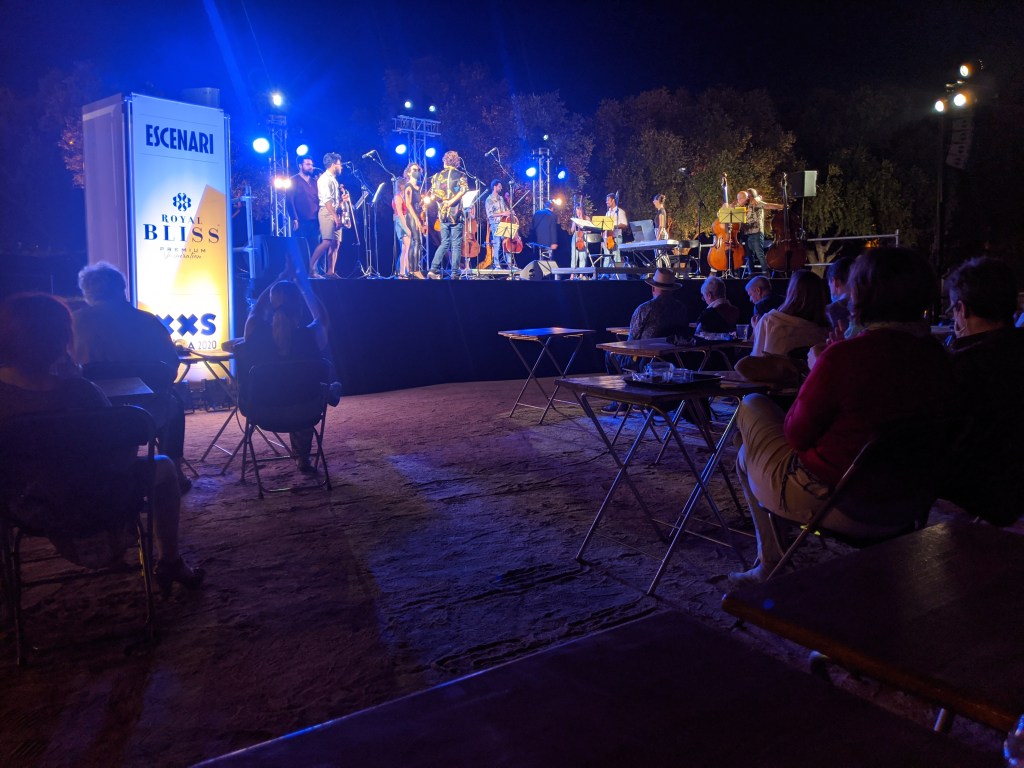
The festivities didn’t stop after the BBQ. I walked with Laura, Jacob, and Joan Miguel to an outdoor concert, my first live concert since March.

Cruïlla XXS outside Teatre Nacional de Catalunya, 11 July 2020.

Like all performing arts organizations, Cruïlla is figuring out how to navigate a post-lockdown environment. The ensemble played a medley of pop hits meant to draw a large audience. No wind players to spread virus onstage. A few of the string players wore masks. As you can see in the photo, the audience was well distanced. There were 400 tickets available. My unofficial count was about 200 sold. I’m not a huge fan of pop music concerts, but it still was transformative to sit outside and enjoy a live concert after so many months without live performances. The only reminder of Covid-19 was wearing a mask. Catalonia requires masks now in public spaces. No one here is protesting.

Other arts organizations are coming to life, too. There are a number of museums I hope to visit soon. MACBA, Barcelona’s contemporary art museum, is trying live performance to draw an inside crowd.

The worst part of living in Barcelona right now is reading Covid-19 news from the US. Sure, Spain has its problems. We’ll know by the end of this month whether Spanish public health authorities can control the inevitable Covid-19 outbreaks. There were rumors at the BBQ of more lockdowns this fall.

The US, on the other hand, seems stuck in a summer rash of uncontrolled Covid-19 outbreaks. Remember the wishful thinking that Covid-19 was seasonal, like the flu? It seems that air conditioning may be the way that not only southerners beat the hot weather, but also Covid-19 does as well.

One issue for the US is partisanship. Dr. Fauci calls out partisanship explicitly as a deterrent to the US Covid-19 response. The Covid-19 response probably seems to Fauci like a replay of Reagan’s response to HIV / AIDS.

Masks are one example of unnecessary partisanship. Trump and his supporters decided masks should be a partisan rather than a public health issue. Then Trump wore one.

The question is why Trump waited to wear a mask in public until 157,000 Americans died. The thing that got Trump to wear a mask wasn’t the death toll or the public health recommendations. He finally wore a mask a few days after Goldman Sachs predicted mask usage would give a trillion dollar uplift to the US GDP. Masks were partisan until they were economic.

Another issue with the US response to Covid-19 is the incompetence of the Trump administration. Besides the obvious problem of lobbying states to re-open early rather than follow CDC re-opening guidelines, Trump still is promoting hydroxychloroquine while missing obvious treatment opportunities like blood plasma.

[Dr. Michael] Joyner, of the Mayo Clinic, said there are probably 10 million to 20 million people in the U.S. carrying coronavirus antibodies — and the number keeps climbing. If just 2% of them were to donate a standard 800 milliliters of plasma on three separate occasions, their plasma alone could generate millions of IG shots for high-risk Americans.

Los Angeles Times, “A plasma shot could prevent coronavirus. But feds and makers won’t act, scientists say,” 10 July 2020.

The US is also woefully behind in Covid-19 testing even as Trump orders less testing. A South Korean case study for tracking down Covid-19 exposures after a weekend Covid-19 flare up shows why.

The 58k Covid-19 tests South Korea encouraged in order to track down all possible exposures during one bar event represents 1/10th of the current daily Covid-19 testing capacity of the US. In other words, the US could track down exposures for 10 bar incidents in the entire country each day and run out of testing capacity.

Why increase testing capacity to enable testing and tracking? Even though it takes a lot of tests to “see” a small outbreak, it’s a lot harder to slow things down after an outbreak is easy to see.

If you don’t trust me that the US Covid-19 response is a complete failure, look at the numbers. Three million infected and 157,000 dead. These numbers are far worse than EU, even though the US had more time to prepare for Covid-19 and more resources to apply.

Here’s a chilling failure analysis written as though the NTSC were analyzing a wreckage of a doomed flight.

The United States still possesses the strongest economy in the world, its military is by far the most powerful, its culture is diverse, and, confronted with the vicissitudes of history, the country has proved resilient. But a veteran of the intelligence world emphasized that the coronavirus era has revealed a sobering reality. “Our system has a single point of failure: an irrational president.” At least in an airplane cockpit, the first officer can grab the controls from a captain who is steering the aircraft toward doom.

The Atlantic, “The 3 Weeks That Changed Everything,” 29 June 2020.

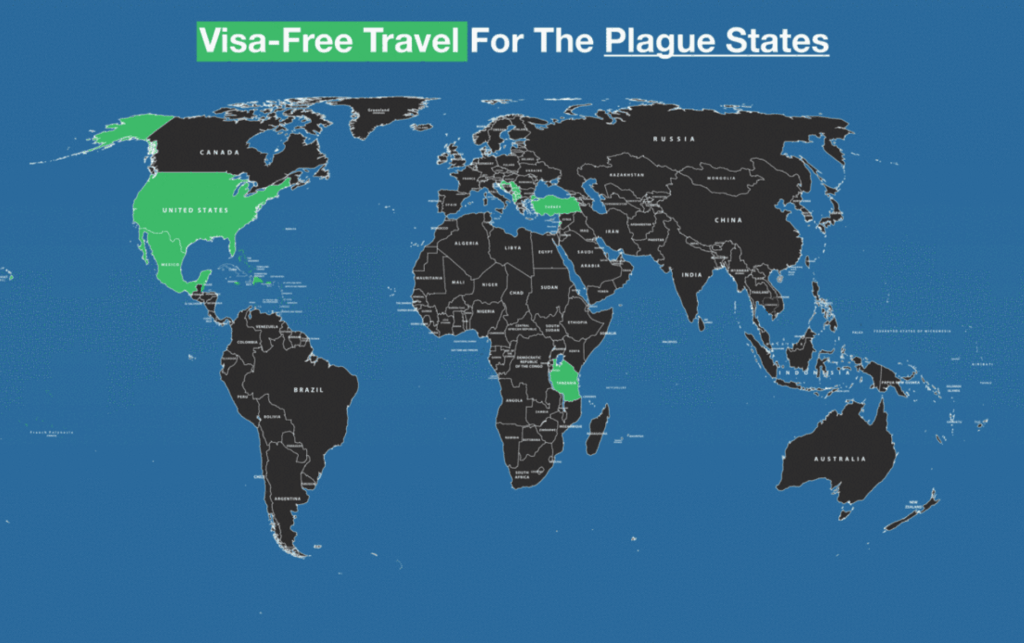
The US failure affects me even though I’m in relatively safe Spain. When I moved to Barcelona, I expected lots of visits from friends and family. My Barcelona friends told me that, unlike other cities I’ve lived in, when friends say they will come to Barcelona, they show up. Brad and I even set up a nice guest room. Unfortunately, the US Covid-19 response is so disastrous that a US passport has become nearly worthless.

Medium, “American Passports Are Worthless Now,” 9 July 2020.

It’s also nearly impossible for me to travel to the US. If my mother were to become seriously ill, assuming I could find a flight, I then would have to quarantine for 14 days before I could see her. If she were sick enough for me to fly, I’m not sure whether I could make it in time. It bothers me that this situation is preventable. My situation is minor compared to others.

A few of the odd medical and science tidbits this week.

To finish off this week’s post, I’m bringing you two dystopian remixes of the promotional video for this weekend’s opening of Walt Disney World in Florida. The first is the Walt Disney World opening as an A24 trailer

The second is the Walt Disney World opening to the Ligeti Requiem.

Which do you like better?

As an encore, here is a Twitter thread of videos from the re-opening of Walt Disney World.

Seems to confirm the Harvard study that high-income people care more about their safety than pumping cash into the economy.


I’ve started tweeting about Covid-19 daily. I’ll continue blogging weekly for now until I see what kind of progress I make with other writing projects and my Spanish language skills. Please sign up for email notifications if you want to know when I post here.

Thanks for following along!