5 July 2020 – Sunday – #102

Sweden tried something different with its Covid-19 response. It didn’t go well.

I don’t mean to make fun of Sweden. Sweden’s Covid-19 response favored its economy. A lot of smart people still make the claim that more people will die as a result of the Covid-19 economic downturn than die from Covid-19 itself and, so their reasoning goes, it is better to lose a few more souls to Covid-19 now than to risk an economic downturn that takes even more lives later. At the beginning of a pandemic, it’s not always clear how to make that particular cost-benefit trade-off and, to its credit, Sweden was clear about the trade off it chose.

Sweden had two other options known to work, to test, trace, and quarantine, and to lockdown. The former was known to work without major economic disruption, but only when testing and tracing capacity enabled the quarantine of most possible cases. South Korea, Taiwan, and Vietnam were early examples of successful test, trace, and quarantine implementations. In this mode, a country’s economy can operate until a treatment or vaccine comes along. Presumably Sweden, like most European countries, lacked the testing and tracing capacity to elect this option.

Sweden could have locked down like the rest of Europe. Lockdowns were known to reduce infection levels, but also known to wreak havoc on economies. China and Italy were early examples of successful lockdowns. Lockdowns reduce infection levels so that countries then can restart their economies while implementing test, trace, and quarantine. Besides reducing infection levels, lockdowns also limit severe Covid-19 cases that can overwhelm a country’s healthcare system.

Instead of test, trace, and quarantine or a lockdown, Sweden opted for herd immunity. Its public health goal was to keep the economy open and allow a Covid-19 “slow burn” until 60% of Sweden’s population was infected. At that point, enough Swedes would have immunity from Covid-19 that, while there might continue to be new infections, there could be no further disruptive outbreaks.

Unfortunately, the Swedish herd immunity experiment demonstrated that Sweden wasn’t able to save its economy by imposing significantly fewer Covid-19 restrictions than a lockdown. There are many reasons that might be true but, at the very least, we know from Sweden that minimal Covid-19 restrictions meant to keep an economy functioning do not lead necessarily to a better outcome than lockdowns, in terms of either lives or money.
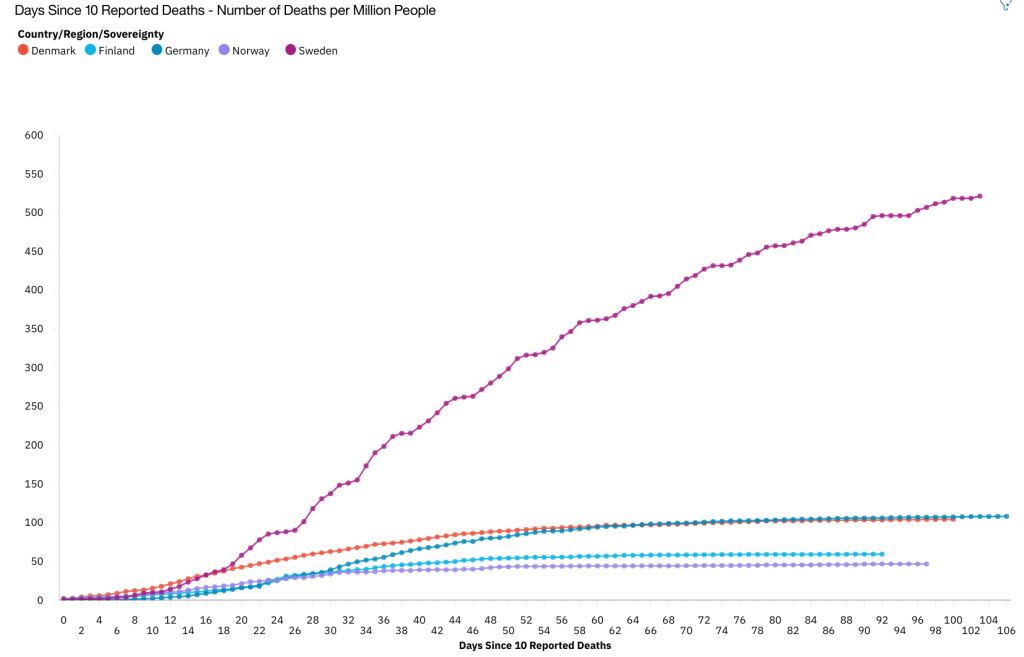
Sweden per-capita Covid-19 mortality versus Scandinavian countries and Germany, 30 June 2020.

Sweden’s economy dropped about the same as its Scandinavian neighbors, but its Covid-19 mortality rate was significantly worse. There is no herd immunity. The measured infection rate of the general population in Stockholm last month was 7%, nowhere near the 60% infection rate (give or take, depending on your assumptions) needed for herd immunity.

It’s probably worse than that, though. There are many reasons the Swedish policy could have failed. It could be simply that the Sweden’s economy is so intertwined with its neighbors and the world that no matter what Covid-19 policy it enacted, its economy would decline.

However, a study from Harvard indicates that fear of Covid-19 infection caused most of the economic decline in the US. Based on reams of credit card and other economic data, the study found the culprits in the Covid-19 recession were high-income people who, fearful of Covid-19, stopped spending.

“The fundamental reason that people seem to be spending less is not because of state-imposed restrictions. It’s because high-income folks are able to work remotely, are choosing to self-isolate and are being cautious given health concerns. And unless you fundamentally address that concern, I think there’s limited capacity to restart the economy.”

Harvard Professor Raj Chetty, NPR, “Why Reopening Isn’t Enough To Save The Economy,” 23 June 2020.

In other words, regardless of Covid-19 policies, economic demand won’t return until high-income people feel safe or until someone invents new ways for them to spend their money during Covid-19 outbreaks.

The US Federal Reserve echos that finding more generally, saying the severity of the US economic downturn is tied to the resolution of Covid-19 outbreaks.

The Fed has repeatedly said the U.S. economic outlook remains highly uncertain and reiterated that a full economic recovery hinges on the battle to control the spread of the novel coronavirus, which has killed more than 127,000 people in the United States.

Reuters, “Fed revisits idea of pledging to keep interest rates low,” 1 July 2020.

At the time Sweden chose its Covid-19 policy, it couldn’t have known about the Harvard study, couldn’t have known that economic demand would drop off a cliff as long as Covid-19 was hanging around. Unfortunately, assuming rich Swede’s behave similarly to rich Americans, Sweden’s herd immunity policy choice exacerbated the very economic downturn it was trying to mitigate.

The Swedish Covid-19 experiment is an example of Covid-19 denialism, a way of sweeping Covid-19 under the rug as if something else was the problem, a rationalization to avoid change in the face of Covid-19. For politicians, Covid-19 denialism is an easy way out of asking for personal sacrifice when the payoff for such sacrifice is watching the economy tank while in social isolation. It’s also an easy sell before an outbreak, when an incipient exponential Covid-19 outbreak seems like something that only happens in other places.

Sweden is not alone in its Covid-19 denialism. It has good company in Brazil, Russia, and the US. Brazilian President Bolsonaro insisted hydroxychloroquine would mitigate the Covid-19 outbreaks as he kept Brazil’s economy open. Russian President Putin minimized Covid-19 by classifying deaths as pneumonia, but no one has seen an outbreak of pneumonia cause the depth of economic turmoil Russia now faces. Then there is the US.

Covid-19 per-capita mortality, US, Brazil, Germany, and Russia, 2 July 2020.

The world expected an exceptional Covid-19 response from the US. The US delivered, but not the way the world expected. The US had the CDC, the biotech industry, the money. It had advanced warning about the severity of Covid-19 and time to prepare. What could go wrong?

The US blundered through a Covid-19 plan both vague and poorly executed which, just as it was showing results, Trump cut short to appease his pro-business friends. Now the states that relaxed Covid-19 restriction early are facing a renewed surge in Covid-19 cases and deaths. The US is left with no Covid-19 plan, a sputtering economic recovery, and lots of happy talk from Trump.

“I think we’re going to be very good with the coronavirus. I think that at some point that’s going to sort of just disappear, I hope.”

Trump on Fox Business, 2 July 2020, as reported in “Virus will ‘sort of just disappear’: Trump has happy talk, but no plan.”

The cost of Covid-19 denialism is high in terms of lives and money for Sweden, Brazil, Russia, and the US. Denying that Covid-19 takes precedence over the economy misses the point that economic demand won’t grow until fear of Covid-19 diminishes so that high-income people boost demand. Losing a few more souls to Covid-19 now will not bring back the economy and save more people later on. Covid-19 has baked in that future loss of life already.

Last week the EU provided Brazil, Russia, and the US with a mirror to reflect on their respective Covid-19 responses. The mirror is in the form of travel regulations, the Covid-19 criteria a country must meet before it can send travelers to EU countries that have beat back the first wave of Covid-19. Residence of these three countries cannot travel to Europe, even rich ones who arrive on private jets.

This is, of course, a blow to US airlines that want to re-start intercontinental routes. Beyond that, it signals that if a country’s leadership won’t comply with its own public health recommendations, eventually either they comply or they isolate their countries from the world, further hampering their own economic recoveries. Sweeping Covid-19 under the rug starts a death spiral, as it were, in the world economy.

Perhaps more disheartening this week than Trump’s racist Independence Day jeremiad was reading Trump’s new Covid-19 campaign messaging, that the US must “learn to live with it.” This is a picture of what Trump wants the US to live with.

US confirmed Covid-19 cases, 4 July 2020.

Trump’s denialism enables his supporters to make irrational claims. Individual freedom is more important than forcing citizens to wear masks. Business must stay open to support the economy. Look! The mortality rate of Covid-19 isn’t rising as cases rise, so it’s not as deadly now!

Simpson’s paradox and Covid-19 in the US.

The US now finds itself where it was in March. For the sake of Trump’s re-election, the US must “learn to live with it.”

Andy Slavitt on Covid-19, 3 July 2020.

Yesterday, my friends Will and U.b. took me to their vineyard near Sant Marti for a lavender harvest. It was my first big trip to the countryside outside Barcelona since I arrived six months ago. The valley where cava is produced reminded me of California wine country. I felt at home.

Lavender harvest near Sant Marti Sarroca, 4 July 2020.

The crowd was a blend of Spaniards, Brits, and Americans. A lot of our conversation during the course of the day was about Covid-19, of course. We’re learning to live with Covid-19 here, but our version of “learning to live with it” is different from the White House version. We’re intent on keeping the case numbers low, not watching them skyrocket.

There was excitement and trepidation about the prospect of travel. Will and U.b. are driving and taking ferries to Greece. Others were traveling to Normandy to see the D-Day memorial. I asked about good day trips around Catalonia. Even as I read reports of a Covid-19 outbreak and lockdown in the Catalan city of Segriá, I felt safe among new friends here. There was no mention of individual rights or a need to prioritize the economy.

After almuerzo, I realized my arms were sunburned, so I mostly stayed in the shade while others cleaned up or continued harvesting. Near the end of the day U.b. was kind enough to cut a bundle of lavender for me with large flowers, something to take home as a memento. As I smelled the lavender this morning, I came to understand that yesterday we harvested more than lavender. We harvested the fruits our our Covid-19 lockdown.
28 June 2020 – Sunday – #101

Mobile World Congress is a huge event every February in Barcelona. Mobile technology companies from around the world meet in Barcelona to show their latest wares. Faster chips! Sharper cameras! 5G! Barcelona’s best hotels and restaurants are sold out a year in advance. Deals are done over vermut and paella.

One of the many reasons for moving to Barcelona was that my friends Donna and Steve attend MWC every year. Since they live in Arizona, that meant I was more likely to see them in Barcelona than in the US. I was disappointed last fall when they shelved their 2020 trip to Barcelona, but I figured I would be crazy during this year’s MWC anyway, getting my residence card and finding a place to live.

Of course, the whole event was called off. Not because Donna and Steve weren’t coming, but because MWC was scheduled to start 25 February, just as all hell Covid-19 was breaking loose in Wuhan. As I expected, I was busy getting my residence card and searching for an apartment the week MWC organizers called off the conference. I barely noticed the news except that suddenly I could get a table at any restaurant without a reservation.

I wasn’t thinking about any of this last week when I read that University of Barcelona researchers measured Covid-19 in Barcelona’s sewage in March 2019. I had to read that twice. March 2019, not March 2020. Sewage is a leading indicator of Covid-19 outbreaks, so it makes sense that Barcelona researchers were checking how early Covid-19 was here. It’s just that March 2019 is an unexpected result. Covid-19 in sewage is a leading indicator of an outbreak by about five days, not by a year.

My first thought was that the researchers needed to check their results. March 2019 is preposterous for Covid-19 in Barcelona. I wasn’t alone in this sentiment.

Prof. Gertjan Medema of the KWR Water Research Institute in the Netherlands, whose team began using a coronavirus test on waste water in February, suggested the Barcelona group needs to repeat the tests to confirm it is really the SARS-CoV-2 virus.

Reuters, “Coronavirus traces found in March 2019 sewage sample, Spanish study shows,” 26 June 2020.

I remembered Professor Medema from my 3 May 2020 entry. He knows his shit, so if he thinks the U. of Barça study could have measured the wrong thing, that was good enough for my confirmation bias. March 2019 was far too early to see Covid-19 in Barcelona.

But then I remembered an article early on in the pandemic questioning whether the infamous Wuhan seafood market was, in fact, the source of Covid-19. Chinese researchers looking at 41 early Covid-19 patients found that 13 of them had no connection to the seafood market.

[Georgetown University infectious disease specialist Daniel] Lucey says if the new data are accurate, the first human infections must have occurred in November 2019—if not earlier—because there is an incubation time between infection and symptoms surfacing. If so, the virus possibly spread silently between people in Wuhan—and perhaps elsewhere—before the cluster of cases from the city’s now-infamous Huanan Seafood Wholesale Market was discovered in late December.

Science, “Wuhan seafood market may not be source of novel virus spreading globally,” 26 January 2020.

And then I wondered why Covid-19 would show up in Barcelona sewage in March 2019 only to disappear until January 2020. And then, while I was looking at the horrendous increase in Arizona’s Covid-19 cases this week, I remembered Donna and Steve and the cancelled 2020 MWC event. And then I asked myself, did any companies from Wuhan attend the 2019 MWC?

Well, it turns out, yes, at least one company called Wuhan GreenNet traveled to Barcelona at the end of February 2019. It’s not clear whether they sent staff from Wuhan or Beijing, but they did send someone. In case you want to know, the company “provides products relating to the fields of fixed networks, mobile networks and Internet of Things.” Wuhan GreenNet’s headquarters are “located in what is known as ‘China Optics Valley,’ Wuhan East Lake High-tech Development Zone Software Park.”

So, when Univeristy of Barcelona researchers confirm their findings, as I now expect they will, I hope at least one of them finds this diary entry and gives someone at Wuhan GreenNet a call. I sent a LinkedIn request to an employee there. Let’s see what happens.

[UPDATE: 12 July 2020. This article has more details on the wastewater findings.]

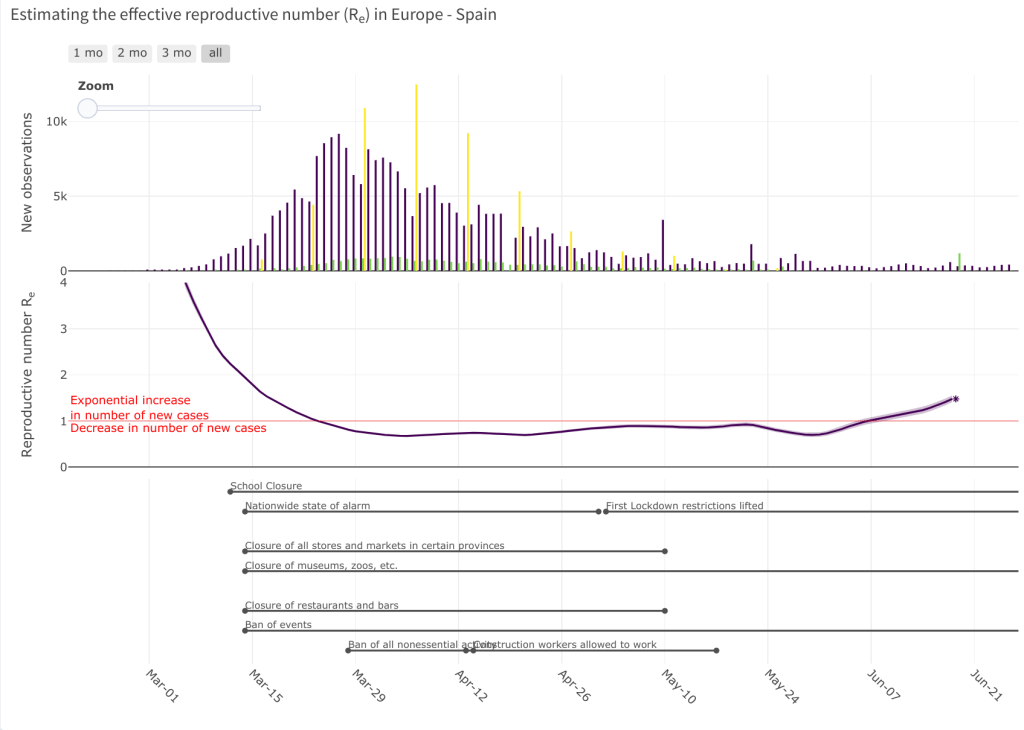
The other big news story in Spain is travel. Tourism officially opens up 1 July, but Spain’s R is already rising as Covid-19 restrictions are lifted.

Reproductive rate R = 1.48 for Spain, 28 June 2020.

The increase in Spain’s R is concerning, but neither unexpected nor alarming, as I wrote two entries back. With small case numbers, a few outbreaks can spike R even though all the outbreaks are under control.

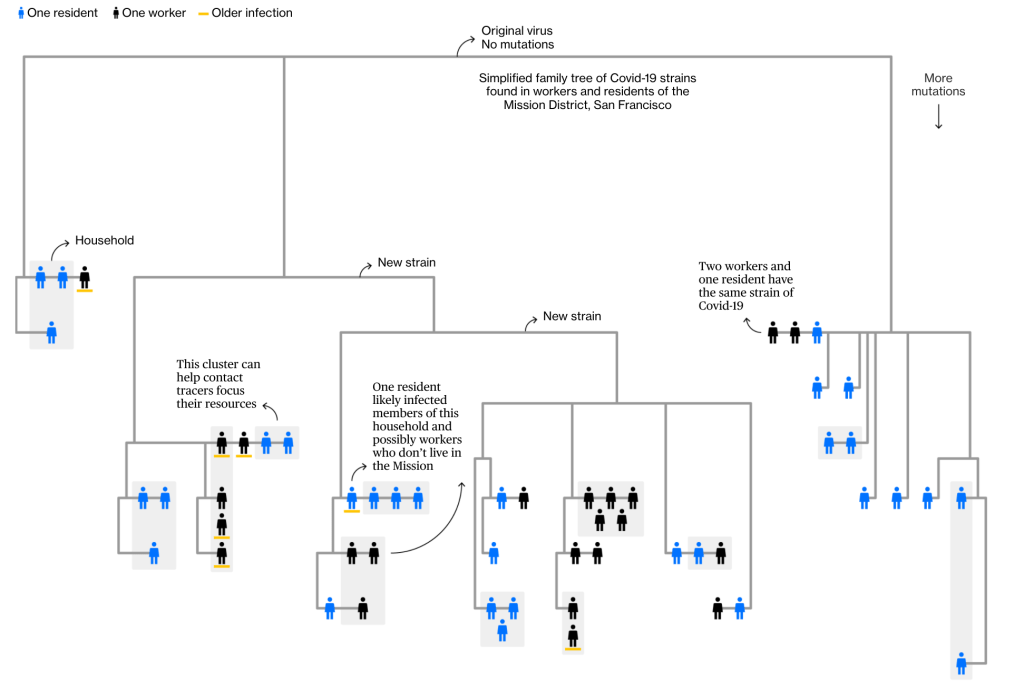
Speaking of keeping outbreaks under control, there are useful tracing techniques emerging from the Covid-19 study in the Mission District of San Francisco. Researchers are now using Mission District data to connect viral mutations of SARS-Cov-2 to social interactions.

Viral relationships can reveal social relationships, making connections we otherwise wouldn’t make, which has implications for contact tracing.

Applying this technique, researchers were able to determine, for instance, that two workers at the same plant who came down with Covid-19 had different strains of the virus. That showed that the workers didn’t get infected working together and allowed the plant to remain open.

Anyway, even as tracing improves, Spain’s increasing R gets more problematic when people start flying to Spain from places with higher Covid-19 activity. While Spaniards are worried about the Brits bringing along Covid-19 for their vacations on la playa, the EU (and Canada) are worried about Americans bringing along their freedom from masks and soical distancing.

The immediate concern here at Casa Solar is how Brad returns. I think a motorcade and parade along Gran Via would be perfect, but Brad is more concerned about navigating customs wherever he enters the EU. In a world where Americans aren’t welcome until they get their Covid-19 act together, the number of intercontinental flights is shrinking and the way to Barcelona is through a larger hub, like Heathrow or Frankfurt. In theory, Brad’s residence visa qualifies him for essential travel. In practice, we’ll know more after the EU finalizes its regulations next week.

The global concern is whether American can get is Covid-19 act together. Dr. Gilman has assembled a list of 16 questions leaders need to answer in order to turn around the situation.

This week, I’m going to leave you with some tips on masks. I’m getting used to mine. I hope you get used to yours. Here’s how much just one layer helps protect others if your sick.

23 June 2020 – Tuesday – #100

Welcome to the 100th entry of Covid Diary BCN! For 100 days I’ve spent my morning writing about Covid-19 from my new home in Barcelona. All in all, it adds up to about 130,000 words. If it were a book, it would be about 500 pages without illustrations. I should have a parade, a flashy dance review, a drag show, fireworks—something to celebrate the 100th entry and the end of Spain’s lockdown.

Hold the phone! Barcelona residents celebrate tomorrow’s Revetlla de Sant Joan holiday by shooting off fireworks tonight, starting around 9pm and ending around midnight, or whenever they run out of things to ignite. Most of my friends tell me it’s a great night to get out of Barcelona. Tonight’s Festival of Fire sounds more like the thunderous days I remember the Blue Angels flying over San Francisco than a bucolic Midsummer Night’s Dream. Who cares? I get my fireworks.

After 100 days, more and more19 Covid- projects are coming to fruition. Here’s one example.

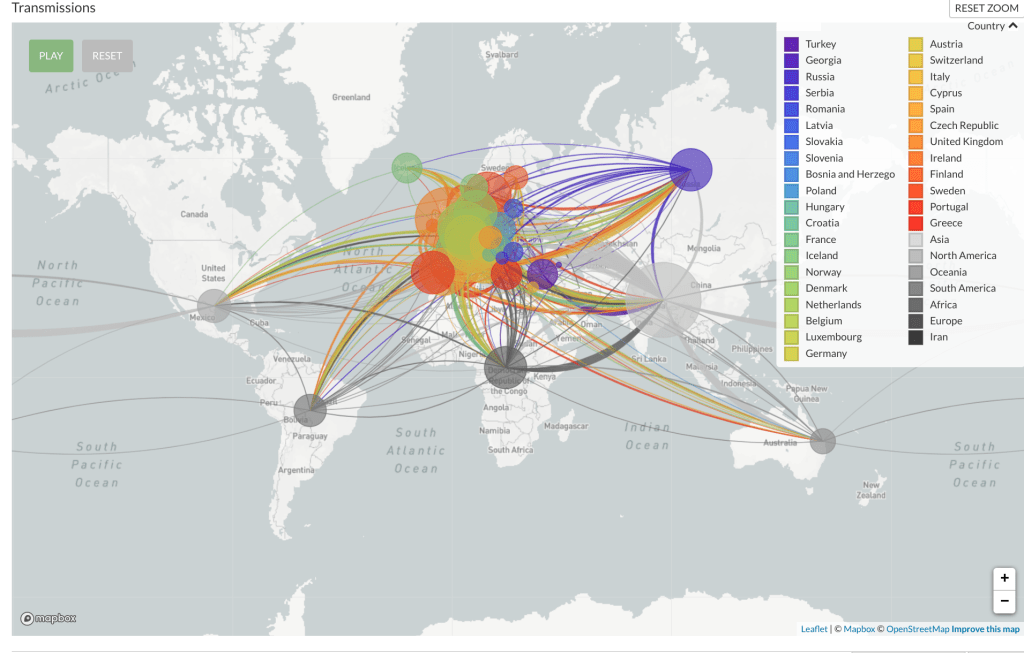
Nextstrain Genomic epidemiology of novel coronavirus – Europe-focused subsampling, 22 June 2020.

The Nextstrain open-source project collects pathogen genome data and provides real time visualizations of pathogen evolution such as the tracking map above. If you play the visualization of data from December 2019 to now, you can watch as Covid-19 infections spreads across Europe, and then as airlines stop flying, lockdowns start, and infections attenuate.

Another example of projects coming to fruition is this Dexamethasone study.

Dexamethasone reduces mortality for Covid-19 patients on ventilators.

We’ve already seen results of the other drug studies. Hydroxychloroquine doesn’t help Covid-19 patients, Remdesivir shortens their hospital stays. We will see more and more studies that started 100 days ago bearing fruit. If clinicians end up with a handful of drugs like Dexamethasone that benefit very specific Covid-19 conditions, we may see the kind of decline in mortality that makes Covid-19 look more like seasonal flu. That would make Covid-19 manageable until there is a vaccine.

In the bad news department, after 100 days we also are learning that some Covid-19 survivors have dreadful outcomes.

ICU nurse Cherie Antoinette on Covid-19 complications.

In the past 100 days, we’ve learned that lockdowns lower Covid-19 infections. Lockdowns worked throughout Europe.

Lockdowns almost worked in the US, but it now looks as though poor federal leadership allowed some states to jump the gun on reopening.

Increases in Covid-19 cases in Arizona, Texas, and Florida are driving up overall US case numbers.

That same poor federal leadership is holding a campaign rally tonight at the Dream City Church in Phoenix, the new epicenter of Covid-19 in the US. But don’t fret.

Dream City Church, Phoenix Arizona describes its ventilation system.

Dream City Church installed a ventilation filter that removes 99.9% of Covid-19. It’s as safe as flying in a plane. What could go wrong?

In the past 100 days we’ve learned that Trump cares more about his re-election than about the health of Americans. I’ll take the fireworks in Barcelona tonight over the contagion in Phoenix. Every day I watch the US response to Covid-19 is another day I’m grateful to be in Barcelona.

After today, I will turn my attention to other writing projects. I want to complete another draft of Dear Mustafa this summer. I have a short Covid-19 love story I want to polish. I may write some essays based on material in Covid Diary BCN.

One of my goals writing Covid Diary BCN was to create a record of life during the pandemic. When I was researching the AIDS pandemic for Dear Mustafa, I found lots of news articles, some useful timelines and histories, as well as good literature and drama. What was missing was a record of what it was like in the moment, how new information about AIDS changed the way gay men in San Francisco lived with the disease. Of course, I remember a lot of that, but I don’t remember all of it.

Another one of my goals was to keep my sanity during the lockdown. Thankfully, that is intact.

I don’t see the Covid-19 story evolving as quickly now. A daily blog entry isn’t as necessary as it was 100 days ago. We’re far enough into the Covid-19 pandemic that we can see how the story is likely to unfold. Deeper and less frequent analysis is possible because it’s clearer what the main decisions and objectives will be. It’s time to consider bigger questions than how we decontaminate our grocery bags. Like, should we fix the economy or change it? As I write this, I plan to update the blog about once a week. Let’s see how that goes.

I have dozens of constant Covid Diary BCN readers who’ve sent notes and tips, and more readers I don’t know. Thanks to each of you for following along!

I’ll sign off for now with this performance at Barcelona’s El Liceu opera house last night.

El Liceu opera house, 22 June 2020.

A string quartet performed for an audience of nearly 3,000 plants. The plants will be donated to healthcare workers. Welcome to the New Abnormal.