22 June 2020 – Monday – #99

The first day after Spain’s Covid-19 State of Alarm went fine. And then.

Four Spanish regions recorded Covid-19 outbreaks.

In terms of the number of cases per 100,000 inhabitants over the last seven days, Madrid tops the list, with 7.91, up from 7.04 the day before. Aragón is second, with 6.9, and Catalonia third with 6.57. This parameter has risen in 12 of Spain’s 17 regions, as has the average across the country, going from 3.08 in Saturday’s ministry report to 3.53 on Sunday.

El País, “Coronavirus infection rates rise in Spain due to outbreaks in Aragón, Madrid, Canaries and Catalonia,” 21 June 2020.

Should I be concerned?

Spain is not alone in seeing Covid-19 cases increase after a Covid-19 lockdown. On Friday, Germany reported its Covid-19 R spiked from 1.06 to 1.79. The increase in the German Covid-19 reproduction rate was due to infections at a (surprise, surprise) meatpacking plant in North Rhine-Westphalia.

The German government explains why the spike in its R is not a big concern for the country.

“Since case numbers in Germany are generally low, these outbreaks have a relatively strong influence on the value of the reproduction number. A nationwide increase in case numbers is not anticipated.”

Robert Koch Institute statement, Reuters, “Germany’s coronavirus reproduction rate jumps to 1.79: RKI,” 20 June 2020.

So, I’m concerned, but not really concerned, about the increase in Spanish Covid-19 infections because Spain’s total case numbers are still relatively low. I admit I’m in less of a hurry to visit Madrid after I read it had the highest per capita case count. If Spain’s increase in cases had occurred when hundreds of people were dying daily, I would be very concerned. As long as public health officials detect and contain these new Covid–19 outbreaks, I should be okay.

Everyone is learning that the value of R has different connotations at different points in the epidemic. Welcome to the New Abnormal.

Spain’s borders opened when the State of Alarm ended. Except that, for instance, I can travel to Sweden, but not next door to Portugal.

From July 1, the Spanish government is planning to open the country’s borders to states where the coronavirus pandemic is under control, but for now there is no list of candidates. The administration is intending to accept a European pact on this list, but other EU states are already saying that they will take unilateral decisions on the matter.

El País, “European borders are reopening, but there is a lot of small print to digest,” 21 June 2020.

I’m sure all the details will be worked out in the next week. It’s only 27 countries at different points in their Covid-19 epidemics that have to agree on safety protocols. Europe’s advantage is that Trump isn’t involved.

The risks for getting travel policy right are significant. Yesterday I wrote that sick passengers are like Covid-19 embers. Many of the infections they carry will die out without significant consequences, but a few may ignite new Covid-19 outbreaks.

When Brad and I were discussing his flight to Barcelona in August, I realized that travel safety has two components. One is passenger safety, the other is the spread of Covid-19 to new locations. For obvious reasons, Brad is concerned about passenger safety. If passengers don’t feel safe, they don’t buy tickets.

On the other hand, if air travel starts a second wave of Covid-19 infections, air travel will close down again regardless of whether passengers feel safe enough to buy tickets. So, solving the passenger safety problem with, say, masks, may not keep the airlines afloat if sick passengers ignite new Covid-19 outbreaks. A low-cost screening method would keep sick passengers off planes in the first place. As with so many things Covid-19, though, no one knows for sure how to screen for Covid-19 short of a PCR test. A smell test would reduce screen about 1/3 or the cases.

Which brings me to the bigger topic of Covid-19 and capitalism. In theory, free market capitalism allocates resources optimally, but Covid-19 provides cases studies of how profit motive doesn’t seem to line up with economic problems created by the virus.

Low cost screening would have a huge payoff for industries like travel and entertainment, but the only development efforts I know about for Covid-19 screening (besides PCR testing, which is costly and slow) are big data efforts, mostly with data from wearables. Perhaps the lack of development is because the travel and entertainment industries are not in a financial position to make Covid-19 screening investments. If the free markets aren’t creating low-cost Covid-19 screening, maybe governments should initiate a Manhattan Project for Covid-19 screening.

As I noted before, there is unprecedented investment in Covid-19 vaccines and treatments, but more in low-risk re-purposing than in high-risk novel approaches. With luck, the sheer number of development and re-purposing efforts will yield a quick Covid-19 knockout punch. The calculus of profit being what it is, a knockout punch will take longer if it depends on a high-risk solution because economic resources are concentrated on solutions deemed to be low-risk.

Covid-19 also is reorganizing the way we work. Why did it take a virus to show us that many information technology employees can work remotely at lower cost? Why didn’t the free markets shows us that same thing? Covid-19 is reallocating real estate in unimaginable ways, sometimes for better (telecommuting), sometimes for worse (theater, restaurants, churches).

In particular, Covid-19 has reorganized the science community. I noted how UCSF organized a worldwide Covid-19 drug re–purposing team in days. In Wired, Maimuna S. Majumder describes the work of scientists she recruited with Twitter to work on Covid-19 problems.

Since our first hackathon, the volunteer network has grown to nearly 100 people, with 23 active research projects. One team is analyzing text extracted from hundreds of thousands of news articles to better characterize the quality of the US media’s pandemic coverage. Another is sifting through millions of tweets to understand how public sentiment toward face masks has shifted since early April, when the CDC recommended that everyone wear them. Without question, the diversity of the network, across disciplines and institutions but demographically too, has been a tremendous boon to the formulation and investigation of problems that really matter.

Wired, “Coronavirus Researchers Are Dismantling Science’s Ivory Tower—One Study at a Time,” 18 June 2020.

Of course, free market capitalism depends on the quality of the information used for pricing a transaction. We know more know now about Covid-19 than when I started Covid Diary BCN 99 entries ago. We still have more to learn.
21 June 2020 – Sunday – #98

Spain’s State of Alarm ended last night while I was sleeping. I woke up refreshed.

This doesn’t mean Spain is Covid-19-free, like New Zealand. The current Spanish infection rate is about 3 per 100,000 per day and there are about six Covid-19 deaths per day in the entire country. Covid-19 seems more like a very weak case of the flu right now.

Actually, New Zealand reported two new Covid-19 cases yesterday. Even when it appears Covid-19 has been eradicated, it’s lurking somewhere.

Actually, Covid-19 was lurking earlier than everyone thought. Sewage samples from Milano and Torino indicate the virus was first present around mid-December 2019.

The findings echo similar discoveries elsewhere in Europe suggesting the coronavirus was circulating globally well before Chinese authorities flagged the new infection on December 31. For example, a French doctor said samples from patients treated in December for pneumonia tested positive for the virus.

Politico, “Coronavirus found in Italian wastewater in December,” 19 June 2020.

The finding that Covid-19 was in Europe in December 2019 may indicate that the virus can lurk for months before starting a high-mortality outbreak. It also may indicate that, like embers drifting from a distant fire, it took several introductions of the virus to kindle the first blaze.

The questions Spain faces today are how long can it keep Covid-19 in lurking mode and how does it keep embers from drifting in. Now that everyone is on the alert for Covid-19 and understands the consequences of an outbreak, another outbreak seems less much less likely. Or so I hope.

Allow me to switch my narrative to another thing happened while I was sleeping last night. Trump had a campaign rally in Tulsa. Bringing supporters to Tulsa seemed like a recipe for disaster because Tulsa has become a Covid-19 hot spot. So many supporters were expected that Trump’s campaign built an overflow space outside. Supporters who couldn’t squeeze inside the 19,000 seat Covid-19 hot box could watch Trump on jumbotrons. As an incentive to participate from outside, Trump said he would address the remote throngs in person after the main event.

Trump says a million people want to attend his Tulsa rally.

Everyone fretted that pushing tens of thousands of people into close quarters in a city with a rapidly growing Covid-19 case count would add to the ongoing Covid-19 outbreak. No one lining up for days in advance to get a seat inside the convention center wore masks. Hours before the event, the campaign confirmed that six of its event staff had Covid-19 infections. Just as the horror film was about to start, I went to bed.

This morning I woke up expecting to see the post-rally carnage. Here’s the first view I got of the Tulsa convention center during the rally.

Small crowd at Trump’s Tulsa campaign rally, 21 June 2020.

The crowd of about six thousand wasn’t wearing masks and didn’t socially distance, but at least it was only six thousand. Those Trump’s supporters will spread Covid-19 around Oklahoma, but not as much as if the expected crowd showed up. Only about a tenth as many supporters as Trump anticipated showed up. As with Trump’s entire presidency, we got lucky. It could have been ten times worse.

My point in bringing up Trump’s rally is that there is some hope that either the polls showing Trump is losing support are correct or that even Trump’s supporters don’t buy into his Covid-19 suicide pact. In either case, that gives me hope about Covid-19.

I’m leaning towards the case that even Trump supporters aren’t buying into his suicide pact, that Covid-19 is breaking through the Trump distortion field. Trump is saying things about Covid-19 that make no sense on their face. Here’s one from his rally.

At Tulsa rally event, Trump says he asked for reduced Covid-19 testing.

While Trump doubles down on his “post-Coronavirus” narrative that increased testing is creating more cases of Covid-19, Republican governors are facing the Covid-19 realities of record cases and overwhelmed healthcare systems.

Even staunch Trump ally Florida Governor DeSantis is changing his tune. Last week DeSantis blamed the increase in Florida’s Covid-19 cases to increased testing of farm workers. Yesterday, he admitted that the rise in cases couldn’t be explained by testing.

“Even with the testing increasing or being flat, the number of people testing positive is accelerating faster than that. You know that’s evidence that there’s transmission within those communities.”

Florida Governor Ron DeSantis on Covid-19 testing, 20 June 2020.

Which brings me back to Spain. If it’s true that Trump supporters can see Covid-19 as a threat in spite of what Trump tells them, then I have hope that Spain can keep Covid-19 in lurking mode until a treatment or vaccine comes along.

20 June 2020 – Saturday – #97

Let’s start with this: Spain’s Covid-19 State of Alarm ends overnight tonight.

Spain exits its Covid-19 State of Alarm.

Here in Catalonia, we ended the State of Alarm on Thursday night. I found that out after the fact when I had lunch in the Gothic Quarter yesterday with Will, U.b. and their daughter. Barcelona, which had delayed starting Fase Uno and then took the normal two weeks for Fase Dos, whizzed through Fase Tres in 24 hours.

After Spain’s State of Alarm ends, the country will observe three public health requirements: social distancing of 1.5m, regular hand washing, and face-masks. This last one is little unclear. Face mask compliance that I’ve counted walking around is under 50% outside and on the streets. I haven’t counted it inside, but it seems to be close to 100% in stores.

Also, after the State of Alarm, regions may impose their own Covid-19 public health regulations as needed. Madrid, for example, is limiting business occupancy initially.

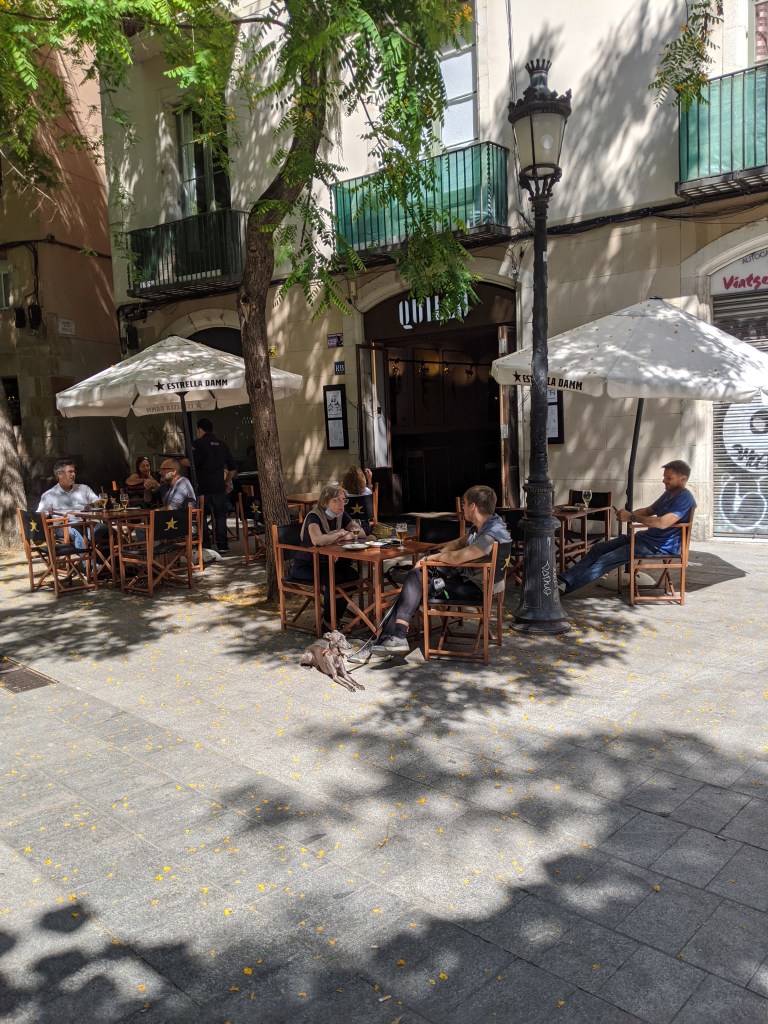
On the way back from lunch, I snapped a well-spaced outdoor dining area at a restaurant in the Gothic Quarter.

Well-spaced outside dining in the Gothic Quarter of Barcelona, 19 June 2020.

This is similar to where the four of us ate lunch yesterday. Eating al fresco with tables spaced far apart, I wasn’t worried about Covid-19, but I had to think about many things I never think about. For instance, if a fellow diner wants to trade tastes of food, is that dangerous?

Suddenly everyone is making travel plans again. Will and U.b. are driving to Greece this summer. Nicole went on a day trip to Sitges today. I’m figuring out day trips I can take to places in Catalonia like Girona and Canet de Mar. I want to see Madrid’s museums, so Madrid is on my list, too. However, it may take longer before travel there is allowed.

Culture is limping back. Museums are opening up over the coming weeks. My friend Jacob performs an outdoor concert on 11 July. There is a long ways to go, though before we have packed indoor cultural events again.

There’s also the angst about a second wave of Covid-19. We’re at the mercy of people to follow the three instructions (social distance, hand washing, and masks). We’re also at the mercy of the government to detect new Covid-19 cases and contain outbreaks. There have been nearly a thousand new cases in the last month in 34 separate outbreaks.

“All the outbreaks are under control,” said Health Minister Salvador Illa on Friday, adding that if there is a new a significant rise in untraceable cases, the only available tool to limit mobility will be to declare a state of alarm once again. For small outbreaks, it will be possible to resort to a public health law to close off affected areas. This is what happened at the beginning of the pandemic, when a hotel in Tenerife, in the Canary Islands, was placed in lockdown.

El País, “Spain updates official Covid-19 death toll, says new outbreaks are under control,” 19 June 2020.

As Spain exits its State of Alarm, the World Health Organization issued a reminder that we’re not out of the Covid-19 woods yet. It’s unsettling that Catalonia left the State of Alarm on the day that the world recorded a record 150,000 new Covid-19 cases. Most of those new cases are coming from the US.

Also as Spain exits its State of Alarm overnight, Trump will hold his first re-election campaign rally in Tulsa.The Oklahoma Supreme Court did not step in to stop Trump’s rally, saying that events should determine for themselves how to provide an environment safe from Covid-19 infection.

Since the only event scheduled at the BOK Center in Tulsa until August is Trump’s rally, it’s safe to say Trump’s re-election campaign is the only organization out of probably dozens that decided large public events at BOK Center are safe.

Dr. Spencer notes that the Trump campaign is the only event not to cancel in Tulsa this month and next.

When Trump Campaign Manager Brad Parscale announced on 11 June that Trump’s first “post-Coronavirus” rally would be in Tulsa, it seemed like a safe bet. Trump won by a landslide in Oklahoma and the state seemingly had done a great job managing Covid-19.

Things changed quickly after Parscale’s announcement.

Chart of daily Covid-19 cases in Oklahoma through 19 June 2020.

But maybe Parscale knows something we don’t. To make sure, CNN asked public health experts whether the Tulsa rally was really a problem.

So while a single individual on average spreads the virus to two to three other people, in this scenario — a packed arena where there’s a lot of shouting and possibly little mask-wearing — each of those 20 attendees shedding a lot of virus could potentially infect 40 to 50 people, [CNN contributor Erin] Bromage said. Those 800 to 1,000 newly infected people go home, possibly out of state, and potentially spread it even more. It is the anatomy of an outbreak.

CNN Health, “How risky is it to attend a Trump campaign rally during a pandemic?,” 19 June 2020.

Covid-19 cases are growing again in the US, so it’s clear that Trump’s Covid-19 policies (does he have policies for Covid-19? For anything?) are not working. If Trump is re-elected, a vaccine may be the only hope for the US to control Covid-19.

So, what’s gong on with vaccines? I put the Stat Covid-19 treatment and vaccine trackers on the Resources page. If you’re trying to keep track of when a vaccine will come to market, the New York Times has a vaccine tracker of note, too.

The New York Times Covid-19 Vaccine Tracker, 20 June 2020.

The good news is that there are over 140 Covid-19 vaccine candidates. The bad news is that, even with this many candidates, it’s hard work and luck that combine to make a viable vaccine. The trackers contain lots of vaccine product development information, but they aren’t as informative on the daunting manufacturing and distribution issues once we have a vaccine.

In other words, it’s unlikely a vaccine will help achieve herd immunity anytime soon. America, get your Covid-19 act together on good Covdi-19 policy and implementation. Writing from Barcelona during Spain’s first post-State-of-Alarm weekend, it’s easy to tell the US is falling behind the rest of the world.