13 June 2020 – Saturday – #90

I bought parasols at Ikea yesterday!

When Brad and I were furnishing Casa Solar in February, shopping at Ikea seemed about as exciting as oatmeal for breakfast. Armed with Brad’s detailed spreadsheets full of part numbers and aisle locations, we arrived as Ikea opened so we had the store pretty much to ourselves. While my worldly possession were bobbing along the Atlantic Ocean towards Barcelona, Brad and I furnished a bedroom for Brad and a guest room for all the friends and family threatening to visit. In two days, we had a situation comfortable enough to survive until my ship came to port.

Yesterday’s Ikea adventure couldn’t have been more different from the February trip. The store was packed. Everyone wore masks. Shopping cart traffic jams everywhere. Twenty minute checkout lines. Oh, what a difference a pandemic makes!

Luckily I found two parasols for the terrace, the entire reason for the excursion, but most of the other things on my list either weren’t available or I couldn’t find them. When I say I couldn’t find them, what I mean is that the lines for the kiosks that reveal where to find things were ten or fifteen deep. I spent nearly as much time at Ikea yesterday as Brad and I spent in February, except instead of furnishing two bedrooms, I bought two parasols and some plastic bags for Nicole. In February, Ikea shipped the next day. Now it’s three business days.

I take this as good news for the Spanish economy. The technical term, I believe, is pent-up demand.

Two mundane transportation notes. I rode a Bicing bike to Ikea only to find out that the Bicing network ends about 1.5 km short of Ikea. It was my first bike ride since March. That felt great. The walk after I docked my bike took me past a busy shopping mall that foreshadowed my Ikea experience.

On the way home, I got confused and took the Ferrocarrils instead of the Metro. Not a big deal. I had to pay two fares instead of one, but the time was about the same. If I hadn’t taken the FGC, I wouldn’t have discovered the new exclamation points on the floor.

FGC floor graphics showing passengers how to stand to avoid Covid-19 transmission.

It’s clear that if you cover the exclamation points with your feet, you won’t have to talk to anyone while traveling. Also, you’re less likely to transmit Covid-19.

A clear pattern is emerging in my diary entries where the first part is about Spain and Europe recovering from Covid-19 and the second part is about the next Covid-19 disaster in the US. From over here, it’s like watching a slow motion train wreck.

The CDC finally released Covid-19 guidelines, what, like two months late? Meantime, many states that pushed to re-open are experiencing spikes in Covid-19 cases and hospitalizations. Here’s yet another handy report that shows change in Covid-19 cases after each US state re-opened. For instance here’s Covid-19 cases in Oklahoma, where, in deference to Juneteenth, Trump has postponed next week’s election campaign kickoff rally in Tulsa by a day.
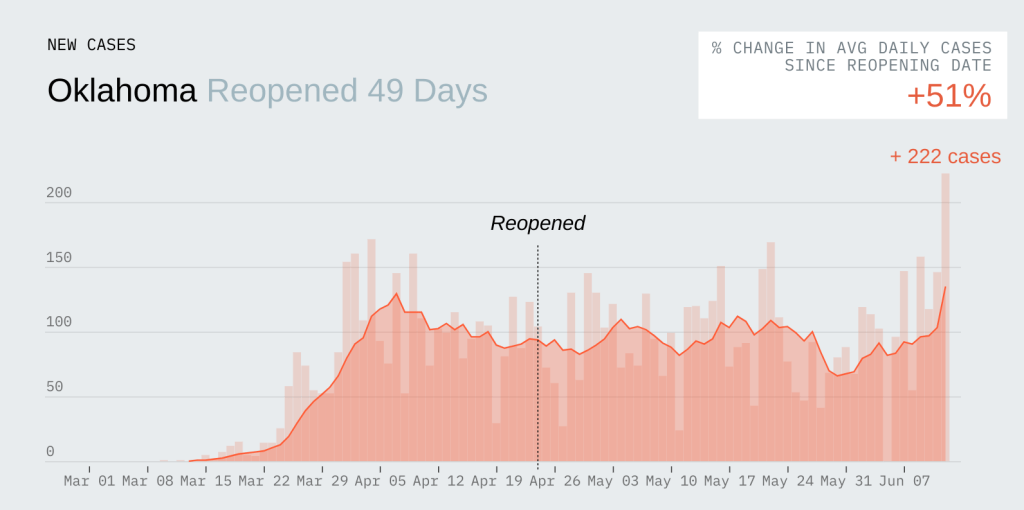
Oklahoma growth in Covid-19 cases after reopening, 12 June 2020.

Whirlpool is closing down its Tulsa manufacturing plant because of a Covid-19 outbreak (Hey, Whirlpool, those CDC guidelines you were looking for? They just came out!), but that’s not stopping Trump from inviting supporters to a packed, mask-free rally. Trump keeps saying it’s post-Coronavirus, but I’m reading more like Darwin.

The absence of any Covid-19 messaging from the White House leaves local officials flapping in the wind. I noted previously that Orange County’s public health director quit because of violent threats after her mandatory mask order. She’s not alone. State and county health directors have resigned or been fired in Ohio, Arizona, California, Missouri, and Colorado, to name a few. Who wants public health officials telling them what to do when Trump invites us to join his post-Coronavirus delusion?

Parenthetically, the Trump administration quietly reduced LGBTQ health protections, I guess because now we don’t have to worry about Covid-19. It is rescinding an LGBTQ non-discrimination rule for healthcare and health insurance. Only doctor in town a homophobe? Too bad she won’t test you for Covid-19.

Oh, and last thing. Houston, we have a problem.

The Houston region is currently at Code Orange, or Level 2, which translates to an uncontrolled level of ongoing transmission and spread. If hospitalizations and ICU populations continue to rise, Hidalgo said the region may be “approaching the precipice of a disaster” and county and city leaders may recommend residents stay home again, only to leave for groceries, medications or to care for a loved one.

Houston Chronicle, “Houston coronavirus updates: What you need to know for June 12,” 12 June 2020.

The “precipice of a disaster.” Let that sink in. Trump’s delusional post-Coronavirus world is colliding with the actual virus. It’s quite a train ride.

While the train wreck in the US continues, I’m lunching with my friend Ruben in El Masnou. It’s my first train ride out of Barcelona since I arrived. Wish me luck!
12 June 2020 – Friday – #89

The EU is pushing Spain to open its borders in three days, but Spain still plans on opening the first of July. The preparations are underway to screen arrivals to Spain for Covid-19. Passengers will submit to a temperature check, which is not a reliable screen for Covid-19, and provide written details on their health and contact information. Seven months into the pandemic and we still don’t know understand how to screen for Covid-19.

Fernando Carreras, deputy director of Sanidad Exterior, the ministry department in charge of the screening, said that his team is incorporating automated processes such as computerized health declarations and thermal imaging cameras, which can check the body temperature of several people simultaneously, an improvement from doing it one at a time with a thermometer pointed at a person’s forehead.

El País, “Thermal imaging and e-forms: How Spain will screen for Covid-19 when the travel ban is lifted,” 12 June 2020.

To its credit, Spain has detected 108 Covid-19 cases entering the country during its lockdown, mostly residents returning from the Americas, but scaling its Covid-19 detection effort for thousands of daily travelers introduces tremendous risk. This is when I pray for government to be competent.

Things in the US look worse as Covid-19 heats up. The hardest hit states in the past week are Arizona, North Carolina, Texas, Alabama, and Arkansas. Except for North Carolina’s governor, these are Republican controlled states that have pushed to reopen quickly.

After correcting a data error, Alabama reached a record 629 hospitalizations of confirmed Covid-19 cases. In Arizona, the state issued a warning to hospitals to gear up for more Covid-19 cases as its public health director said business would go on as usual.

Arizona public health official says “… we can’t stop living” as Covid-19 outbreak brings more death.

US Treasury Secretary Mnuchin also said business must take priority over Covid-19.

“We can’t shut down the economy again. I think we’ve learned that if you shut down the economy, you’re going to create more damage.”

Treasury Secretary Mnuchin appearing on Squawk on the Street with Jim Cramer.

Wall Street wasn’t impressed. The Dow Jones Industrial Index dropped over 1,800 points.

The Covid-19 response in Republican controlled states shuns lockdowns, much as Sweden, Ecuador, and Brazil have done. At this point, the results are predictable. Higher Covid-19 mortality and about the same economic outcome as locking down.

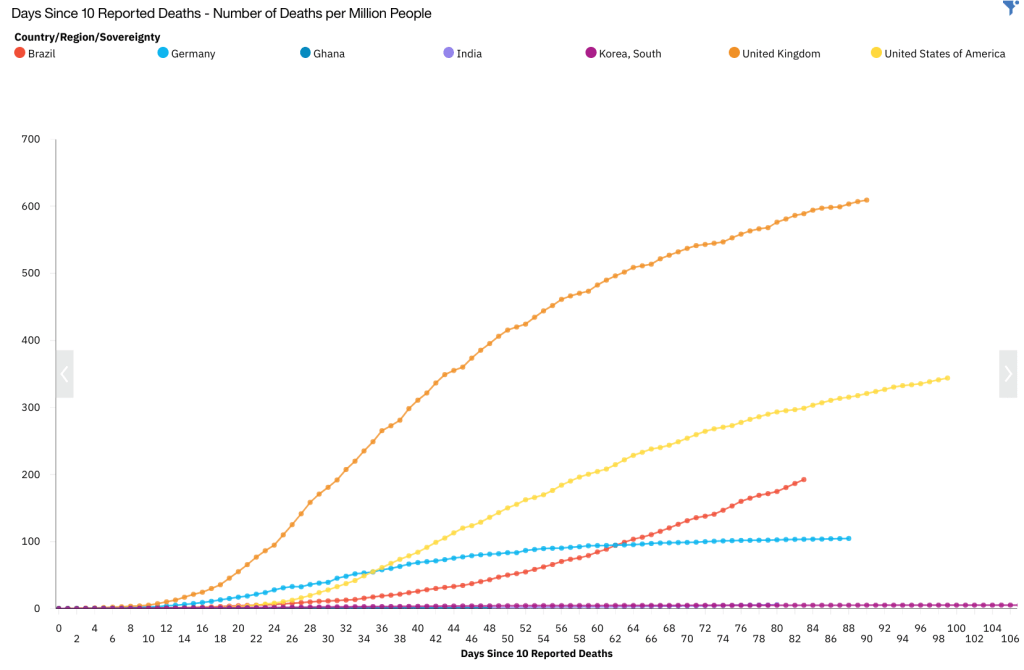
Here’s a chart with three countries that have made contact tracing work (South Korea, Vietnam, Ghana), one country which locked down early and put in place effective testing after it was too late for contact tracing (Germany), and four countries with conservative governments that were late to lockdown and poor on testing (US, UK, Brazil, India).

Covid-19 per capita mortality for Brazil, Germany, Ghana, India, South Korea, UK, and US, 11 June 2020.

I realize this is not scientific, but I think it’s indicative of how much leadership style affects Covid-19 outcomes. There’s no question that getting contact tracing is the most effective Covid-19 response in terms of mortality rates and economy. Short of contact tracing, Germany shows that early lockdown and good testing flatten the mortality curve effectively. US, UK, and Brazil demonstrate that waiting to lockdown increases the mortality without improving the economy. India isn’t registering yet, but unfortunately I expect it will soon.

With this much data, the assumption that people will go on with life during a pandemic as though nothing is happening and that the economy will work itself out seems delusional to me. That’s especially true from here in Spain where things are coming cautiously back to normal.

But, you know, what can I say? Delusion is so much easier. Welcome to Las Vegas!

Also, please note, you are responsible for the outcome of your delusion. Not Las Vegas. Not the Republican Party. Certainly not Trump. To attend Trump’s Tulsa rally next week, you must “voluntarily assume all risks related to exposure to COVID-19.” Unfortunately, all the risks include spreading Covid-19 to others in your community. Good luck, Tulsa!

Some quick science updates.

Vitamin D. I have friends recommending it for Covid-19. I’ve taken supplements for years because I have a deficiency. There is no clear evidence Vitamin D protects against Covid-19.

“People with lower vitamin D have a higher risk of COVID infection, but it looks like this is explained by other risk factors and not by the vitamin D itself. Our findings do not support a link between vitamin D concentration and the risk of COVID-19 infection.”

Dr. Claire Hastie, University of Glasgow, public health research associate

Covid-19 Vaccine. Derek Lowe has his usual great summary of Covid-19 vaccine development here. The good news is lots of human trials soon. For some reason, “it doesn’t seem like the NIH/NIAID coordinated trials will be sharing control groups,” something that could speed the testing process. Nevertheless, there is a huge P.R. opportunity for the company that comes up with a Covid-19 vaccine first, so lots of investment.

Sand. Who knew that there is a worldwide shortage of sand? Who knew a sand shortage would slow Covid-19 vaccination?

Medical vials are traditionally made with borosilicate glass, which is highly resistant to extreme temperatures changes and more chemically durable than commercial glass. It has been shown to preserve vaccine potency and pH stability. That’s important in making sure that a vaccine does what it’s supposed to.

CNN Business, “Finding a coronavirus vaccine is hard. Getting it to people is a whole other problem,” 11 June 2020.

There aren’t enough sand mines in the US to produce the vials needed for vaccine. The search is on for alternatives.

Baldness. This is my 89th diary entry and I’d never heard of a relationship between baldness and Covid-19 until now. But there is! And it may lead to new therapies for Covid-19.

Until recently, scientists have been at a loss at why this might be, pointing to factors such as lifestyle, smoking, and immune system differences between the sexes. But increasingly they believe it could be because androgens – male sex hormones like testosterone – may play a part not only in hair loss, but also in boosting the ability of coronavirus to attack cells.

The Telegraph, “Bald men at higher risk of severe case of Covid-19, research finds,” 4 June 2020.

One of the new therapies? Maybe an election will take care of this Covid-19 superspreader, but you never know.

Trump’s bald spot.

11 June 2020 – Thursday – #88

Last night Alexa and I picked up pizza from the recently reopened corner pizza shop and ate on the terrace. I’m not sure if the pizza tasted better than I remember because, you know, hot pizza or because it’s actually better. Even though the pizza shop had well-spaced seating, the terrace felt safer.

Anyway, Alexa and I got to talking about the New Abnormal. As we discussed the seating at the pizza place and how it still seems strange eating with others in public, I recalled how the police closed down crowded clubs on the first night of Barcelona’s Covid-19 lockdown. Alexa said the police aren’t closing clubs anymore. I was confused about how packed clubs could be allowed to operate when restaurants still had to space out their tables.

Because each region of Spain is rolling out its own version of the lockdown relaxations, it’s a hard to parse what it means now that Barcelona is in Fase Dos. Even my Catalan friends aren’t quite sure where we can travel and what we can do within Catalonia.

Luckily, there’s a WhatsApp cartoon to help.

The humor is good, but the reality is that Covid-19 cases in Spain doubled yesterday, mostly in Madrid and Catalonia (which, by the way, are verde oscuro on the map). A doubling is not completely unexpected after lockdown restrictions were relaxed and it only means 84 new cases. Still, the news of increased cases only adds to the anxiety of figuring out what we can do and what feels okay in Phase 2.

During my conversation with Brad yesterday about his theoretical August return to Barcelona from San Francisco, it’s clear how much Covid-19 factors into what were once routine decisions. I mentioned that a friend managed to snag a flight next week from Buenos Aires to Barcelona by flying to Madrid and taking a bus the rest of the way. That, Brad noted, meant contact with more people and higher risk. We discussed that aircraft ventilation systems could clear the air of viral material if the nozzle is pointed correctly, that most of the passengers would be from San Francisco where Covid-19 infections are low anyway, and that the position of his seat in front of a bulkhead would block Brad from a coughing passenger behind him.

One wave of Covid-19 was plenty. Everyone is trying to figure out how to avoid a second wave. Where is our Covid-19 rulebook?

One thing that adds to the confusion of what to do is misinformation and political narratives forced on top of public health policy. This keeps us asking questions (good), but also keeps us from believing experts (bad).

The political narratives are difficult. My friend Andy, the one who de-friended me on Facebook, kept insisting that I was pro-lockdown because the economic consequences were better for me. That’s kind of a standard dig from the anti-lockdown Covid-19 argument playbook. As much as I noted that my financial situation actually would be much less risky if the economy weren’t disrupted by Covid-19, Andy stuck to his assertion. I see this inability to get beyond the political narratives repeat itself over and over on social media. I may even be guilty of it. It’s how Facebook keeps us engaged.

Here’s how crazy political narratives get. The anti-lockdown US president, who should be somewhat trustworthy, is declaring that the US is now living in a post-pandemic world at the same time the public health expert Dr. Fauci worries about ongoing Covid-19 outbreaks.

Honoring white supremacy, Trump to hold his first “post-Coronavirus” rally in Tulsa, home of the Tulsa race massacre, on Juneteenth, the day celebrating freedom of slaves.

Notice how I worked my political narrative into the attribution above?

Another thing that adds to the post-lockdown Covid-19 confusion is the growing legion of armchair epidemiologists who, for instance, criticize public health policy flip flops.

When experts change their advice, they draw criticism. Although some changes reflect errors, many are responses to new, better information. Wearing masks is an example. As evidence of asymptomatic spread emerged, it became clear that infections can be reduced if people wear masks when they are within six feet of one another, particularly indoors. The changed recommendation was progress, not correction of a mistake.

Washington Post, “How amateur epidemiology can hurt our covid-19 response,” 11 June 2020.

I try not to be one of those armchair epidemiologists (and please call me out if I am). I try to research information and, when appropriate, present contrasting points of view. I scold my friends for their misinformative social media posts. I allowed myself to evolve my thinking about masks.

That last point is a good thing, because there are more and more indications that masks reduce Covid-19 transmission and the chance of a second wave.

In all scenarios the study looked at, routine face mask use by 50% or more of the population reduced COVID-19 spread to an R of less than 1.0, flattening future disease waves and allowing for less stringent lockdowns.

Reuters, “Widespread mask-wearing could prevent COVID-19 second waves: study,” 10 June 2020.

I used the word “indications” because wearing masks is not a done deal for stopping Covid-19. “Brooks Pollock, a Bristol University infectious disease modelling expert, said the likely impact of masks could be much smaller than predicted.” We have to try wearing masks to see whether the models’ predictions are right. We haven’t measured in real life that masks work.

We don’t know that much yet. We will have anxiety. It’s okay.

Well, it’s okay if you don’t work for the man.

We all know about Covid-19 and the meatpacking industry by now.

Remember how Elon Musk threatened to move his Tesla plant from Fremont, California to Nevada or Texas if he couldn’t start make cars? So, guess what happened at the Tesla plant after it reopened. Will you buy a Tesla?

It gets worse. The Wall Street Journal reports on how the US is outsourcing Covid-19 manufacturing deaths to Mexico.

I’m not sure if this Covid-19 mortality outsourcing is part of Trump’s upgrade of the NAFTA agreement, but the US has managed to kill not only Mexican immigrants with Covid-19, but also Mexican workers who don’t want to come to the US. Parenthetically, almost no one in Barcelona is talking about traveling to the US these days.

To attenuate your Covid-19 angst, allow me to reiterate that an effective Covid-19 vaccine won’t be available this year. There will be something Trump can claim is a vaccine before the election. You can take that prediction to the bank.

While there won’t be an effective Covid-19 vaccine this year, you should feel less anxious. Vaccines are hard, but there is really great vaccine science happening. This New York Times discussion with vaccine experts lays out where we are with updates on recent human testing. It also accompanies nicely the vaccine chart I included here.

Still worried after that good news about Covid-19 vaccines? Don’t be. The Happiest Place on Earth is reopening.