10 June 2020 – Wednesday – #87

The Italian pizza restaurant on the corner re-opened yesterday. I will survive Barcelona’s New Abnormal just fine.

Except for the weather. The first time it rained three days in a row, my Barcelona friends told me that was an exceptional event that wouldn’t repeat this year. Well, this week is about the fourth time this year it’s rained three days in a row. Now my Barcelona friends are trying to remember when there was ever a year this wet.

At least there’s been less pollution during the pandemic, although air pollution is rising in Spain as the lockdown ends. Pollution has been lower because energy consumption dropped about 15% – 20% worldwide during the Covid-19 lockdowns.

Like the petroleum market where prices went negative in April when it looked like there wouldn’t be enough storage tanks for excess oil, electricity prices in Europe went negative several times as renewable sources continued pumping energy into the grid.

European electricity prices during the Covid-19 pandemic.

A dozen times during the pandemic, the European electricity market effectively was willing to pay for batteries.

The news is not so good for carbon-based energy producers. Coal and fracking are in shambles. Oil countries like Saudi Arabia and Russia have cut production significantly to prop up prices.

One silver lining from the energy market turmoil during Covid-19 is that it’s possible now for people to see that a renewable energy strategy works. Will Covid-19 help in other ways with climate change? That would be a good thing because the climate is changing. It’s not just the extraordinary rain this year in Barcelona.

Arctic Circle temperatures reach 86F on 9 June 2020.

Warming at the poles is creating a cascading set of problems, like infrastructure collapse, the release of CO2 and of viruses that have been locked in permafrost, and, last week, an enormous oil spill in Siberia.

The cause of the spill, in which 20,000 tons of diesel leaked from a reservoir owned by MMC Norilsk Nickel PJSC, hasn’t been determined but the company has suggested it could be the result of damage from melting permafrost. The rate of warming in the Arctic is twice as fast as the rest of the world.

Insurance Journal, “Massive Fuel Spill in Siberia Blamed on Melting Permafrost – or Climate Change,” 6 June 2020.

The Siberian spill is being compared in size to the 1989 Exxon Valdez catastrophe in Prince William Sound, except that the Siberian spill is due to climate change rather than human error. Well, I guess climate change might be considered a different version of human error.

Unfortunately, even though cutting energy use during the Covid-19 lockdowns also cut CO2 emissions by about 17%, the lower emissions didn’t last long enough to change CO2 levels much.

Daily emissions of carbon dioxide fell by an average of about 17% around the world in early April, according to the a comprehensive study last month. As lockdowns are eased, however, the fall in emissions for the year as a whole is only likely to be only between 4% and 7% compared with 2019. That will make no appreciable difference to the world’s ability to meet the goals of the Paris agreement, and keep global heating below the threshold of 2C that scientists say is necessary to stave off catastrophic effects.

The Guardian, “Atmospheric CO2 levels rise sharply despite Covid-19 lockdowns,” 4 June 2020.

It’s not that reduced energy consumption didn’t help because it did help a bit. It’s that consumption has to be reduced for a much longer period of time. It’s easy to see here that CO2 levels didn’t change too much after reducing CO2 emissions by 17% for just a couple months.
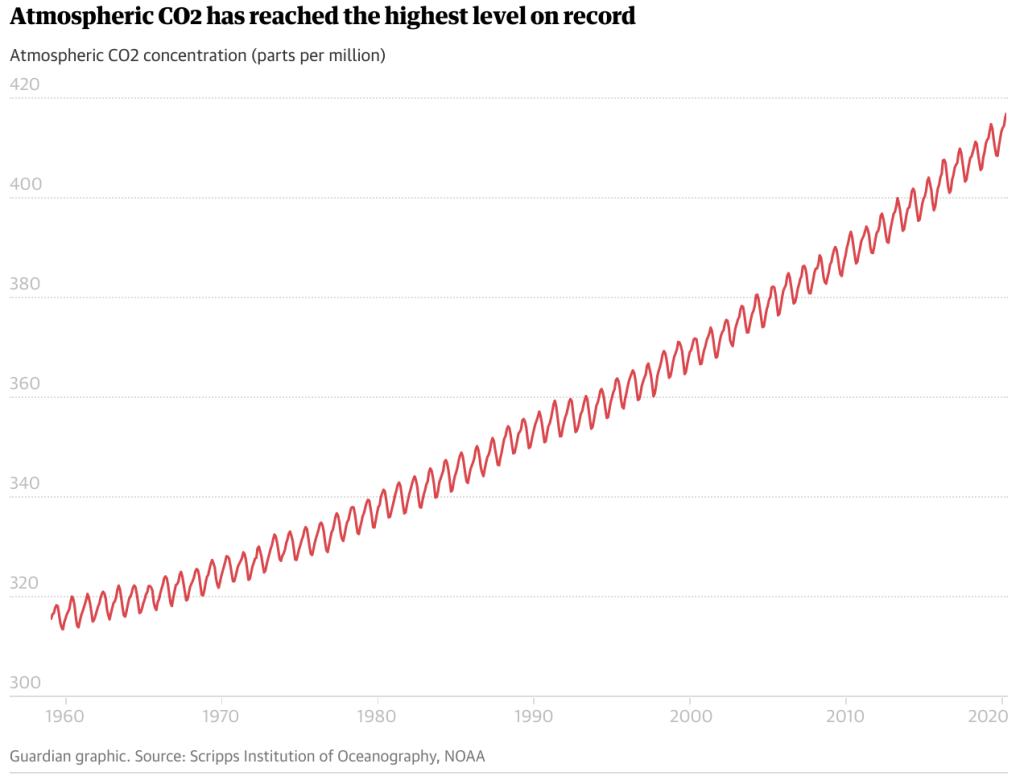
Manau Loa CO2 measurements show little change after Covid-19.

If Covid-19 has taught us anything, it’s that we can change very quickly. So, can we cut CO2 emissions by 17% for a longer period of time? Can we cut emissions in a way that enables the economy to grow?

Some of the news about how Covid-19 can help climate change is bad. For instance, since there are fewer flights now, the EU and UN are postponing airline carbon caps that were supposed to start next year. Governments are willing to forgo CO2 reduction in order to keep afloat struggling industries like air travel. Will they do the same for, say, the carbon-based energy industry?

On the other hand, Covid-19 has helped with climate change. The lockdowns confirmed that renewable energy is a viable strategy. Many companies learned how to telecommute. To a large extent, video conferences replaced business travel. People started biking instead of using cars or public transit.

The World Economic Forum has identified many opportunities to mitigate climate change and to help the world economy come back after Covid-19 lockdowns. Stimulus programs can put labor back to work building green infrastructure and better public transit. Cities can allocate more space to bikes and restaurants, and less space to cars. Need an effective carbon mitigation work program? How about planting lots of trees?

In many ways, Covid-19 is like our training wheels for climate change. As the Siberian oil spill is showing us, disasters of the magnitude of the Exxon Valdez are table stakes for the magnitude of disasters we should expect from climate change.

Covid-19 teaches us two important lessons.

One is that cutting pandemic programs when we knew pandemics were more and more likely was expensive. It probably will cost the US alone 100,000 deaths and trillions of dollars of economic loss. If climate change isn’t addressed, the costs will be much higher than Covid-19 in both mortality and money.

Second is that deadly viruses get people to change. Covid-19 has shown that good leadership in places like South Korea, Vietnam, and Ghana can get people not only to change their behavior, but change it in ways that solve a problem with minimal economic distress.

Covid-19 may have been the right virus at the right time. In some ways, HIV and Ebola are easier viruses to deal with than Covid-19 from a public health perspective. With HIV and Ebola, chances were high before there were treatments and vaccines that infection resulted in death. That got people’s attention. That gave people a strong incentive to change behavior. During the AIDS epidemic, the incentives to avoid sex were strong, although not always stronger than the desire to have sex. Condoms were the life saving concession. No strong protests about using them.

Covid-19 infection, on the other hand, has a range of reactions from no symptoms to death, with death only about one percent of the time. Enough of a chance of death to create anxiety, but not necessarily to stay in when you feel a little under the weather or to stick to your 14 day quarantine. Enough mortality that people will play along with the experts for a little while, but protest when it comes to their own pocketbook. The risk profile of Covid-19 actually feels a little like the risk profile of climate change.

The virus reveals who we are.
9 June 2020 – Tuesday – #86

My terrace garden already produced its first cherry tomatoes yesterday. There’s a bumper crop on the way. Life in the New Abnormal isn’t all bad.

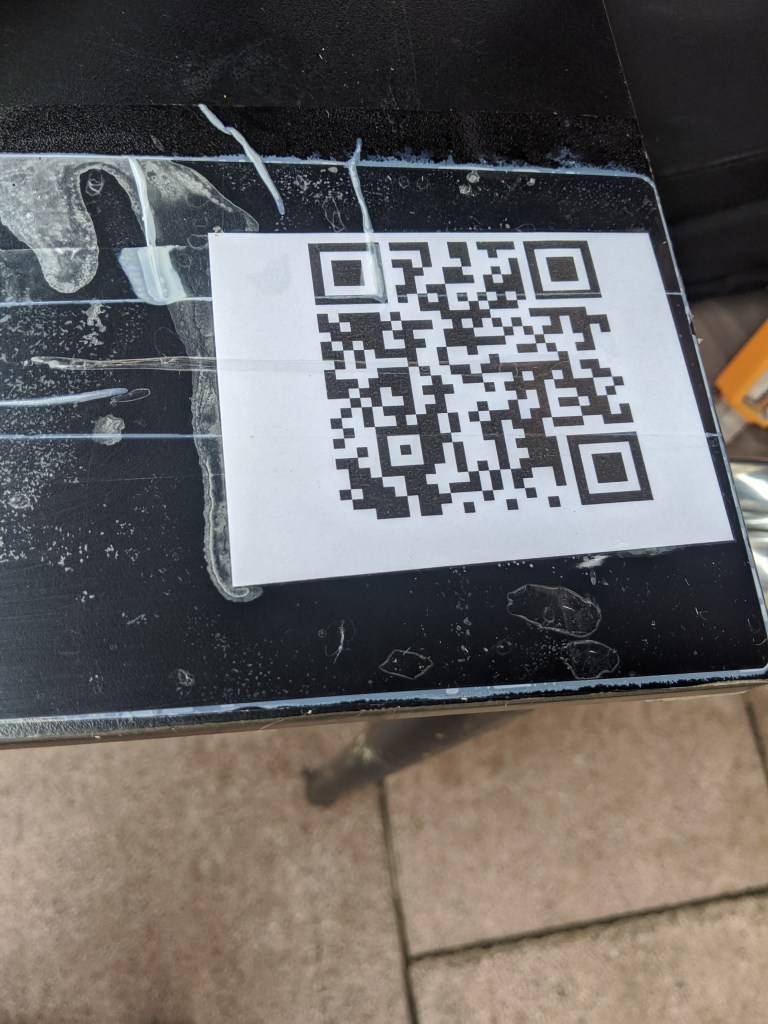
To give you a taste of how things have changed, here are two images from the New Abnormal in Barcelona. The first is the new QR code menu system at one of the local Thai restaurants where I ate last week with Nicole and her daughter.

Menu QR code at Banna Thai Restaurant in Gracia.

Instead of passing around menus, many restaurants provide a QR code that you scan with your mobile. In this case, the QR code is taped to the table, but sometimes it’s at the door or on a planter. You can scan the QR code above if you want to find out today’s prix fixe almuerzo menu. It’s good practice for your next trip to Barcelona.

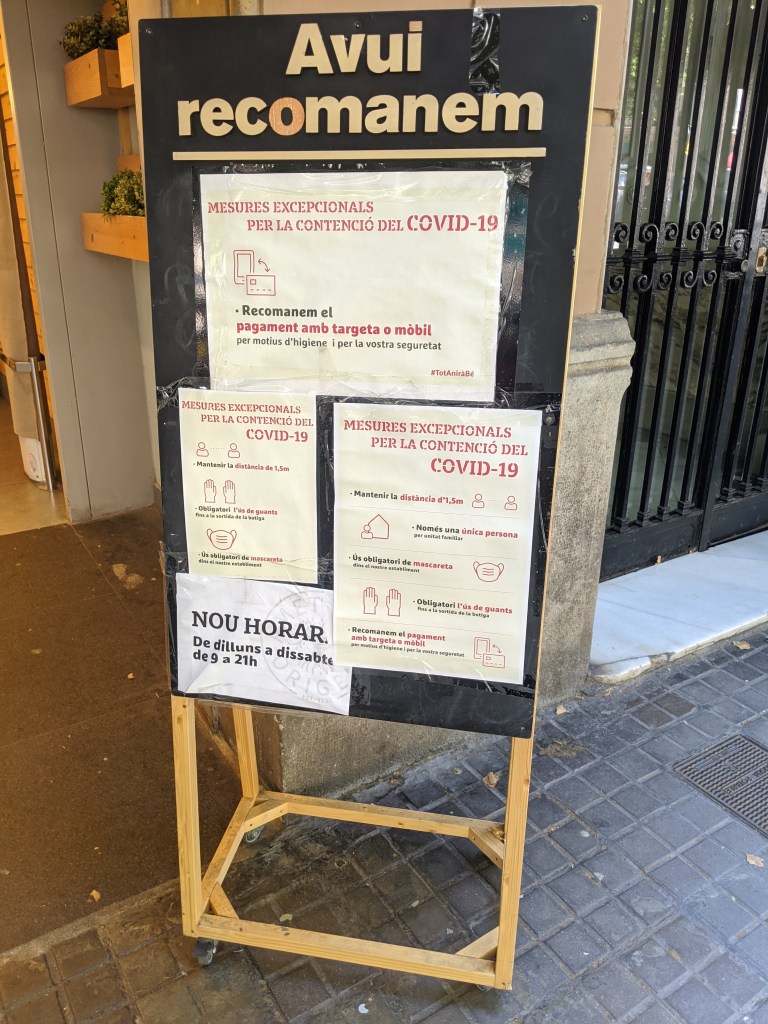
The second image is the New Abnormal grocery shopping protocol posted outside a local store.

Grocery shopping instructions in Catalan and Spanish at an Ametller Origen store.

All the grocery stores have about the same shopping protocol. As with most signage in a cosmopolitan city, the graphics make the instructions clear even if you don’t know Catalan or Spanish. The number of customers inside the store is limited and customers must wear masks (your own) and gloves (provided). Sometimes hand sanitizer is available. Paying by mobile is recommended, although a credit card seems just as safe if you tap it instead of having staff insert it. My biggest complaint is that I usually can’t unlock my mobile with my fingerprint when I’m wearing gloves so I have to type in my code. Boo-hoo.

I’ve noted before that life in the time of Covid-19 is safer with a smartphone, which puts people who can’t use or can’t afford smartphones at higher risk. People who can’t use or can’t afford smartphones probably are at higher risk already, so it’s a double whammy for them.

Some good Covid-19 news. WHO says asymptomatic transmission of Covid-19 is rare. At least that’s how the headlines read.

CNBC Headlines, 8 June 2020.

This seems like great news. It implies we don’t have to worry about transmission unless someone is sick. If you get on an airplane and no one has symptoms, no problem flying. Like the headlines last week that the Covid-19 virus was weakening, this news from WHO seems a little too good to be true.

Is it too good to be true? There’s something about the headlines from yesterday that doesn’t quite square with this headline from three days ago.

Time headlines, 5 June 2020.

According to the Time article, San Diego researchers have not found asymptomatic spread of Covid-19 to be rare at all.

In a study published June 3 in the Annals of Internal Medicine, researchers at the Scripps Research Translational Institute reviewed data from 16 different groups of COVID-19 patients from around the world to get a better idea of how many cases of coronavirus can likely be traced to people who spread the virus without ever knowing they were infected. Their conclusion: at minimum, 30%, and more likely 40% to 45%

Time, “Nearly Half of Coronavirus Spread May Be Traced to People Without Any Symptoms,” 5 June 2020.

That doesn’t seem like asymptomatic transmission of Covid-19 is rare. It seems like 1/3 to 1/2 of Covid-19 transmission is from asymptomatic carriers. So what’s going on? Is there asymptomatic transmission of Covid-19 or not? Is WHO right or wrong? To untangle this, Dr. Faust (what a name!) analyzes the WHO statement beyond the headlines.

Dr. Jeremy Faust on the WHO’s statement that “Asymptomatic spread of coronavirus is ‘very rare.'”

If you read through Dr. Faust’s Twitter thread, he concludes it’s not that asymptomatic Covid-19 carriers don’t spread the virus, but “that CONTACT TRACING is woefully inadequate at finding asymptomatic spread.” Aha! That means something very different from the headline. The headline is drawing the wrong conclusion.

So, like the headline from last week that Covid-19 is weakening, yesterday’s headline about asymptomatic spread of Covid-19 is misleading and spreading like wildfire on my social feeds. I’ve seen people on social media arguing to shut down WHO based on this headline. A better idea might be to research the headline before sharing it.

That leaves us in the same quandary. Everyone wants yesterday’s headline to be true because it would simplify life. Now we’re back to worrying whether there’s an asymptomatic Covid-19 carrier in our midst. We still don’t know how to protect ourselves from Covid-19. We still don’t have a clear protocol for screening for Covid-19.

Such is life at the beginning of a pandemic. Such is our New Abnormal.

So, what do the experts say they’ll do? Epidemiologists aren’t expecting life to return to normal soon. I was disappointed, but not surprised, about cultural events in particular.

New York Times, “When 511 Epidemiologists Expect to Fly, Hug and Do 18 Other Everyday Activities Again,” 8 June 2020.

The article shows when epidemiologists expect to resume a range of activities, from hair cuts to funerals. Recent polling shows that epidemiologists don’t think too much differently about what the New Abnormal looks like than the general public. It’s good to know everyone is in sync with the experts on this topic. In sync, that is, if they can read past the headlines.

The experts have been right about Covid-19 lockdowns.

new study published in the journal Nature has calculated how many lives were saved in 11 European countries thanks to confinement policies during the Covid-19 pandemic. Researchers estimate that the measures imposed first in Italy, then in Spain and later in the other countries under analysis may have saved over three million lives – including around 450,000 in Spain.

El País, “Coronavirus confinement measures may have saved 450,000 lives in Spain,” 9 June 2020.

My anti-lockdown friends will insist that the human toll from the lockdowns is higher than the lives saved. Looking at Brazil and Ecuador, where there are effectively no lockdowns and the economies are bad anyway, and at Japan, where there was no lockdown and no significant Covid-19 mortality, it’s hard to say there is correlation (let alone causation) between lockdowns and economic performance (let alone excess deaths due to lockdowns). In the absence of evidence that letting the virus run wild and kill 1% of the population leads to a better outcome, it seems to me like lockdowns were the right decision.

But people don’t believe experts for any number of reasons. In Orange County, County Health Officer Nicole Quick resigned after protesters threatened her family. They were upset about her mandatory mask order, although the science is now clear on how masks prevent Covid-19 spread. Probably the hardest part of public health and part the models fail to predict is how people react to the change that goes along with a pandemic.

Shane sent along a link to a TED talk with Sonia Shah, the author of Pandemic: Tracking Contagions, from Cholera to Ebola and Beyond.

Sonia Shah TED talk 30 March 2020.

The interview was recorded near the beginning of the lockdowns in Europe and the US. It’s great for understanding how experts think about pandemics, why there will be more pandemics, and how we can live with them. One hint: we need more accessible health everywhere, more biodiversity, and better international public health infrastructure. That is, we need pretty much everything the opposite of what Trump is doing.


AFTERNOON UPDATE.

WHO clarified its statement about asymptomatic transmission of Covid-19.

“The majority of transmission that we know about is that people who have symptoms transmit the virus to other people through infectious droplets. But there are a subset of people who don’t develop symptoms, and to truly understand how many people don’t have symptoms, we don’t actually have that answer yet.”

Maria Van Kerkhove, Covid-19 Technical Lead, WHO

8 June 2020 – Monday – #85

Laura sent a message yesterday that she was returning to Barcelona with Jacob in early July because Jacob performs on July 11. I entered the concert in my nearly empty calendar. Jacob performed in the last concert I heard before the Covid-19 lockdown, so there’s some strange cosmic symmetry if he performs in the first concert after. Just so you know, the concert is outdoors. The New Abnormal in Spain.

Meanwhile, as the world surpasses 400,000 Covid-19 deaths, the US leads the way with 110,000 deaths.

Similar to what happened in Italy for weeks, it appears that US Covid-19 mortality has plateaued and is not declining. It’s hard to tell right now whether the mortality curve will follow Italy and eventually decline, or whether a second wave of Covid-19 is about to hit the US.

It’s not hard, on the other hand, to discern pre-election narratives forming about the cause of a second wave should it hit.

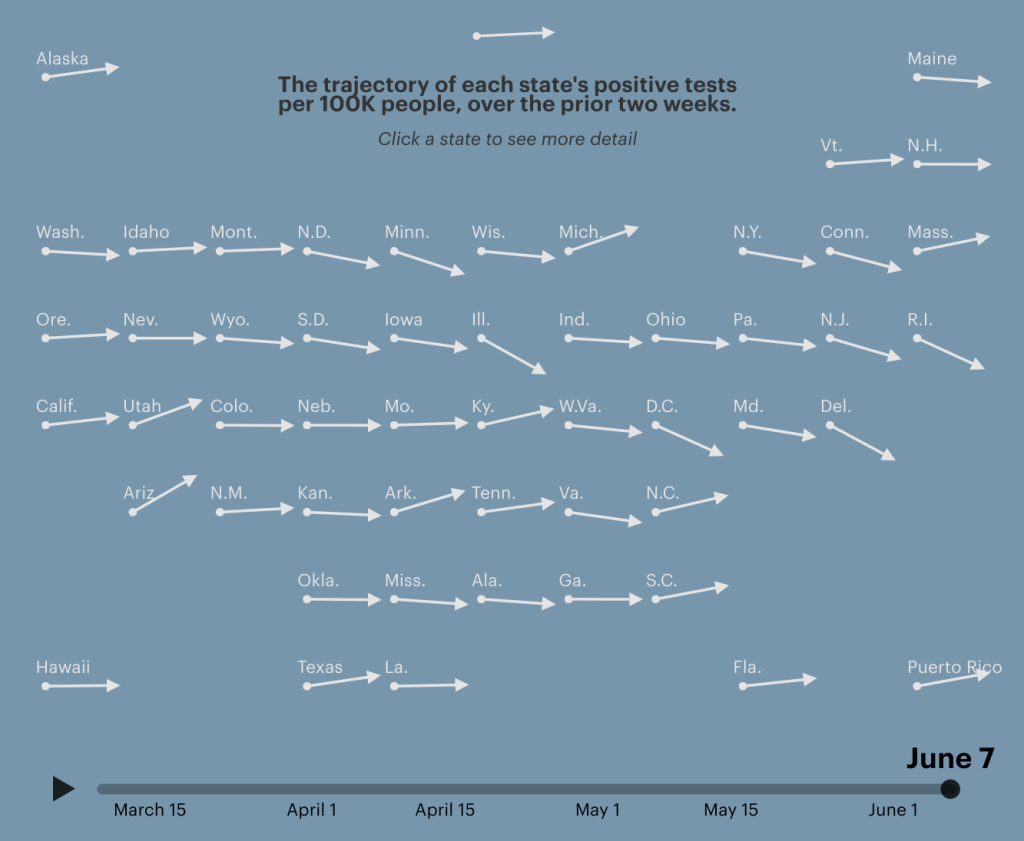
If you want to know how your state is doing, here’s another tracking site from ProPublica (see Resources page for other Covid-19 tracking sites). The chart shows some of the reasons a second wave of Covid-19 may not be far off—look at all the arrows pointing up!

ProPulbica Covid-19 status by US state and territory, 7 June 2020.

The ProPublica site gives detailed information by US state and territory. As you can see, many states have increasing Covid-19 cases. About 1/3 of US states have both increasing positive tests and increasing percentage of positive tests. In states with both these metrics increasing, the increasing positive tests are due to more people getting infected rather than more people getting tested.

If you live in one of the American states with bad Covid-19 numbers, you can thank your lucky stars you don’t live in Brazil or … Saudi Arabia. Saudi Arabia has the right ingredients for a Covid-19 outbreak: international travel, a poor immigrant working class, and the celebration of Ramadan.

Last week, a senior Saudi doctor warned that the number of coronavirus patients in critical condition is “very disturbing”, after the kingdom reported nearly 1,300 cases are on ventilators.

Middle East Eye, “Coronavirus: Saudi Arabia passes 100,000 Covid-19 cases,” 7 June 2020.

As Covid-19 cases surpass 100,000 in the Saudi Arabia, the Turkish press notes that divorces in the Kingdom have shot up, too.

Apparently, the preventive measures taken to stem the spread of the coronavirus including imposing lockdown – contributed to helping women to uncover the secret marriage of their husbands.

Anadolu Agency, “Divorce rates increase in Saudi Arabia amid COVID-19,” 5 June 2020.

On our phone call yesterday, Mom said she thinks we’ll have a vaccine by the end of 2020—that’s in just six months if your keeping track—and thought out loud about who would get first access to a vaccine. I cautioned her that a year was optimistic.

I hate the way news media eats up early vaccine results and reports great things are close at hand. The San Diego Tribune has a balanced story about Covid-19 development with this great ‘splainer chart on the five basic ways science uses to make vaccines these days.

Different development approaches for Covid-19 vaccines, San Diego Tribune.

The world has 135 Covid-19 vaccine candidates, 40% of which are being developed in the US. The effort is unprecedented, but not bulletproof. There are no vaccines for HIV, SARS, or MERS even though those viruses have been around much longer. Don’t hold your breath for a vaccine.

I’m ending today with a shout out to a more ambitious Covid-19 project than Covid Diary BCN, the New Decameron Project.

The New Decameron project plans to post a story every day, to share art and aspiration during this crisis and bring our community together. All stories will be visible to everyone, but if you support us with a pledge, the money will go to pay the creators and to support Cittadini del Mondo, a charity running a library and clinic for refugees in Rome, which badly needs extra support during this crisis

I have considered linking to charities, but that gets into the complication of vetting and choosing between charities. I like the approach of the New Decameron Project to work with a known charity.

I also love using Boccaccio’s Decameron as an writing inspiration. It was written shortly after the Black Death hit Florence in 1348, so it’s relevant in so many ways to Covid-19. Enjoy!