7 June 2020 – Sunday – #84

I had a BBQ on the terrace last night! It was awkward figuring out the etiquette (we bumped elbows at the door) and weird to remember how to host a dinner party. For the record, I didn’t get the coals quite hot enough. Still, the meal was delish if a little late to the table.

While Francesc and I waited for the others to procure gin and tonic for a postprandial blaze of glory, I asked Francesc about what going on at his Barcelona law practice. Lawyers, who, by the way, are essential workers, see the nitty-gritty of how business works. If I understood Francesc correctly, he sees local economic activity picking up rapidly. A big financial roadblock for small businesses here is simply writing the financial plan required by lenders. The Spanish situation seems similar to the US where the small businesses that have limited avenues for financing also seem to have the most trouble with the process of accessing stimulus funding.

Friday’s US unemployment numbers were a sign that Covid-19 unemployment appears to be peaking.
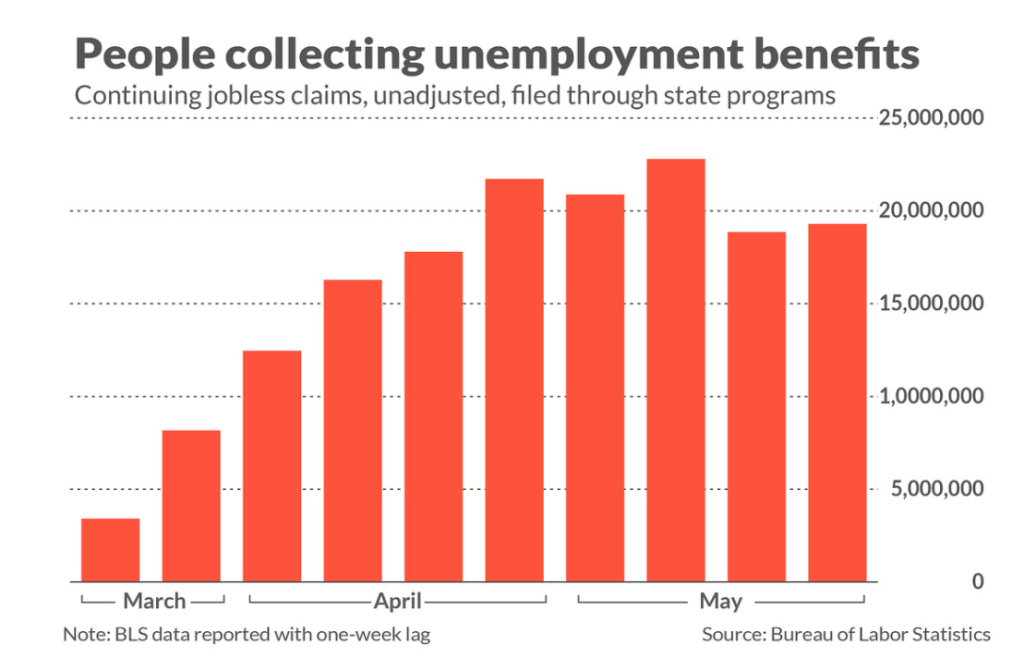
US continuing jobless claims during the Covid-19 crisis.

The question now is what shape the economic recovery will take. Anecdotally, Francesc thinks Spain will have a V-shaped recovery. My concerns about the US economy are that it relaxed Covid-19 restrictions too quickly and that the George Floyd protests may increase infections. If a second wave of Covid-19 hits the US this summer, new lockdowns reduce the chance of a V-shaped recovery.

In the UK, Prime Minister Johnson is pushing to end lockdowns sooner to save jobs. I think many PhDs will be written about the politics of economy versus health in the age of Covid-19. It’s a little too soon to know for sure whether the US relaxed Covid-19 restrictions so soon that a second wave of Covid-19 will occur this summer, but it looks like the better trade off is to err on the side of public health so that when jobs come back, they come back stronger. In other words, better to wait a little longer to de-risk a V-shaped economic recovery than to start working sooner only to have Covid-19 reappear and drag out the economic recovery. Johnson probably would do the UK and himself a favor by waiting to push for jobs. For the record, I don’t want a PhD.

Meanwhile in Brazil, President Bolsonaro, the Trump of South America, is hiding Covid-19 numbers. He stealing from the Florida playbook on Covid-19 public relations.

Neither Bolsonaro nor the ministry gave a reason for erasing most of the data on the covid.saude.gov.br website, which had been a key public resource for tracking the pandemic. The page was taken down on Friday and reloaded Saturday with a new layout and just a fraction of the data, reflecting only deaths, cases and recoveries within the last 24 hours.

Reuters, “Brazil takes down COVID-19 data, hiding soaring death toll,” 6 June 2020.

Bolsonaro has avoided Covid-19 lockdowns, but finds his economy in a tailspin anyway. My hunch is that he thinks that covering up Brazil’s Covid-19 numbers will calm Brazilians so they will return to work. Good luck with that. Excess deaths are easy to measure and tell the story of Covid-19 devastation at least as well as actual Covid-19 statistics.

Watching the continuing US protests, it’s frustrating that US law enforcement isn’t on the same Covid-19 page as public health agencies. Simple public health resources aren’t being applied to protect George Floyd protesters. It’s not that difficult. Here, for instance, is a program to protect Atlanta protesters.

CORE Covid-19 services for George Floyd protesters.

It’s also frustrating that the US government keeps prison and immigration detention center Covid-19 hot spots operating. ICE has tested 13% of immigrant detainees, but hasn’t said whether the testing is randomized or for symptomatic detainees.

According to statistics provided by the U.S. Immigration and Customs Enforcement, there are currently 781 positive cases of COVID-19 in detention facilities across the United States.

KVOA.com, “Nearly 100 confirmed cases of COVID-19 reported at Arizona ICE detention centers,” 5 June 2020.

In Arizona, a state where Covid-19 cases are rising, ICE houses 100 detainees with confirmed Covid-19 infections. Releasing these detainees would have reduced Covid-19 infections. Detaining them puts not only more detainees at risk, but also detention center staff and the communities around the detention centers.

The entire US law enforcement apparatus ignores public health at the peril of the country’s health and economy. Law enforcement costs and benefits aren’t lining up during the pandemic.

Good news from China on the Covid-19 vaccine front. A vaccine based on an inactivated virus provided protection to monkeys.

Still a long way to get through human trials, but this candidate Covid-19 vaccine appears more effective than the much touted Oxford vaccine and several other early candidates. Since Trump is pulling out of WHO, it’s not clear how the US gets access to the vaccine if it passes through human trials.

It’s hard to track all the Covid-19 treatment and vaccine trials. The BioCentury clinical trial dashboard is your new best friend for that. I’ve posted it on the Resources page.

BioCentury Covid-19 trial readouts, 7 May 2020.

I want to end today with a sad video of the White House, sad because Trump finally built the wall he really seems to want.

I’m rooting for the US to do the right thing. The protesters give me hope. The public opinion polls give me hope. The ridiculous new barricade around the White House is a great symbol of how Trump deals with things he personally doesn’t like. It’s not a productive way forward. It’s a gated-community way forward.

6 June 2020 – Saturday – #83

Spain has retested and so far, so good.

The results indicate no major resurgence of the virus in this period, and confirm geographical variations observed the first time around. They also underscore the role of asymptomatic spreaders and the greater presence of the coronavirus in large cities.

El País, “Spain’s macro study shows just 5.2% of population has contracted the coronavirus,” 5 May 2020.

In the previous nationwide test, Spain had an overall Covid-19 seroprevalence of 5.0%. This has grown to 5.2%, indicating no major outbreaks since relaxation of Covid-19 restrictions began.

Resting on its laurels for a bit, Spain is taking a more conservative position on re-opening its borders than its neighbors. While Italy’s borders are open and most of the rest of Europe wants to open mid-June, Spain prefers to wait until July 1. I suspect one reason Spain wants to wait is to bolster its Covid-19 testing capacity.

Watching from Barcelona, it’s hard to understand what is going on in the US.

The protests over the police murder of George Floyd and Covid-19 have at least one thing in common. So many Black men die in the US at the hands of police that both police brutality and Covid-19 are legitimate public health issues.

The same way that Trump couldn’t figure out how to take political advantage of Covid-19, he can’t figure out how to take political advantage of the protests. With Covid-19, he pitted the economy against public health. With the protests, he’s trying to play Americans against each other, encouraging police to brutalize peaceful protesters into submission. As with Covid-19, Trump is missing the point. Most Americans don’t want to be against one another and they don’t want fellow citizens to die needlessly.

During the protests, the police have been their own worst enemy, making the case against themselves that police brutality is a problem in the US. It’s not difficult to find evidence of gratuitous police brutality in social media feeds. Here’s one comprehensive documentary Twitter thread that makes several cases against police.

The police are not factoring Covid-19 safety into their response to the George Floyd protests. This is a stark contrast to hands-off police response to anti-lockdown protests a few weeks earlier. Police attacking George Floyd protesters are exacerbating dangerous conditions during the pandemic. For instance, tear gas increases the chance of Covid-19 transmision.

Scientists know little about how [the chemical in tear gas] affects the general public. The most comprehensive studies were conducted by the U.S. military on thousands of recruits who were exposed to tear gas during training exercises. Afterward, it left them at higher risk for contracting influenza, pneumonia, bronchitis and other respiratory illnesses.

ProPublica, “Tear Gas Is Way More Dangerous Than Police Let On — Especially During the Coronavirus Pandemic,” 4 June 2020.

Tear gas also forces people to remove masks while coughing, further increasing infection risk.

In one of many strange episodes from the government response to protesters, an unknown government agency confiscated Covid-19 masks being sent from a small business to protesters. How much more clear could it be that the government wanted protesters to infect each other? Then the Feds released the masks. It seems that the Feds know more about what the protesters are doing than about how to produce Covid-19 test kits. This episode speaks volumes about Trump’s focus on anything other than public health.

There’s another similarity to George Floyd protests and Covid-19. Turns out the behavior of a bad cop is “infectious.” That is, hiring someone with a record of bad policing behavior is a recipe to spread bad behavior through a police force just like singing with someone who has Covid-19 is a recipe to spread the virus through the chorus.

As with Covid-19, we can use contact tracking to follow the bad cops.

Covid-19 is such a drag.

And who else but drag queens can figure out how to have a little fun during a pandemic.

“We’re uniquely equipped to deal with this moment in time. As an artistic entity, so much of the beauty we’ve made over the decades and centuries has been fueled by adversity, and pushing back under circumstances that don’t necessarily set us up for success to begin with.”

BenDeLaCreme, Former “Drag Race” All Star

I ended in Paris yesterday. I’ll end in virtual drag Paris today.

Juku performing La vie en rose for the Biqtch Puddin’ Digital Drag Show

5 June 2020 – Friday – #82

The same week as Spain had its first day without a reported Covid-19 death, the San Francisco Bay Area had its first day since without a reported Covid-19 death since Covid-19 struck. I know how good that feels.

I’m a little concerned, though, when I see how crowded Dolores Park is during the George Floyd protests.

Those useful social distancing circles San Francisco created for Dolores Park a couple weeks ago are out the window.

Yesterday’s entry covered how we could avoid future Covid-19 outbreakes with vaccines and how we could mitigate the severity of future Covid-19 outbreaks with better treatments. Another aspect of Covid-19 management going forward is human behavior.

I mentioned the Pareto Principle a month ago in the context of herd immunity. Turns out there may be another Covid-19 application for the 80/20 rule: Covid-19 superspreadering. In a (not yet peer-reviewed) study of 1,038 cases in Hong Kong, researchers found the 80/20 rule applies to people who spread Covid-19.

Of the 349 local cases we identified — the remaining 689 cases were imported from other territories — 196 were linked to just six superspreading events. One person alone appears to have infected 73 individuals after frequenting several bars in late March. Weddings, temples, hot-pot dinners, work parties and karaoke venues featured in the other clusters.

New York Times, “Just Stop the Superspreading,” 2 June 2020.

The study found that 20% of Covid-19 cases did most of the spreading while about 10% spread Covid-19 a little and 70% didn’t spread it at all.

Digging a little deeper, scientists characterize an epidemic’s transmission in two ways. One is the familiar reproduction rate, R. At any given time t during an epidemic, R(t) measures how many new cases result on average from each case at time t. At the beginning of an outbreak, t = 0. The basic reproduction rate R(0), or R naught, for Covid-19 is estimated to be between two and three. R goes up and down during an outbreak. One way or another, R always goes to zero at some point in time.

The other way scientists characterize transmission is in terms of its dispersion, k. Dispersion measures how many of the cases at time t generate new cases. In other words, if a lot of cases spread a disease, the disease is very dispersed. The Hong Kong study suggests that k = 0.45 for Covid-19. As my cool friends like to say, k is the new R.

The reason k is important going forward is that it tells scientists that some specific set of behaviors probably is responsible for most of Covid-19’s spread. If we can identify these, we can adapt to Covid-19 without treatments or a vaccine. This is what happened with condom use during the AIDS crisis.

New behaviors like wearing masks prevent Covid-19 from spreading. There may be more effective behavior modifications available. From what we know already, superspreading is probably some combination of the physiology or behavior of a person, certain types of events and locations, the kind of ventilation, the use of masks, and the duration and proximity of contact. It’s not clear yet how each of these factors contribute and whether there are other factors not yet discovered.

One thing on the mind of travelers is whether airplanes are implicated in superspreading. A recent Spanish flight to Canary Islands highlights why. Passengers were surprised to learn as the Spanish Civil Guard met their arriving flight at the gate that someone onboard had Covid-19.

The 53-year-old passenger had traveled to Madrid and then to Manzanares, in the Castilla-La Mancha region, to attend his mother’s funeral. Although the man had not been in contact with his mother, according to regional authorities from Castilla-La Mancha, he was in contact with the rest of the family, at least one of whom had tested positive for coronavirus. It was this diagnosis that prompted the man to get tested. Health officials realized the man was flying to Lanzarote when they tried to inform him of his test results.

El País, “Outrage over passenger who boarded Spanish flight with coronavirus: “My son sat next to him”, 1 June 2020.

I was somewhat encouraged by the airline’s response. Iberia Express is providing free meals and health services to their passengers who are now in quarantine. Airlines trying to attract travelers need to manage passenger safety through the entire travel experience. For instance, if passengers can’t opt out of flights when they feel sick because of additional hotel fees or fees to change tickets, many will fly when they shouldn’t.

Parenthetically, Mom’s nursing home pays contractors to stay home if they feel ill in order to reduce the risk that sick staff members work when they need to pay their rent. Business needs to re-think sick time policies for the sake of not only the safety of their employees and vendors, but also their customers.

One thing people worry about on long airplane flights is ventilation. As in, how much Covid-19 is in the cabin air? Airline ventilation systems use a combination of fresh air and recycled air, recirculating the air inside the cabin every three minutes. Recycled air passes through HEPA filters to remove 99% of viruses.

HEPA filters are hospital-grade air filters, which means that they are the kind of filters used by hospitals to help insure that patients have the cleanest air possible. HEPA filters extract more than 99% of viruses – even those as small as 0.01 micrometers – so they can filter out coronaviruses specifically, which range from 0.08 to 0.16 micrometers in size.

CheapAir.com, “How Airplane Ventilation Actually Works,” 14 March 2020.

What no one seems to know is how dangerous airplane cabins actually are. I can’t find any useful statistics, for instance, on airline crew Covid-19 cases or deaths. Even if the statistics exist, it’s difficult to tease out Covid-19 transmission that occurred in the air versus all the other places a crew member might contract the virus.

On April 28, a pilot reported sharing a hotel van with 18 other people, including the driver. Pilots were sitting shoulder-to-shoulder and most weren’t wearing masks.

Bloomberg, “There’s No Escape From the Virus in a Cockpit at 30,000 Feet,” 7 May 2020.

This seems like an opportunity for testing to improve safety conditions. Where are those Covid-19 tests, by the way?

On the science front, a new study from Germany finds two genetic loci associated with severely ill Covid-19 patients. In February, researchers collected blood from patients on ventilators in Italy. One similar genetic area they found among the DNA of these patients is involved with blood type. Chinese doctors noticed very early on that people with Type A blood are much more likely to have severe cases of Covid-19.

As scientists have begun to understand Covid-19 as a vascular disease in addition to or instead of a respiratory disease, I wonder if more connections to Covid-19 and blood related genes will be found. For instance, Covid-19 appears to be implicated in removing iron from red blood cells.

The other genetic area the German researchers found in common with the critically ill Italian patients is involved with both ACE-inhibitors and immune system signaling.

One of those gene candidates encodes a protein known to interact with ACE2, the cellular receptor needed by the coronavirus to enter host cells. But another gene nearby encodes a potent immune-signaling molecule. It is possible that this immune gene also triggers an overreaction that leads to respiratory failure.

New York Times, “Genes May Leave Some People More Vulnerable to Severe Covid-19,” 3 June 2020.

Other researchers are looking at genetic links to Covid-19, too. This may help identify high risk patients or superspreading characteristics that, in turn, help mitigate future Covid-19 outbreaks.

Now that both Barcelona and the San Francisco Bay Area have had a day without a reported Covid-19 death this week, I’m turning my attention to Paris. My friend Anne wrote an up-close and personal account in Vogue about Paris opening up after its Covid-19 lockdown. Like Barcelona, Paris isn’t normal, but it’s sure better than March and April. Europe is opening up.