26 May 2020 – Tuesday – #72

I’ve been craving homegrown tomatoes for years. When Brad and I rented Casa Solar at the end January, I finally had the perfect terrace to grow tomatoes. With all the rigmarole of moving in and obtaining my Tarjeta de Identidad de Extranjero, though, there was no time to order plants before the lockdown.

The first full day of Phase 1 in Barcelona gave me plenty of time to shop for the new vegetable and flower garden.

Flower and vegetable garden.

It’s weird how Phase 1 has changed life. For some reason when businesses are closed and outdoor time is restricted, I found it hard to get anything done, even things like cleaning that I could do any time. Yesterday, I cleaned house, did laundry, blogged, set up the jardinito, and had a friend over for vermut. All in one day!

So, what’s next?

One of the many ongoing Covid-19 debates is lockdowns versus the economy. A lockdown saves lives, but slows the economy and creates “excess” deaths from non-Covid causes. On the other hand, not locking down creates “excess” Covid-19 deaths, but may reduce “excess” non-Covid deaths and may have a smaller impact on the economy. I use the word may because, in either case, it’s difficult to model the outcomes.

Anti-lockdown proponents claim, for instance, that people avoid cancer diagnoses during a lockdown. However, it seems unlikely someone avoiding a cancer diagnosis during a lockdown will run to see their oncologist while an unchecked Covid-19 contagion ravages their healthcare system. The anti-lockdown proponents so sure life is better without any lockdown might want to take a look at Ecuador in the wake of what was effectively its Covid-19 non-response.

How much does a lockdown slow the economy and create excess deaths? Ditto for the case of no lockdowns. As Dr. Spencer points out on Fox News, the choice between lockdown and the economy is a false dichotomy.

Dr. Craig Spencer on Fox News regarding public health and the economy.

The tricky part of our dance with Covid-19 has been balancing public health and the economy, especially at the beginning of the pandemic when so little was understood about the disease other than it was spreading like wildfire and killing people. Would the lockdown cure be worse than the disease? Who knew?

There is no question that the Covid-19 lockdowns crushed the world economy, nor is there any question that a bad economy is bad for health. As someone noted on one of my social feeds, public health officials measure success in terms lives saved and economists in terms of per capita GDP. In other words, the solution for what to do after the economy is in tatters and before we have a treatment or vaccine may depend on the way you’re trained to look at the world.

What we do know now from the Swedish “lockdown lite” experiment is that avoiding a full lockdown doesn’t necessarily lead to a better economic or public health outcome. Sweden’s Covid-19 mortality is relatively high, its economy is performing about the same as its neighbors, and the country is nowhere near achieving the herd immunity it sought.

Another thing we know is that a bad economy with all is attendant health problems is baked in. No matter what we do at this point, there will be excess non-Covid-19 deaths.

Finally, we know that staying locked down is not a viable long-term, or even medium-term solution. Is there a better way than for each country to go it alone?

Here’s a UK group that’s investigating Covid-19 policies to move forward in Low- and Middle-Income Countries (LMICs).

Over the coming weeks we will share the findings of a scoping review (see here our call for resources and here for a teaser of what we’re finding) that maps data and evidence to a conceptual framework to help understand the multifaceted nature of the indirect health effects. We will also share a simple tool to support the estimation of indirect health effects, in terms of excess non-COVID-19 mortality (and also reductions in non-COVID mortality, e.g. road traffic deaths). 

Center for Global Development, “More Harm Than Good? The Net Impact of COVID-19 Policies Is What Matters for Health,” 15 May 2020.

As the Center for Global Development and other organizations develop nuanced Covid-19 policies, the next question is whether countries have the government and leadership skills to implement those policies. In countries like the US, Brazil, and Russia that already have demonstrated poor Covid-19 responses, it’s not clear.

And what of the world economy? Nouriel Roubine predicts a decade of depression. Sorry, I know that’s probably not what you wanted to read today. Roubini says monetary stimulation may help financial markets over the next year or two, but that inflation seems likely after the dust settles. There’s a lot to chew in this interview.

Thirty-five to 40 million people have already been fired. When they start slowly rehiring some of them (not all of them), those workers are going to get part-time jobs, without benefits, without high wages. That’s the only way for the corporates to survive. Because they’re so highly leveraged today, they’re going to need to cut costs, and the first cost you cut is labor. But of course, your labor cost is my consumption. So in an equilibrium where everyone’s slashing labor costs, households are going to have less income. And they’re going to save more to protect themselves from another coronavirus crisis. And so consumption is going to be weak. That’s why you get the U-shaped recovery.

Intelligencer, “Why Our Economy May Be Headed for a Decade of Depression,” 22 May 2020.

The on-shoring of factory jobs Trump keeps saying he wants may bring manufacturing back to the US, but, according to Roubini, not jobs. On-shoring that results from the Covid-19 pandemic will accelerate supply chain innovations that use more AI and robotics and less labor. All this exacerbates existing US income and wealth inequality.

The cynic in me thinks that maybe government is happy to have us argue about whether we’re better with lockdowns or without. It’s a distraction from bigger issues, like how the rich get even richer.

If you’ve been wondering how different Covid-19 is for the 1%, well, VistaJet now offers a transportation service designed to avoid Covid-19 infection when you fly to your yacht.

I’m ending today with something Dana sent to me, a report of seven successful Cannonball runs and a new record set during the Covid-19 pandemic. I’m sure you’re wondering, how does one set a Cannonball run record? “To set a Cannonball Run record, you must traditionally start at the Red Ball Garage in Manhattan, then traverse the entire United States of America as fast as possible to finish at the Portofini Inn in Redondo Beach, California,”

Seven Cannonball runs during the Covid-19 pandemic.

Reportedly someone took advantage of light traffic during the pandemic to drive coast-to-coast in under 26 hours. There’s something so apt these days about a sport where you win by breaking the law.

I’m going to go back to watching my tomatoes grow.

25 May 2020 – Memorial Day – #71

In Barcelona, it is not Memorial Day, but it is the first full day of Phase 1. In Barcelona’s version of Phase 1, we are free to go outside, but not beyond the city border. No one can enter or leave the city.

As Covid-19 deaths in Spain dropped to 48 yesterday, the lowest since March, Prime Minister Sánchez invited tourists to book travel for July. That’s a good sign that Brad can return from San Francisco soon. Well, maybe. Spain has to work out travel agreements with other countries before tourism starts again. I imagine European negotiations will take priority over the US.

For those of you enjoying a holiday weekend in the US, NPR has tips on the Covid-19 risks of 14 common summer vacation activities. No big surprises. Outdoor activities are generally better than indoor activities, although bathrooms aren’t as risky as I’d thought. I was a little disappointed to read on one of my feeds that the Fire Island boys are dancing in close quarters. They’re not alone in their proximity.

I was pleased, on the other hand, to see the way San Francisco implement outdoor social distancing circles in Dolores Park. Amazing how a hint as simple as a line encourages healthy behavior.

Social distancing circles in Dolores Park, San Francisco.

Yesterday I wrote about how current Covid-19 models aren’t good at predicting things like attaining herd immunity. Models, however, are reasonably good at predicting near term Covid-19 death rates. A consensus of these models works even better. FiveThirtyEight looks at US mortality forecasts from several models. The models’ consensus predicts 110,000 – 140,000 US Covid-19 deaths through mid-June.

FiveThirtyEight, “Where The Latest COVID-19 Models Think We’re Headed — And Why They Disagree,” 24 May 2020

This is what caught my eye. The article breaks down each model as well as each US state. It seems to me like anonymized mobile data should be a good proxy for social distancing and that social distancing, in turn, should be a good proxy for infection rates. I’ll note, however, that the two models using anonymized mobile data, the University of Texas and IHME models, give the best and worst Covid-19 mortality forecasts, respectively, of the entire group. Feel free to speculate in the comments about why the two models using mobile data might give such divergent forecasts.

Of note as Covid-19 ravages underdeveloped countries is that it’s not ravaging all underdeveloped countries. I’ve mentioned the success of Covid-19 responses in Ghana and Senegal due to sensible leadership, practical public health policies, and innovation.

Here’s another example of Covid-19 innovation by a team of teenage girls in Afghanistan. Ravaged by war and poverty, Afghanistan is in desperate need of ventilators and can’t pay anything near the $50,000 a new ventilator costs. A team of girls in Herat came up with an idea to use spare car parts to build a ventilator based on the MIT open source design.

And because Herat is largely shut down due to COVID, Farooqi says the team had to be ingenious about sourcing parts. “Most of the material we are using is actually from Toyota Corolla car parts” from nearby secondhand markets, such as the windshield wipers, a gear box and motor, along with some motorbike parts.

NPR, “All-Girl Robotics Team In Afghanistan Works On Low-Cost Ventilator … With Car Parts,” 22 May 2020.

After six weeks of work, the team needs two more parts, a transducer and a microprocessor, to finish their prototype. Those two parts are nearly impossible to source in Herat, but that’s not stopping these girls. Even if they aren’t successful, the important thing is to empower as many people as possible to innovate during the Covid-19 pandemic. It’s unexpected successes from unexpected places like Herat that can turn the tide of this pandemic.

One underdeveloped country that’s is being ravaged is Brazil. Its leader has followed the unfortunate leadership footsteps of Trump, poo-pooing lockdowns and promoting hydroxychloroquine as a Covid-19 treatment. We don’t need a model to predict the results of poor leadership.

Covid-19 per-capita morality, 24 May 2020. Brazil in red.

Brazil’s per-capita Covid-19 curve (in red above) appears to be following the US trend of rising without a clear inflection point to level off. I’ll go out on a limb and speculate that Brazil is under-counting its Covid-19 deaths, but probably not as much as Russia (in orange above). Arguably, European countries have fared much worse than the US and Brazil, but US and Brazil had the advantage of knowing what worked against Covid-19 in Europe and Asia for several weeks and yet failed to implement it by the time Covid-19 reached them.

One of my concerns about the US is that Trump is normalizing the magnitude of (the mostly unnecessary) Covid-19 deaths in the US. He’s out golfing this weekend as though it’s normal for more than a thousand Americans to die every day from a pandemic. That’s why I want to end on an up-close and personal note.

One of my social media sources is Dr. Craig Spencer, a New York City ER doc. He and other healthcare providers have seen the popularity of their social feeds rise as they fill in the Covid-19 information void left by the US federal government. I’ll end today with his day-in-the-life video.

Dr. Craig Spencer, Emergency Room Diary.

Happy Memorial Day from Barcelona. Please keep your distance, wear a mask, and wash your hands.

24 May 2020 – Sunday – #70

It turns out the car horns I heard while I was writing yesterday’s diary entry were from a protest by the Spanish right-wing party Vox. It’s still a mystery how people in Spain find out about these events. Once in a while I’ll get a message that we’re banging pots and pans to protest some or other cause, but most of the time I hear something unusual and have no idea its significance.

I don’t pretend to know anything about Spanish politics except from what I’ve seen in the even-handed documentary Dos Cataluñas. I figured I better at least know something about the local independence movement before I got trapped in a vermut-fueled cocktail party conversation. El País reports 6,000 vehicles participated in yesterday’s Vox protests in both Madrid and Sevilla, but only 500 in Barcelona. Because of the correlation between right-wing politicians and homophobes, this seems like another good reason to be in Barcelona.

As a quick compare-and-contrast of Spanish and US right-wing politics, in Madrid the protest organizers asked protesters to comply with Covid-19 safety measures.

The far-right leader called on protestors to respect all of the necessary health precautions, but with the streets of Madrid at a standstill due to the demonstration, many people were seen leaving their cars and failing to keep two meters apart. Municipal police officers in the area instructed protestors to put on face masks, something that this week became obligatory in Spain when social-distancing is not possible.

El País, “Protestors take to Spanish streets in vehicles, at anti-government marches organized by far-right Vox,” 23 May 2020.

In the US, on the other hand, conservatives have turned refusal to wear face masks into a defiant rallying cry against government public health experts, so much that the Republican North Dakota Governor Doug Burgum held back tears while asking his constituents to wear masks.

The messaging problem US conservatives face in reopening states is that masks signify that things aren’t normal.

It hasn’t just been White House leaders stroking divisions surrounding the facial coverings. Missouri Gov. Mike Parson earlier this month defended his decision to go mask-free when visiting a thrift store for veterans in Joplin, Missouri. He said he didn’t believe it was the “government’s place” to determine whether residents should wear a face mask in public and it was up to the individual.

Business Insider, “North Dakota’s GOP governor grew emotional discussing the partisan divide over face masks, asking residents to ‘dial up your empathy’,” 23 May 2020.

Trump’s unfortunate choice to politicize face masks is good for his bouffant and his campaign positioning, but bad for public health. If he had brains, he would be giving away campaign face masks so that people could go back to work with a smaller chance of a repeat Covid-19 outbreak. That’s a sensible way to restart the economy, but once Trump digs himself in on any position, he prefers to doubling down, as they say, to a reality check. Being wrong is a sign of weakness.

Masks are a perfect example of why it’s a bad idea to adhere religiously to any position on Covid-19. Oh so many months ago at the beginning of the Covid-19 pandemic, masks were considered protective gear. The World Health Organization, the CDC, and other health experts implored the public not to buy masks so that front-line healthcare workers could obtain them.

Except that it turns out that, as Covid-19 transmission became better understood and Covid-19 aerosols became better measured and new models were built, new information now says people should worry less about surface transmission of Covid-19 and more about extended time with others in closed quarters. The new advice is that everyone should use masks, not for personal protection, but (in the absence of adequate testing) to reduce the amount Covid-19 available for others to breath.

Which brings me to my real topic today. As the US surpasses 100,000 Covid-19 deaths in the next couple days, most of which were unnecessary, it’s important to consider the things we still don’t know about Covid-19. My social media feed is full of people who know what to do about Covid-19. They’ve dug themselves into various Covid-19 public health positions the way Trump has dug himself in to the benefits of not wearing masks and of taking hydroxychloroquine. Lockdowns are good, or not. Masks or good, or not. Everyone should do what Sweden is doing, or not. Covid-19 kills old people, or not.

The reason to stay flexible on your Covid-19 worldview is that Covid-19 will continue to surprise us. Some examples.

Covid-19 mortality is higher as age increases, especially over 60 years old. Anti-lockdown advocates want to cloister older people so that everyone else can go back to work. Never mind that cloistering older people in poor and immigrant neighborhoods is nearly impossible, this anti-lockdown argument goes that if we lose a few older people, the overall population is better off in a better economy.

However, in developing countries, Covid-19 kills more younger people than in developed countries. A lot more younger people.

In Brazil, 15 percent of deaths have been people under 50 — a rate more than 10 times greater than in Italy or Spain. In Mexico, the trend is even more stark: Nearly one-fourth of the dead have been between 25 and 49. In India, officials reported this month that nearly half of the dead were younger than 60. In Rio de Janeiro state, more than two-thirds of hospitalizations are for people younger than 49.

Washington Post, “In the developing world, the coronavirus is killing far more young people,” 22 May 2020.

This is a new piece of Covid-19 information. If you’ve poured all your social media heart and sould into your anti-lockdown identity, now you’re faced with either cherry-picking data that say it’s still mostly older people who die or changing your online identity. If you’re a politician who’s advocated anti-lockdown, you have a lot more to unwind.

Ditto Sweden, which I wrote about yesterday. More specifically, though, the model Sweden used to pursue its failed “lockdown lite.”

Philippe Lemoine on problems with the ICL Covid-19 model Sweden used.

Philippe Lemoine argues that researchers have failed to understand why the ICL model predictions were wrong in Sweden. He writes that it is easier to attribute the failed prediction to, say, incorrect social distancing assumptions, without checking if that’s, in fact, the reason the model failed.

Which is to say that our ability to predict what happens next with Covid-19 is limited. Pushing down the classic infection curve works, but predicting when we get to herd immunity doesn’t seem to work at all. Sweden proved that. Parenthetically, I’m concerned about the mask models used to predict masks will slow the spread of Covid-19, but the risks of trying the mask experiment are low, whereas the risk of Sweden’s herd immunity experiment were quite high.

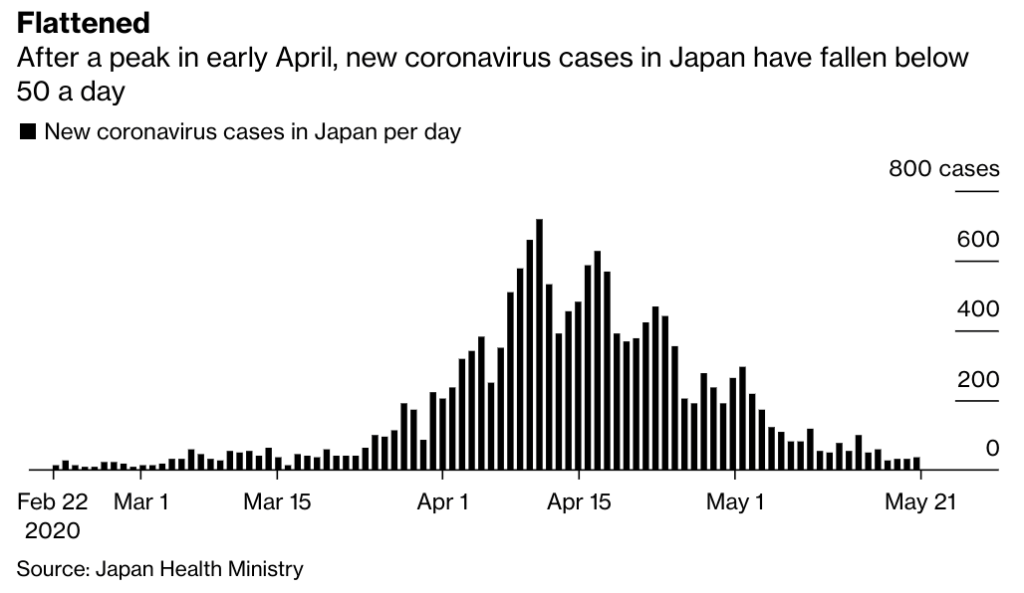
And then there’s Japan. Japan is ready to reopen, but nobody understands exactly how they did it. They didn’t have mass lockdowns. They didn’t have extensive testing. No silver bullet in reducing their Covid-19 caseload to the lowest of any G7 country.

Japanese Covid-19 cases by day.

If you’re fluent in Japanese, here’s 43 possible ways Japan beat Covid-19, including the suggestion that Japanese speakers expel fewer Covid-19-laden droplets than speakers of other languages expel.

Covid-19 will continue to surprise us. And to reveal who we are. Think about what you really know about Covid-19 before you get up in arms. Think about who you are.

Some things we know. We know that social distance and hand washing work. We are pretty sure masks work if over 80% of us wear them. We know hydroxychloroquine doesn’t work. We know a lot about the pathogenesis of Covid-19, how it attacks the body and the kind of damage it can do. We have a lot more to learn about how to treat Covid-19.

We also know that leadership is a key component to a successful Covid-19 response. Poor countries and provinces with good leadership have minimized Covid-19 mortality without expensive public health investments.

Because it’s Memorial Day weekend, before I sign off today I want to note that the USS Comfort left New York City’s Upper West Side. It’s a strange symbol to me of the US response to Covid-19. The ship treated 182 patients during its month stay in New York City. Military medical personnel are reportedly staying in New York to help with the city’s Covid-19 response. All the intentions were good, but it seemed like the Comfort delivered more promise than help.

Last, but not least, Brad found this a capella Covid-19 re-work of Imogene Heap’s Hide and Seek. It’s called Quarantine and it’s by Tim Blais.