23 May 2020 – Saturday – #69

Even though Catalonia disclosed to Spain’s central government 635 deaths it hadn’t properly classified as Covid-19 deaths, Spain has allowed both Barcelona and Madrid to advance to Phase 1 on Monday. There are cars honking their horns along Avinguda Diagonal as I write this. I believe the honking is a celebration of Phase 1, not a traffic jam.

Phase 1 allows movement inside a province where healthcare zones are at the same phase, opening of restaurants and hotels, operation of businesses under 400 square meters, and meetings of not more than 10 people. Restaurants and businesses have occupancy restrictions. And no buffets!

While Phase 1 brings free movement, exercise periods continue from 6a – 10a in the morning and 8p – 11p at night. Or maybe not. It does appear we have to avoid exercise when the elders exercise from 10a – noon and from 7p – 8p.

If you don’t like the rules, find another news site.
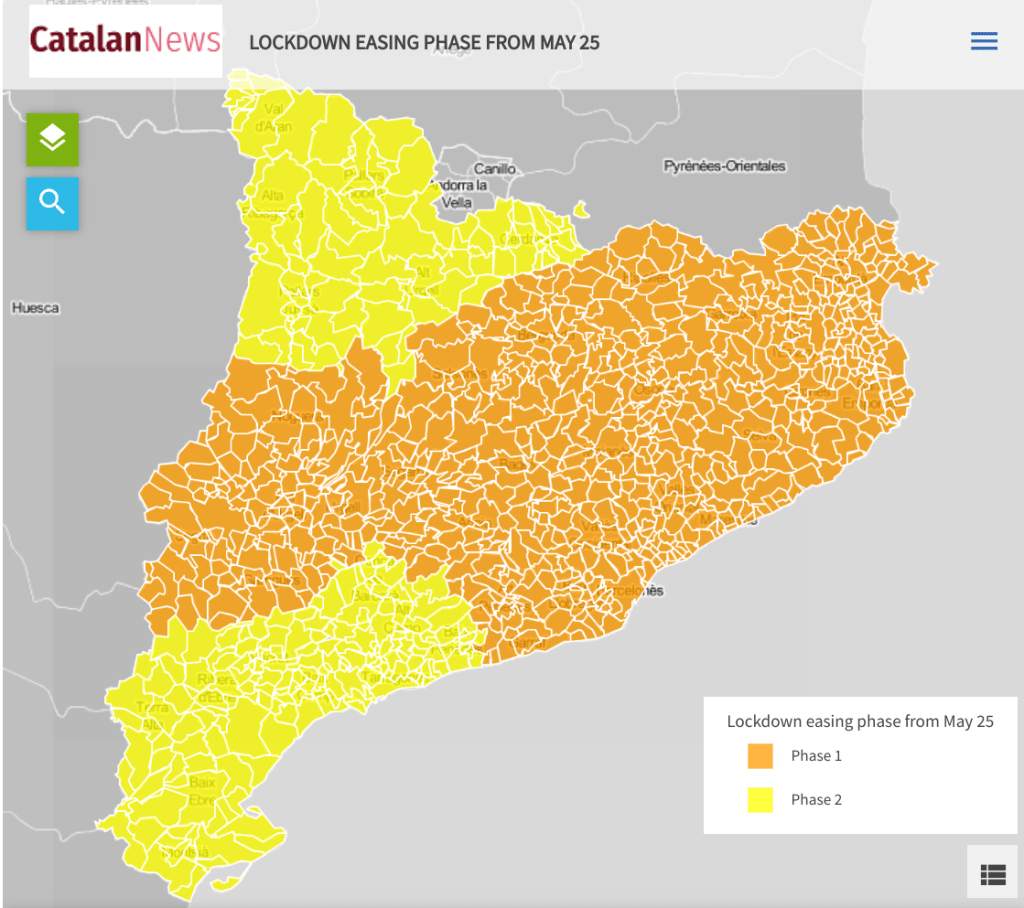
Covid-19 Phases by Catalan sanitary district beginning 25 May 2020.

I really am trying to get all this right. Checking through the Catalan News, though, it appears that even though Girona and Barcelona are both in the same Province and both in Phase 1, residents of Barcelona cannot leave the city. So much for my day trip to Girona. Also, Barcelona keeps changing rules for using its beaches. As long as you’re walking on the beach and not lying on the sand, you should be good.

But, really, who knows? I got a haircut, so now, as long as I can grow tomatoes on the terrace and invite fewer than ten friends over for a BBQ, I’ll be happy. If Brad can get back from San Francisco for a BBQ, even better. The thing is to avoid the €600 fine.

If Spanish policy seems unclear, imagine living in the schizophrenic US where Covid-19 deaths are expected to surpass 100,000 this Memorial Day weekend. On the one hand, some are celebrating Georgia’s apparent successful reopening. On the other, a new (non peer-reviewed) study says 24 states in the US have conditions ripe for Covid-19 outbreaks.

It is a snapshot of a transitional moment in the pandemic and captures the patchwork nature across the country of covid-19, the disease caused by the virus. Some states have had little viral spread or “crushed the curve” to a great degree and have some wiggle room to reopen their economies without generating a new epidemic-level surge in cases. Others are nowhere near containing the virus.

The Telegraph, “Study: Texas leads the country at coronavirus spread,” 22 May 2020.

US Covid-19 policy is driven by the need to re-elect Trump. The US is going to have a Covid-19 vaccine by election day whether it works or not. Also, the US will go back to church, whether it’s healthy or not—Trump is losing evangelical support and needs God’s help to win. Both these policies seem to me like recipes for disaster.

US Covid-19 policy is also driven by free market economics. That couldn’t be a recipe for disaster, could it?

Well, remember the miracle Moderna vaccine tests results announced last Monday? The results that were delivered all of six days ago without any backup data? Turns out Moderna’s management does actually knows what it’s doing, after all. They exercised options and cleared US$30 million to their benefit after their announcement.

It’s not that free markets don’t work, it’s that they work better for some people than others. Which makes the cynic in me wonder, can free market economics deliver a Covid-19 vaccine? Luckily, Brad found the Twitter thread on this very topic!

Twitter thread on the economics of Covid-19 vaccines.

While the large market potential for a Covid-19 vaccine is driving significant R&D investment, that R&D is mostly in business propositions less risky than a vaccine. This is where a smart government could step in to fund the risky R&D needed for vaccines through an organization like, say, I don’t know, maybe the World Health Organization.

However, besides deciding to withdraw the US funding commitment to WHO, Dr. Trump has decided that there won’t be a need for a second shutdown if Covid-19 reappears. That’s great because it will give the US an opportunity to repeat Sweden’s Covid-19 experiment.

So how’s that going?
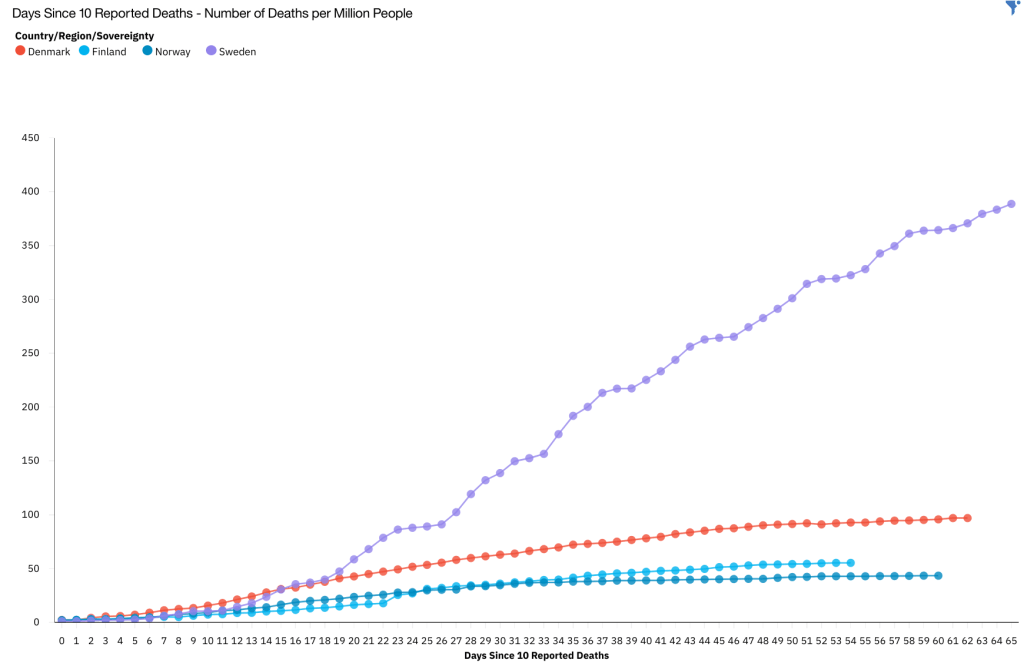
Swedish Covid-19 per capita mortality rate versus its Scandinavian neighbors.

It’s not just that Sweden’s Covid-19 mortality is much worse than neighboring Norway, Denmark, and Finland, it’s that Sweden’s economy isn’t performing any better than its neighbors, either. The whole point of Sweden’s “lockdown lite” policy was to keep its economy chugging along while it established herd immunity to Covid-19. But Sweden is nowhere near the 60% or infection rate needed for herd immunity. With a 7.3% infection rate, Stockholm has about the same herd immunity as Barcelona.

The one thing that is working during Covid-19 is dis- and misinformation. In fact, it seems the only thing both liberals and conservatives agree on, actually, is that there is a lot of Covid-19 misinformation. The problem is that what conservatives see as liberal misinformation is what liberals see as truth, and vice versa.

I’m seeing this in my social feeds. People establish their conservative cred with anti-Fauci, anti-Gates, pro-Sweden posts. People establish their liberal cred with anti-Trump, pro-lockdown, pro-science posts. I’ll take the news above about Georgia’s apparent success at reopening as an example.

Georgia’s successful reopening should be good news, but it’s loaded politically because Georgia’s Republican governor has pushed Trump’s agenda. People who presumably are liberal dismissed the post because the state’s reporting has been less than stellar, even though Yahoo claims to have confirmed the numbers. On the other hand, the poster was applauding the result without looking at the larger context: does it matter if one state succeeds while others appear to be failing.

One issue that didn’t come up in the discussion was how people in Georgia changed their behavior after the state reopened. No one mentioned that maybe Governor Kemp ordered the state to reopen and most of its citizens continued to shelter-in-place. I’m not saying that happened. I am pointing out that people responding to the post got locked into a point of view without thinking through all the possibilities. Clever sound bites and memes are easier.

It’s one reason I’m writing long-form about Covid-19. It helps me think through issues. I hope it’s helping you, too. Pass it on!

22 May 2020 – Friday – #68

Barcelona is moving to Phase 1 next week. Well, hold on, it’s complicated.

I sometimes think that since Covid-19 curtailed the football season here, the government has stepped in to provide alternative sporting entertainment. Rooting for regions of Spain to advance through the four phases of Covid-19 relaxation has replaced rooting for football teams to advance in their leagues.

Right now Barcelona is in Phase 0.5 which allows small businesses and social services to reopen. The Catalan government has made a request to the central government that Barcelona move to Phase 1. I’ll know later today what the central government decides. It’s like waiting for the referee to make a call.

If Barcelona moves to Phase 1, I can travel as I please throughout my sanitary region, but not throughout all of Catalonia. For instance, I want to take a day trip to Girona, which is 1-1/2 hours by train, but Girona is in a sanitary region that’s requested to advance to Phase 2 next week. Going to Girona would be the equivalent of committing an off-sides foul in football, traveling where you’re not supposed to travel. To remain on-sides in this Spanish Covid-19 game, I’ll have to set my travel sights on closer sites.

Along with Girona, most of the rest of Spain will advance to Phase 2 next week. Valencia, however, has requested to remain in Phase 1 due to increased Covid-19 cases. It’s as though Valencia’s team as too many injuries and has requested a bye.

Like Barcelona, both Madrid and Castilla y León have requested to advance to Phase 1. We three regions are the Covid-19 league laggards. Unlike Barcelona and Castilla y León, however, this is Madrid’s third attempt to advance to Phase 1. Madrid is the football coach who never stops threatening the referees. Its center-right government is suing in court to overturn previous central government decisions to keep Madrid in Phase 0.

Anyway, football analogies aside, after a haircut, Phase 0.5 living seems pretty good. Email from my mother, who’s locked down in her retirement home, makes me appreciate just how good. Mom’s extravagances are the homemade cookies friends and family mail to her, and groceries my sister delivers. I, on the other hand, go out evenings for exercise, sneak a friend over for dinner on the terrace, and buy things from local merchants.

Grocery shopping has been allowed during the whole lockdown, but there’s a limit on what you can buy at grocery stores and Mercats. Yesterday I surreptitiously walked to a bookstore to pick up a book I ordered. Today I’m ordering tomato and basil plants delivered from the local nursery. It’s Christmas in May!


I couldn’t think of a clever transition to Africa, so I used a dividing line, which seems like about as good a metaphor as any. One reason to move to Barcelona was quick access to Africa and the Middle East. Among other places, I wanted to travel to Algeria to fact check sections of Dear Mustafa, the novel I finished writing last month. Now it seems unlikely I’ll get to Algeria before the book gets published. If I look from the terrace towards the Mediterranean Sea, Algeria is just over the horizon. I”ll have to make due with that.

Which got me to wondering what’s going on with Covid-19 in Africa. It turns out some remarkably good things.

One smart innovation is “pool” Covid-19 testing used as part of Ghana’s extensive test, track, and quarantine system. Since tests are scarce, a single test is used for blood from a group of people. If the result is positive, the individuals then are tested individually. I haven’t done the math, but that should lead to better test kit utilization per capita if the proportions are calculated correctly. Of course, a false-negative has more significance in this testing methodology.

Senegal is working on super low cost Covid-19 antibody saliva tests.

Senegal is developing a Covid-19 testing kit that would cost $1 per patient, which it is hoped will, in less than 10 minutes, detect both current or previous infection via antigens in saliva, or antibodies. It’s hard to know exactly how this compares with the price of Britain’s tests, but many of them use polymerase chain reaction, or PCR, to detect the virus, and cost hundreds of dollars.

Afua Hirsch, “Why are Africa’s coronavirus successes being overlooked?,” The Guardian, 21 May 2020

Senegal, a nation of 16 million, has 32 Covid-19 deaths so far. Ghana, a nation of 30 million, has one fewer death than Senegal.

These are remarkably good numbers, similar to the kind of results I noted last week in the Indian state of Kerala. They are evidence that effective Covid-19 response has very little do with a community’s resources and everything to do with its leadership and gumption.

Africa has its own version of the Trumpian hydroxychloroquine saga, the herbal medicine artemisinin.

One of the most high-profile advocates for using the herbal remedy against the novel coronavirus is Madagascar’s President Andry Rajoelina, who has been touting Covid-Organics, a tonic containing A. annua that was developed by the Malagasy Institute of Applied Research. This week, he claimed that more than 20 other African countries had ordered supplies of the elixir.

C&EN, “Artemisinin raises hopes and fears amid COVID-19,” 15 May 2020.

Like hydroxychloroquine, there are American and European researchers looking at artemisinin as a Covid-19 treatment, or as a source of a treatment. Like hydroxychloroquine, there are no studies that show artemisinin benefits Covid-19 patients.

Then there is the cultural issue.

“If it was a European country that had actually discovered this remedy, would there be so much doubt? I don’t think so.”

Madagascar President Andry Rajoelina, on French television

President Rajoelina has a fair point, but that doesn’t mean artemisinin works.

No continent is perfect, I guess.

I’ll end today with a caution. If you’re reading about Covid-19 in your social feed, it’s a coin toss whether you’re reading a person or a bot. These bots are making people stupid on every continent.

Such bogus ideas on the Internet have caused real-world harm. In England, dozens of wireless towers have been set on fire in acts officials believe have been fueled by false conspiracy theories linking the rollout of 5G technology to the coronavirus.

NPR, “Researchers: Nearly Half Of Accounts Tweeting About Coronavirus Are Likely Bots,” 20 May 2020.

Don’t be stupid. Don’t pay attention to the bots. Pay attention to your friends in India and Africa who are figuring out how to stop Covid-19.


AFTERNOON UPDATE

Spanish Covid-19 Phase Map, 22 May 2020 for the following week. Barcelona advances to Phase 1.

21 May 2020 – Thursday – #67

Today is the first day of mandatory masks in Spain. Six months into the Covid-19 pandemic and a solid two months into Spain’s lockdown, I’m finding my point of view on masks has evolved.

Except for N95 masks, a mask doesn’t provide much protection from Covid-19 in the air. I tested this by wearing a paper mask and walking behind someone smoking a cigarette. Since cigarette smoke particles are similar in size to droplets carrying Covid-19, when I smelled the cigarette smoke, I knew my mask wouldn’t screen Covid-19 droplets.

However, as long as masks are mandatory and more than 80% of people wear them, the science looks good for reducing Covid-19 transmission with masks. This public health method uses masks differently from their intended protective purpose.

Allow me to explain. In one experiment, NIH researchers measured the spray of droplets when one of the researcher said “stay healthy” with and without a mask.

Laser light scattering off of droplets emanating from uncovered mouth during speech.

You can watch the video if you follow the link above. It’s clear as day (or night?) that a mask reduces droplet emission from speech. The experiment demonstrates why it’s vital for people who are contagious to wear a mask. Masks prevent the spread of Covid-19 droplets. The problem is we don’t always know who has Covid-19.

If everyone wears masks, though, we collectively reduce the Covid-19 droplets available to inhale. A collective effort to reduce Covid-19 presence in the air is the reason everyone needs to wear a mask, not protection from the virus.

I test drove my mask yesterday during my haircut (!!!) and again during my evening walk. I heated up just sitting in the air conditioned barber chair and again walking outside later in the evening, a little more than on previous walks. It’s going to be uncomfortable as the temperatures start hitting 25C more regularly.

I have to admit I’m a bit skeptical of the computer models of this new mask application. However, it’s a cheap experiment and, as long as at least 80% of my fellow travelers are willing to play along, I’m in. I just hope any benefit is clear by the time temperatures are regularly above 25C. I’ll need motivation. And more showers.

There are plenty of other things we’re learning six months into the Covid-19 pandemic. For instance, yesterday the CDC changed its mind about contaminated surfaces. It announced that surface spread of Covid-19 is possible, but unlikely. I don’t want to be the first one to tell you that all those hours you spent wiping down packages with bleach were a waste of time, but, well, from now on, just wash your hands, please.

Speaking of the CDC, here’s a post from a former CDC staffer about how bad things are at the CDC. Many Americans, including me, are disappointed that the CDC didn’t deliver a timely Covid-19 test. Perhaps Americans should be disappointed about decades of CDC budget cuts instead.

Oh, and about the Trump administration’s inability to execute on standard operating procedures during the Covid-19 crisis.

CDC awareness of the threat of spread from China prompted it to activate its emergency operations center on January 20th. That is when a national-level incident-command system should have been activated in Washington. One early task of such an ICS would have been to reach out in January, not March, to industrial collaborators to prepare for the predicted massive need of tests. In 2014, a prompt, government-wide effort coordinated the Ebola response that successfully kept that epidemic in Africa.

Bruce G. Weniger, MD, MPH and Chin-Yih Ou, PhD, “Straight Talk from ex-CDC for the Long Slog Ahead,” 3 May 2020

This insightful essay examines the influence of politics on a scientific organization struggling to deliver good public health. It explains that we should expect the Covid-19 pandemic to extend well into 2021 and that we should not expect a vaccine for at least 18 months. This is the kind of public health information we can hear from former CDC staff, but not current staff.

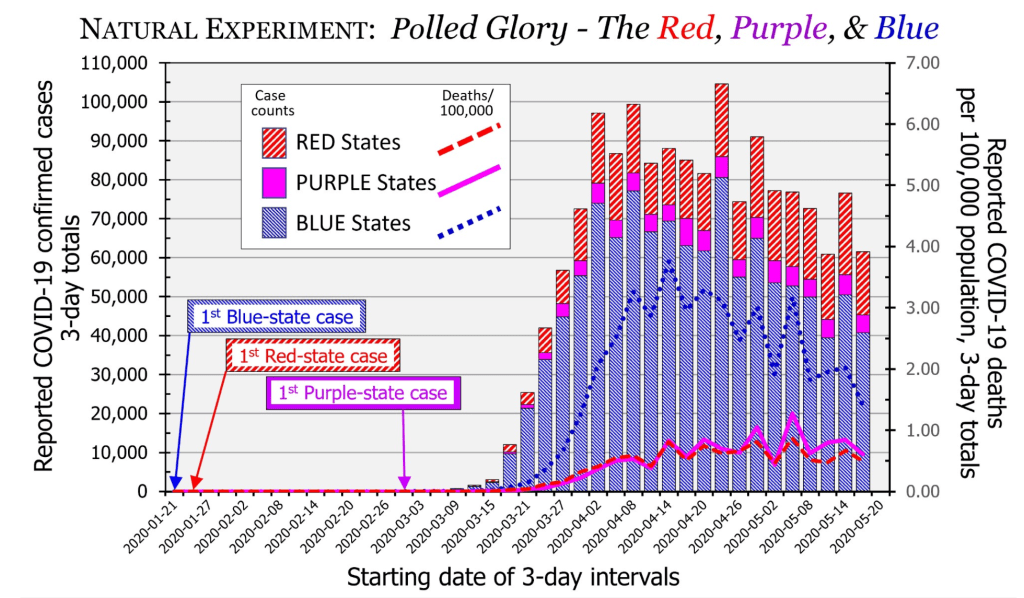
Because Trump cannot manage anything as long as an intelligence briefing, let alone a full scale public health response to Covid-19, the essay contends that the US has left behind the world where the scientists guide public health policy to a world described as a “natural experiment.”

Confirmed Covid-19 cases and per-capita deaths by Red, Blue, and Purple states. See article for details.

In the the world of the natural experiment, each state or consortium of states carries out its own Covid-19 experiment. The role of the scientist is simply to observe and report rather than to guide policy. The American dream comes to fruition.

So, it’s no surprise Covid-19 testing is screwed up in the US. The CDC can’t deliver and the administration doesn’t want bad numbers in front of an election. How important is it to the Trump administration not to test?

Rachel Maddow reports on JBS denying Covid-19 tests to workers.

I hate to report this. Meat producer JBS prevented low wage workers from getting Covid-19 tests after they were exposed to Covid-19 or had symptoms. That’s how screwed up testing is in the US.

Shame on JBS. Eight workers at the Colorado JBS plant have died from Covid-19. After 20 years on the job, the local public health director resigned to “spend more time with family and [focus] on his health.”

America is prioritizing business over safety because Trump needs to win re-election.

There’s so much more to talk about with the Covid-19 catastrophes in Brazil and Russia, the double whammy of Covid-19 and Cyclone Amphan in India and Bangladesh, and a Ramadan Covid-19 spike. But I’m going to end in Bolinas, California, a quaint coast city just north of San Francisco where my family sometimes took summer vacations.

Residents of Bolinas noted that Vò. a town in Italy cloistered from the world the way Bolinas is cloistered, tested all its residents for Covid-19. Bolinas decided to folllow in Vò’s footsteps. What it learned testing all its residents was as much about the how small communities work together as about the actual test results.

… U.C.S.F. researchers agreed to process the tests in Bolinas. They also undertook a parallel testing effort in San Francisco’s Mission District, which is the opposite sort of place: a highly populous urban residential and commercial center at the nexus of several transportation systems. (Historically, the Mission has also been fairly ethnically diverse, and home to much of San Francisco’s Hispanic population. Bolinas is almost ninety per cent white.) Their idea was that, by comparing these very different places, they could bookend a spectrum of conditions that further research could fill in. If we understood how the virus spread under different circumstances, with different factors in play, our modelling would gain nuance.

Nathan Heller, “The Town That Tested Itself,” The New Yorker, 20 May 2020.

The testing was good for scientists and for residents. It showed that a small city can organize itself to fight the pandemic and succeed. What we all need, whether we’re in Bolinas or Barcelona, is the information and guidance to succeed.

Even if you’re not in Bolinas or Barcelona, here’s a list Brad found for all the things your community needs to consider as it relaxes its Covid-19 restrictions. Like everything else with Covid-19, it will change next week and next month. For now, I’m going to put on my mask and buy a copy of Virginia Woolf’s Orlando.