20 May 2020 – Wednesday – #66

Yesterday afternoon I learned the phrase Me gustaría. I’ve spent too much time since then trying to understand how that phrase differs from Yo quisiera.

What’s the difference?

Brad had the best answer so far: “If a doctor recommends a colonoscopy because you might have cancer, you might say yo lo quisiera if you want to avoid cancer, or yo me lo gustaria if you enjoy having things shoved up your derriere.”

I don’t know if Brad’s answer is correct, but it’s the best so far in terms of amusement. Having been confined here in Barcelona for weeks and weeks, it obviously doesn’t take much to amuse me.

The other thing amusing me lately is space utility. Perhaps I am going batty from learning Spanish in confinement, but the whole mask debate has me fixated on Covid-19 transmission in enclosed spaces, the likely transmission culprit.

Much to my relief, one thing the space study above seems to indicate is that elevators and lobbies are not efficient places to spread Covid-19. It would be great to have more data on this, but the Twitter thread indicates that unventilated air-conditioned spaces are Covid-19 superspreaders. This is significant not only for how we avoid Covid-19 risk, but also for business models.

Commercial real estate rent is set by supply and demand, but the revenue a tenant can generate using a space constrains demand by capping the rent. For example, if a 100 square meter restaurant can generate, say, 50,000 euros per month from diners, it has to pay much less than 50,000 euros rent. In this example, the demand for 100 square meters of restaurant space drops as rents approach something like 5,000 euros.

Until Covid-19 came along, a restaurant could squeeze diners as close as comfortable to maximize revenue, increasing the rent cap of the restaurant real estate market. In a Covid-19 world, though, restaurants have to reduce diner density not only for safety, but also for marketing—who’s going to dine at a packed restaurant no matter what the price? Restaurants may be able to raise prices to capture some of their lost revenue, but not double or triple if they reduce their seating by half or two-thirds.

As I noted a few days ago, restaurants are figuring out new business models that leverage their supply chains, kitchen, marketing, and staff to generate additional revenue. Like restaurateurs, all businesses that use space—which is pretty much all businesses—will have to re-think the way they use space.

Airlines have a clear problem with passengers sitting in an enclosed air-conditioned metal tube for up to a half day. Like restaurants, airlines used to squeeze passengers together to maximize revenue yields per flight. There are the obvious Covid-19 adjustments with middle economy seats blocked off, boarding the rear of the plane first, and PPE for crew and passengers.

Further changes probably will be needed. On planes, designers are imagining new seat configurations and cabin safety measures.

Airline seat designs for Covid-19 protection.

Before passengers even board the flight, they may have to go through health screening and decontamination. All that, of course, takes more space at airports where passengers already need more space for social distancing. How do airlines create more space in airports?

Here’s one idea. If airlines moved baggage handling offsite by, for instance, outsourcing the baggage process to companies like FedEx or Mybaggage, they could free up huge swaths of airport baggage handling space to provide space for new needs like health screening. Shipping baggage rather than taking it along for the ride is a huge shift in passenger behavior, but passengers learned to change the way they fly after 9/11. The airlines have another benefit—passengers can’t blame them for lost luggage.

Retail is a large consumer of enclosed air-conditioned space. Stores now need to provide distance between shoppers and staff to protect against the spread of Covid-19, which probably reduces their revenue. In Barcelona, I’m seeing signs like this to help manage customer load.
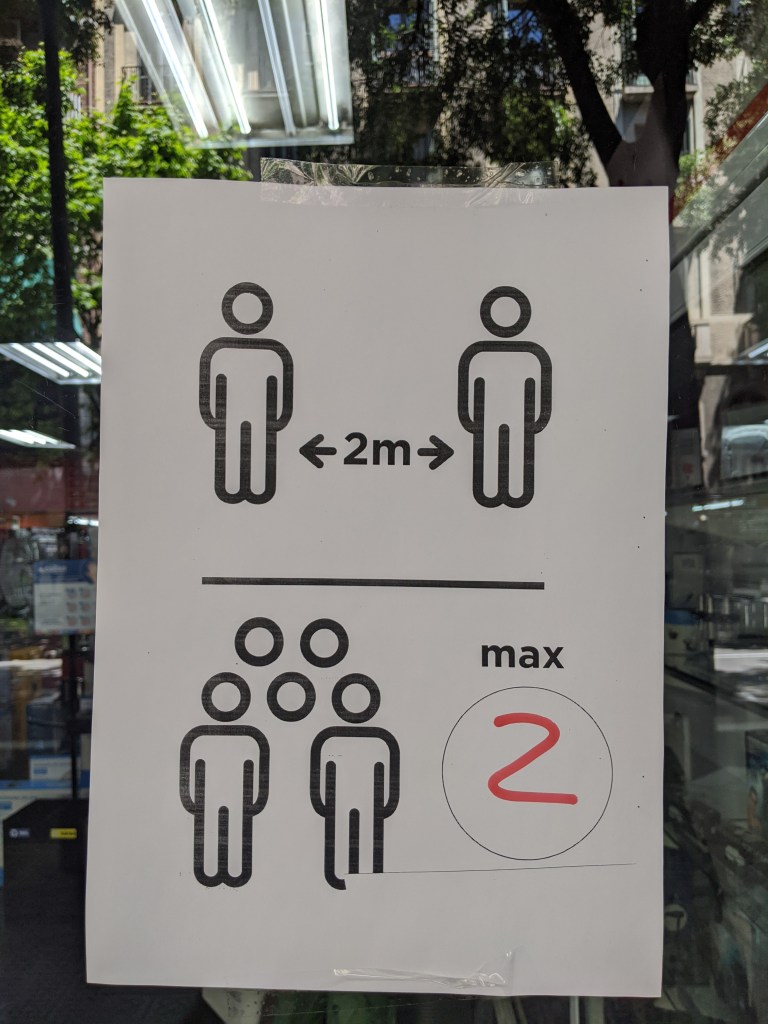
Hardware store sign limiting customer.

Retailers can’t limit customers and maintain their revenue. They might want to take a cue from the residential real estate market.

My friend Felipe just marketed a house in the Los Angeles area using video tours. He sold it in a month at US$30k over asking price in the middle of California’s Covid-19 restrictions. The residential real estate market has slowed, but sales are possible. I’ve heard agents say their jobs are better now because buyers only tour the final two or three candidates instead of seeing dozens of places in person. In other words, remote video reduces their effort to sell a house.

Virtual residential real estate tour.

Virtual tours and video demonstrations like those used in residential real estate can give retailers a way to interact with clients before they arrive at the store. There’s nothing like trying on a pair of pants or touching a bowl in person, but a good retail clerk can have all that ready when a customer arrives at the store at a scheduled time.

I’m going online this afternoon to buy a book and shop for some plants from two local retailers. I’ll pick up the book and have the plants delivered. It’s not as nice as going to the stores where I can talk to the proprietors, but it helps them stay in business.

Once businesses dream up innovations for the Covid-19 world, how much should they invest in changing their business models. That depends, of course, on how long Covid-19 is around.

The quick answer is Covid-19 will be around two to five years. To answer that question more fully, I’m going to update a couple things I wrote about yesterday and report a new story.

Yesterday’s big story was Moderna’s Phase 1 Covid-19 vaccine results. My friend Shane was ready to celebrate the end of Covid-19 when we chatted about it. Unfortunately, Moderna still hasn’t released its testing data. There may be legitimate reasons for that, but it also may be that the company needed to pump up its stock price to raise capital. Who knows?

The Oxford Covid-19 vaccine also has been getting a lot of hype, but there is good criticism of its animal studies. Along with the undocumented Moderna results, it seems to me that organizations are taking advantage of the demand for Covid-19 treatment to hype themselves. Call me a cynic, but until there are test data, there is not a Covid-19 vaccine to bank on. If I were planning for my company, I’d say the best case is there is a Cvoid-19 vaccine early next year that scales to worldwide application in two years.

The other follow-up is Trump’s weird disclosure that he’s been taking hydroxychloroquine for two weeks as a Covid-19 prophylactic. No one knows whether he’s taking hydroxychloroquine, but everyone knows he’s signalling to his cult that he knows better than the scientist what works for Covid-19. If I were a planning for my company, I’d say that slows down a scientific response to Covid-19 by a year.

The new piece of information I’d look at if I were planning for my company is this DoD Covid-19 planning report.

“We have a long path ahead, with the real possibility of a resurgence of COVID-19. Therefore, we must now re-focus our attention on resuming critical missions, increasing levelts of activity, and makgin necessary preparations should a significant resurgence of COVID-19 occur later this year.

Task & Purpose, “Leaked Pentagon memo warns of ‘real possibility’ of COVID-19 resurgence, vaccine not coming until summer 2021,” 19 May 2020

This report is 1-1/2 months old, so I might discount it a little for planning purposes, but I would be looking at what Covid-19 investments get my company through at least the next two years.
19 May 2020 – Tuesday – #65

Wall Street is dying for good Covid-19 news. Yesterday, Moderna’s Covid-19 vaccine trial results pushed up the Dow Jones Industrial Average 912 points, or nearly 4%. Can we relax now?

Watching the hydroxychloroquine birthers, I worry that everyone could jump on the wrong Covid-19 bandwagon again. Trump’s strange revelation that he’s been taking hydroxychloroquine for two weeks (most of my social media feed either don’t believe him or want proof of his claim) adds fuel to the distracting fire. Check the comments in this Twitter thread about a hydroxychloroquine study.

The hydroxychloroquine birthers really want the stuff to work, regardless of the data. I don’t expect the data from Dr. Boulware’s study will show a different outcome from two previous studies: hydroxychloroquine has no benefit to Covid-19 patients and increases their cardiac risks.

Back to Moderna’s vaccine announcement. The study size was miniscule, eight people on the low dose vaccine and four on the high dose. MIT Technology Review provides a succinct summary of Moderna’s Phase 1 trial results.

The results are encouraging, but we can’t draw conclusions from a phase 1 trial, with data from only eight participants so far. Way more data is needed. The FDA has already given Moderna approval for a phase 2 trial (testing the drug’s biological effect on patients), and Moderna says it will add a 50-microgram arm to the phase 2 study.

MIT Technology Review, “Moderna’s latest vaccine results are promising—but it’s still too early,” 18 May 2020

In other words, at least Moderna’s vaccine didn’t fail in Phase 1.

Moderna created its vaccine using Covid-19 mRNA, which is a quick method to create a vaccine. Before you start your love affair with Moderna, though, remember that no mRNA vaccines have been approved before. I’m not saying the mRNA approach won’t work, but it’s unproven at this point. Wait for the data.

And remember, even if the data are good in Phase 2, it’s another 12-18 months to billions of doses.

Lots of places are lifting Covid-19 lockdown restrictions. It’s hard to know when to start and anticipate all the consequences of reopening. There are lots of details like how to screen airline passengers safely. In France, 70 schoolchildren have contracted Covid-19 since the country re-opened schools. Now what?

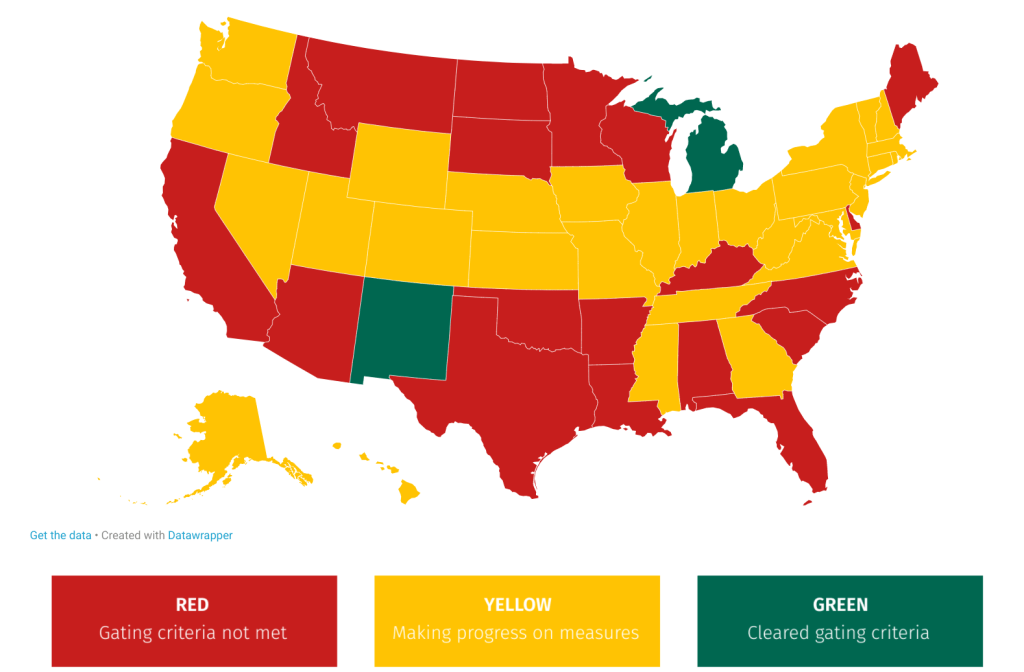
In the US, none of that is keeping states from reopening before they’re ready. According to Covid Exit Strategy, two states are ready.

States’ preparedness to re-open after Covid-19 restrictions, 18 May 2020

To be fair, Covid Act Now, which I posted in the Covid-19 beauty contest last week, paints a yellower picture of the Covid–19 preparedness situation. In either case, few states in the US meet the public health criteria for relaxing Covid-19 restrictions.

People can’t stay cooped forever, though. It’s a recipe for at least a mental health disaster, if not widespread unrest. Even Spain’s 1% has had it with Covid-19 restrictions in Madrid.

Harvard Medical School Professor Julia Marcus writes about how public health officials can help people identify high- and low-risk Covid-19 behavior as Covid-19 restrictions are relaxed.

A sustainable anti-coronavirus strategy would still advise against house parties. But it could also involve redesigning outdoor and indoor spaces to reduce crowding, increase ventilation, and promote physical distancing, thereby allowing people to live their lives while mitigating—but not eliminating—risk.

The Atlantic, “Quarantine Fatigue Is Real,” Julia Marcus, 11 May 2020

Marcus uses AIDS public health programs as a successful example of how to educate about virus risk. She points out that, as with HIV, shaming people’s risky behavior is less effective than educating them to reduce their risks.

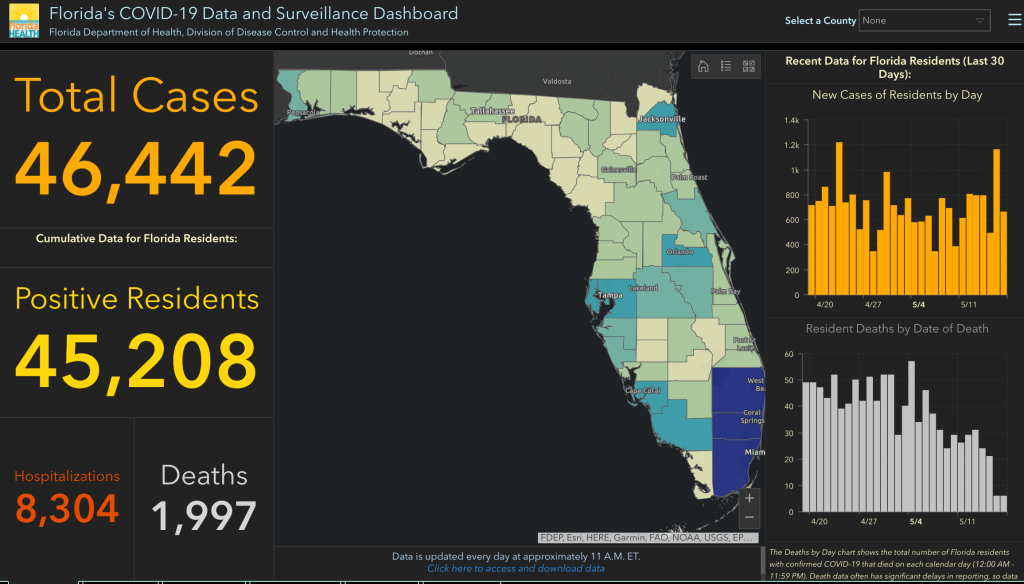
A little detour through Florida, where Governor DeSantis says the state is ready to reopen, but the data suggest otherwise. Well, suggested otherwise. The Governor is fixing the state’s Covid-19 data problem by replacing Rebekah Jones whose work was making Florida Covid-19 data just a little too transparent. In an email to colleagues, Jones warned about the accuracy of Covid-19 data the state is providing.

As a word of caution, I would not expect the new team to continue the same level of accessibility and transparency that I made central to the process during the first two months. After all, my commitment to both is largely [arguably entirely] the reason I am no longer managing it.

Rebekah Jones, PhD., in email to colleagues regarding accuracy of Florida Covid-19 data.

I’ll also note that unlike every other Covid-19 map I can remember, Florida paints its worst hit communities in cooler shades of blue rather than hotter shades of red.

Florida Covid-19 portal, 18 May 2020.

No telling whether the 1,997 reported deaths include non-residents who died while living in their Florida winter homes. Probably not.

Anyway, back to relaxing restrictions. Shane emailed some useful links about what’s going on as Europe unlocks. Italy will open its borders in a couple weeks and Germany will follow suite in about a month. Some restriction apply, so check before you book tickets.

Travel is at the crossroads of discretionary spending, safety, and profitability. Restarting the travel industry is tricky. Spain expects domestic tourism to restart at the end of next month. I assume other European countries are expecting domestic tourism this summer as well. In the US, my friends Neil and Tim were going to join me in Barcelona, but have decided instead to buy an RV and tour the US. I assume other Americans are doing the same.

The first international travel proposals involve travel “bubbles” or European transit corridors that link jurisdictions with similar levels of Covid-19 containment. Lots of hygiene issues to work out with trains and planes.

Skift provides 22 hopeful signs the travel industry is on its way back. That seemed impossible a month ago, but not so crazy now. Especially in light of my final topic today: masks.

Where did masks come from? A mask story from NPR’s Throughline answers that question and is worth a listen. Masks have been used from at least the time of the Black Plague, but the precursor to today’s medical and industrial masks was invented by Dr. Wu Lien-Teh after the pneumonic plague outbreak in Manchuria in 1910. He demonstrated that masks can stop airborne transmission of a bacterium at a time when germ theory wasn’t very well understood.

Plague doctor wearing a bird mask.

Years later, the American designer Sara Little Turnbull took mask technology an important step forward. She applied new forms of non-woven fabric technology to improve mask design for the 3M company. Her innovations were the basis for the N95 masks used in hospitals today.

“If you don’t stretch, you don’t know where the edge is.”

Sara Little Turnbull, inventor of the modern industrial masks

As Spain and the rest of the world don our masks, perhaps we owe a debt of gratitude to Wu Lien-Teh and Sara Little Turnbull.

18 May 2020 – Monday – #64

We’re wearing masks in Spain! Actually, we’re waiting for the rules, but it’s inevitable.

I wrote a lot about masks nearly two weeks ago. Since then, Austria has noted a 90% drop in Covid-19 after instituting a mandatory mask program (standard correlation-is-not-causation disclaimer applies) and UC Berkeley research Dekai Wu has released a model showing that if 80% of a population wears masks, Covid-19 infections decline (standard models-are-not-reality disclaimer applies).

Dekai Wu explains how his mask model works.

You can play with the Covid-19 mask simulator here. As with most models, it’s a little more complicated when you make adjustments for transmission rates, mask performance, and other model parameters.

Wearing masks doesn’t matter if you don’t wear them correctly. The CDC provides a useful guide to making and wearing masks.

In the US, people are spreading this misinformation to avoid wearing masks.

HIPPA and ADA protect against wearing mask?

It is not true that HIPAA or the ADA allow people to avoid wearing masks.

Speaking of misinformation, Brad found this Twitter thread on the politicization of masks and how that’s affected public health policy and social media practices. It’s useful to think about because, as you may have noticed, we keep learning new things about Covid-19.

To me, the more interesting story from Spain is still last week’s test results that show only five percent of its population has Covid-19 exposure. Vox has a good write up on the implications of Spain’s Covid-19 test results.

The Spanish data suggests about 1.15 percent of those who got infected in Spain ended up dying. Spain has a significantly older age profile than the US, so Americans might be better off. But the fact remains that if the virus fully blows through our population, the US could end up with millions of deaths — there’s no secret pool of hidden infections to indicate the virus is much less deadly than assumed.

Vox, “The results of a Spanish study on Covid-19 immunity have a scary takeaway,” 16 May 2020

With an IFR of 1.15% and an estimated 60% exposure needed to achieve herd immunity, a country that wants to achieve Covid-19 herd immunity should expect about 0.7% of its population to die along the way, more if Covid-19 infections swamp healthcare systems, less if demographics skew younger than Spain.

In the US, for instance, that implies 2.3 million deaths to achieve herd immunity. If you are one of the Wall Street investors advocating that the US lifts its lockdowns to save the economy, maybe a better idea than lifting lockdowns to save the economy is figuring out how to change the US economy to save 2.3 million lives.

Everyone is looking at Sweden as a model for avoiding lockdowns. I still haven’t found economic statistics one way or the other on the Swedish experiment, but it doesn’t look like a great plan to me.

Swedish per-capita Covid-19 mortality versus its Scandinavian neighbors, 17 May 2020.

Swedish mortality is reaching 10x its neighbors Denmark, Finland, and Norway. Some people claim Sweden is still better than Italy and Spain, but that ignores Swedish demographics and geography. In Stockholm, Covid-19 has devastated nursing homes and immigrant neighborhoods.

Parenthetically, using Spain’s 1.15% IFR and 60% exposure for herd immunity, the number on the vertical axis of the chart above that indicates successful herd immunity is 7,000. In other words, Sweden, which is at about 350 deaths per million, should expect that about 20x more people have to die from Covid-19 to achieve herd immunity. I realize that is different from what Swedish officials are saying and the discrepancy implies that Sweden, for some reason, has a significantly lower IFR than Spain.

I don’t want to minimize the importance of the economy. Spain’s disadvantaged are queuing for supplies and services with just 5% of the population exposed to Covid-19. But I don’t think anyone is signing up to let another 250,000 Spaniards die because it might help the economy. I write might because people afraid of a virus don’t always go back to the way things were.

In the US, JBS, Tyson, and other operators kept processing livestock at their meatpacking plants. Those had to close down after turning into Covid-19 incubators that infected workers and their communities. Now Covid-19 is rearing its ugly head in other manufacturing facilities. This part of the get-back-to-work story might not get as much attention because these plants aren’t part of the food supply chain. Also, these stories are inconvenient to Trump’s reelection.

In fact, as mostly red states rush to end lockdowns, it’s clear that the Trump machine doesn’t want Americans to consider Covid-19 a public health problem. Covid-19 isn’t something to be afraid of.

It’s something the Chinese invented.

Or it’s a Democratic Party Hoax that will go away the day after the election.

Or it’s something that only African Americans get. Wait, what?

This interview with Secretary of Health and Human Services Alex Azar made my head spin. When Azar says, for instance, that things could have been much worse, he avoids the obvious comparison that things could have been much better. Sure the US mortality rate isn’t as bad as Panama or Brazil, but it’s a whole lot worse than Germany, South Korea, and Vietnam.

But the worst thing Azar says starts at about 6:30 into the interview.

Jake Tapper interviews HHS Secretary Alex Azar, 17 May 2020.

Azar blames America’s diverse population for its high mortality. If you need help with Azar’s code language, he’s saying that the US Covid-19 mortality rate is high because black people aren’t healthy.

As states open up, Azar wants everyone to believe they’re safe and the economy is on the way to recovery. Just don’t look behind the curtain. Please don’t notice that Texas saw its largest one day Covid-19 death toll. Please don’t care that Georgia’s Covid-19 reporting is a mess. And that hotspot in Palm Beach, Florida? Probably too much sun.

So now, let’s take a trip through the Department of New Things We’re Learning.

5% of Covid-19 patients get weird symptoms for a long time.

There is growing evidence that the virus causes a far greater array of symptoms than was previously understood. And that its effects can be agonisingly prolonged: in Garner’s case for more than seven weeks. The professor at the Liverpool School of Tropical Medicine says his experience of Covid-19 featured a new and disturbing symptom every day, akin to an “advent calendar”.

The Guardian, “‘Weird as hell’: the Covid-19 patients who have symptoms for months,” 15 May 2020

Hundreds of children have come down a strange auto-immune response to Covid-19.

Finally, in our tour of the Department of New Things We’re Learning, we all know that someone who’s asymptomatic with Covid-19 can transmit the disease, right?

Well, not so fast. Researchers who wrote the study used to prove there is asymptomatic Covid-19 transmission did not follow up with the person they assumed was asymptomatic. It turns out she had symptoms. That doesn’t mean that there isn’t asymptomatic transmission. It means we don’t know for sure one way or the other.

I don’t report Covid-19 deaths very often, but this death is notable because, well, when people argue that we should let old people die to save the economy, some of the old people they are talking about helped save the world. Ann Mitchell died at the age of 97 from Covid-19. During WWII, Mitchell worked at Bletchley Park where, “for nine hours a day, six days a week, from September 1943 until the final exultant hours of VE Day, the young Oxford graduate would create complex diagrams used to break strings of incomprehensible Enigma code used by the Nazis.” R.I.P. Ann Mitchell, and sorry we didn’t do enough to save you.

I’m signing off today with “How to medical” by Sarah Cooper. Dana turned me on to Sarah and her great interpretations. Enjoy!