11 May 2020 – Monday – #57

Brad and I are scheming to get him back to Barcelona, but it’s hard to plan travel, especially international travel, more especially when a visa is in play. To enter Spain from the US right now, you have to be a Spanish citizen or resident, which takes a visa. To obtain a visa, you need proof of a ticket to travel. You can buy a ticket for a theoretical flight to Barcelona, but it’s not clear what airline will fly the route soonest or whether any airline has the cash to refund a ticket. That’s Brad’s travel puzzle without the visa details, which complicate things more.

Our discussion got me to checking out travel news. According to this article, US airlines saw a “spike” in demand as states relaxed stay at home orders. Spike is an interesting term. After weeks of no demand, the sale of one ticket could qualify as a spike.

We may be changing our airline safety habits more than we did after 9/11. No one is sure what’s safe in the skies, but everyone seems to want masks during a flight. Ditto empty middle seats.

However, according to this article, medical professionals returning from helping in New York found themselves on a flight so full that all the middle seats were taken. So, the official policy is empty middle seats unless there is a enough demand to fill them with passengers, which is how I think it used to be, but who can remember that far back. This story made me wonder if there’s a demand asymmetry in New York travel. It could be that all flights leaving New York are full right now, and all flights to New York are empty.

Then there’s the whole issue of long haul international flights.

According to this article, US citizens shouldn’t expect to travel out of the country until the US gets its Covid-19 act together. According to this article, UK will let you enter as long as you self-quarantine for 14 days, which is what most countries with open borders do already. Not sure why it took the UK so long, except every country is figuring out travel on its own.

If you think getting to the airport 1-1/2 before an international flight was bad, try four hours.

Among the steps under consideration: no cabin bags, no lounges, no automatic upgrades, face masks, surgical gloves, self-check-in, self-bag-drop-off, immunity passports, on-the-spot blood tests and sanitation disinfection tunnels

Forbes, “Future Air Travel: Four-Hour Process, Self Check-In, Disinfection, Immunity Passes,” 10 May 2020

Arriving at the airport four hours ahead of a 6-12 hour international flight is bad enough, but two weeks of quarantine precludes most international business and holiday travel. As an incentive to get Brad to return to Barcelona, I did offer him a choice of water or gruel while he luxuriates in his sealed bedroom during his quarantine.

Because the US has a two week international travel quarantine, I’m not sure I would return even if I could catch a flight, but then I’m not sure if I’d return to the US anyway until it gets its Covid-19 act together.

In a nutshell, no one has any idea what’s going to happen with travel or when. Except, here’s a catalog of where airplanes are taking their vacations.
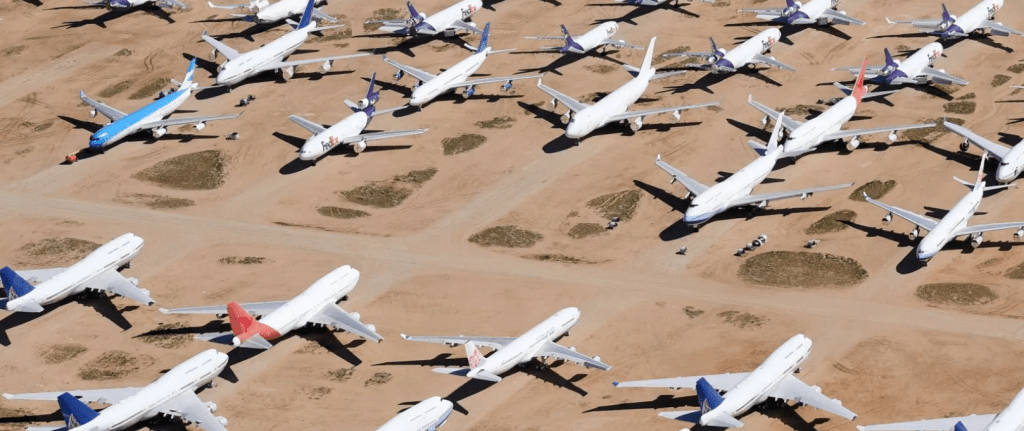
Aircraft storage for during Covid-19 pandemic.

And here are some satellite photos of cruise ships taking vacations when you can’t.

Satellite photo of cruise ships during Covid-19 pandemic.

Now I’d like to turn your attention to Covid-19 beauty contests. No, not a photo essay on mask design (although I will hasten to say that Paris, the capital of fashion, is embracing masks while continuing to ban burkas and that I am re-thinking my position on masks).

There are many Covid-19 beauty contests right now. Here are the winners of a Covid-19 beauty contest comparing countries’ Covid-19 responses.
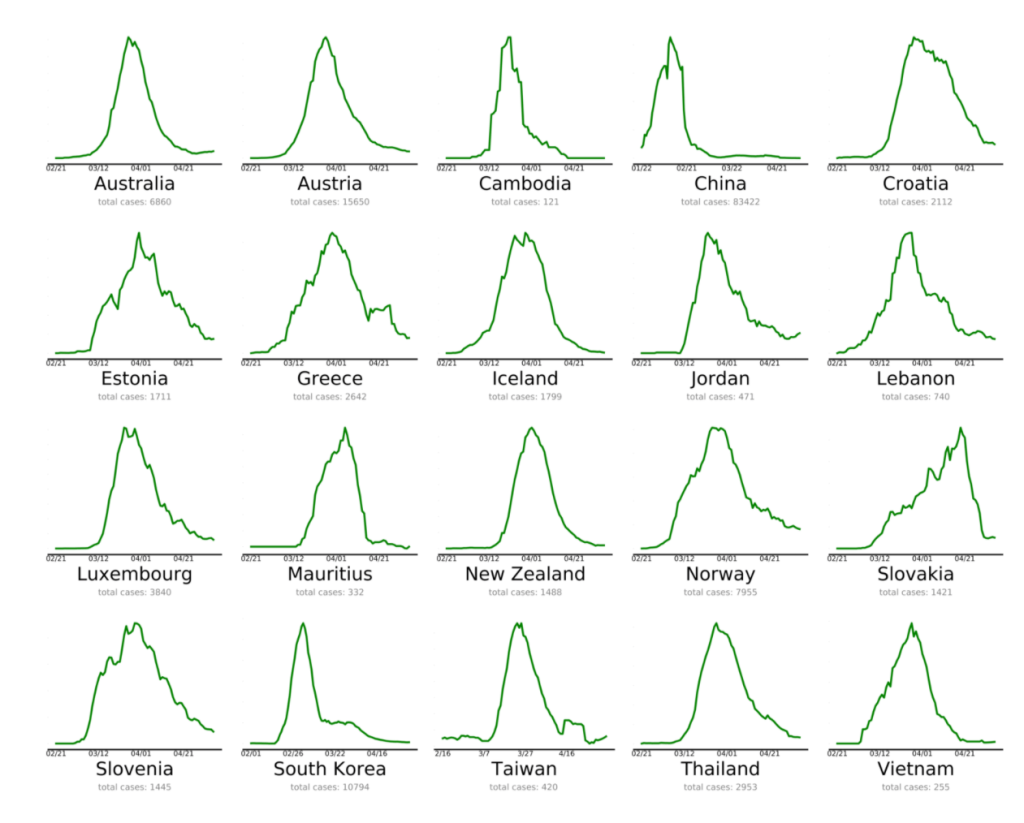
Countries beating Covid-19, 11 May 2020, EndCoronavirus

If your country isn’t in this group, please keep your social distance and wash your hands.

Here’s a Covid-19 beauty contest showing US states best prepared to relax Covid-19 restrictions.

Preparedness to relax Covid-19 restrictions by US state, 11 May 2020, Covid Act Now

In this contest green is a winner and red is a loser. The map colors are based on three factors that determine a state’s preparedness to relax its Covid-19 restrictions: 1) declines in Covid-19 cases and deaths, 2) Covid-19 testing capacity, and 3) hospital capacity.

There is third beauty contest that I saw but can’t find. Darn! It shows Covid-19 test-and-track preparedness by US state. If you’ve seen that one, please pass it along in a comment.

[UPDATE 12 May 2020: TestandTrace is the third beauty contest. Winners of this contest are ready to start testing at high enough volume to enable contact tracking and quarantine. This is the next phase of our Covid-19 lifes].
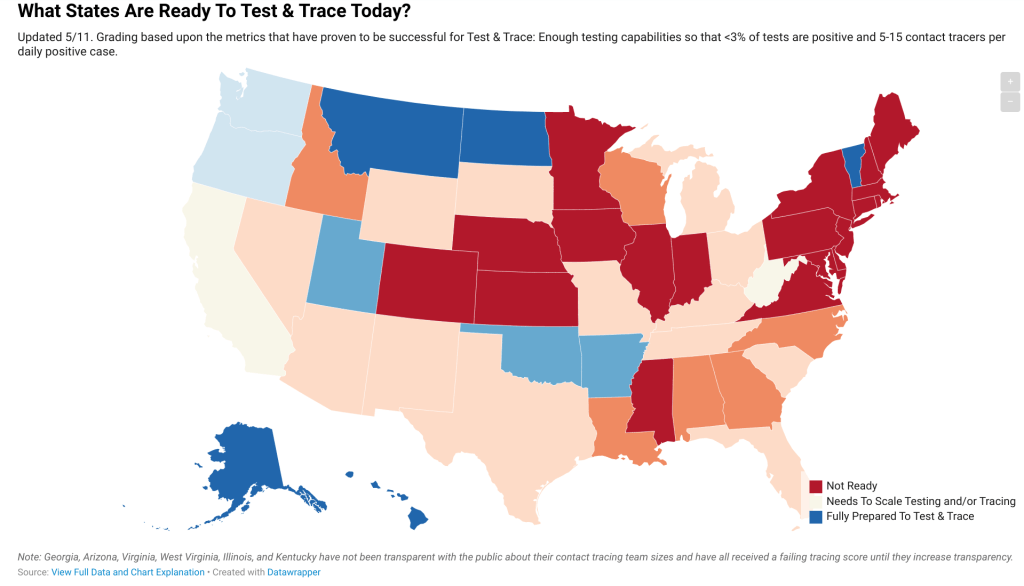
TestAndTrace shows states ready to implement Test, Track, and Quarantine. 11 May 2020.

I wanted to look at Covid-19 business innovations today, but that will wait until tomorrow because I’m out of time. We’re all in this Covid-19 mess together and lots of us are finding interesting ways forward.

Instead of business innovation, I’ll end with this!
10 May 2020 – Sunday – #56

Wow, I slept a lot last night. Like ten hours. It must be because I’m walking 10,000 steps again. I remember waking up to an intense rain storm, but that’s all. Then back to snoozeland. The weather in Barcelona reminds me of the weather in San Francisco because of the proximity to the sea. But the rain storms here are something else. Anyway, I usually start writing around 10a, but I didn’t get out of bed until 10:30a. So, hang on, here I go!

As I was emailing Janet this morning about masks, I remembered that when I started Covid Diary BCN, I posted about Covid-19 decontamination protocols. Back then, no one knew. It made sense to wipe down every new surface entering the house with bleach or blast it with UV because, well, it was the most comprehensive advice at the time. It made sense to shower and put on clean clothes after each outing. It made sense to microwave any to-go food. More is better. Better safe than sorry.

Narratives change with new information. Surfaces aren’t as dangerous as we thought. Long periods of time in enclosed spaces with others is more dangerous than we thought.

My Covid-10 decontamination these days is to quarantine every package or item coming into the house on the back patio or in a separate refrigerator for 1-2 days, and then wash my hands. It takes a minute or two. And if I want something right away, I don’t worry about it. Last week I didn’t microwave the pizza I brought home and I didn’t quarantine the box. My decontamination ritual evolved as the Covid-19 narratives change.

Today I want to look at some other narratives that are changing. One is the herd immunity narrative. The common narrative that I have repeated in Covid Diary BCN is that if 60% of the population has immunity, the population has reached the point where there won’t be additional crippling outbreaks of a disease like Covid-19.

The 60% number for herd immunity is like Pareto’s principle, or the 80-20 rule, that says, for instance, 20% of your customers buy 80% of your products. Pareto’s principle isn’t strictly 20% or 80%, but people know that you’re referring to a particular statistical distribution shape when you just say the words “80-20 rule.”

The same way it’s important to question whether it’s 20% of your customers buying 80% of your products or 5% buying 95%, it’s important dig a little deeper on the 60% herd immunity. Here there may be some good news about Covid-19 herd immunity.

Although estimates vary, it is currently believed that herd immunity to SARS-CoV-2 requires 60-70% of the population to be immune. Here we show that variation in susceptibility or exposure to infection can reduce these estimates.

M Gabriella M Gomes, et al., “Individual variation in susceptibility or exposure to SARS-CoV-2 lowers the herd immunity threshold,” 27 April 2020

Researchers suggest that since susceptibility to Covid-19 isn’t homogeneous across the population, that the 60% rule for herd immunity may apply to the susceptible subset of the population rather than the entire population. If the susceptible subset of the population is infected more early on, then it’s possible that the infection rate for overall herd immunity may be less than the commonly assumed 60%.

So, maybe our 60% herd immunity narrative will change soon. How about my narrative that Covid-19 is going to break supply chains?

I’ve asserted that the Covid-19 outbreaks at meatpacking plants are the canary in the coal mine for Covid-19 and the supply chain economy, that the way the food supply chain is breaking is a warning about how other supply chains will break. By the way, Covid-19 outbreaks at meatpacking plants are not unique to the US. Covid-19 outbreaks at meatpacking plants happen here in Spain, too. And elsewhere.

It turns out that meatpacking plants have attributes that are conducive to Covid-19 transmission.

Thanks to the magic of Youtube, we can take a look at what goes on inside a (very recently cleaned) meatpacking plant.

Inside a meatpacking plant. OMG, who selected the sound track?

So, let’s see. Enclosed space, lots of ways aerosols could be flying around with saws spewing particles and machines launching animal parts. A low wage, often immigrant labor force with incentives to show up even when they are sick and with minimal access to health care. An industry with a history of outbreaks of other airborne diseases. A White House directive to keep the plants open at any cost. What could go wrong when Covid-19 makes an appearance?

Parenthetically, Shane asked the other day whether I thought meat itself was a medium for Covid-19 transmission. I don’t think it is. The sum total of my evidence is that butchers at meat counters and hamburger flippers at MacDonald’s are not falling over dead at work.

Maybe my canary in the coal mine narrative about meatpacking plants and supply chains is wrong. Maybe other supply chains are less prone to Covid-19 outbreaks. Certainly robotics and Machine Learning are reducing human participation in certain parts of supply chains. For instance, seaports.

Robotics and Machine Learning at Ports of Auckland.

But people are still involved in most supply chain activity even when it’s highly automated. I think the approach with Covid-19 should be development of checklists to help supply chain operators identify and remediate Covid-19 risks. Then, perhaps the meatpacking supply chain can be instructive to other supply chains rather than the first in a series of broken supply chains.

That kind of regulation, however, takes international coordination, something in short supply these days. Which brings me to the final prevailing narrative I want to challenge today. That the government is here to help.

The starkest contrast in government response is Germany, whose chancellor has PhD in quantum chemistry, and the United States, whose president is a failed businessman turned reality TV star. Americans keep thinking the US government is going to help. But why are they clinging to this narrative?

Germany is solving its Covid-19 epidemic with measurements and analysis. The US is solving its Covid-19 with capitalism. Actually, capitalism with a dash of zero-sum reality TV adrenalin.

Trump is the capitalist warrior ready to go back to work at any cost. He is ignoring the country’s mounting Covid-19 death toll (79,696 at this writing) and brushing aside the Covid-19 infections in White House staff and Secret Service. Not enough Covid-19 tests to monitor infection rates? Don’t worry. Profits will solve Covid-19 and put meat on the table!

By the way, those anti-lockdown protests Trump eggs on? It looks like as many as 72 people were infected with Covid-19 at the controversial Wisconsin protest. But profits will solve that, too.

Not that it’s a cakewalk in Germany. Germany relaxed its lockdown about two weeks ago. It’s not a surprise the infections have gone up, but it appears that R = 1.1. That’s the bad news. The good news is that Germany, unlike the US, is testing enough to know its infection rate R > 1. As Chancellor Merkel explained, if R = 1.1 in Germany, the country runs out of hospital resources in October. Germany has some wiggle room to adjust its Covid-19 policies.

If there’s a country to beat for Covid-19 reponse, it’s South Korea. This Twitter thread from an American in Seoul is instructive for understanding the steps South Korea has taken to stop the spread of Covid-19.

Until there’s a treatment, cure, or vaccine, the next step for the world looks like test, track, and quarantine. That’s an easy narrative, but everyone has to be on the same page.

9 May 2020 – Saturday – #55

I was in a bit of a funk last night. I got a taste of socialization during my walks this week and now I’m realizing how much I’m over FaceTime and how much I crave face-to-face time. It’s strange figuring out appropriate physical behavior, though. And complicated. It’s not just my feelings here. I have to think about other people. Geez. I’m a little out of practice on that.

For instance, masks. I’ve had an instructive Facebook debate with Janet about masks. She is in a precarious situation health-wise and understandably advocates for everyone to wear a mask. As I wrote here earlier in the week, I’m in sync with WHO’s mask recommendations rather than CDC’s.

It occurred to me that Janet and I may see masks differently not because of science, but because of politics. The US federal government’s Covid-19 response is so poor, masks have become yet another thing to politicize there. In the US, masks are now de rigueur, giving people a sense that there is something they can do despite the whooshing sound of the leadership vacuum. I saw a friend up in arms because Senator Feinstein addressed the Senate without a mask, as though she’s a serial killer. Mask polarization is a little crazy right now in the US.

In Barcelona, my informal survey of mask use last night counted about 1/3 of people wearing masks outside while exercising. European countries have turned the corner without mandatory mask use. It’s not a political issue here. It’s really not that much of an issue at all.

For the record, here is one of the most useful articles I’ve found about Covid-19 transmission. It spells out transmission in terms of proximity, duration, and mode (breathing, speaking, coughing, sneezing, flushing, etc.). What’s important to note is that social distancing doesn’t work in closed environments over a long period of time. That means hospitals, restaurants, offices, theaters, churches—basically wherever people congregate for hours. It’s not clear that paper masks work in these environments, either.

Anyway, the lesson from the friendly debate with Janet about masks is that social time will be a negotiation, not so different from the negotiations about sex I had during the AIDS crisis, but possibly more political and presumably more frequent. Contrary to the rumors my P.R. firm has been spreading, I’m not sex addict promiscuous.

Speaking of negotiations, Vlad is sending telegrams to Don and Boris. Not Valentine’s Day telegrams, but Victory Day telegrams. Today is the 75th anniversary of the unconditional surrender of the Nazis, but traditional Russian celebrations have petered out due to, you guessed it, Covid-19.

Putin’s overture was the latest in a series of contacts with Washington with which Moscow is keen to rebuild relations frayed over everything from election hacking allegations to Syria. Ties with London remain badly strained over the poisoning of a former Russian spy and his daughter in England.

The World, “Fiona Hill: Putin has become ‘wild card’ for Russia’s political system,” 8 May 2020

My friend Gail alerted me last month to Covid-19 tips she was hearing from Russian colleagues. The Russians reported to Gail surprisingly high incidents of “pneumonia” at the same time the Kremlin was in full Covid-19 denial mode. Everyone knew what “pneumonia” meant, but the Kremlin stuck to its line that strict border policies were working.

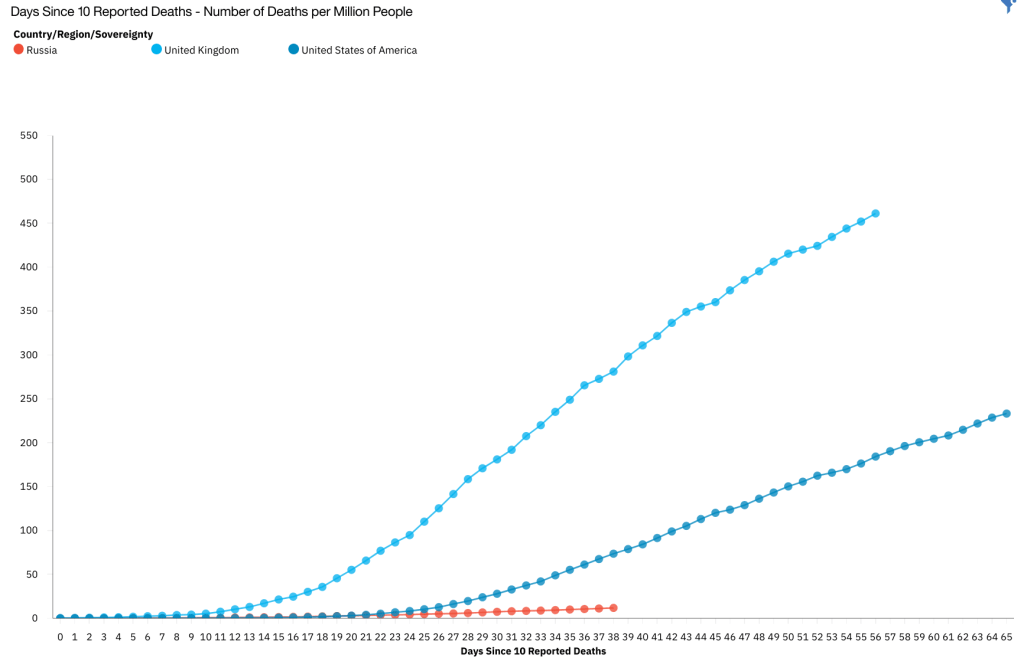
Well, of course, the Kremlin finally acknowledged the reality. Partly. If you look at its per capita Covid-19 mortality rate versus the US and the UK, Russia has had a Covid-19 miracle.

Covid-19 per capita mortality, Russia versus US and UK, 8 May 2020.

With a Covid-19 response this good, I’m pretty sure Putin continues to classify many Covid-19 cases as “pneumonia.” Russia has run into pretty much all the same obstacles in its Covid-19 response as the UK and the US, so it’s hard to find another explanation for its flawless statistics. I can say this, but if you’re a Russian doctor who says this, you should learn to keep your mouth shut or stay away from windows.

Parenthetically, it seems Florida Governor De Santis has embraced fully Putin’s reporting sleight-of-hand. Unfortunately, I suspect Trump will attempt the same.

Anyway, Covid-19 is very inconvenient for Vlad, coming as it has on the heels of his oil war with Saudi Arabia.

Russia’s economy is currently suffering from two simultaneous, partly interdependent crises. Since 2014, Russia has been prepared for one of them: an oil market shock for which it is partly to blame. However, Russia is only partially prepared for the simultaneous spread of the Covid-19 pandemic. Overcoming this crisis is becoming a systemic issue. More cooperation at the international level is desirable in the short term.

Gunter Deuber, “Two Economic Crises at the Same Time—Too Much Even for Russia,” Russian Analytical Digest No. 251, 20 April 2020

So, it’s becoming clear why Vlad sent VD telegrams to his pals Don and Boris. Given Russia’s interference in the 2016 US elections and in the UK Brexit campaign, everyone should be suspicious of Putin. He may have dirt on Don and Boris that gives Russia the upper hand as countries work out their Covid-19 economic problems.

Finally today, Anne asked if I’d take the ten hour drive down to Marbella to check out this Freddie Mercury character. Right now, I’d take a ten hour drive almost anywhere. But, yeah, let’s all take a drive to Marbella!