8 May 2020 – Friday – #54

Most of Spain starts Phase 1 of the relaxation of its Covid-19 restrictions on Monday. Catalonia decided to hold off, so we probably start Phase 1 in ten days. That’s a little frustrating. After 60 days, though, I’d rather get this right than have to go back to lockdown. Until Spain has adequate resources to test, track, and quarantine, a return to lockdown may be the best option if the Covid-19 infection rate R pops up above one again.

It’s much better now that we can go outside for exercise. I can meet people for a walk, so there’s socialization in my life again. My friend Ruben, who lives about 15km up the coast, was wondering what Barcelona looks like during our evening communal exercise time, so I took a snap.
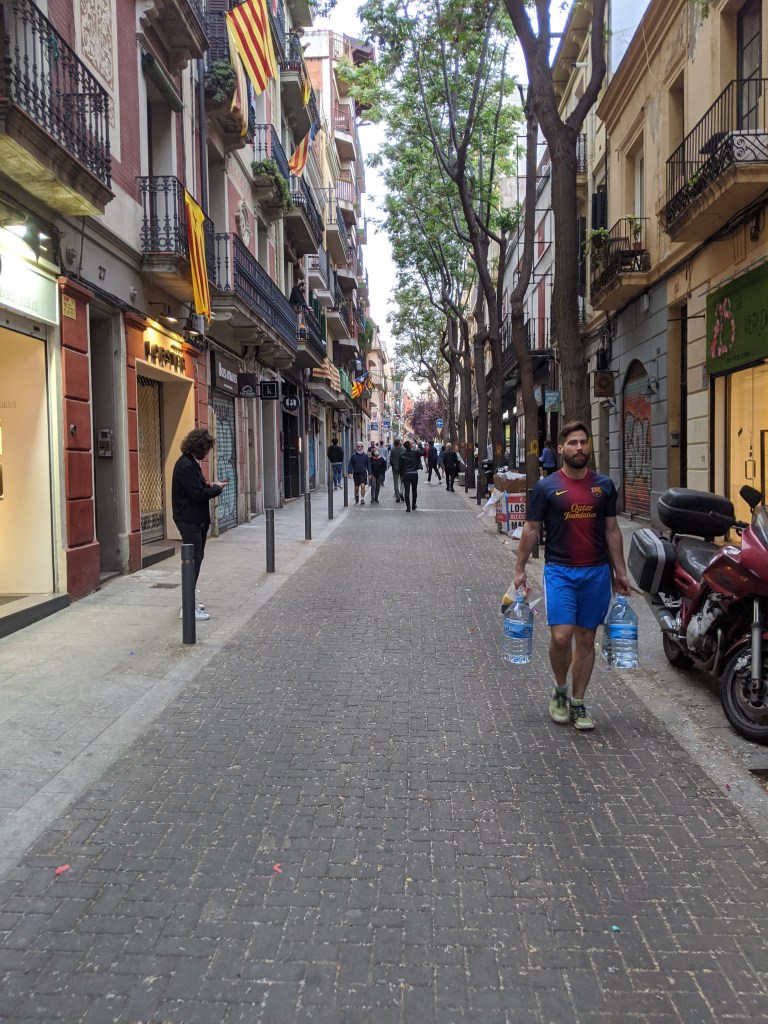
Carrer del Verdi in Gracia, 7 May 2020, evening.

It’s clear that not everyone wears a mask. On Carrer del Verdi, which was Gracia’s version of Restaurant Row in Manhattan all those days ago when restaurants were allowed to operate, I counted about half the people with and half without masks. On the quieter side streets, most people weren’t wearing masks.

I don’t know why the streets that were crowded before Covid-19 are crowded now. Old habits, I guess. People congregate now where they were used to congregating before. They want life to be normal, even if all the stores are closed and we can go out only during certain hours. It seems much safer to walk on the quiet side streets. Fewer opportunities to cough and sneeze on each other.

Spain has some of the same crazy political dynamics as the US. I feel safer here, though, in spite of the similarities. With the exception of a few wingnut politicians, Spanish intentions seem less economic and more healthy than the US. As in the US, though, the conservatives are pushing to open sooner. Madrid, the worst hit city in Spain, has a conservative government. It will start its Phase 1 on Monday. I wish I understood better why conservatives are pushing to open so fast, to risk the progress containing Covid-19.

To me, the claimed economic benefits from relaxing Covid-19 restrictions seem like a convenient rationalization for ending restrictions sooner than later. I’m watching the meatpacking debacle in the US with some alarm. The meatpacking industry is the canary in the coal mine for supply chains operating during the Covid-19 pandemic, the supply chains the economy needs if it is to work the way it worked before.

People want meatpacking plants to operate at any price. They are, after all, part of the food supply chain. At least, that’s the rationalization.

For instance, Nebraska’s Governor Ricketts overruled local officials in Grand Island who asked JBS to close its meatpacking plant because of Covid-19 infections. Grand Island officials wanted to stop the Covid-19 outbreak before it overwhelmed the local healthcare system. Governor Ricketts, on the other hand, was concerned about food riots if meat production stopped.

“Can you imagine what would happen if people could not go to the store and get food? Think about how mad people were when they couldn’t get paper products…. Trust me, this would cause civil unrest.”

Nebraska Gov. Ricketts in a press conference explaining his decision not to close a JBS meatpacking plant in Grand Island.

I’m not going to second guess Gov. Ricketts’ intentions, but his rationalization to overrule local officials lacks the very imagination he asked the press to conjure. Can you imagine what would happen, for instance, if people cooked without meat for a few weeks? Can you imagine what would happen if people shut down the plant just long enough to figure out how to protect the workers?

A successful response to the novel problems the novel Coronavirus presents takes a large dose of imagination. It helps to imagine ways to contain Covid-19 rather than spread it.

After all, Covid-19 has an imagination, too. Maybe not in the way that you or I think of imagination, but look what Covid-19 figured out how to do all on its own at other meatpacking plants that turned into Covid-19 hotspots.

Why, look! Following anonymized tracking data from the mobile devices that visited five other meatpacking plants with Covid-19 outbreaks, it’s clear that the owners of these mobile devices could have transmitted Covid-19 to all 48 continental states and into Canada. Free trips for Covid-19 all over the country. That’s imagination!

Not to make light of this, but when we say we want to open up for business again, we can’t just open up for business again. We have to re-imagine supply chains, re-think the way we use enclosed space, re-organize our activities to fit Covid-19’s requirements. If we fail to apply our imaginations, Covid-19 will use its own imagination to shut down business for us. It’s quaint to think we just go back to business, to imagine that when people start dying around us at work, we’ll just keep slogging it out through the ensuing chaos.

There’s a larger problem, though, with the argument to forget Covid-19 and get back to work. It’s too late. It’s like waking up in Hiroshima in August 1945, pouring a cup of tea, looking over the irradiated landscape outside, and saying something like, oh, don’t worry about that, all we need to do is make it like before.

The economic damage from Covid-19 has been done. It’s massive. This is not particularly controversial. The May 2020 report from the Bank of England is indicative of what other central banks are saying.

Composite output PMIs, in selected economies, Bank of England Monetary Policy Report May 2020.

As billionaire and hedge fund manager Ray Dalio says in his recent TED talk, the Covid-19 economic is on the order of the 1929 market crash, the kind of destructive meltdown that occurs every 80 years or so.

Ray Dalio TED talk.

This is a long, but useful listen as much for the history as for the economics. Based on past economic disruptions, Dalio expects significant shifts in income and wealth distribution. The tools in a government’s toolbox to manage through these massive disruptions are:

  • Cutting spending (austerity)
  • Debt restructuring (forgiveness)
  • Redistribution of wealth (taxes)
  • Printing money

In Dalio’s estimation, the world is likely to see not only a shift towards Chinese power, but also a new Bretton Woods type of agreement. Bretton Woods made significant changes to the way central banks coordinated policy after WWII, turning the US dollar into the world’s peg currency. One risk with Trump’s ineptness is that the world could peg to a different currency and put the US economy at enormous peril.

Dalio points out that creativity and productivity have been key to transforming economies in past crises. In a related vein, Kim Stanley Robinson writes in the The New Yorker about the way Covid-19 demonstrates our ability to change. She sees hope that if we deal with Covid-19 effectively, we may figure out how to deal with other cataclysmic problems like climate change.

Economics is a system for optimizing resources, and, if it were trying to calculate ways to optimize a sustainable civilization in balance with the biosphere, it could be a helpful tool. When it’s used to optimize profit, however, it encourages us to live within a system of destructive falsehoods. We need a new political economy by which to make our calculations. Now, acutely, we feel that need.

Kim Stanley Robinson, The New Yorker, “The Coronavirus Rewrites Our Imaginations,” 1 May 2020

When my friends say the best thing is to open up the economy, my biggest fear isn’t that they’re probably wrong. My biggest fear is that they may have forgot to apply their imaginations to the crisis at hand. The safest thing for our health and for the economy is unlikely to be opening up things as quickly as we can. We know that from the meatpacking plants.

The safest thing is to play our advantage against the virus, to use our imaginations to outwit Covid-19. Just as I find safety in Barcelona’s less traveled side streets, I expect the same less traveled streets to present me with unexpected answers to my questions.

7 May 2020 – Thursday – #53

Everyone is excited about llamas. Meanwhile, Republicans are like ostriches putting their heads in the sand. The results are not hard to predict.

The White House is deep-sixing CDC guidelines on how to relax Covid-19 restrictions.

Florida is covering up Covid-19 deaths.

Arizona is opening up for business and shutting down its Covid-19 science panel.

The US is becoming a Covid-19 Tale of Two Countries, the Blue US and the Red US. That explains why the overall US mortality trend fools me each day. Some days I think it’s finally flattening, others not so much.

Covid-19 mortality per million people by country.

Every country on the chart above has a clear flattening inflection in its Covid-19 mortality curve except Brazil and the US. By now, I would have expected an inflection in the US curve, so I looked for what might explain the lack of inflection.

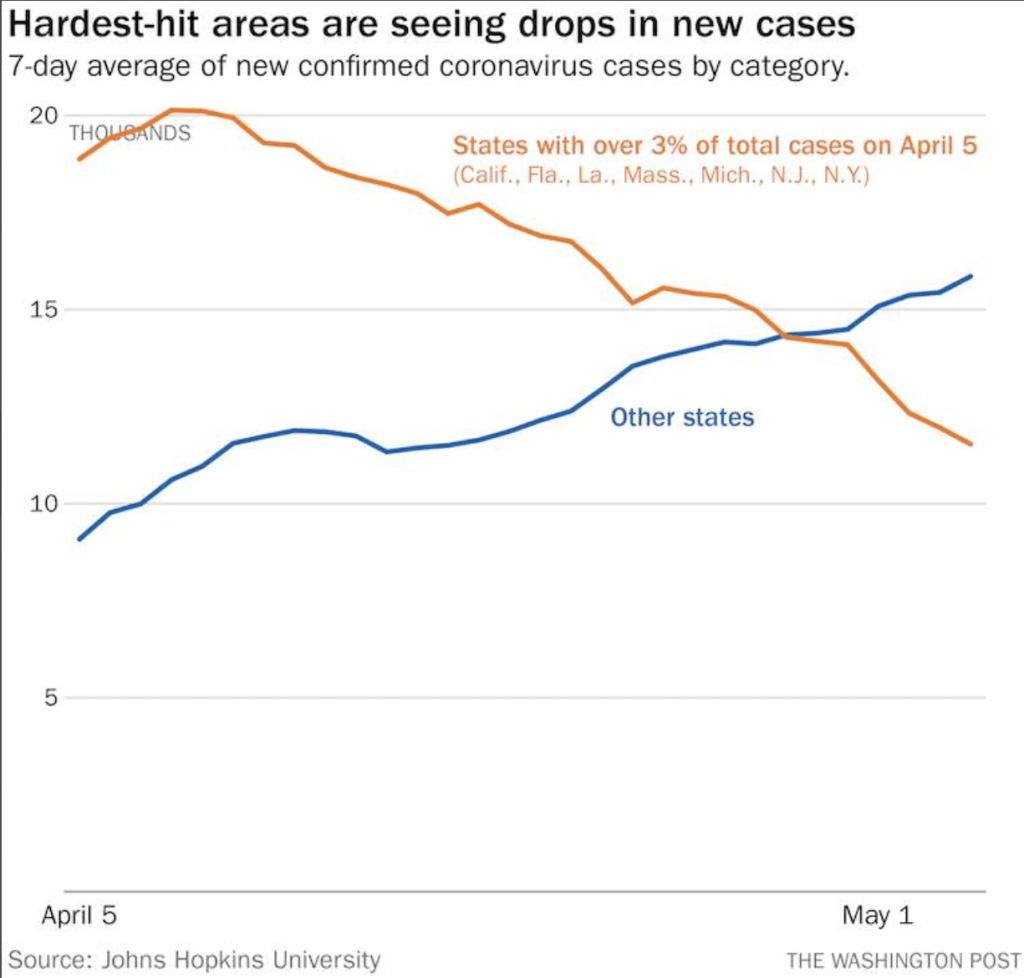
It’s a red state versus blue state thing. Here’s a chart that makes that clear.

Covid-19 cases by early and late US states (Washington Post)

The US has two Covid-19 trends. States that had the most Covid-19 cases in early April are seeing their caseload decline as a result of social distancing. The rest of the states are seeing their Covid-19 caseload increase.

This explains why I haven’t seen an inflection in the overall US mortality curve, and probably won’t for at least a month. States like Texas, Georgia, and Arizona that are relaxing Covid-19 restrictions increase their upside risk in R, the viral infection rate. That, in turn, leads me to believe the increasing Covid-19 case trend (“Other states”) will get steeper rather than inflect down until there is a course correction by these states.

Of the early states in the chart, California, New York, New Jersey, and Massachusetts have Democratic governors and a combined population of 75 million, or 23% of the total US. The other three early states have Republican governors. Florida, Michigan, and Louisiana have a combined population of 36 million, or 11% of the total US.

In the “Other states” category, that leaves 23 states with Republican Governors and 20 with Democratic Governors. The red states in the climbing trend line have 120 million people, or 37% of the total US. The blue states have 97 million people, or 30% of the total US. Another way of looking at this is that about 1/3rd of the US population has sheltered in place to achieve a decline in Covid-19 caseload while the other 2/3rds of the population has increasing caseload. Most of the “Other state” population is in red states aggressively relaxing Covid-19 restrictions.

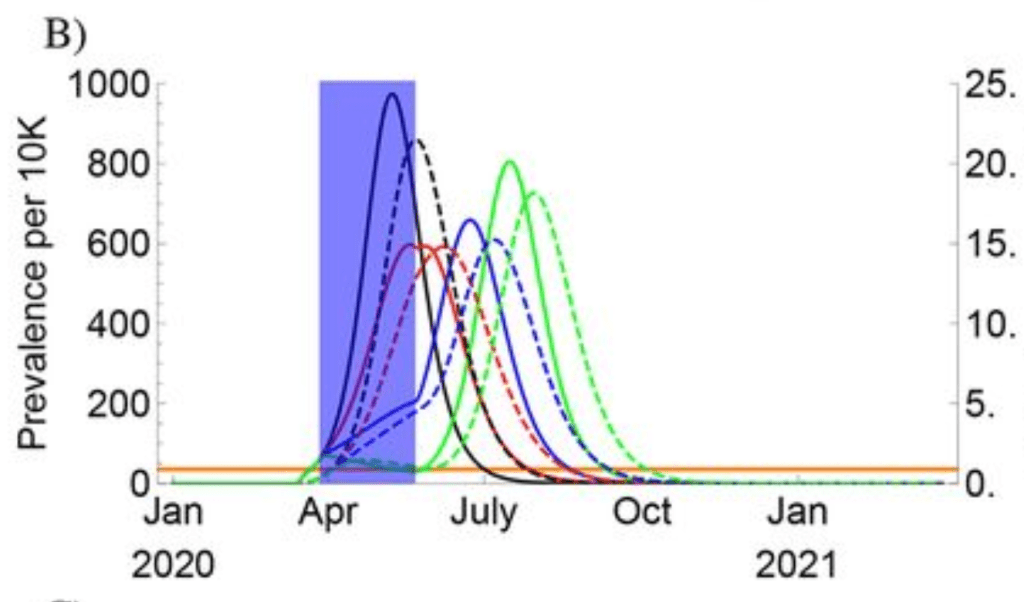
Of course, it’s difficult to predict what will happen as a result of changing Covid-19 restrictions. How difficult? Here’s a Harvard paper that discusses a Covid-19 outbreak model and below is a small part of what the model predicts. This chart shows Covid-19 infection for a population that does eight weeks of social distancing without corrections for possible seasonality.

Harvard Covid-19 transmission model for 8 weeks of social distancing without seasonality.
Red line = 20% reduction in R0, blue = 40%, green = 60%.

The models tell us a few things. One is that completely relaxing social distancing leads to an increase in R. That means states or countries relaxing social distancing either need to have thorough test, track, and quarantine programs in place, or need to measure the response of overall R to a set of relaxations and reverse the relaxations if R increases. The latter is the case here in Spain and will be for most of the world until testing ramps up enough so that tracking can be implemented. In the absence of either rigorous testing or overall R monitoring, R will increase and force another lockdown.

Another thing the model tells us is that we’re at the mercy of Covid-19 immunity in terms of strength and duration, neither of which we understand yet. Sweden makes an assumption in its effort to achieve herd immunity that such immunity is long-lasting, but those with mild cases of Covid-19 appear to generate a small immune response that may not last. Also, there are various reports of SARS-Cov-2 mutation to a more virulent form that is not only predicted to increase Covid-19 virulence and mortality, but may also defeat existing immunity.

The Harvard model also says seasonality is important. Again, we know nothing about Covid-19 seasonality other than similar viruses are seasonal. We know that Covid-19 was a catastrophe in Ecuador, which has a tropical climate.

There is a lot of uncertainty! But not at the White House!

Here is a Twitter post about the new White House model for Covid-19.

Republicans clinging to office need Covid-19 to go away. Unlike the Harvard model, the Republican Covid-19 model makes the whole mess disappear! The White House “improves visualization” by applying a cubic fit to the data. In other words, someone fiddled with Excel until they found the line fit function that suited Trump’s political visualization.

Unfortunately, if the Harvard model is close, it predicts that a quick relaxation of Covid-19 restrictions will lead to rebound in caseload in August or September. It would be unfortunate for Republican Covid-19 messaging to have ICUs overloaded in red states a month or two before the election.

But there are always the llamas to save us.

The researchers linked two copies of a special kind of antibody produced by llamas to create a new antibody that binds tightly to a key protein on the coronavirus that causes COVID-19. This protein, called the spike protein, allows the virus to break into host cells. Initial tests indicate that the antibody blocks viruses that display this spike protein from infecting cells in culture.

Science Daily, “Antibodies from llamas could help in fight against COVID-19, study suggests,” 1 May 2020

Researchers from UT Austin and National Institutes of Health and Ghent University in Belgium have found an antibody in llamas that binds to the so-called spike protein that allows SARS-Cov-2 to hijack cells in order to replicate.

I hope it works!

But I’m going to be a Debby Downer. The soonest we should be planning for something brand new like a vaccine or a monoclonal antibody is later next year.

Should some of the more “scalable” vaccines prove to be protective, it’s conceivable that they could be made at existing plants, rather than require the construction of whole new facilities. Production of this type of candidate could reach hundreds of millions of doses within about a year, Emini said. But any vaccines that would require bricks-and-mortar construction is obviously going to take longer to reach those output levels.

Stat, “Mounting promises on Covid-19 vaccines are fueling false expectations, experts say,” 6 May 2020

Excited researchers issuing pre-prints have got my Mom convinced we’ll have something later this year. The reality is that at the scale we need to make the world safe again, we’re at least a year away from protection.

An important political note about vaccines. Of the eight vaccines currently in human trials, four are in China. If Trump got you worked up about how China was so terrible during the Covid-19 outbreak (you trusted something Trump said?), you may be singing a different tune this summer if China has the only vaccine that works. We have to work together to solve Covid-19 problems because we’re going to have to share the solutions.

I really wanted to talk about the economy today, but that will wait for tomorrow.

In the meantime, Brad wants to remind you that it’s not Trump who will save us from Covid-19. It’s Dolly Parton!

So, for Dolly’s sake, please stay at home and get back to work!

6 May 2020 – Wednesday – #52

I wore a mask when I was the orderly at an outpatient hospital in Palo Alto. My father snagged the job for me during the quarters I took off from college. Both my parents deny that they were pushing me to become a doctor, but it’s hard for me to draw other conclusions based on the evidence. My father and his brother were doctors. My grandfathers were doctors. One of my great-grandfathers was a doctor. I think it was assumed I would be, too.

At the outpatient hospital everyone except patients wore masks in the operating room area. Outside the operating room area, it was anything goes. So, if you’re thinking that healthcare workers wear masks primarily to protect themselves, that was not the case where I worked. We wore masks to protect patients from us when they were vulnerable to infection during surgery. If our goal had been to protect ourselves from patients, we would have worn masks outside the operating room area, too.

That’s why the current situation with Covid-19 confuses me, the insistence on wearing masks. I still haven’t bought one. I’d guess that about 2/3rds of the people walking on Barcelona’s streets during our communal exercise periods wear masks. I’m not religious about the issue of masks and wearing one certainly reduces the chance that a contagious person infects others.

I worry that people aren’t thinking things through, though, that they’re creating a false sense of security when they don a mask. Masks are a great opportunity for everyone going through Covid-19, but not necessarily for safety.

You may be scoffing at me, thinking I’m being selfish. Maybe I am being selfish, but before you scoff any further, check out this Twitter thread Brad found. (For the record, I have no idea where Brad finds this stuff, but he saves my ass writing these Covid Diary BCN entries).

If you’re an information sadist, read the entire thread. The point is this: a wide range of data indicates that Covid-19 transmission mostly takes place in closed environments with prolonged exposure. In other words, Covid-19 is not lurking in every nook and cranny waiting to hop in your nose. In other words, social distancing is your best defense against infection.

Since isolation started, I have been to doctors’ offices about once a month where I would maintain extra social distance. I’ve spent 30-60 minutes a week inside stores that have a closed environment. I go to these stores when they are not crowded and maintain distance. I’ve spent none of my time in closed environments with prolonged exposure to Covid-19 virus. I’ve spent none of my time in crowded environments. On top of all that, I wash my hands every time I return home and don’t touch my face while I’m outside. Please pardon my graphic comparison, but at this point wearing a mask to protect others from me seems like wearing two condoms instead of one to prevent the spread of sexually transmitted diseases.

I did make out with a guy. Okay, I admit that’s a weak point in my argument. But what are the chances? He was asymptomatic. He wore a mask. Before we made out, that is.

Masks make sense to me sometimes. If someone is sick, he or she should wear a mask. It contains 50%-80% of the viral load.

If I were in a closed environment for long periods, I would wear a mask. I wouldn’t wear it to protect me, though. I would wear a mask because, even if there is the teeny-tiniest chance I’m contagious, that teeny-tiny possibility is multiplied by the hours I share a closed space and the number of people I’m sharing it with. Ditto if I’m in a crowd outside, but where do I find a crowd outside these days?

You still may be scoffing at me, telling me I’m rationalizing my beliefs. You may have seen the erroneous meme that says if everyone wears a mask, the chance of transmission goes down to 1.5%. I’ll post again a Twitter thread about masks from Dr. Christine Eady Mann that I posted a while ago.

Also you can read the WHO mask recommendations here. If you’re too lazy to click through, here’s a summary:

  • If you are healthy, you only need to wear a mask if you are taking care of a person with COVID-19.
  • Wear a mask if you are coughing or sneezing.
  • Masks are effective only when used in combination with frequent hand-cleaning with alcohol-based hand rub or soap and water.
  • If you wear a mask, then you must know how to use it and dispose of it properly.

I can’t write about masks without discussing their cultural significance. For instance, if you’ve ever been to Bali, you know masks play an important part in its rituals and that the use of masks changes along with the island.

Sacred masks are used in various [Balinese] processions from massive temple rituals to ceremonies celebrating personal milestones like weddings or funeral rites. But as the uses and functions of dance and performances extend to non-spiritual purposes, the use and meaning of Balinese masks follow. During social or entertainment dances, the masks serve as symbol or impression of certain characters in the story.

Culture Trip, ‘The Sacred Meanings of Balinese Masks,” 15 January 2019
Balinese masks. © Eden, Janine and Jim / Flickr

It seems so quaint right now to take a trip to Bali.

Regardless of the efficacy of masks during the pandemic, Covid-19 masks are here to stay. In Barcelona, we’re required to wear masks when we take public transit. My friends in San Francisco have to wear masks in a number of situations outside home.

The use of masks during the Covid-19 pandemic creates fashion opportunities and political tensions. Although I mostly see plain paper medical masks, Covid-19 masks also let us play with our identities.

Covid-19 mask. Sad and Useless, “Just In Time For Coronavirus Outbreak: Unusual Protection Masks,” 11 March 2020.

Washington Post had a story yesterday about Covid-19 masks and fashion, but I can’t share it with you because it’s behind a paywall. That doesn’t keep me from having a couple observations about mask fashion.

First, my friend David mentioned that the fashion industry is figuring out how it markets casual products for a growing shelter-in-place population. Fashion brands have to figure out how to position so they don’t appear to be taking advantage of fear. Do you want to project power when you’re queuing for groceries? On top of that, these brands have to figure out why brands matter at all to consumers sitting at home all day. Does an Yves Saint Laurent mask say “I’m healthy” around the neighborhood better than a paper medical mask?

GritDaily, “The Coronavirus Reveals the Twisted Conformity Between Fashion and Fear,” 6 February 2020

Second, my friend Heidi is selling masks for causes. For many masks she gives away part of her proceeds to good causes. Plus you can breathe blue all day.

HASbags Biden 2020 Covid-19 mask.

On the political front, the Vice President refused to wear a mask at the Mayo Clinic last week, then apologized. Yesterday, Trump refused to wear a mask at, of course, a mask factory. Very meta way to draw attention to his need to end to the pandemic years before it will be over, Covid-19 being inconvenient for his re-election campaign.

Masks have a racial overtones, too. In the US, whites wear masks to lynch blacks. Blacks fear murder when they don a mask. For many, protection from the pandemic adds to the fear of the pandemic.

People argue online about masks. It is yet another topic for heated dispute with powerful memes and informational articles on both sides of the argument. Choose your point of view on masks and you can hide behind your own mask of cherry picked facts.

I took acting class to overcome my stage fright. It worked. I learned that if I stayed in character, the audience had no idea I was blowing my lines. For one of the early exercises in class, my teacher Rhoda handed out masks. Acting is all about role play and masks give everyone permission to play a role regardless of ability.

Even if we don’t put on a mask, we still are wearing a metaphorical Covid-19 mask. Everyone has to figure out new roles and new behaviors. Everyone has a new scene. As I learned from Rhoda, no matter how small the part, it is an opportunity to play the role of a lifetime.