5 May 2020 – Tuesday – #51

Those of us living in the midst of Covid-19 sometimes forget how distant Covid-19 seems before it arrives. I can remember in January when Covid-19 still seemed like something in China, and then in February when it seemed like something in Italy. It felt remote even when Mobile World Congress was cancelled mid-February. The organizers of this massive Barcelona event seemed super cautious to consider cancellation until multinational companies started pulling out. I could feel the Covid-19 wind picking up.

By now most of Europe and the Americas know what it’s like to live in the eye of the Covid-19 storm. In the US, New York, California and Washington states certainly know what it’s like. But I forget that large swaths of flyover states haven’t felt tornado-force Covid-19 yet. This video is a great reminder of what it feels like when Coivd-19 slams into a community from a doctor dealing with a Tyson meatpacking plant outbreak in Iowa.

Dr. Sharon Duclos, Co-Director, People’s Community Health Clinic, Waterloo, Iowa

The Covid-19 meatpacking plant disaster Dr. Duclos describes is a cautionary tale. The events she describes could happen in almost any Midwest community.

A large corporation invests in enough Covid-19 protection at its plant to protect itself from lawsuits, but not enough, as is clear from the subsequent Covid-19 outbreak, to protect workers from actual Covid-19. Perhaps Tyson had good intentions when it installed worker protection. More likely it checked the boxes rather than limit production in order to understand and remediate as many Covid-19 workplace problems as possible.

The good people of the town continued working. They needed money to pay rent and buy food. They were poor and a low-wage job was salvation. It was the only way to put food on the table. Nothing to worry about. The plant managers, after all, had put in place measures to make the work place safe.

There was food on tables, workers were safe, and profits continued as the factory churned. The invisible hand was working.

And then it wasn’t. Another invisible hand showed up, a viral hand.

Capitalism broke when workers buzzed home from the Covid-19 hive carrying the virus into their community. There was food on the table, but grandma and grandpa couldn’t breathe. The rent was paid at home, but there were no rooms available where they were needed, at the hospital.

If pricing worked perfectly, if Adam Smith’s invisible hand were as powerful as God’s, then the price of meat would cover the cost of Covid-19 remediation at the plant. Meat prices would have gone up when Covid-19 was just something in China so that meatpacking plants could afford proper Covid-19 plant improvements while providing investors with market rate profits.

The irony of this cautionary tale is that the US, perhaps the world’s premiere champion of free markets and capitalism, is laying off healthcare workers in the middle of a pandemic. How crazy is that? People are dying and the dominant economic construct insists on firing healthcare workers. The pricing models for healthcare assume elective surgeries, not pandemics. As with meat, healthcare pricing models also didn’t change when Covid-19 was just something in China.

No wonder things don’t make sense.

Lots of us want to go back to normal, go back to the way it was. Yesterday, my friend Deborah emailed “I am hopeful  that we will soon see some normal way of living.” Hers is a common lament. We want to know what’s next, how the story ends, when we will stand again on the illusive terra firma, enjoying a pleasant summer breeze.

Getting back to normal depends, in large part, on maintaining our economic constructs, on our continued attendance at the Church of the Invisible Hand. Brooke Binkowski has assembled a Twitter thread of the high priests from the Church of the Invisible Hand. They are discounting the value of our lives in order to enrich theirs.

I’m going to switch gears here. You’ll see why in a moment.

I’ve been thinking about the arguments we have about IFRs and about mortality curves and about what all these numbers mean. UCSF’s comprehensive Covid-19 infection study of the Mission District of San Francisco provides more data points. The Latin population has a much higher rate of Covid-19 infections than the white population. No big surprise there.

This is the story that got me thinking about IFRs and mortality curves: the US death toll from Covid-19 just surpassed the US death toll during the Vietnam war.

What an odd comparison. The US Department of Defense marketed its success using body counts. By abstracting the war dead to a number, it could divert attention away from the one thing that really mattered: the United States could not win the war in Vietnam. When Trump says his administration should be considered successful if it limits US Covid-19 deaths to 60,000 100,000, you can hear those Vietnam body counts echoing in his bone spurs mind.

We’re doing a disservice to the Covid-19 dead when we compare their deaths to Vietnam or 9/11 or other acts of war. We’re doing a disservice to ourselves when we focus on IFRs and mortality curves to rationalize our positions.

We live in a world where the economic construct of the world’s largest economy insists on firing healthcare in the middle of a pandemic. That, my friends, is what we’re up against. Covid-19 is revealing us for who we are.

During last night’s exercise period, I walked along Diagonal and met a Moroccan stranded in Barcelona. He hates Barcelona because it’s a kind of purgatory for him. He can’t get back to Brussels, so he’s lost his job there. He can’t get home to Morocco. He’s nowhere. Like all of us, really.

This morning Faoud sent this message about living with Covid-19: “I think the world will be born again.”

4 May 2020 – Monday – #50

My weekly phone call with my Mom popped my euphoria bubble. I still was elated from Saturday’s hour of outdoor exercise and looking forward to last night’s walk. I was excited to chat with Ruben about when Covid-19 restrictions would be relaxed so that I finally could visit his place for dinner, the dinner we planned two months ago but have postponed until travel is allowed. It seemed like things Covid-19 were going the right way.

Then, near the end of yesterday’s catch up with Mom, she wondered if she might spend the rest of her life in Covid-19 lockdown.

That was both startling and reassuring. Startling because, of course, she’s right. Covid-19 might go on for a few years and Mom, who’s in her mid-eighties, doesn’t have actuaries on her side if it takes 3-5 years to find a Covid-19 cure or vaccine. On the other hand, it was reassuring to know Mom still has her marbles and she’s rational about what’s going on in the world. I know she reads the news from the 100 news flashes she emails every day. Now I know she’s digested what all the news means, too.

That call triggered some Big Thoughts.

Well, that and a couple op-eds I read last night. In one op-ed, Laurie Garrett, whom the New York Times dubs the Cassandra of Covid, says that Covid-19 is at least a 36 month event. The interview is worth a read. Here’s what stood out to me.

“I’ve heard from every C.D.C. in the world — the European C.D.C., the African C.D.C., China C.D.C. — and they say, ‘Normally our first call is to Atlanta, but we ain’t hearing back.’ There’s nothing going on down there. They’ve gutted that place. They’ve gagged that place. I can’t get calls returned anymore. Nobody down there is feeling like it’s safe to talk. Have you even seen anything important and vital coming out of the C.D.C.?”

Laurie Garrett from New York Times, “She Predicted the Coronavirus. What Does She Foresee Next?,” 2 May 2020

This description of the US CDC Covid-19 lack of response crystallized my thinking about America’s current leadership. First Big Thought: there is no US leadership and there won’t be for at least a year. The US leadership vacuum ends either after a new administration moves into the White House and gets up to speed or, if Trump unfortunately is re-elected, after the world already has figured out Covid-19 without US assistance.

The world is moving ahead without America. It can’t wait. Trump’s current Chinese fireworks are just that. He is diverting attention to China because he has no idea what he’s doing in the US. It worked! People are arguing about China furiously on social media.

I don’t want to engage in the argument because it feeds the distraction. I will point out, however, that if you are a fervent believer that Covid-19 came from a lab in Wuhan, if you believe Chinese science is far enough ahead of the the rest of the world to create or somehow filter out Covid-19 for its virulence, there are far more important discussions to have with China than how they managed the Covid-19 outbreak. Discussion like, what else is in that Wuhan lab.

I’m mad about Trump’s China stupidity because it means Mom probably will spend the rest of her life in lockdown. My contact with her may be limited to visits with gloves and masks for the rest of our time together on the planet.

How is Trump helping in the US? Aside from blaming China, what is his actual Covid-19 policy? He is encouraging governors to relax lockdowns prematurely.

Andy Slavitt backs out New York Covid-19 statistics from the rest of the US. This is an important cut because New York statistics have dominated overall US statistics.

What is clear is that, while New York has reduced R to less than one (R < 1) with its lockdown, that’s not true elsewhere. R > 1 in the rest of the US. Covid-19 cases are not declining in many major metropolitan areas. It is the wrong time to relax Covid-19 restrictions, yet states like Texas, Georgia, and Florida are opening up for business. Based on Slavitt’s analysis, we should expect US Covid-19 hospitalization and deaths to increase even more rather than flatten by the end of May. The signal should emerge by the week of 18 May. We’ll know for sure by June.

I hope I’m wrong, but I can trust that Trump is erring on the side of making money, not saving lives. He has a history of making risky bets with other people’s money and losing. With Covid-19, he’s making risky bets with other people’s lives.

The other editorial I read last night that fed my Big Thoughts was about herd immunity. In it, Carl T. Bergstrom and Natalie Dean discuss the merits of natural herd immunity. Before UK Prime Minister Boris Johnson caught a touch of Covid-19, he advocated for natural infections to create herd immunity. Some very smart friends of mine agree. Of course, the anti-vaxxers agree, too.

But this is just like the argument about China and the origins of Covid-19. Why are we even discussing natural herd immunity? Like Trump’s China argument, the herd immunity argument that we need to stop social distancing to save the economy doesn’t make sense on its face. Justifying a non-response to Covid-19 requires throwing away both science and every shred of humanity you have. It puts millions of people to death in order to “get back to normal” and “save the economy.”

Except we don’t get back to normal and we don’t save the economy. Well, I mean, we might on some planet a billion light years from here, but there is no rational prediction that says sacrificing millions of souls leads to a happy ending for the rest of us. The meatpacking and prison industries are continuing to operate as though Covid-19 never existed, but the meat supply chain is breaking and prison hot spots are infecting the communities around the prisons. They are not getting back to normal.

New York Times, “What the Proponents of ‘Natural’ Herd Immunity Don’t Say,” 1 May 2020.

Even if we sacrificed millions of fellow humans and achieved the vaunted herd immunity, then what? Covid-19 infections don’t stop. We’re not even sure that immunity is long lasting for people who have build weak immunity and we don’t understand for sure how Covid will mutate (although, to be fair, that problem doesn’t look bad right now). The risks of throwing away social distancing are enormous and the rewards unclear.

What we do know for sure is that social distancing and hand washing reduces R.

And yet Trump is encouraging Second Amendment wingnuts and anti-vax crusaders to swarm state capitols and demand their governors lift Covid-19 restrictions.

This herd immunity editorial led me to my second Big Thought: there is no US leadership and there won’t be for at least a year. Yeah, I know, I know, that’s the same as the first Big Thought.

My second Big Thought is actually this: I’m learning what it’s like to be a war correspondent.

I don’t know what made me think of Ernest Hemingway after my phone call with Mom. Maybe it was my call later with David, a Venezuelan-American whom I met here in Barcelona before the lockdown, when he was spending a day in transit from Rome to Los Angeles. David is in fashion industry PR. In other words, he doesn’t have a job and is trying to navigate towards what comes next. As David and I thought up business ideas and spoke of the uncertainty he’s faced throughout his immigrant life, we spoke of how Covid-19 is like war, the enormity of the displacement.

Anyway, back to Hemingway. He was a crazy American writer who fought in WWI and later worked as a war correspondent during the Spanish Civil War and WWII. He had four wives, a trait I can identify with. I think Hemingway came to my mind because I read something in the past couple months about Hemingway leaving Barcelona to witness the Battle of the Ebro. That, and I was wide awake at 03:00, ruminating about what I was doing with this blog.

I haven’t read Hemingway since college, but last night I wondered how Hemingway wrote about war. What stories did he chose to tell? How did he sort through the rumors and gossip to find some shred of truth? Who was good? Who was bad?

Writing this blog in the midst of Covid-19 seems like the work of a war correspondent. There are casualties. Uncertainty. Oodles of uncertainty. The displacements are enormous. Friends become enemies, and vice versa. No one knows when it will end.

But it’s also different from the work of a war correspondent because Covid-19 doesn’t distinguish between soldier and civilian and because everyone has front row seats to the disaster. (And because I don’t have an editor.) We may not be watching patients on ventilators die, but we’re wary of trips outside like Covid-19 booby traps lurk everywhere and cautious who we meet as though they could be unwitting Covid-19 spies.

Hemingway filed this New York Times report on 11 April 1938 as Franco’s forces moved toward the sea. How does Hemingway choose this culinary detail? “After watching the progress of the Ebro defense from an observation post, this correspondent came down the steel trail through vineyards and ate a plate of mutton chops, smothered with tomato sauce and onions, with the divisional staff.”

During WWII, Hemingway graduated from war correspondent to accidental soldier.

Hemingway got into considerable trouble playing infantry captain to a group of Resistance people that he gathered because a correspondent is not supposed to lead troops, even if he does it well.

Paul Fussel, “Hemingway on War and Its Aftermath”

I don’t foresee myself leading violent Resistance forces, but I understand why Hemingway felt the urge not only to write, but also to engage in the battle.

While I’m trying to get my hands on Hemingway’s report on the battle of Ebro called The Bombing of Tortosa, I’m going to leave you with this very Spanish Covid-19 video that Ruben passed along. The only set up I want to give is that there is a “secret” Barcelona life in the air shafts of apartment buildings. People put their laundry out to dry and windows are open for ventilation when, as now, the weather is nice. You hear your neighbors’ private discussions and see their underwear drying. It’s very personal.

A dos metros de distancia.

3 May 2020 – Sunday – #49

It’s all about R.

Yesterday Spain let us out of our houses to exercise. It was a glorious jailbreak. First time in 1-1/2 months I got over 10,000 steps in a day. I didn’t quite follow the guidelines, but I kept my distance, didn’t touch anything except for my mobile and a pizza box, and washed my hands when I returned home.

The evening before I started isolation 50 days ago, I walked to Sagrada Familia. Last night I returned. They still haven’t finished construction.

Sagrada Familia, 2 May 2020

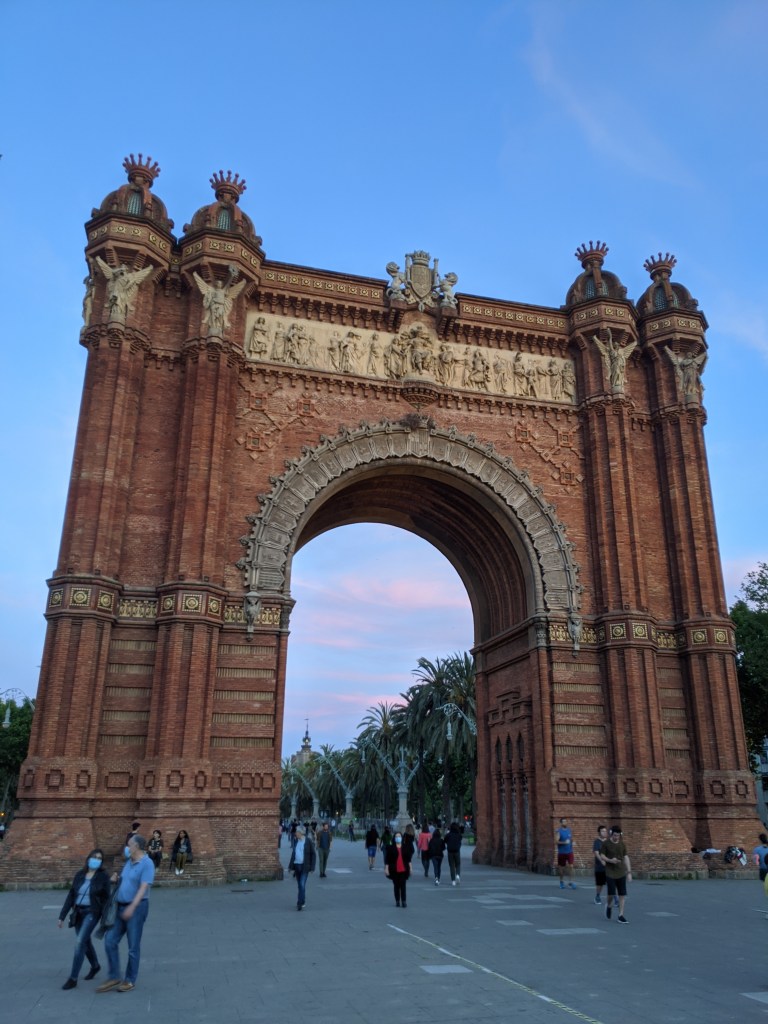
I probably should have returned home, but I was on a hunt for pizza. Two months without pizza is a lifetime. Somehow I ended up here.

Arc de Triomf, 2 May 2020

It was nice to see many people out walking! And scary. I headed back up Passeig de Sant Joan and found a pizza place. The pizza wasn’t perfect, but the weather was. Pizza and wine on the terrace last night. Hooray!

Sure, I was out a little too long, but yesterday was the first time people went outside in large numbers, so infection rates had to have been lower than they’ve been in months. They may be a little higher today because we went outside yesterday. As long as we keep R < 1, though, we can continue to go outside.

Barcelona and Spain have started the R dance after 1-1/2 months of lockdown.

Germany started its R dance a week ago. The naysayers already claimed it’s a failure based on a recent uptick in Germany’s R. German scientist point out, though, that relevant R readings won’t be available for another week. Even Germany, which has one of the best Covid-19 testing programs in the world, needs 10-14 days to measure which way R is headed after a change in Covid-19 restrictions.

Infections don’t show up immediately. Most people aren’t tested for the coronavirus until they start to show symptoms, which can take days to appear. Tests take time to process, and there is a further delay before positive results are reported to the authorities

The Telegraph, “No evidence of a second wave in Germany after lockdown lifted,” 1 May 2020

With R hovering around 0.75, Germany has some wiggle room. Every four people who get infected with Covid-19 infect three other people. Infections are waning. Chancellor Merkel and her government will decide whether to relax Covid-19 restrictions more next week when they have the relevant R measurements.

The R news isn’t so good on the Japanese island of Hokkaido, the prefecture hardest hit by Covid-19. The government instituted a model Covid-19 response with testing and a contact tracking program. However, anxious to get business started again and seeing Covid-19 cases drop significantly, the island lifted Covid-19 its restrictions on 19 March.

With hindsight, experts agree, it was too early and, just 26 days later and after 135 new infections were reported in the space of a week, the lockdown was reimposed on Hokkaido’s 5.3 million residents.

The Telegraph, “Japanese island suffering second wave of coronavirus after lifting lockdown too early,” 29 April 2020

Hokkaido lifted restrictions too soon. Its Covid-19 cases shot up again and it had to re-institute a full lockdown. The country of Japan is expected to extend its Covid-19 restrictions for another month, through 6 June.

I was talking to Cristián last night about applying Machine Learning to understand R, the rate at which the Covid-19 infection is spreading. Where testing data is weak, which is almost everywhere right now, the most reliable data on Covid-19 infections and R are hospitalizations and deaths. Unfortunately, those signals come 1-3 weeks after the actual infection, so R is detected retrospectively.

I hope someone is training Machine Learning models on non-testing data that could predict hospitalizations and deaths. Such Machine Learning models would provide an implied R from signals other than Covid-19 tests. Cell phone movement data, for instance, certainly seem like they would help predict R. We see less cell phone movement while people are sheltering in place.

What about using sewer system data? WHO has used polio detection in sewage to assess the effectiveness of its polio vaccine programs. The Michigan State Universiy has measured Hepatitis A in Detroit sewage, showing that the virus in waste water predicts viral outbreaks in the city about a week in advance. It’s no surprise, then, that researchers measuring Covid-19 in sewage see viral load increase about five days before an outbreak.

Researchers haven’t been able to predict Covid-19 case load, yet, but future work may provide a quick way to understand whether a Covid-19 lockdown is working and whether it’s safe to go out. Especially if sewage data is combined with other data in a Machine Learning model. For now, waste water analysis may be one of the best predictors of an impending Covid-19 outbreak and signal the need to lockdown at the city level or even by neighborhood.

As their testing becomes more reliable and precise, Dr. Medema and other researchers hope to zoom in on future outbreaks. Instead of looking at a wastewater treatment plant that handles an entire city or county, they may go down into manholes to monitor changes in individual neighborhoods.

New York Times, “Is It Safe to Come Out of Lockdown? Check the Sewer,” 1 May 2020

People are, in fact, training Machine Learning models to predict Covid-19 infections. It’s difficult to dig up news on how they are modeling R, though, because “R” is also a programming language.

The worst case R scenario? It’s shelter-in-place at a jail. Unfortunately prisons have been allowed to turn into Covid-19 herd immunity experiments. It seems as immoral to me as the Tuskegee syphilis experiments. Or providing unsafe work conditions for low wage workers in meatpacking facilities in order to keep the meat supply chain operating.

It appears 70% of the 150,000 inmates in the US federal prison system have contracted Covid-19. Federal prison officials claim they are doing everything possible, but don’t have guidelines for containing an epidemic in confinement. Meantime, prisoners are going to the hospital for Covid-19 and dying without any notification to next-of-kin. The prison guard labor union says prison guards are getting infected, too, which means the prisons function as Covid-19 hot spots infecting the communities around them. The prision systems are not only immoral, they’re stupid public health.

I’m going to finish today with a fun Twitter account Brad found.

Brad claims he broke the Bookcase Credibility story before the NY Times. I’m breaking it after everyone else. It’s that good. I hope they don’t offend your favorite pundit’s bookcase. Or maybe I do.

We’re out of our home prisons in Barcelona. For now. The R dance goes on.