29 April 2020 – Wednesday – #45

I’m not sure which is better news, that Spain announced a step-by-step relaxation of its Covid-19 lockdown or that apricot season arrived. Spain’s lockdown relaxation is a series of two week “phases” beginning 11 May. If there is no upswing in Covid-19 infections in a given region at the end of a phase, then that region continues to the next phase of lockdown relaxation. That is, each region of Spain will advance through phases independently. Full mobility between regions won’t start until regions achieve the “new normal.”

The announcement comes as the Covid-19 reproduction rate R drops under 1 for nearly all of Spain.

R for regions in Spain, 28 April 2020. Centro Nacional de Microbiología.

Phase One of relaxation includes mobility within a region and reopening of some small businesses. Restaurants, theaters, and religious services will be allowed to operate at 30% of capacity. Prime Minister Sánchez advises that this relaxation is highly adaptable depending on the Covid-19 infection rates.

“The adaptability is because we don’t know what we are facing. Science still doesn’t know a lot of things about this virus. As such, we are facing something that we don’t know, and that is why we have to be cautious.”

Spanish Prime Minister Pedro Sánchez, 28 April 2020

In Barcelona, the Catalan government issued regional relaxation orders. To me, the most important part of its order is mention of Project Orfeu. Three weeks ago, the Spanish government announced Orfeu, its program to ramp up Covid-19 testing. From the Catalan announcement, it looks like testing is running roughly 1 test per 1,000 residents per day based on the total of 240,000 tests to date. The announcement says Orfeu will deliver 309,000 tests in six weeks, but it’s unclear how that translates into tests per day. For comparison, South Korea was able to manage down its Covid-19 case load with 5 tests per 1,000 residents per day.

In the US, the Covid-19 train wreck continues. In the wake of Tyson’s warning yesterday about the US food supply chain, Trump invoked the Defense Production Act to force US meat processing plant to stay open. The order gives US Secretary of Agriculture Sonny Perdue authority to ensure meat and poultry processors continue to deliver food to Americans and addresses “liability problems” Tyson voiced.

Bill Kristol on Republican position on US workers and Covid-19.

The question is why low-wage workers would show up when their colleagues are getting sick and dying. While pressing the country to re-open for business, Trump has failed to address worker safety in terms of either testing or protective gear. Some advocates of relaxing Covid-19 lockdowns assert that Covid-19 IFR is low enough that workers should continue working to protect the economy, but the workers’ unions have a different take.

Mohamed Goni, an organizer with Greater Minnesota Worker Center, said workers have complained the company is not sharing information about sick colleagues, has not implemented social distancing on the line, and that workers who were sick returned after just two or three days, and some workers who developed symptoms were not allowed to leave when they asked to go home.

KATU-2, “Trump order keeping meat packing plants open worries unions,” 29 April 2020

As Mohamed Goni, a union organizer points out, many of the Somali workers at the meat processing plants go home to their families and don’t want to put elder parents at risk of Covid-19 infection.

Trump also is pressing schools to re-open. With schools closed, parents lacking childcare alternatives have to stay home rather than go back to work.

“I think you’ll see a lot of schools open up even if it’s for a very short period of time. In terms of what this vicious virus goes after, young people seem to do very well. Young people seem to do very well so I know that there are some governors that aren’t necessarily ready to open up states, but they may be ready to open up the school systems.”

Trump

It seems reasonable to allow children into social settings because Covid-19 mortality is low in youngsters. Earlier this month, a US study showed only 1.7% of confirmed Covid-19 cases were in children under 18 while that group makes up 22% of the US population. Last month, when much less was known about Covid-19, Israel sent teenagers to sanitize its metro systems to keep older residents safe.

Hold the train.

UK Health Minister Matt Hancock warned yesterday about a rare autoimmune response the NHS is detecting in children. The illness presents similarly to Toxic Shock Syndrome and with severe inflammation.

Guidance was sent to doctors in north London describing “an apparent rise in the number of children of all ages presenting with a multi-system inflammatory state requiring intensive care across London and also in other regions of the UK”.

IBC, “Matt Hancock ‘very worried’ about new coronavirus condition that affects children,” Nick Ferrari, 28 April 2020

While the new pediatric syndrome is not directly associated with Covid-19 at this point, the appearance of this autoimmune response during the Covid-19 pandemic suggests a connection. Just when we think we know what’s going on with Covid-19, it finds a way to surprise us.

Except maybe in New Zealand. Congratulations to New Zealand for crushing Covid-19. The country expects full eradication in the coming weeks and is relaxing its lockdown. After providing a model for how to execute a lockdown, I’m hoping New Zealand provides a model for reintegrating with the world economy after eradication.

That brings me back to apricots. Apricots are the harbinger of the best part of the fruit season for me. Next come peaches and nectarines.

Spanish apricots.

For the past five years, I’ve lived in New York City and missed apricot season. To be fair, around this time of year good New York markets do offer small yellow globes that suggest what an apricot might taste like. How nice, then, to find fresh, flavorful apricots at Barcelona markets after my five year hiatus.

The thing is that Spanish apricots taste different. There are some apricots that, although redder, have a similar texture and taste to California apricots. The apricots in the photo have a slightly different texture and a citrus taste. It’s part of the fun of moving to Spain, to learn these differences.

I wrote at the top that I wasn’t sure whether the end of the lockdown was better than apricot season. I’m looking forward to going outside, of course, but I’m also looking forward to the predictable return of fresh peaches that come after fresh apricots.

Predictability. What a comforting word.

28 April 2020 – Tuesday – #44

The Spanish government allowed children to go out for an hour a day starting two days ago. My friend Cristián told me yesterday that Spain will let adults out for exercise on Sunday. Today El País says the government is reviewing results today of the program to allow children out before it decides to let adults out, too. Each region in Spain has a different proposal how to proceed.

Like all things Covid-19, nothing seems certain.

Take, for instance, Covid-19 screening. A Yale team has determined that many people with Covid-19 infections do not present with a fever. That means two things. One is that facilities like my mother’s retirement home that rely on fever to test for the presence of Covid-19 in its staff fail to detect all infections. The other is that we’re six months into Covid-19 and no one has developed reliable Covid-19 screening standards.

Clinicians are in the same boat. The US medical field may have though it was prepared for Covid-19, but it’s learned that the viral attack is more complicated than a bad case of pneumonia. Six months into Covid-19 and we’re still running into unforeseen medical problems.

But the degree to which doctors and scientists are, still, feeling their way, as though blindfolded, toward a true picture of the disease cautions against any sense that things have stabilized, given that our knowledge of the disease hasn’t even stabilized. Perhaps more importantly, it’s a reminder that the coronavirus pandemic is not just a public-health crisis but a scientific one as well.

Intelligencer, “We Still Don’t Know How the Coronavirus Is Killing Us,” 26 April 2020

If you’d asked me at the beginning of 2020 which country would have a food supply chain problem during a major pandemic, I wouldn’t have answered the US. A couple weeks ago, though, Covid-19 fatalities started shutting down meat processing plants in South Dakota and Iowa. Now Tyson has warned of a US meat shortage entirely due to inadequate Covid-19 safety measures at processing plants.

Almost a third of U.S. pork capacity is down, and JBS said Sunday it will shutter another beef production facility in Wisconsin. Brazil, the world’s No. 1 shipper of chicken and beef, saw its first major closure with the halt of a poultry plant, and key operations are also down in Canada, the latest being a British Columbia poultry plant.

Bloomberg, “Americans on Cusp of Meat Shortage With Food Chain Breaking Down,” 27 April 2020

It turns out the concentration of US meat distribution that allows the US to deliver so efficiently so much meat at such low cost is also its Achilles heel. If the US had a less efficient, more diverse supply chain, meat would cost more, but the system would have better redundancy to sustain single-point failures. Tyson’s meat supply alert is a harbinger of things to come as countries start relaxing their Covid-19 lockdowns.

Which brings me to the future. We live in a world full of precarious supply chains many of which are likely to break due not only to Covid-19 outbreaks, but also to political responses to lock down borders and stop trade. The free market principles that enabled the world to drive up efficiency and drive down costs are the same principles that discount black swan events like Covid-19. We didn’t build in redundancy because it’s not efficient. Or it didn’t seem efficient two months ago.

We also live a world where institutions are breaking and labor is being displaced at a dizzying pace. In the US everything from the court system, which can’t keep schedules, to the postal service, which is running out of cash, are at risk. Courts and the USPS are bedrock American institutions. Jails are becoming de facto test labs for Covid-19 herd immunity. The US State Department has closed up shop. Almost. I could go on.

All this change has people speculating what a post-Covid-19 world looks like, or at least what a world coping with Covid-19 might look like. If the Spanish flu is any indicator, it will be a world where we’re coping with Covid-19 outbreaks for a while.

Epsilon Theory published one such look at a post-Covid-19 world called “First the People.” I call your attention to this piece not because I agree with much of it, but because it’s asking the right questions. What are the stories we’ve been telling ourselves? Which of those narratives is holding true after Covid-19 showed up? Americans have bought into efficient meat distribution because they could feed the world, but Covid-19 hit the pause button on that video.

Marc Andreessen, who has oodles of capital to deploy, also has written about a post-Covid-19 world in “It’s Time to Build.” It shouldn’t be a surprise that someone with investment money sees Covid-19 as an opportunity to build stuff. But, to his credit, Andreessen is asking what has kept us from building the things that we haven’t built like housing and first class education. Covid-19 provides clarity about what we’ve failed to do.

The airlines are figuring out their vision for a post-Covid-19 world. It involves rearranging the furniture.

Reconfigured aircraft seating for Covid-19 protection.

I’m not sure I’m on board with this vision unless the seats are much larger. But then, I also don’t have a clear vision for a post-Covid-19 world. I have lots of questions and more time than I’d like during my isolation to think about them.

Covid-19 is a deadly foe, a foe that is forcing us to check our assumptions as we watch our institutions and systems break and adjust. As I watch the US and Spanish governments scrambling to let us outside, I wonder what we might have done differently to make these decisions easier, and what we need to differently going forward.

In better and less futuristic news, a Covid-19 vaccine looks likely to go to large scale trial as early as September. Oxford University’s Jenner Institute has a head start with a MERS vaccine already tested for human safety. In recent days, its Covid-19 vaccine candidate, a genetically reworked version of its MERS vaccine, has passed muster in an animal study with rhesus macaques.

Having seen promising HIV vaccine candidates come and go for forty years, I’m not getting my hopes up until I see human trial results. I understand that finding a Covid-19 vaccine should be easier because there’s been success with viruses similar to Covid-19, but it would be a bit of miracle for the first candidate to pan out.

But as the first to reach such a relatively large scale, the Oxford trial, even if it fails, will provide lessons about the nature of the coronavirus and about the immune system’s responses that can inform governments, donors, drug companies and other scientists hunting for a vaccine.

New York Times, “In Race for a Coronavirus Vaccine, an Oxford Group Leaps Ahead,” 27 April 2020

Even if a large scale test fails this early, though, it will help other vaccine candidates. And there are lots of vaccines (and treatments) in the pipeline. Brad found the lists to prove it. With about 100 vaccine candidates, the larger problem will be deciding which of those deserve full funding. If you listened in to yesterday’s great video on Covid-19 vaccines, you already know it takes about US$1/2 billion to bring a vaccine to market.

I still have friends asserting that Covid-19 is not a big deal and we need to “get back to normal.” I’ve pretty much stopped arguing with them. I simply point out that in its first month, Covid-19 killed more Spaniards than the flu did for an entire year. Ditto for Americans. That’s without factoring in how many lives were saved by lockdowns and how many deaths weren’t properly ascribed to Covid-19. In a bad flu season, the flu swamps the US healthcare system. You can do the math with Covid-19.

Looking at pages of Covid-19 obituaries reminded me that during the AIDS crisis, the best way to find out who died in San Francisco’s gay community was the obituary section in the Bay Area Reporter. There was no World Wide Web, no search engine. It was a weekly ritual to scour the obits for friends and acquaintances. Since I knew a lot people by first name, the tiny photos helped identify the kids who worked at ice cream parlors or the bartenders who poured my cocktails.

As the deaths grew, the Bay Area Reporter capped the length of each obituary to keep its page count reasonable. This obituary story is repeating itself with Covid-19. The Boston Globe expanded its obituary section to 20 pages, estimating that would be enough for the surge of Covid-19 deaths. Now it’s increased its obituary section to 21 pages.

I don’t want to be a total Debbie Downer today, so let’s end with this PSA: Please stay home and wash your hands.


I was excited to see in yesterday’s site statistics that someone (not me!) searched for coviddiarybcn.com. Ah, the first glimmer of brand recognition! Thanks for your support. Please share on your social feeds or email your family and friends.

27 April 2020 – Monday – #43

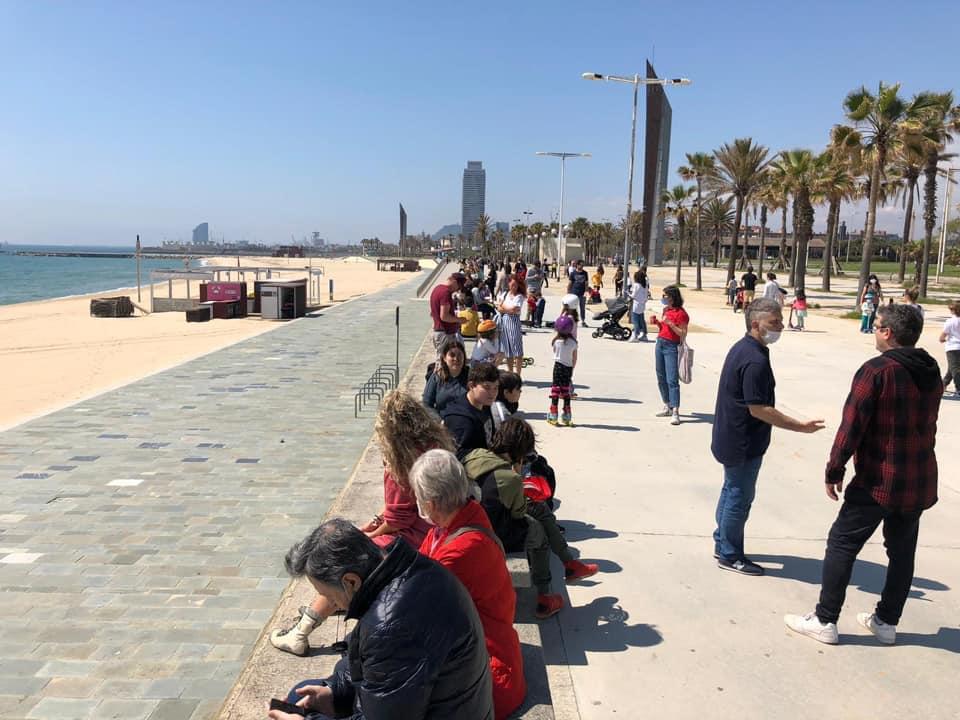
It was a spectacular day in Barcelona yesterday, first day warm enough to wear a camiseta. I stayed inside, but not everyone did.

La Barceloneta, 26 Apil 2020 (unatrributed)

Two months ago, I would have wondered why everyone was so spread out. Now it looks like a scene from a horror film where a deadly virus is lurking in someone’s nose, but we don’t know whose. This photo presents us with our current conundrum: what do we have to do to enjoy life outside once again?

Unfortunately, I’m not going to answer that today. Or tomorrow. Or next week. No one is.

Yesterday I went on a whirlwind tour of Covid-19 science and technology, mostly looking at what’s going on with testing. We’re entering the phase of the pandemic where testing is our best bet to keep Covid-19 at bay as we spend more time outdoors.

One of the testing technologies I wrote about was Paul Buchheit’s effort to create a Covid-19 test platform using Surface Plasmon Resonance (SPR). I’m a little less optimistic about this effort after an email from my friend Dennis.

… SPR was the technique Liz Holmes et al were using for their blood sampling at Theranos.  And we all know where that landed. SPR is wildly famous for being hypersensitive to the conditions of the optics in the sensor.  Down to the angstrom level for parallelness and completely free of contamination on surfaces to the level of an atom or two per square millimeter or so.  You have to deal with those issues to have a successful sensor based on SPR.

Email from Dennis Hancock

SPR sounds great in a controlled lab environment, not so great for deploying a network of millions of test stations. Still, it’s good someone talented is doing the SPR experiment.

Today, I’m continuing on from yesterday to look at some Covid-19 basic science. I’ll try to make this enjoyable enough that you won’t need a hit from your bong or a quarantini to make it through. I want to warn you that most of my knowledge of the immune system comes from high school biology and from studying developments made during the AIDS crisis when scientists were figuring out the role of T-cells.

Shane forwarded this morning a few articles on Covid-19 pathogenesis. I know “pathogenesis” is a fancy scientific word because WordPress spellcheck flags it. “Pathogenesis” means the way a disease or, more specifically, a pathogen develops. There’s still a lot to work out with Covid-19 pathogenesis, but it’s becoming clear that Covid-19, or the SARS-Cov-2 virus, hijacks the body’s immune system in a clever way, a way completely different from HIV.

In addition to pathogenesis, I want to introduce two additional terms, ACE2 (Angiotensin Converting Enzyme 2) and Interferon. The same way it was worth getting to know about T-cells during HIV / AIDS, it’s worth getting to know about ACE2 and interferon because you’ll be hearing about them more and more.

ACE2 is an enzyme commonly known for its role in modulating blood pressure. I’m simplifying here, but enzymes are kind of like scissors for proteins. You already may know something about ACE2 because one class of hypertension (high blood pressure) therapeutics is called ACE-inhibitors. ACE2 is found throughout the human body and plays other roles in addition to blood pressure modulation.

Interferons are proteins that our immune systems use to send signals. A cell that detects a pathogen, for instance, emits interferon to signal for help. Interferons are one part of a general class of proteins called cytokines that modulate immune system response. I’ve written about Covid-19 induced “cytokine storms” in previous entries.

Now that we’ve got definitions out of the way, what do ACE2 and Interferon have to do with Covid-19? In a pre-proof of an article with the simple title SARS-CoV-2 receptor ACE2 is an interferon-stimulated gene in human airway epithelial cells and is detected in specific cell subsets across tissues (Ordovas-Montanes, Shalek, et al.), the authors make some interesting and hard to understand claims.

Strikingly, we discover that ACE2 is a human interferon stimulated gene (ISG) in vitro using airway epithelial cells, and extend our findings to in vivo viral infections. Our data suggest that SARS-CoV-2 could exploit species-specific interferon-driven upregulation of ACE2, a tissue-protective mediator during lung injury, to enhance infection

From summary of SARS-CoV-2 receptor ACE2 is an interferon-stimulated gene in human airway epithelial cells and is detected in specific cell subsets across tissues pre-proof.

Put down your bong or your quarantini. Not yet. Luckily we have an article that helps explain what this summary means. What the researchers have discovered this year is that SARS-CoV-2 (I’m going to use that term for the Covid-19 virus here) uses ACE2 to gain entry to human cells and replicate itself. It turns out the virus needs help not just from ACE2, but also from another enzyme, a protease called TMPRSS2.

The next thing the researchers asked was, where does SARS-CoV-2 find the ACE2 and TMPRSS2 it needs to hijack human cells? It turns out there are only a few places that human cells produce both ACE2 and TMPRSS2. “Those cells fall in three types: goblet cells in the nose that secrete mucus; lung cells known as type II pneumocytes that help maintain the alveoli (the sacs where oxygen is taken in); and one type of so-called enterocytes that line the small intestine and are involved in nutrient absorption.”

Now we have a clue about why Covid-19 is transmitted via the nose and why it so often develops into a lung disease. The nose and lungs areas of the body are rich in ACE2 and TMPRSS2 as well as easily accessible by airborne Covid-19.

There’s one other important thing Ordovas-Montanes, Shalek, et al. seem to have figured out. It has to do with our friend interferon. Remember, that’s the protein that cells emit when they detect a virus and signal for help. It turns out that one effect of interferon is to increase ACE2 production. So, when cells detect SARS-CoV-2 and they yell for help with interferon, they end up increasing levels of the ACE2 that SARS-CoV-2 needs to enter cells. It’s kind of like the infected cells emitting interferon are inadvertently pouring gas on the SARS-CoV-2 fire burning all around them.

This is pretty exciting stuff! Covid-19 tricks our immune systems to produce more of the enzymes it needs to attack us. There is a ton more for scientists to figure out, like whether administration of interferon helps or hurts Covid-19 patients and whether hypertension patients should stop using ACE-inhibitors.

The good news is that this kind of basic research also is leading to new potential therapies. One example is the use of X-ray crystallography to discover the structure of the main protease in SARS-CoV-2 called Mpro. Simplifying again, this is like figuring out what kind of scissors SARS-CoV-2 use. Scientists are developing an Mpro inhibitor to gum up the inner workings of Covid-19 and believe they can deliver it with an inhaler.

I realized after talking with some of my younger gay friends that they don’t have a good working knowledge of the human immune system. During the AIDS crisis, I was a sponge for immune system information. During that era, researchers were figuring out how T-cells worked and how the immune system signaled its various components to manage the HIV pathogen.

My cousin Nancy posted this interview about Covid-19 vaccine development with Dr. Jerome Kim, the Director General of the International Vaccine Institute. It’s about 45 minutes long and a good explainer on Covid-19 vaccine development that includes a quick tour of the human immune system. This is highly relevant, easily digested information about all aspects of Covid-19 from a top world expert. Well worth the time.

Dr. Jerome Kim, the Director General of the International Vaccine Institute, discusses Covid-19 and HIV vaccines as well as the human immune system.

Sorry if it got a little science-y today. You can pick up your bongs and quarantinis now. I’ve got just the thing to relax you: Celeste Barber on Day 8 of Quaranine.