23 April 2020 – Thursday – #39

I was more than a little surprised to get this message from Bicing yesterday (translated from Catalan by Google Translate).

Barcelona biking service Bicing announces the reopening of its shared biking service.

I wrote in a previous entry that one of my favorite things about Barcelona is Bicing, the bicycle sharing service. After a few years riding Citibike in New York City, seeing the Bicing bike stands when I visited Barcelona last summer made my decision to move here easy. I was sad to see Bicing mothball its service last month due to Covid-19.

Now that Bicing is up and running again, I just need somewhere to bike to. Still waiting for Spain to let us out of our cages for at least a bit of exercise.

Two statistics I want to discuss today. One is the Covid-19 mortality rate, the other is the Covid-19 Infection Fatality Rate (IFR).

By now, if you haven’t seen any of the Financial Times Covid-19 charts, you’ve been sleeping much more than I have. The guy behind all these dazzling charts is John Burn-Murdoch, who’d I assumed was a curmudgeon I’d run into in the bowels of the British Museum churning through spreadsheets, but turns out to be a rather telegenic bloke. Near the end of this useful Twitter thread about Covid-19 charts, Burn-Murdoch, which is such an ironic name for someone competing against News Corp, inserted this video explainer about decisions FT makes in presenting Covid-19 case and mortality data.

John Burn-Murdoch explains how Financial Times sorts through and presents Covid-19 data.

It’s hard to get accurate Covid-19 data that are consistent across regions and it’s hard to present them. Burn-Murdoch describes some of the issues he faces with Covid-19 data. For instance, making a distinction between Covid-19 cases and confirmed Covid-19 cases, and understanding that some governments are better than others at testing. One important takeaway from his Q&A is that Covid-19 data trends are predictive. That is, while the data may not be accurate, all countries’ Covid-19 outcomes resemble each other. The curves are converging.

One emerging story this week that demonstrates a problem with mortality data accuracy is the underreporting of Covid-19 deaths, mostly in jurisdictions whose healthcare systems have been overwhelmed by Covid-19. My cousin Nancy passed on the chart below, but New York Times and other sources have reported similar death reporting discrepancies.

Eyeballing the countries on this graphic, it looks like about 26k deaths were underreported worldwide. Covid-19 deaths worldwide are at about 176k right now, which puts the worldwide undercount around 13%.

Covid-19 deaths and excess deaths by region.

I’d pull out my spreadsheet and calculate the exact percentage except that I want to make the point that most Covid-19 data don’t have eighteen places of accuracy. If you get within a percent of the right number these days, you’re doing well.

A mortality undercount means we may have underestimated Covid-19 morbidity. As good as our models may be, they’re only as good as the data. Over time models and data improve. It’s important to acknowledge we have a ways to go.

On the IFR front, my social media streams are hot with assertions that Covid-19 IFR is about the same as seasonal flu because of recent studies of Covid-19 infection rates in Santa Clara County and Southern California. These assertions are usually in the context of, see, we really don’t need lockdowns.

Here’s a good Twitter thread that covers IFR data from UK, China, South Korea, and the Diamond Princess cruise as well as a new study from Geneva.

IFR calculations based on data from UK, China, South Korea, Diamond Princess cruise, and Geneva.

While Gardiner estimates a Covid-19 IFR of 1.1% with a confidenc interval of 0.5% to 2.5%, the Centre for Evidence Based Medicine comes in with a lower Covid-19 IFR confidence interval of 0.1% to 0.36%, a confidence interval whose highest estimate (0.36%) is lower than Gardiner’s lowest estimate (0.5%). Unlike Gardiner, the CEBM numbers exclude Geneva, but include Iceland. I suspect that the different regions under consideration have less impact on the two different Covid-19 IFR confidence interval estimates than the different estimate methodologies.

I write all this about IFR to point out that when I read social media posts that claim the real IFR is such-and-so based on the most recent measurement made wherever, I strongly suspect someone is trying to make a case along the lines of all lockdowns are bad (or good). I’m not about to trust my social media feeds when even the experts are having trouble converging on an IFR number. One reason for IFR uncertainty may be the undercount of deaths mentioned above. Another possibility that’s emerging (see yesterday’s entry) is that different strains of Covid-19 seem to have spectacularly different virility, meaning we may start seeing regional IFRs emerge based on the dominant Covid-19 strain.

One of the reasons I’m spending time on mortality and IFR today is I’m reading lots of assertions based on these data, often with a reference to some sketchy blog (not this one!) or a random quote. There are assertions that the cost of the Covid-19 lockdowns is higher (in death or money) than the cost of letting Covid-19 run its course. There are assertions that mortality rates are higher than we thought or lower than we thought. There are calls for all of us to use our critical thinking skills so we’ll agree with what someone has just posted!

In times of uncertainty, we all want answers. But before we even get to critical thinking, here’s a simple set of rules from University of Washington on how check something before you post.

  • Stop when something moves you to post
  • Investigate the source
  • Find better coverage
  • Trace Claims, Quotes, and Media to the Original Context

When I write about something, I try to find a trusted source and confirmation. I don’t always find those, but my agenda here is about getting things right. It’s what got me through the AIDS crisis. Often the search for sources and confirmation takes me down paths to different stories of interest, so part of where I’m exerting editorial control is by excluding what I think is irrelevant to an entry. I hope part of the value I add is developing a sense of the importance of a story at any given time in the enormous context of the Covid-19 pandemic.

For now, I’m taking claims based on Covid-19 mortality rates and IFR with a large grain of salt. What we know works is social distancing, hand washing, and testing. What we don’t know with enough precision to make decisions is Covid-19 mortality rate and IFR.

Sorry I got all high and mighty about sourcing. That allows me to sink innocently into some pure speculation about blood type, blood clots, ACE inhibitors, and testicles. Now that I’ve got your attention, these are all subjects I plan to write about in the next couple of days. I’m just going to say that (cover your eyes if you’re squeamish) it looks like men may have a higher mortality than women because their testicles are a reservoir for Covid-19 and so be careful having oral sex! Just speculation, mind you.

Books. I knew you wanted an update on books, so welcome to the book corner.

First off, I sent the final revision of Dear Mustafa to my editor yesterday. Yea!

Writing yesterday about how the earliest US Covid-19 cases probably were in Santa Clara County rather than Kirkland, Washington, I was reminded of Randy Shilts’ Patient Zero conceit in his book And the Band Played On: Politics, People, and the AIDS Epidemic. Shilts annoints Canadian flight attendant Gaëtan Dugas as Patient Zero and follows his sexual exploits as way of educating readers about the early spread of HIV. For the record, I had dinner with Randy at some random AIDS benefit in San Francisco.

Before Covid-19, small bookstores were making a comeback. In this interview, Peter Mulvihill from Green Apple Books talks both about his struggle to keep his three San Francisco stores open during the Covid-19 pandemic and about what people are reading. [Hint: think plague]. It’s a great view into the day-to-day problems of trying to keep a small business afloat.

Finally, Happy Sant Jordi Day from Barcelona! My friend Laura reminded me that, along with everyone else, I’m missing Barcelona’s Sant Jordi book festival because we can’t have one this year. Barcelona has book stores everywhere, which, in addition to Bicing, is another reason I was attracted to the city. This also was the first year New York City was going to adopt the Barcelona tradition, so I guess I could have celebrated Sant Jordi there if I hadn’t moved to Barcelona. Alas, I have my Bicing bike again but no bookstores to visit.

22 April 2020 – Wednesday – #38

One of the most useful Covid-19 online trackers I’ve seen for US states is at rt.live.

Current Covid-19 R value for every US state (at 21 April 2020).

For an infectious disease, “R” refers to the number of people an infected person infects. If an infected person infects two people, R = 2. When R > 1, there is an outbreak. When R < 1, an infection is attenuating in a population and, assuming no further outbreaks, will be eradicated.

None other than German Chancellor Merkel explains how tiny changes in R can make huge difference to a country’s healthcare system.

Chacellor Merkel explains the relationship of R to Germnay’s healthcare system (subtitled in English).

Parenthentically, wouldn’t it be great if the resident of the White House could articulate Covid-19 policy issues so clearly?

For Covid-19, the current methods to reduce R are either to isolate populations or, if enough Covid-19 test kits are available, to test, quarantine infected people, and track their contacts for testing. Let’s call those the isolation and quarantine methods. The quarantine method is preferable because fewer people die and the economy can run reasonably well.

Presumably some day there will be a treatment or a vaccine. In the absence of treatments or vaccines, we know these two methods work. And there’s bad news on vaccines (see below), which is why we need to pay attention to what is working now.

In the chart above, 21 US states have R values greater than one, so Covid-19 is spreading. In the other 29 states, Covid-19 infections are coming under control. Checkout the site. It also shows historical R values for each state. Five states are preparing to relax Covid-19 restrictions: Georgia (R = 0.60), South Carolina (R = 0.76), Tennessee (R = 0.91), Texas (R = 0.52), and Vermont (R = 0.46). I would take these R values with a grain of salt given the overall quality of Covid-19 data at this point, but I think the trend lines on the site are indicative.

The question, of course, is whether this is the right time for these five US states to relax their Covid-19 restrictions. It’s the same question in Europe. I reported yesterday the Spanish government was going to allow children to go outside. Well, after I reported that, the government went back and forth about lifting these restrictions. We were supposed to go to our windows and bang our pots to protest in favor of “liberating” the kids, but the heavy rain got the better part of that protest. Yesterday evening, the government decided to let children out starting 26 April. This small tempest in a teapot is indicative of how hard it is for governments to make even incremental Covid-19 policy changes.

What is the cost of relaxing Covid-19 restrictions? In my mind, Sweden continues to be an example of what the costs of relaxed Covid-19 restrictions might be. Unlike its neighbors, Sweden has prioritized its economy over a tight Covid-19 lockdown.

Swedish per capita Covid-19 mortality versus neighboring countries with greater Covid-19 restrictions.

Swedish per capita Covid-19 mortality has been running about double that of its neighbors (Denmark, Finland, and Norway) that have strict Covid-19 lockdowns. In recent days, Sweden’s mortality continues to increase, heading towards triple the per capita mortality of its neighbors, while its neighbors mortality is leveling off (R < 1). We probably won’t know the benefits to Sweden of it’s lighter Covid-19 restrictions until Q2 financial reports come in July, but we can tell retrospectively from increasing deaths that Sweden’s R is going the wrong direction.

I want to take a step back for a moment to ask the question, how many tests would a country need to relax all Covid-19 restrictions and get back to “normal.” Nobel prize winning economist Paul Romer has an answer. If a country tests its entire population every 14 days, it can beat down R without Covid-19 restrictions. In the US, that means 22 million tests per day. Per DAY. As Ezra Klein has pointed out, that’s a wartime effort.

How close is the US to 22 million tests per day? A volunteer effort called the Covid Tracking Project tracks US testing by state and territory, presumably because no one in the federal government is tracking critical statistics like this. Right now the US tests about 150,000 people daily for Covid-19. To put this in perspective, South Korea had about 10x this per capita Covid-19 testing capacity at the beginning of the pandemic. With about 5 tests per 1,000 daily, it was able to contain its Covid-19 outbreak using the quarantine method.

So the US isn’t just way short of the 22 million daily Covid-19 tests Romer says are needed to relax all Covid-19 restrictions entirely. If the South Korean number of 5 per 1,000 is what it takes to get to the quarantine method of controling R, the US is still short by 10x its current Covid-19 testing capacity to achieving the quarantine method. It’s likely this late in the game that the US would need much more than 5 per 1,000 tests per day to get to the quarantine method.

In light of all this, should these five US states lift their Covid-19 restrictions. Probably not until there is enough testing to understand very quickly the effect of lifting restrictions on R. In theory, a state or country would change one aspect of its Covid-19 restrictions, measure change in R, and revert the change if R increases.

I’m not sure what amount of testing is required to see changes in R quickly enough, but I’m guessing it’s north of 0.5 per 1,000, which is where the US is today. In the absence of adequate testing, the way these states will measure R is through hosptial beds and deaths, both of which are lagging indicators. In other words, by the time these states see a problem, R is out of control again. My guess is that Dr. Fauci wants at least for all states to have R < 1 before any states relax their Covid-19 restrictions. That gives the US a little more time to ramp up testing and keeps the balance of states in the R < 1 column.

US testing has been behind from the beginning because the CDC failed to follow its own protocols when generating the first Covid-19 test kits. And because test kits weren’t available early, it wasn’t until this week that public health officials realized the first US cases of Covid-19 were not in Kirkland, WA at the end of February, as previously thought, but in Santa Clara County on 6 February and 17 February.

One reason the US and other countries are so far behind in Covid-19 RNA testing is a lack of reagents needed during the RNA extraction process. A group at the University of Vermont College of Medicine and their collaborators at the University of Washington have issued a pre-print of a method of RNA testing that skips the extraction step. A North Carolina company called BioSkryb has developed a different way to avoid RNA extraction, using a stabilization buffer that inactivates the virus but preserves the viral RNA. There are similar efforts in Denmark and Chile to design Covid-19 RNA tests without an extraction step. If any of these method works and scales, then there is no need for reagents and Covid-19 RNA tests would process faster.

In other testing news, the FDA has granted the first EUA for the first Covid-19 home collection test from LabCorp. Home testing is more error-prone than in-person testing, but is safer for healthcare workers and may increase testing rates.

By the way, it’s not just the US that’s figuring out what to do next. As Shane reminds me, the entire world is figuring out how to relax Covid-19 restrictions.

Every country should be concerned about ramping up Covid-19 testing. It’s the one thing that can get the world back to normal without a treatment or vaccine. There are, unfortunately, good reasons to be concerned about a Covid-19 vaccine.

First is this informative Twitter thread from David States, Chief Medical Officer of Affigen, Inc. Essentially, States says it looks like human immune response to Covid-19 is weak. This seems consistent with South Korean reports of recurrences of Covid-19.

Second, Chinese scientists are warning about mutations of Covid-19. In the 28 March entry, I reported that Italian researchers measured few Covid-19 mutations over the course of the Italian epidemic. That seemed like good news for a vaccine. Now, however, it looks like the there are significant mutations in the virus. Accordding to Chinese researchers, “The most aggressive strains created up to 270 times as much viral load as the least potent type.” This implies significant variation in mortality rates depending on the strain of the virus. More mutations of Covid-19, of course, make it harder to develop a single vaccination.

My social feeds have debates going on about CFR / IFR. Brad passed on this Twitter thread about French rates.

French IFR rates.

A couple points about this. First, as one of the commenters in the thread notes, “Again raises the question of why everyone argues about death rates (which are broadly consistent), when what is really remarkable is how effective lock-downs have been?” Second, as Chinese researchers noted above, I suspect we’re going to start finding that CFRs / IFRs are not broadly consistent as different strains promulgate around the globe.

Not to beat a dead horse, but on the hydroxychloroquine front, another study from the Veterans Administration confirms an earlier French study that showed the malaria drug provides no benefit to Covid-19 patients and increases risk of damage to internal organs. I noted the French hydroxychloroquine study results last week. The French study measured results of patients receiving hydroxychloroquine against a control group. The VA did a retrospective study looked at outcomes of 368 male patients. Of those receiving hydroxychloroquine, 22% died. Of the others, 11% died. Neither study has been peer reveiwed yet. As far as I know, no one in the Trump administration has acknowledged these studies.

Finally, is it just me, or are everyone’s social media feeds full of offers for shavers, razors, scissors, dyes, gels, creams, lotions, and all other form of hair treatment? For more than you’ve ever wanted to know about cutting your own hair, Brad found this in Wired.

21 April 2020 – Tuesday – #37

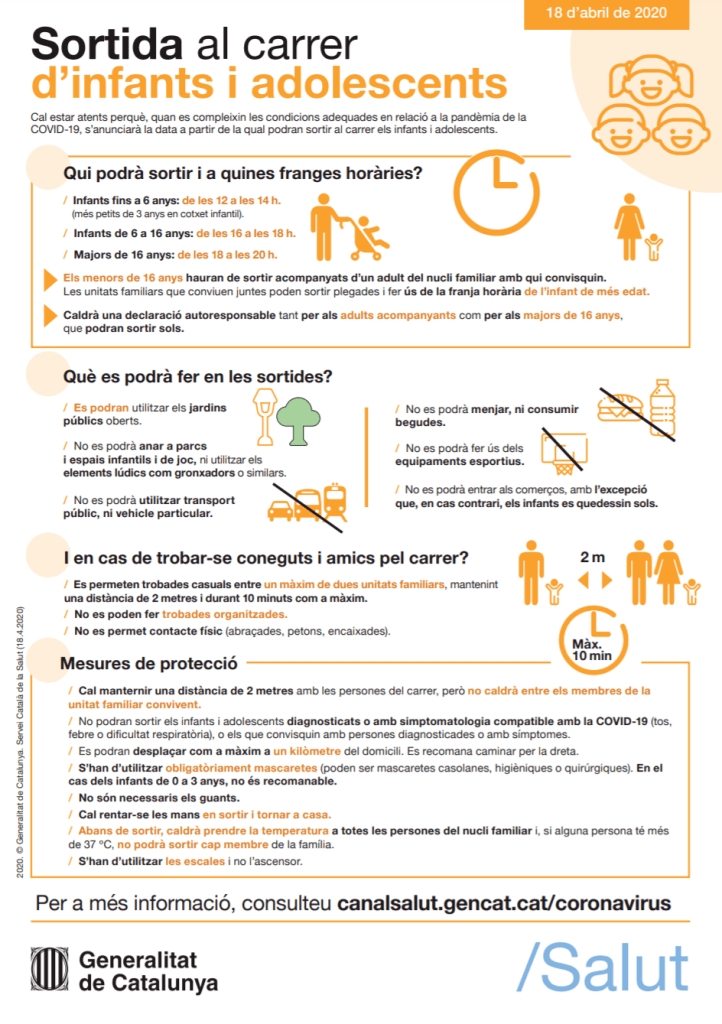
Nicole spotted a sign that the Spanish government is preparing to relax its lockdown. It’s an actual sign. If you’re having trouble reading it, so am I. It’s in Catalan. It gives directions on when children can go outside and what they can do.

The rumors are that relaxation measures will begin going into effect next week or the week after in Spain. Nothing has been approved at this time. The advisory above indicates the Spanish government is devloping its messaging. As in the US, it seems that, as excited as my friends are to get outside, what they really want to know is how to stay safe.

Relaxing the lockdown comes with risks of a resurgence of Covid-19. As I noted on 17 April, after Singapore’s Covid-19 cases plateaued, it saw a resurgence of Covid-19 cases in worker dormitories last week. Last night there were new reports that China is having a Covid-19 resurgence in the north.

Two billion people in lockdowns around the world want to go back to normal, but no one knows for sure what will happen when we start going outside. We don’t even have testing good enough to tell us what’s happening now.

Everyone wants to go back to normal because the world economy sucks. Federal Reserve Bank of Philadelphia President Patrick Harker expects the US economy to contract 5% in 2020. What to do?

Here’s a quick explainer from Steve Davis at University of Chicago Booth School of Business on market volatility this year.

Professor Steve Davis on unprecedented market volatility during Covid outbreak. Chicago Booth School of Business.

Davis attributes volatility not to media reporting of the pandemic, but rather to both the international interconnectedness of the economy and the extent of Covid-19 policy responses (social distancing of two billion people).

I will add that, unlike 1929 and 2008, the markets themselves are not the problem this time around. As McKinsey noted (see my 5 April entry), this market event looks like the end of WWII when there were enormous labor discontinuities as troops returned and industry transformed from supporting a worldwide military effort to creating consumer goods.

This suggests that fiscal policy support for displaced labor is the key to recovery rather than monetary response to market problems. The liquidity crunches in this downturn should be easier to manage than 1929 and 2008. In other words, putting money in the hands of workers will work better than putting it in the hands of financiers a la 2008. What will be difficult is maintaining supply chains while protecting worker health. One silver lining: Covid-19 may be a fast-motion trial for how economies change as Artificial Intelligence and Machine Learning displace large segments of the workforce.

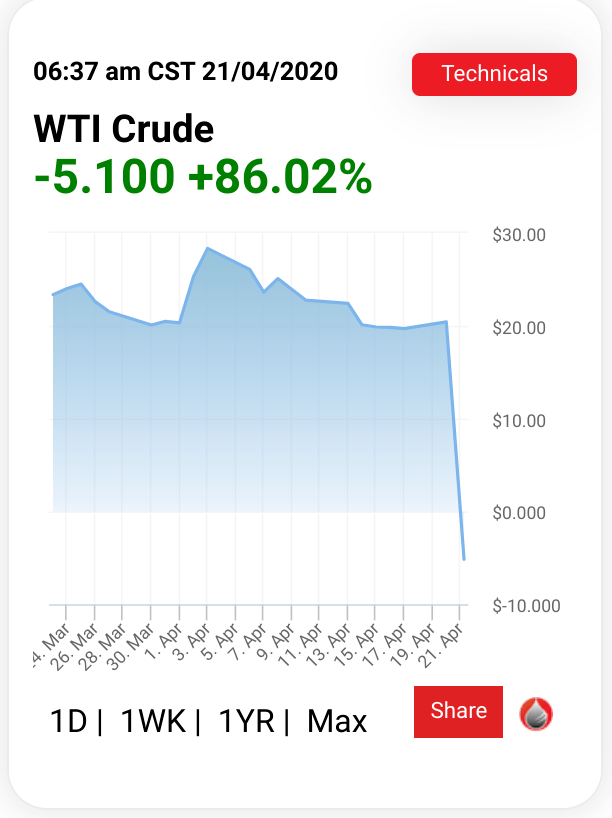
As you might expect, the reduction in travel and office use has upended the energy segment. This Twitter thread records Texas crude dropping from US$8 to less than $US2 per barrel.

West Texas crud oil drops below $2 per barrel

So much for ending the oil war between Saudi Arabia and Russia that started last month. Even Vladmir Putin might be having second thoughts about having helped Trump win in 2016. And, as Brad notes, who would have guessed oil would hit US$0 before bitcoins? It’s a great opportunity for clean energy businesses to buy their carbon-based competitors and shut them down.

West Texas crude trades for negative values on 21 April 2020. We’ll pay you to take it!

In my 18 April entry, I mentioned a Stanford study of Covid-19 infections that claimed 50x-85x more infections than previously thought in Santa Clara county. The methodology of the Stanford team set off a bit of a firestorm in the epidemiology community, with some saying that 30x more infections that previously thought would be a higher bound. A recent Southern California test seems to confirm the initial Stanford findings.

I take away two points from the bruhaha. First, wait for the peer review process to play out before developing policy based on these kinds of studies. This is no different from hydroxychloroquine where people jumped to a conclusion based on anecdotal evidence rather than waiting for a proper study (which showed that hydroxychloroquine was ineffective at treating Covid-19).

Second, do more testing with better tests and better methodologies. A lot of the controversy about the Stanford study stems from how the Stanford team adjusted their raw numbers. For understandable reasons, it appears researchers are trading off reliable results with timely results right now.

The reason people are willing to trade off some accuracy to get these numbers as quickly as possible is that they are the raw inputs to the epidemilogical models that help us manage Covid-19. In the absence of these numbers, we can’t use models and we’re left with social distancing and hand washing.

If and when we have accurate infection rates and mortality rates for Covid-19 in Santa Clara county and Southern California, those numbers won’t necessariy apply to other places. For instance, BCG vaccine seems to reduce mortality by 10x (there is a trial in Australia underway to test this hypothesis). That would suggest that mortality rates for Santa Clara, which has never had a BCG vaccination program, will be different from, say, Germany, where BCG vaccinations were given to populations in parts of the country controlled by the USSR.

Bottom line: we need more testing to understand what to do next.

Sorry I missed 4/20 day. It’s 20/4 day here in Barcelona, so it didn’t register. But not to disappoint. My friend Matt resurfaced a classic AIDS-era pot brownie recipe to help you stay calm at home this week. All I can say is, if it worked during AIDS, it will work during Covid-19.

Also, sorry to report Pamplona has cancelled this year’s Running of the Bulls festival and San Francisco Pride has cancelled the Pride Parade on its 50th anniversary.

Hey, listen. I don’t want to sound like everyone else, but I’ve been writing Covid Diary BCN for seventy five years, always trying to help friends and family, even people in my community I don’t know. Today, more than ever, in these times of uncertainty, when we’re spending time apart, there are still ways we can stay together without leaving the comfort and safety of home. I’m here to help. You can count on me. We’ll get through this together.

Every Covid-19 Commerical is Exactly the Same

If you like what you read, please share with friends on social media and via email. Thanks!