10 January 2021 – Sunday – #129

Mom says she’s getting her Covid-19 vaccination next week. She lives in Oakland, so maybe California is getting its vaccine act together. I told Mom I’ll believe it after she gets the shot. Not that I don’t trust my mother, but the US Covid-19 vaccine rollout has been flawed and now it’s the last thing on anyone’s mind.

How could Covid-19 vaccine be the last thing on anyone’s mind? In case you missed it, after Spain celebrated Dia de los Reyes on Wednesday, Trump led an insurrection at the US Capitol. To judge from US headlines I see, I’d have thought the Covid-19 pandemic was pretty much over.

Yahoo! News headlines, 10 January 2021.

On the sixth of January, Trump’s “Stop the Steal” insurgents swarmed the Capitol to interrupt the certification of President-elect Biden’s election. Certification is the final formality before Biden is inaugurated in ten days. By late Wednesday, the Capitol was cleared of insurgents and, by early Thursday morning, congress completed its certification. By Thursday, House Speaker Pelosi was calling for Trump’s removal from office.

The world gasped at the breach in democracy. Everyone was watching. Even our local storekeepers, who were kind enough to ask Brad and me what in the actual fuck was going on. It sounds nicer when they ask that in Spanish.

Here in Barcelona, news of Trump’s insurrection brought back fond memories of the long ago Catalan independence movement.

As the world gasped, Spain was battening down the hatches for Tormenta Filomena. To judge from Spanish headlines, I also might have concluded the Covid-19 pandemic was over.

El País headlines, 10 January 2021.

Spain’s weather has been unseasonably cold. I can make that claim with some authority since I spent winter in Spain last year. Filomena blanketed Madrid with snow, which is unusual but not unheard of. The capital had about 20 cm of snow, shutting down its airport and halting train service.

The bad news is that even though it’s snowing throughout Spain, Covid-19 restrictions prohibit travel to ski slopes. The good news is that the Madrid government’s snow restrictions should bring down its Covid-19 reproduction rate R.

If Filomena dumped snow for another week, the conservative Madrid government could continue its snow restrictions and R would drop below one just as Covid-19 vaccinations ramp up.

I’m jesting, of course. A little. It turns out that public health officials are getting better at imposing Covid-19 restrictions that work because they have more data.

Closing schools and universities, which is what Madrid has ordered because of snow, correlates well with lower Covid-19 R. If Madrid’s R does drop next week, it may be that what its conservative government needed to do all along to improve Madrileños’ compliance with Covid-19 restrictions was to re-brand the restrictions as “snow days” or “enjoy your family week.”

Here in Barcelona, the independence movement complained that Madrid got all the snow while Barcelona was left with none. The snow protests turned violent.

Okay, now I am jesting. But it’s nice to know people have a little sense of humor left, even if it’s at the expense of Trump’s inexcusable insurrection.

Here in Catalonia it actually has been very quiet after Three Kings Day. This was the scene last night in Gracia.

Gracia street, 9 January 2021.

That’s a Saturday night. Woo-hoo!

Like the US, the Covid-19 vaccine rollout here is slow.

Catalonia Covid-19 vaccine administrations as of Friday, 8 January 2021. Source: Catalan News.

Please welcome the latest member of the Covid-19 family of charts, the vaccination rollout chart. Averaging the first 13 days of Catalonia’s vaccine administration, the region will achieve herd immunity in about four years. At least the curve is going in the right direction. I’m debating how soon to call my healthcare provider about availability.

In the first 3 weeks of US Covid-19 vaccine administration, about 2% of the US population has been vaccinated. At that rate, it will take about 2-1/2 years to reach herd immunity. Too bad Trump isn’t paying attention. Vaccinations need to go 5x – 10x faster. In ten more days, Biden’s team will take over the US vaccination charge.

Sorry to harp on this, but the “let the virus burn” argument to achieve herd immunity has many flaws. Besides assuming an unacceptable number of fatalities is a price that must be paid to save the economy, proponents discount the danger of mutations. Last week I blogged about the rising reproduction rate R of emerging Covid-19 strains.

This week, with confirmed worldwide cases approaching 90 million, new Covid-19 mutations now appear to be a source of Covid-19 reinfection.

The good news on the new UK and South African strains of Covid-19 is that lab tests indicate vaccines will continue to be effective against emerging strains. As I also noted last week, Dr. Bell from Oxford expressed concern about about how much the Spike protein changed in one of the recent South African mutations. Pfizer said this week that it doesn’t think that will be a problem for its vaccine.

Covid-19 bits.

My news feeds were swamped with news of Trump’s insurrection this week. I think that’s the right way to end this week’s post.

Chris Hayes reports on the insurrection at the US Capitol on 6 January 2021.

I write this for sanity, not for money. And to create a record of living through a pandemic. If you like it, please pass it on to friends and family. For more frequent Covid-19 updates, follow me on Twitter. It’s a million times nicer there now that they shut down Trump’s account.

3 January 2021 – Sunday – #128

The weather was a meteorological metaphor this week, strong winds blowing incessantly the final days of the 2020 to clear the Covid-19 taint from the air, then a cool sprinkle on New Year’s Day to cleanse celebratory hangovers, and finally a blushing New Year’s Day sunset to set the stage for 2021.

After sunset, I met Cristián in Barceloneta. We took a late New Year’s Day stroll along the Mediterranean.

Mediterranean Sea, late on New Year’s Day 2021.

The night before, on New Year’s Eve, Brad and I hosted Will and U.b. for a quiet dinner at Casa Solar. Four people for a celebration seemed reasonably safe, well within the current limit of six people for a social gathering.

Others had trouble with the idea of limiting their party to six, not to mention limiting their travel. 40-km (25 miles) up the coast from our dinner, there was a New Year’s rave in Llinars del Vallès. Reportedly 400 people from as far away as France, Belgium, and Holland attended.

Llinars del Vallès New Year’s Eve rave report.

The rave was organized on social media. No Covid-19 protocols were followed and it took two days for the police shut it down. With cases in Catalonia rising again, this rave seems like an avoidably irresponsible way to start 2021.

Catalonia Covid-19 cases per 100,000 for most recent 14 days. Source: Catalan News.

Of course, Catalonia wasn’t alone. In France, police broke up a two day New Year’s rave in Britanny that included 2,500 people.

New Year’s Day is a time for looking back and looking forward. New Year’s Day 2021 brought many retrospective pieces on Covid-19. My favorites were in The New Yorker (fans of the New Yorker’s old in-depth articles will dig this reporting), The Atlantic (everything Ed Yong writes is worth reading), and Politco (Trump’s dismantling of CDC, replacing scientists with political hacks).

What rang true in each of these articles is the importance of leadership, institutions, and preparation. I’ve harped about the importance of leadership in combating Covid-19, but public health and scientific institutions are other key elements of pandemic response. Good leadership without expertise and experience is like sword fighting with a wet bucatini.

These three articles provide example after example of Trump disassembling institutions with the expertise and experience required to respond to Covid-19, usually in the name of efficiency or better management. One of my hypotheses is that less developed countries are responding better to Covid-19 because, in order to deal with endemic disease and previous viral outbreaks, they maintain strong public health institutions.

Trump’s response sidelined government resources and relied on big pharma and the US healthcare system to manage Covid-19. While big pharma has delivered the vaccine, there is no coordinated system in place for its administration. The US for-profit healthcare isn’t designed for overwhelming numbers of sick people or for prevention. There is, for example, no test and trace in the US healthcare DNA. Trump dismantled non-profit parts of the US healthcare system like the CDC leaving for-profit parts lacking the requisite experience or expertise for the systematic shock of a pandemic.

Getting back to the Retrospection Department, the worst Covid-19 predictions came from none other than Trump.

Trump’s numerous 2020 Covid-19 predictions. Source: Politico, “The Worst Predictions of 2020.”

The bad news is that all of Trump’s Covid-19 predictions were wrong. It didn’t just “go away.” Instead, the US reached 20 million cases on New Year’s Day. The good news is that Trump keeps repeating another prediction: he’ll stay in the White House.

I hate looking forward right now. Sure, the Covid-19 vaccines are effective, but Covid-19 news was bad last week and is likely to get much worse for a couple of long winter months.

First, cases are rising in North American and Europe with colder weather (Covid-19 is more stable in colder weather) and holiday gatherings (more transmission opportunities). In the US, hospital bed maps are replacing weather maps.

Percent of US hospital beds occupied by Covid-19 patients. Source: National Public Radio.

Second, the new UK Covid-19 strain is really bad, portending future Covid-19 bad news. As this Twitter thread discusses, the reproduction rate R in this strain may be nearly double previous strains.

The UK B117 strain is spreading everywhere despite efforts two weeks ago to close down transportation lanes to the UK.

The news on the new South African Covid-19 strain doesn’t look good either, but there’s a dearth of information so far. What is clear with available information is that significant mutations in the South African strain may require a rework of Covid-19 vaccines.

Sir John Bell on the emerging South African Covid-19 strain.

South African researchers also are trying to determine if the new Covid-19 strain there is causing reinfections. “What doctors don’t know, [a Tygerberg Hospital spokeswoman] said, is whether these repeat positives are due to true reinfections, or to some people carrying the virus for a longer time.”

The final bit of bad Covid-19 news from last week is that the US vaccine rollout is slow. After Trump announced pre-election that the US would administer 100 million vaccine doses in 2020, and then scaled down his estimate post-election to 20 million doses in 2020, the actual number injected at year’s end was closer to 3 million. That number has increased to 4.3 million today. The US needs to deliver about 3 million doses per day (25-30 times more doses per day than it’s currently delivering) in order to achieve herd immunity this year.

It’s too early to tell about Europe vaccine rollouts since EMA Covid-19 vaccine approval came late in December and shipments started last week.

If the Covid-19 vaccine rollout is slow, one way to fix that might be to postpone the second dose so more people get first doses. UCSF’s Bob Wachter has suggested that, as has Professor Akiko Iwasaki in this Twitter thread.

The UK has adopted this approach. For now, though, it looks like Dr. Fauci wants to stick to the protocol that vaccine makers have tested (n.b., there are conflicting news reports on Fauci’s position).

One final end of year topic: Covid-19 disinformation. This is largely a US problem (European disinformation ROIs aren’t as good because the market is fragmented by language). Disinformation is a problem that extends well beyond 2020 and well beyond Covid-19.

The Guardian had a good year-end review of US disinformation, including Covid-19.

Mainstream media outlets still follow a traditional top-down broadcast model: an authoritative source produces the news and sends it out to consumers. The rightwing media ecosystem, which developed through talk radio, on the other hand, operates as a network of media personalities interacting with each other, “a community telling stories to their own community”, [Claire Wardle, the executive director of First Draft] said.

The Guardian, “Facts won’t fix this: experts on how to fight America’s disinformation crisis,” 1 January 2021.

Fox News is the bedrock of US conservative media. Evidence of its Covid-19 disinformation isn’t hard to find. From the 2020 Retrospection Department, here’s Tucker Carlson’s extensive 2020 Covid-19 disinformation.

The latest salvo in the conservative echo chamber is a faux debate about whether Covid-19 skeptics are being classified unfairly as Covid-19 deniers. The disinformation problem isn’t about skeptics versus deniers. It’s about owning the narrative and about the agenda of those who own it.

Stock markets are one place to look for disinformation correction. Will Covid-19 just go away? Is it something we shouldn’t worry about? What do funeral stocks tell us?

Zacks one year industry performance, Funeral Services vs Internet Commerce vs. SP500. As of 3 January 2021. Source: Zacks.

First of all, the market clearly prefers living consumers who buy stuff. While Covid-19 lockdown skeptics say that the economy won’t come back with lockdowns in place, the numbers show online commerce performing well above the market. More generally, industries that can conduct business online are doing fine.

With the long delays in funeral services due to high numbers of Covid-19 deaths, I would have thought the funeral industry would be booming, too. As I dug a little deeper, though, I found out that profit margins are sliding into the ground as consumers switch from formal memorial services with caskets to simpler cremation.

Rising demand for cremation over traditional funerals has hurt revenue per client in the funeral services space. Cremation costs significantly lower than traditional funeral, with the average cremation service cost being roughly $2,500. In fact, we note that the pandemic has fueled this trend, with families choosing cremations over the elaborate traditional funerals.

Nasdaq Latest News, “Rising Demand Keeps Funeral Industry Going: 4 Stocks to Watch,” 29 September 2020.

Part of the problem, of course, is that people can’t travel to funerals, so there’s less demand for elaborate services. Ironically, this suggests that the funeral industry, which is not inherently online in any sense, would benefit from lockdowns. Like many industries, if Covid-19 levels subsided and people felt comfortable meeting in person (with masks on, of course) in places like funeral homes, then profitability would increase even if fewer people went in the ground.

Covid-19 bits.

Happy New Year! Here’s a salute to you from our Casa Solar celebration.

Steven, Brad, Will, and U.b. celebrate New Years at Casa Solar.

I know you’ve been wondering why I used the awkward “wet bucatini” reference above. It has nothing to do with our New Year’s dinner. It’s because of the 2020 bucatini shortage. Yes, that’s right. Toilet paper was not the only critical shortage in 2020, at least in the US. Still not sure whether the bucatini shortage was due to Covid-19, but Covid-19 herd immunity might come before the bucatini shortage is resolved.


I write this for my sanity and to make a long-form record of living during the time of Covid-19. If you like it, please pass on to friends and family. For more frequent Covid-19 updates, follow me on Twitter.

27 December 2020 – Sunday – #127

There are a couple of odd Christmas traditions in Catalonia, el Caganer y el Caga Tió. Ruben taught these to Brad and me when we arrived last year. The polite way of explaining el Caganer is that he’s a pastor symbolizing fertility, but fertility in the sense of fertilization. As in, how to say this tastefully, taking a dump.

At Casa Solar, we had un Caga Tió. Tió in this case is not an uncle (that’s tío in Spanish), but a log (in Catalan), and, in the case of Caga Tió, a log that Catalan children feed and then hit until it poops Christmas presents.

Caga Tió at Casa Solar.

Not sure why the scatalogical fixation in Catalonia, but word is that the log got a face upgrade to make it easier to feed (and to compete with Santa Claus in retail). The Catalan traditions make as much sense, of course, as a man in a reindeer powered sled who slides down chimneys to deliver presents.

Although Brad and I didn’t feed or hit our Caga Tió, I, for one, believe it’s entirely responsible for the Pfizer’s Covid-19 vaccine that showed up in Spain for Christmas.

In the tradition of celebrating Christmas as an extended marketing event, the Spanish government has outdone itself with its Covid-19 Christmas wrapping paper. Spain and other countries moved quickly to deploy the Pfizer vaccine after EMA gave it full approval (not a EUA) last Monday. Not to be outdone by EMA and in the holiday spirit, the Vatican also gave the new Covid-19 vaccines its blessing, even if some of the underlying technology uses fetal tissue.

The first vaccination is like the immaculate conception. Every country has its iconic first vaccination Tweet. It’s the contemporary Madonna and child. Here is the Spanish first vaccination from Prime Minister Sánchez this morning.

Given the way Covid-19 numbers have risen since restrictions were relaxed at the beginning of December, the Spanish government can use good Covid-19 P.R. In the days before Christmas, Spanish regions started clamping down again. In Catalonia, restaurant hours have been cut back to two hours in the morning and two hours in the afternoon. Para llevar is allowed any time, so many restaurants continue serving in the evening from their front door. Travel is limited again, curfew at 10p (except Christmas Eve and New Yearś Eve at 1:30a), and social gatherings cannot exceed six.

Caga Tió gave us another Christmas present. US vaccine surveys show that Covid-19 vaccination attitudes are changing as actual vaccine arrives. “In polls by Gallup, the Kaiser Family Foundation and the Pew Research Center, the portion of people saying they are now likely or certain to take the vaccine has grown from about 50% this summer to more than 60%, and in one poll 73% — a figure that approaches what some public health experts say would be sufficient for herd immunity.”

Word of caution: Lots of debate about what percentage of the population needs vaccinations to achieve Covid-19 herd immunity. Second word of caution: I’m still encountering lots of vaccine misinformation on my social feeds.

One last Christmas present, an amazing jamón serrano from Jim, all 15 lbs of it. Our small Christmas Eve orphans’ dinner started by learning how to carve el jamon. We needed vocabulary lessons for parts of the ham and carving equipment. If you’re in the mood to give a late Christmas present, we still could use carving lessons. The best maestro cortador charges €4,000 to slice a jamón. It’s an art that takes practice.

Jamón serrano at Casa Solar.

Our Christmas Eve feast included roast chicken and artichokes. Alexa, who’s returning to Germany soon, cooked up excellent German sauerkraut and mashed potatoes. For dessert, Cristián made a delish German-style vegan berry tart and Amy brought creamy tiramisu. Brad survived his first Christmas intact.

Most of the Covid-19 news before Christmas sensationalized new virus strains from the UK (reportedly more transmission in children, stronger binding) and South Africa (reportedly more virulent, higher viral load). Bottom line is that more study is needed of both new strains to characterize their virulence and transmission.

The UK strain got more press as countries stopped travel to the UK to contain the spread. That didn’t work very well. In addition to cancelled holiday flights, around 3,000 lorries transporting Christmas goods were stuck when their continental passage was denied. In spite of the UK transportation bans, the new strain has been detected around the world. For the UK, the whole debacle seemed to be a preview of life after next week’s Brexit.

The new strains brought up questions about Covid-19 vaccines. Specifically, will the current vaccines work as the virus mutates? The answer is that Covid-19 vaccines are based on so many proteins that a handful changing shouldn’t change effectiveness significantly.

The question is, is this virus going to change the surface proteins in a way that can obviate either the vaccines or prior immunity, and there’s no indication that it’s doing  that right now, but over time it will evolve in ways where it can probably obviate prior infection or vaccines to some degree, so we’ll probably need to adapt our vaccines over time.

Former FDA chief Dr. Scott Gottlieb, CNBC, “‘I think this is already in the U.S.,’ Dr. Scott Gottlieb says of new U.K. Covid strain” 21 December 2020.

If you want to get into the weeds, here’s a good Twitter thread about “antigenic drift,” the dance between the mutating virus and vaccines.

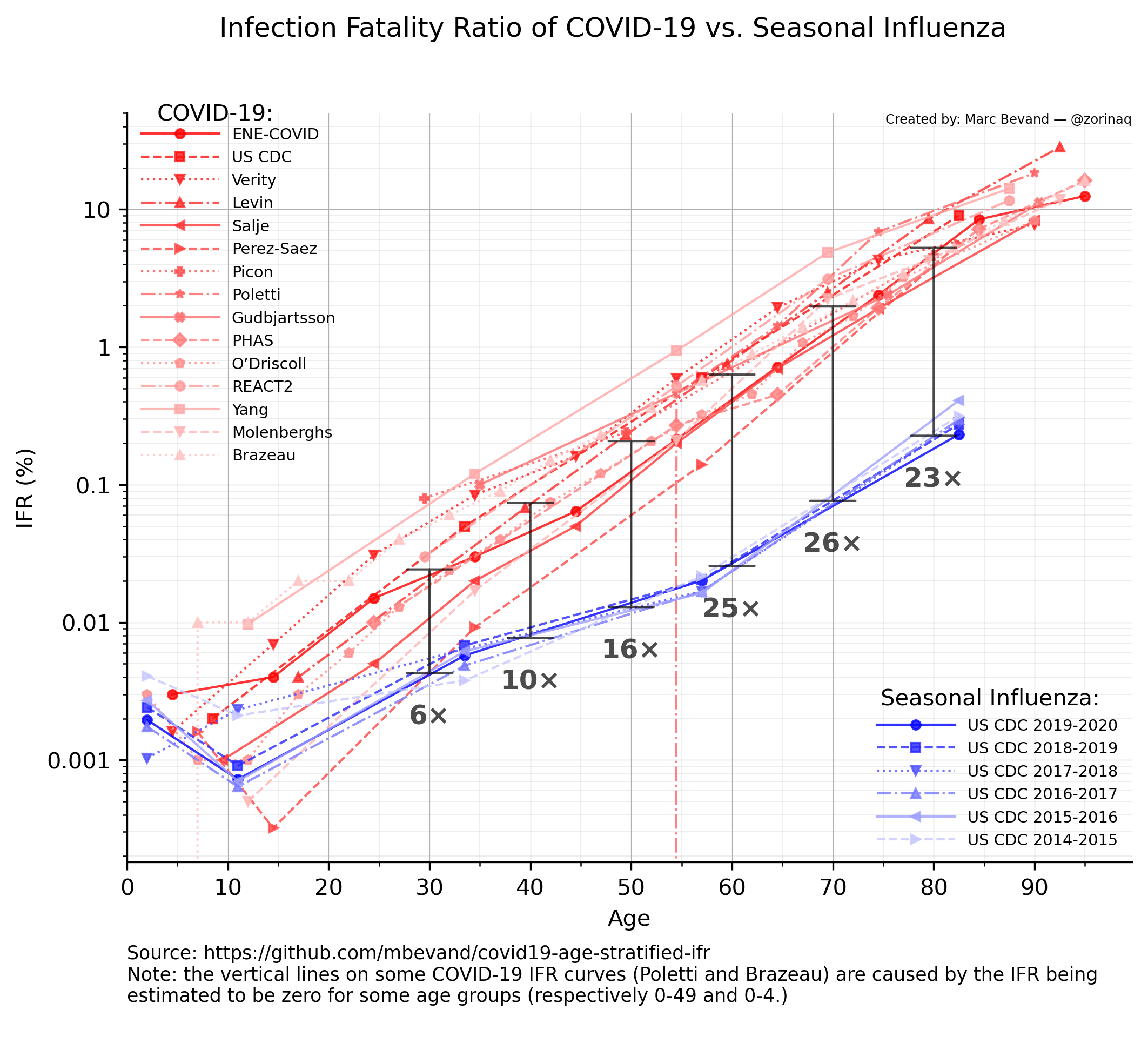
To me, the bigger question is whether Covid-19 IFR will change as the virus mutates.

Marc Bevand, comparison of Covid-19 and flu IFR by age based on several studies. Source: https://github.com/mbevand/covid19-age-stratified-ifr

The only way we know how IFRs change is to measure each new dominant strain. The risk of letting the virus essentially run wild is that more infections lead to more mutations and to more uncertainty about vaccine effectiveness and IFRs.

If you’re a software nerd who wants a software explanation of how Covid-19 vaccines work, Brad passed me this article on reverse engineering the BioNTech mRNA code. Even if you’re not a software nerd, the technology is impressive.

Since it’s the end of 2020 (thank goddess!), I’m going to post a year end review of Covid-19 mortality.

Cumulative Covid-19 deaths per million by country. Source: Australian Broadcasting Company.

This chart is based on confirmed cases. The actual Covid-19 deaths for countries at the top of the chart are much higher according to excess death statistics. At the end of the year, it looks like the US did end up copying Sweden as so many anti-lockdown pundits recommended. Too bad.

One local Covid-19 note: there sure is a lot of road construction going on around Barcelona. Not far from Casa Solar, Avinguda Diagonal is completely closed at the intersection of Passeig Sant Joan. This is like closing Broadway at 42nd Street in New York City, or Market Street at Van Ness in San Francisco, or the 405 in Los Angeles.

Road construction on Av. Diagonal

Brad mentioned that during the pandemic, while there is so little traffic, San Francisco has prioritized all approved and funded infrastructure projects that slow traffic. I suspect Barcelona is doing the same thing.

Covid-19 bits.

I arrived in Barcelona on the first of January, so this coming week I’ll celebrate my first anniversary living here. This article, 72hrs in Barcelona, describes the city I expected to enjoy in 2020. It’s a quaint read now. Covid-19 has changed life here and everywhere. I feel lucky to have met so many great people in spite of the Covid-19 restrictions. Going forward, Barcelona seems like it will be a little less touristy than it used to be. I can’t wait to enjoy more live events and to travel around Spain and Europe more.

It’s not only the winter holiday season, it’s also still 2020. That, and I’m living in the land of scatalogical Christmas symbols. So what more perfect way to end this Christmas blog post than a touching Covid-19 fecal transmission story.

Covid-19 fecal airborne transmission.

I write this to create a long form record of life during the Covid-19 pandemic. If you like it, please pass it on to friends and family. For more frequent Covid-19 updates, please follow me on Twitter.

Until we reach herd immunity, please wash your hands, keep your distance, and wear a mask.

Happy New Year from Barcelona!