8 November 2020 – Sunday – #120

All eyes were on the US election last week. People here are well informed and attentive. Local friends checked in, sent political cartoons, shared updates, and made prognostications. My friend Simon even stayed up all night after Tuesday’s election watching returns come in. He outlasted me. The alcohol I’d consumed overpowered my election nerves insomnia. I drifted off around 1am.

On Wednesday, I woke up at 5am to check online for a result. I’d have been better off sleeping in. Amy, Nicole, and Nicole’s daughter came over that afternoon to celebrate, although by 3pm the outcome still wasn’t entirely clear. It was nice to process the continuing election anxiety with compatriots. The vermut didn’t hurt.

Covid-19 added to my election anxiety. Wednesday night Nicole messaged that a teacher and a student at her daughter’s school tested positive. That left Brad and me in a bit of social limbo until Nicole’s daughter got her negative test result late Friday.

All last week, store proprietors who knew I was American (not hard to discern from my accent) asked polite non-partisan questions until I allowed as how I voted for Biden. Then we commiserated—as much as I can commiserate in Spanish—about the last four years of US political disaster. My commiserations boiled down to “Trump es loco.” Their commiserations felt like a blend of making sure I was okay and venting to an American. I wasn’t diplomatic in my responses. After all, the possibility of ongoing Trumpism, with or without Trump, is a big reason I’m residing in Barcelona.

Last night, after five tedious days of unending election website refreshes, eons after the winner was clear, the news services finally called the election for Biden. I found out from the zillion messages my local friends sent.

Overnight, my US friends sent messages of relief after four years of Trump’s race baiting and homophobia. Celebrations in the US spilled into the street.

The open questions today are who will deliver the bad news to Trump and whether Secret Service will have to escort him from the White House in January. As the Twittershpere notes, Trump is now like millions of Americans who got Covid-19, lost their jobs, and face eviction.

Before it was clear Biden would win, many friends in the US mentioned how smart my decision to move to Spain looked. Even my mother said that, which is a pretty big concession since she’d preferred I stay closer to home when I left. After Biden’s win, I’m content to watch the reconstruction from afar. It will take years to de-program Trump’s cult.


There is, of course, always foreign interest in US elections. This year interest is higher than normal, especially in Europe. Trump damaged US alliances bigly in four years. His nonsensical demands that NATO allies pay their fair share (they already were) and that Russia re-join the G7 (after multiple heinous international transgressions) are a couple of well-known examples of the way he upset world order in favor of authoritarianism. There are plenty more.

Covid-19 added to international anxiety about Trump. His Covid-19 response was another manifestation of his America First authoritarian streak. He alone decided on the US response, not public health experts, not scientists. He had no interest in cooperating with the rest of the world. He prioritized the US economy over its public health, then discounted the mounting death toll (“it is what it is”).

The result of prioritizing the economy while allowing Covid-19 to run its course has been predictably disastrous. By election day, the US surpassed 100,000 new Covid-19 per day. 27 US states set new records for Covid-19 cases. ICUs in Minneapolis-Saint Paul and Iowa are now over capacity. Today there are nearly 240,000 confirmed dead from Covid-19 in the US and another 100,000-200,000 projected to die by the time Biden is sworn in. In nearly every Covid-19 statistical category, the US is at or near the bottom compared to the rest of the world.

Not that Europe’s Covid-19 response has been perfect. After a summer with little Covid-19 in the air, it’s back with a vengeance. Spain set a seven day record for new cases led by Murcia, which has an as yet uncontrolled outbreak. Paris hospitals are at capacity. The UK is a week into a four week lockdown. Italy, which led the first wave of Covid-19 in Europe, has another bad case of Covid-19.

Here’s a good Twitter thread on the situation in Europe.

Unlike Trump, European authorities pay attention to experts as they shape Covid-19 policy and they prioritize health over economy. Where European leaders have failed is in building the testing and tracing capacity required to contain Covid-19 and in responding quickly enough to new outbreaks. Unlike Trump, who is doing nothing while Covid-19 burns through the US population, every European country has imposed restrictions during Europe’s second wave. European restrictions may be late, but they’re working (again).

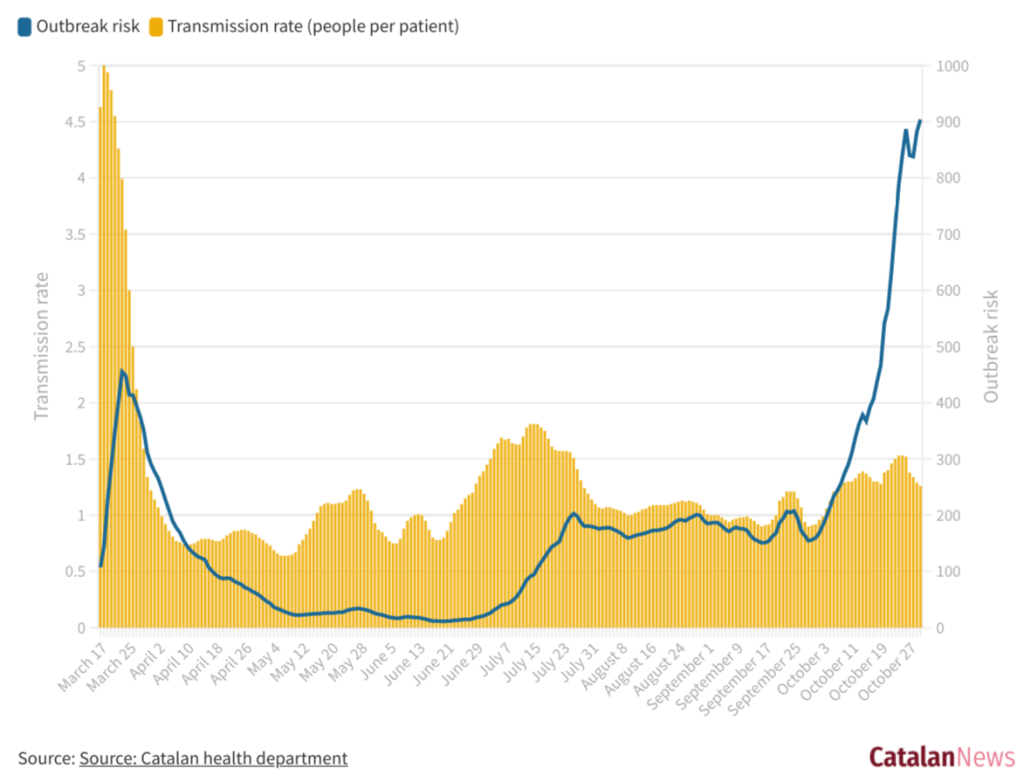
I’m going to toot Catalonia’s horn here. While Murcia and Madrid dillydallied as Covid-19 infections soared this summer, Catalonia imposed restrictions quickly as infections took off at the beginning of October. Three weekends ago, health authorities here closed down bars and restaurants and limited social gathering to six. Two weekends ago, they imposed a 10pm – 5am curfew. One weekend ago they limited transit between municipalities during weekends. Here’s what happened.
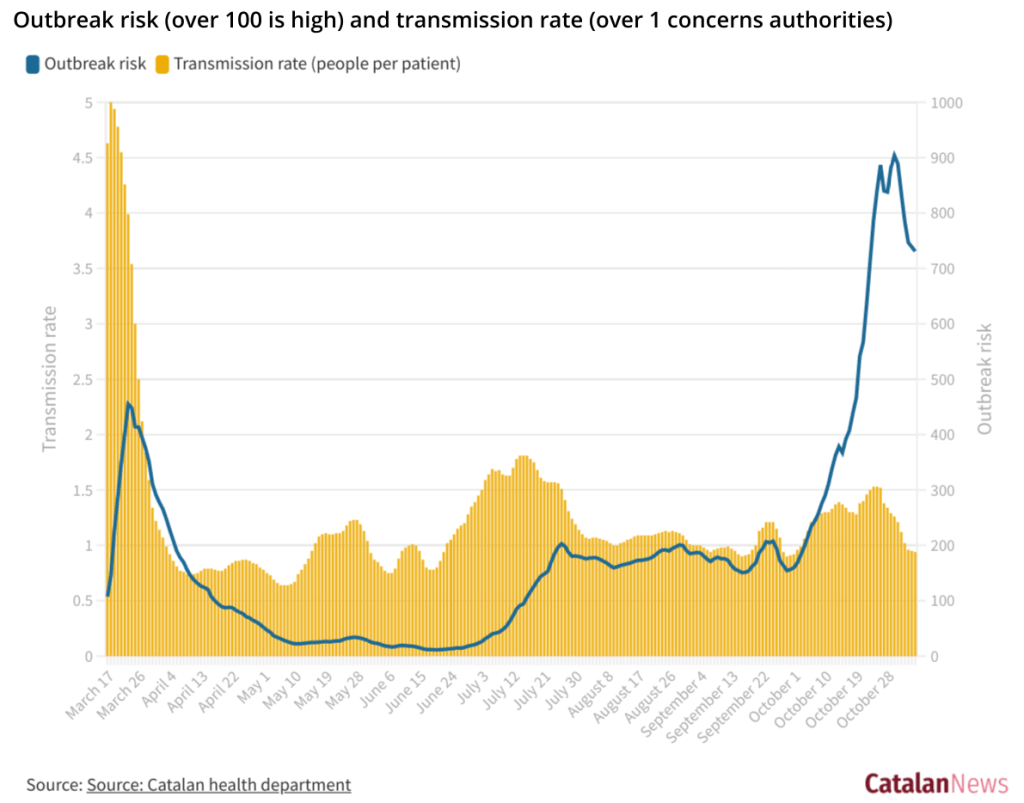
Catalonia Covid-19 reproduction rate R and outbreak risk. Source: Catalan News.

Catalonia’s Covid-19 statistics are moving the right direction. The reproduction rate R is below 1.0 again and the highly sensitive outbreak risk is dropping. Hospitalizations have peaked.

Trump’s inaction on Covid-19 is a drag on Europe and most of the rest of the world. Brazil’s President Bolsonaro is perhaps the best example of Trump’s deadly influence. But Trump’s influence is pervasive. He implicitly has empowered conservative politicians like Isabel Díaz Ayuso, the president of the Madrid Region, to ignore public health officials and tout freedom from government at the expense of high Covid-19 infection rates. Trump implicitly empowers protests against masks and other forms of government “intrusion.”

Covid-19 is an important reason the world watched last week’s election. Foreign leaders did not wait for Trump to concede before congratulating President-elect Biden and Vice President-elect Harris.


Two stories from last week highlight the difference between the way Trump and Biden approach Covid-19.

Trump sees Covid-19 as a hindrance to his aspirations, as something best swept under the rug. When White House Chief of Staff Mark Meadows tested positive last week, Trump ordered the result kept secret. A positive test didn’t fit Trump’s campaign narrative that he’d controlled the virus and the economy was coming back.

Meadows attended several election day events without a mask, probably super-spreading the virus to White House staff and Trump supporters at the Trump election night party at the White House.

Parenthetically, it’s not clear whether Florida Representative Matt Gaetz, who also tested positive, was in contact with Meadows. Gaetz is the fourth member of Florida’s Republican delegation to get Covid-019.

Contrast Trump’s management of Meadow’s test result with President-elect Biden’s first official action on Covid-19. Tomorrow Biden is scheduled to announce a twelve member Covid-19 task force. He’s announcing his Covid-19 task force before he nominates any cabinet members. We already know the task force will be lead by “former Surgeon General Vivek Murthy, former Food and Drug Administration Commissioner David Kessler and Dr. Marcella Nunez-Smith from Yale University.”

The world will see a very different US attitude about Covid-19 emerge in the next 2-1/2 months.

There are a couple of other Covid-19 stories from this election that I don’t understand yet. One is that the economy rated higher as a factor in voters’ decision making than Covid-19. The other is that 93% of US counties with the most new Covid-19 cases per capita voted for Trump. I’m waiting for the avalanche of election analysis coming in the following weeks to understand how either of these is possible.

The big surprise to me is that Trump didn’t call out this election result. North Dakota voters elected a Republican who died of Covid-19 to the state legislature. This fits Trump’s narrative perfectly that if we simply disregard Covid-19, everything will be normal.

Covid-19 bits.

I’m ending this election edition of Covid Diary BCN with a heartfelt reaction to the election of Joe Biden and Kamala Harris.


I write Covid Diary BCN for my own sanity. If you like it, please pass it along to friends and family. Follow me on Twitter for more frequent updates.
1 November 2020 – Sunday – #119

Happy Halloween! It’s starting to feel scarier than the first wave of Covid-19 in March. Last week, the US recorded nearly 100,000 new Covid-19 cases in a day. Spain reported its first day over 25,000. Both countries set unfortunate and unnecessary records.

At least Spain is doing something about its Covid-19 surge, even if it’s late and disorganized. Most of Spain’s second wave started over the summer in Madrid, Murcia, and the Basque Country. As schools opened, the second wave spread to most other regions. The central government finally approved a six month state of alarm last week.

Catalonia’s infections didn’t start trending up until October, then quickly climbed well over 500 per 100,000 for the most recent 14 days. That’s usually a good indication that a lockdown is called for. The region hasn’t locked down, but two weeks ago it limited social gatherings to six and closed restaurants and bars. Cultural events have been prohibited, too. A week ago Catalonia imposed a curfew from 10p to 6a.

Here’s what’s happened to the reproduction rate R (yellow bars) and the outbreak risk (blue line).

Covid-19 R and outbreak risk as of 27 October 2020. Source: Catalan News.

It’s too early to tell if Covid-19 infections have leveled off. At least R is responding well to the new Covid-19 restrictions even if the more sensitive outbreak risk continues to bounce around. Restaurants and bars were supposed to be closed for two weeks, but clearly they will stay closed longer. While it’s not hard to find restaurants serving para llevar from their front doors, most look closed for the duration.

On Friday Catalonia, like most regions in Spain, imposed travel restrictions between regions and municipalities. Catalonia’s weekend restriction means I cannot travel to see friends in other parts of Catalonia or Spain unless I arrive before Thursday night and leave after Monday morning. It seems like a final attempt to slow Covid-19 before imposition of a full lockdown.

Unlike March, these latest restrictions are being met with resistance in Barcelona (and elsewhere). Not what I would characterize as major resistance, but rather pockets of resistance. Part of the reason there was little resistance in March is that the main thing people understood about Covid-19 was that it killed people, so staying inside seemed like as good an idea as any. Ten months later we have lots more information and lots less desire to isolate.

I’m concerned that disinformation is fanning the flames of frustration here as it has in the US. Cristián sent me a photo of Covid-19 disinformation flyer he found in the lobby of his apartment in the Born district of Barcelona last week.

Covid-19 disinformation flyer in Barcelona.

The flyer says the wealthiest one percent is using Covid-19 as a way to take advantage of the other 99%. It contains standard QAnon-style disinformation about 5G, nanotechnology, and vaccines. The QR code on the reverse side of the flyer lands on Google Drive folders chock full of disinformation.

It’s not clear how disinformation is influencing protesters here, but there are protests. Friday night saw protests in Plaça de Sant Jaume against the new Covid-19 restrictions.

Parenthetically, there were videos on social media of looting as well as protests. Brad chalks up the looting to out-of-work pickpockets. He said many bicycles shown being stolen on the sports store looting videos were listed for sale online minutes after the looting.

Last night I photographed a smaller contingent marching down Corsega, the street just below Gracia. They look more like Covid-19 protesters than Halloween revelers.

About 50 protesters on Halloween below Gracia in Barcelona, 31 October 2020.

My concern about disinformation may be paranoia after so many months of reading about Covid-19 and other disinformation in the lead up to this Tuesday’s US election. But I do wonder who is behind the flyer Cristián spotted.

Hints I see of Covid-19 disinformation and resistance to Covid-19 restrictions in Barcelona are coming on the heels of a significant Catalonian independence story that broke last week. To wit, Judge Joaquín Aguirre is investigating whether Russia tried to aid the Catalonian independence movement three years ago with offers of soldiers and money.

On October 24, 2017, three days before Catalonia’s failed declaration of independence, [Victor] Terradellas is reported to have contacted the then president, Carles Puigdemont, assuring him that the Russian group could send 10,000 soldiers and pay Catalonia’s debt.

Catalan News, “Russia’s alleged plot to send 10k soldiers to defend Catalan independence denied by Kremlin,” 30 October 2020.

For the record, both the Catalan independence movement and Russia deny the allegation. However, knowing that Russia probably saw Catalonia as a cheap way to destabilize Spain and knowing its track record on disinformation, I have to wonder if Russia is behind the Covid-19 disinformation flyer and Google drive account mentioned above. It’s also possible other foreign interests know that Russia gamed Catalonia’s independence movement and see an opportunity for more interference.

Or maybe the one percent is really behind Covid-19 while it’s busy kidnapping children in pizza restaurants for sex and blood. You never know.

In the US, Covid-19 disinformation is stoked from the White House on down. Dr. Scott Atlas, the radiologist whom Trump effectively put in charge of his Coronavirus Task Farce, appeared on RT television last week espousing herd immunity (with vaccines at least a year away at scale, saying lockdowns and masks don’t work is implicitly advocating herd immunity, so let’s call it that). As you may know, RT is registered with the US government as a Russian agent.

Let me simplify that last paragraph. Russia is spreading Covid-19 disinformation from the White House that gives US conservatives permission to stand against US public health advice.

As an example of how this Russian mediated White House influence spreads and stifles the US response to Covid-19, a well-known conservative I follow on social media posted an article about how Covid-19 restrictions lead to authoritarianism. Its author argues that any public health restrictions must be viewed as authoritarian in nature because the only thing government employees want is power.

In addition, people who go into government tend to be the sort who naturally gravitate toward using power. And crises are excellent excuses for accumulating unprecedented authority and using it in novel ways.

Reason, “The Post-Pandemic ‘New Normal’ Looks Awfully Authoritarian,” 5 October 2020.

I would suggest that if that’s the opening gambit in a discussion about responding to a deadly virus, the virus wins. Using that argument, there can be no effective public health programs let alone dialog about the best public health response. Besides, it’s simply disingenuous to argue that, after decades of service, Drs. Fauci and Brix are motivated by political power. If they were so power hungry, why wouldn’t they, I don’t know, like run for office?

The main reason disinformation scares me is places like the US Midwest, where ICUs are running out of beds, and Belgium, where the government is asking healthcare workers sick with Covid-19 to continue to work because there aren’t enough healthcare workers. It’s easy to believe the disinformation, it’s lazy to rationalize that lockdowns lead to authoritarianism, but the reality is that it’s hard to comprehend Covid-19’s path of death and destruction until it’s too late.

I was heartened last night when Prime Minister Johnson announced a four week lockdown in England. Johnson had a severe case of Covid-19. He knows first hand the reality England is facing. He is demonstrating leadership by spreading public health information.

I’m also heartened by other countries. Last week Taiwan marked 200 days without a new Covid-19 case. Australia reduced its Covid-19 cases to zero. With its Covid-19 under control, China’s GDP surged with 4.9% year-over-year growth in the last quarter, far surpassing other G-7 economies (NB: that’s year-over-year). For the next couple of quarters, China is expected to outpace other G-7 countries that will be dealing with local outbreaks of Covid-19 rather than growing their economies.

Things are not going back to normal.

Covid-19 bits.

If you’re registered to vote in the United States, please vote Tuesday. 90 million already have because the health of the country is at stake.

25 October 2020 – Sunday – #118

When I moved to Barcelona on the first of the year, I was looking forward to short flights from BCN to cities in Europe, North Africa, and the Middle East. Covid-19 changed that plan.

Wednesday, I took a three hour train ride with Henrique for a long weekend in Valencia. It’s my first time out of Catalonia this year. It had been so long since I traveled that I had a little trepidation, worrying about things I don’t usually worry about when I travel, things like leaving a charger behind or finding the right train.

The good news about traveling to Valencia is that Covid-19 levels are about half what they are in Catalonia. The other good news is that Valencia, Spain’s third most populous city, is beautiful and vibrant.

Friday, we walked from the old city to the beach, starting from the Torres de Serranos, a medieval fortification near the original Roman city.

Torres de Serranos.

Along the way, we passed the Museo de las Ciencias, a spectacular building by Santiago Calatrava in the City of Arts and Sciences. To put things in perspective, the museum opened about 700 years after the Torres de Serranos opened.

Museo de las Ciencias.

We got a little lost, but made it to the beach in time for an evening meal and walk.

Playa de las Arenas.

The beaches are long in Valencia with fine sand. So late on a fall weekday, they were nearly deserted.

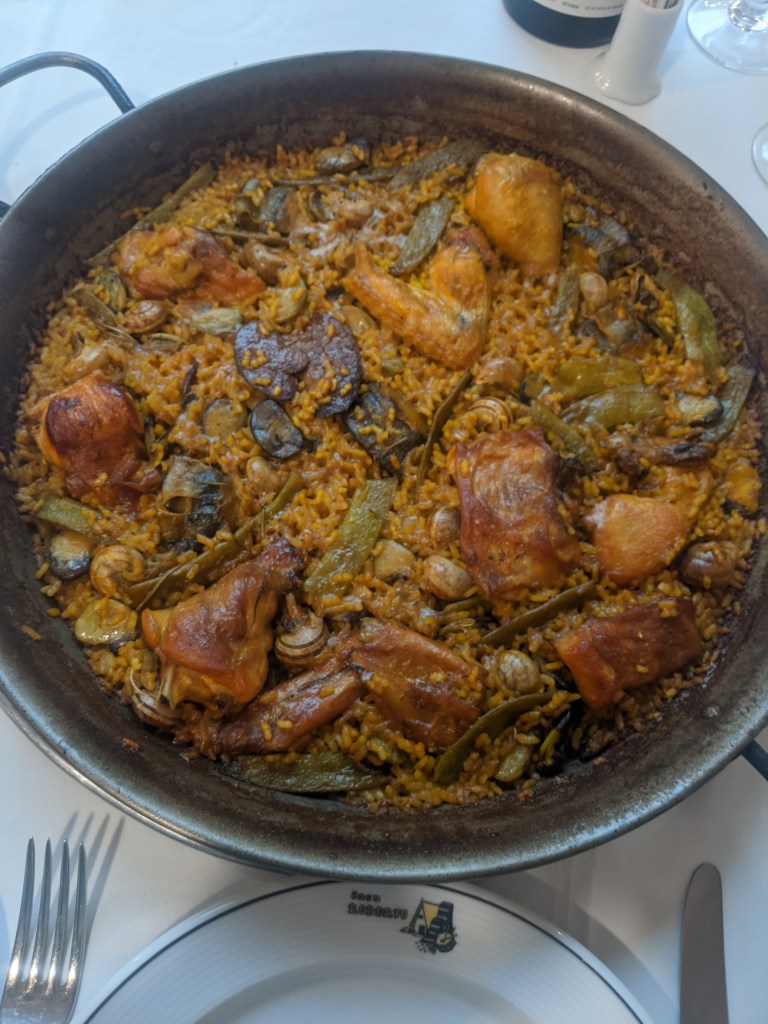
Valencia is the home of paella and there is no shortage of paella restaurants here. We shared a traditional Paella Valenciana at Casa Roberto.

Paella Valenciana at Casa Roberto.

In anticipation of my trip to Valencia, I cooked my first paella last week to understand the process. The main difference in the Casa Roberto recipe is the addition of snails and flat beans. There wasn’t much socarrat in this paella, just a bit of crust along the circumference and in the middle of the pan. I learned that if you want more socarrat, you have to order it. Due to reduced demand during the Covid-19 pandemic, the restaurant only served one other table for dinner. That made me feel safe eating inside, but was a shame for the business.

The timing for this trip may have been perfect with Spain debating a new State of Alarm. Spain became the first European country to surpass one million Covid-19 cases last week. It’s not clear how much longer I’ll be able to travel outside Barcelona.

Regions with bad outbreaks like Rioja are asking the central government to declare a State of Alarm so they will have the legal framework to impose a second round of severe Covid-19 restrictions. Travel restrictions and curfews seem most likely this time around rather than complete lockdowns. During our trip, Valencia announced a curfew from midnight until six in the morning, subject to court approval.

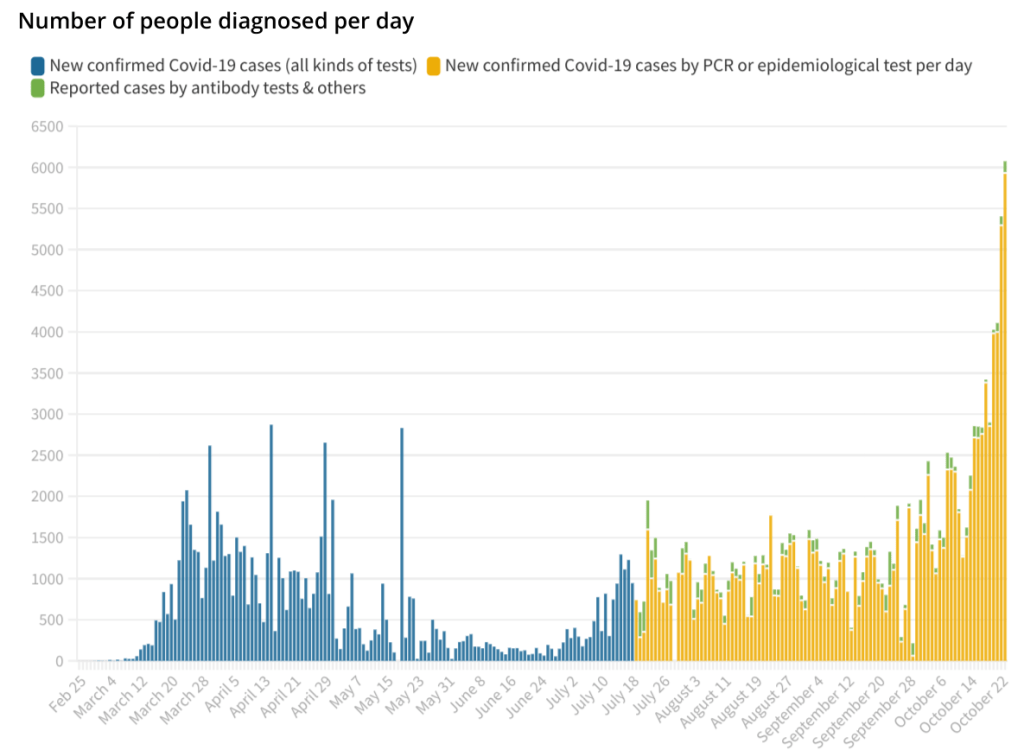
While Covid-19 cases stayed flat in Catalonia most of the summer, the virus has been heating up this month.

Confirmed new Covid-19 cases in Catalonia. Source: Catalan News.

Due to differences in reporting, it’s difficult to compare the second wave to the initial Covid-19 outbreak in Barcelona, but it’s clear hospitalizations are increasing again. Deaths will follow in the coming weeks. So far Catalonia has closed restaurants and restricted social gatherings to six people. Masking was mandatory already. It will be another week until the numbers show whether more and longer restrictions are needed.

Spain is not the only European country with a second wave of Covid-19, but it seems like the most disorganized. One sign of disorganization is that every region is adopting unique curfew hours. Another sign came last week when, rather than focusing on Covid-19, the opposition party wasted two days debating a no-confidence vote against the government of Prime Minister Pedro Sánchez, a vote it knew it could not win. The natural power struggle between Spain’s regional governments, its central government, and its political parties will have to give way to the reality of rising Covid-19 cases.

At least Sánchez isn’t promoting bad science like his counterpart in the US. The Covid-19 problems in Spain are child’s play compared to the US, especially as the 2020 election exacerbates Trump’s politicizaton of public health. While Trump claimed in last week’s final presidential debate that the US was turning the corner on Covid-19—a claim he has made repeatedly since the beginning of the US outbreak—new Covid-19 cases surpassed 80,000 per day for the first time in the US. The US is turning a corner, for sure, but around this corner is increasing death. Without any changes to Trump’s Covid-19 public health policies, University of Washington researchers predict 500,000 deaths by February.

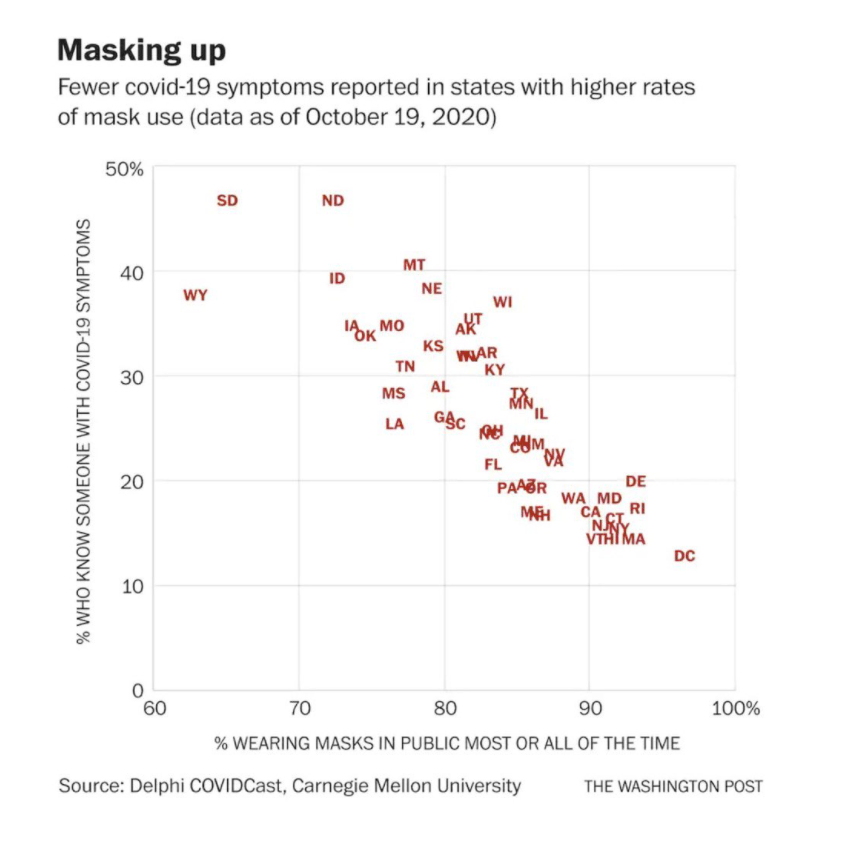
The clearest example of public health politicizaton is masks. Yes, there was confusion about wearing masks at the beginning of the pandemic. That confusion went away in the science community as evidence piled up over the summer. Here’s one recent proof point.

Masking compliance versus spread of Covid-19 symptoms.

Like most masking proof points, this one isn’t perfect. It shows correlation rather than causation. No one has shown direct causation for masking and reduction in Covid-19 cases and severity, but the accumulation of proof points like this chart makes it nonsensical to insist that masks don’t help. If there were any high cost to masking, it would make sense to look for more proof points before adopting masking as public health policy. For Trump, the cost of masking seems to be suffocation. For those 250,000 who predicted to die before the inauguration, the logic of Trump’s masking analysis will have failed.

Covid-19 bits.

  • Covid-19 cases increased in places where Trump held campaign rallies which typically feature large crowds without masks.
  • Researchers have discovered that inhibiting something called factor D (not to be confused with vitamin D) may control inflammatory responses in Covid-19 cases.
  • Johnson & Johnson and AstraZeneca restarted their respective Covid-19 trials.
  • Three billion people live in places without cold distribution systems needed to deliver many Covid-19 vaccines candidates.
  • New Jersey’s governor signed a law that releases thousands of state prisoners early to avoid Covid-19 infections.
  • San Francisco’s oldest restaurant, Tadich Grill, will reopen for inside dining.
  • The CDC changed its definition of “close contact” to mean close indoor proximity to someone with Covid-19 for any 15 minutes during a 24 hour period. Previously it was for 15 consecutive minutes.
  • Members of Vice President Pence’s staff tested positive for Covid-19. Although the Vice President, who chairs the Coronavirus Task Force, was in close contact with several infected staff members, he will carry on campaigning rather than self-isolate.

I write this for my sanity. If it helps you, please pass on to friends and family. I tweet Covid-19 information frequently, so follow me there for the details.