18 October 2020 – Sunday – #117

I decided I should cook my first Paella Valenciana before my first trip to Valencia next week. I wanted to have a clue about the cooking process before I order a paella in the city that invented it.

Even though paella is from Valencia, Catalonia has adopted it. I don’t think that’s just because tourists who don’t know better expect it here. After all, it’s not nearly as far-fetched to find paella in a Barcelona restaurant as it, say, to find hominy grits in a Salt Lake City restaurant. However, my Barcelona friends often remind me that paella isn’t really from here.

My first Paella Valenciana

The main thing I learned cooking paella is that a successful paella has a yummy socarrat, a crust of rice that forms on the bottom of the pan. I had beginner’s luck with socarrat. I have a lot more to learn about getting socarrat just right every time.

The timing of my first Paella Valenciana last week is ironic since all restaurants in Catalonia closed Friday. Catalonia’s Covid-19 numbers were steady in August and September. After school started, though, Covid-19 numbers rose this month. The public health authorities say interaction with Madrid’s Covid-19 hot spot is another contributing factor to rising Covid-19 cases here.

Central Barcelona has two main boulevards, Passeig de Gracia and Passeig Sant Joan. The big retail brands line the former and outdoor restaurants line the latter. After the lockdown, Passeig Sant Joan foot traffic picked up much more than Passeig de Gracia. I think that’s because Barcelonians are more interested in meeting friends out for a bite while tourists are more interested in shopping, and there very few tourists.

Anyway, I strolled along Passeig Sant Joan yesterday and all the restaurants are, in fact, closed. It’s a ghost town again, not as unpopulated as during the lockdown but very quiet. A few restaurants were offering para llevar from the front door, but none of the outdoor dining spaces were in use.

The Obrador DelaCrem ice cream shop is a good indicator of the drop off in foot traffic. There have been lines of 10-20 people waiting for a lick when I’ve walked by recently. Yesterday there was no line.

Grocery stores were busy. People were stocking up on food to eat at home at the same time that grocery stores imposed limits on the number of shoppers in the market. That created long lines in some locations, but there doesn’t seem to be a repeat of the great toilet paper shortage that happened in March.

Barcelona retail and supermarkets impose limits on customers in the store.

So far, the Covid-19 restrictions in Catalonia don’t feel like a significant adjustment, not nearly as bad as the restrictions being imposed in Madrid and Paris right now. Of course, I don’t work in a restaurant. Catalonia has ordered restaurants to close for 15 days. If Covid-19 numbers don’t improve, I suspect it will be longer. Restaurants are feeling the pain and schools may not be far behind.

I don’t know whether I’ll find an open paella restaurant in Valencia next week, but Covid-19 numbers are much better there and I haven’t seen reports of additional restrictions in that region. Such is the uncertainty of travel in the time of Covid-19.

Here’s a geographic view of how things Covid-19 look in Europe.

Here’s a less geographic view of confirmed Covid-19 cases throughout the region including Eastern Europe numbers.

Confirmed new EU/EEA Covid-19 cases. Source: European Centre for Disease Prevention and Control.

While Europe is having its second wave, the US is having its third. Like the US, Europe’s current Covid-19 wave is worse in some places than in others. Here’s the picture in the US.
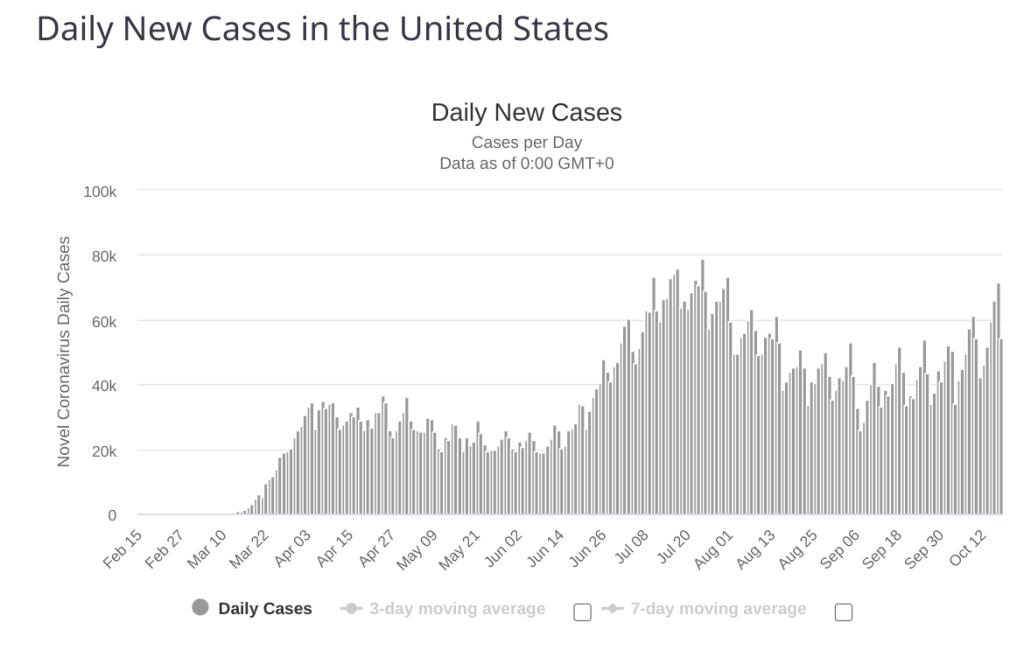
New US Covid-19 cases. Source: Worldometers.

The big difference between Europe and the US? Even if regions like Madrid have been slow to respond, generally Europe is putting in place Covid-19 restrictions to contain Covid-19. Republican US governors, on the other hand, continue to play politics with something as simple as mask mandates while their states run out of ICU beds.

It starts at the top. Trump’s catastrophic management of Covid-19 in the US has neither fired up economic growth nor improved his chances of reelection. The Republican party revolt is starting. Here are signs of a landslide for Biden.

As new US cases surpassed 60,000 per day last week, Trump continues to downplay Covid-19, holding crowded political rallies without mask mandates. Here’s the crowd waiting for him in Wisconsin yesterday. The state is having one of the most serious Covid-19 outbreaks in the US.

The outcome of the US election has implications for how Covid-19 vaccines come to market. Trump has taken a free market approach. In that framework, the first mover has significant advantage over other pharmaceuticals regardless of the effectiveness of its vaccine. After the first vaccine is approved, other candidates will face higher costs to complete trials and obtain distribution.

Biden has said that he will follow the advice of scientists. That could give more effective Covid-19 vaccines a better chance to complete trials and obtain distribution. In a world of anti-vaxxers, that matters. The possibility that 20%-30% of the population will refuse vaccination means Covid-19 herd immunity through vaccination requires more effective vaccines.

Covid-19 bits.

Last of all culture. Brad and I were bemoaning the lack of live performance, clubs, and other social events in Barcelona. It was one of the reasons we moved here. We’ve met great people so far, but Covid-19 restrictions reduce our opportunities to meet locals and extend our social circles. It’s like living in social limbo.

Luckily, artists continue one way or another. As an example, I leave you this week with a sample the Kinsey Sicks’ latest album, Quarantunes. I don’t get to meet anyone while I listen, but at least this is a sign that there will be cultural life after Covid-19.


I write this for my sanity. If you like it, please pass it on to friends and family. Also, you can follow me on Twitter for more frequent Covid-19 updates.
11 October 2020 – Sunday – #116

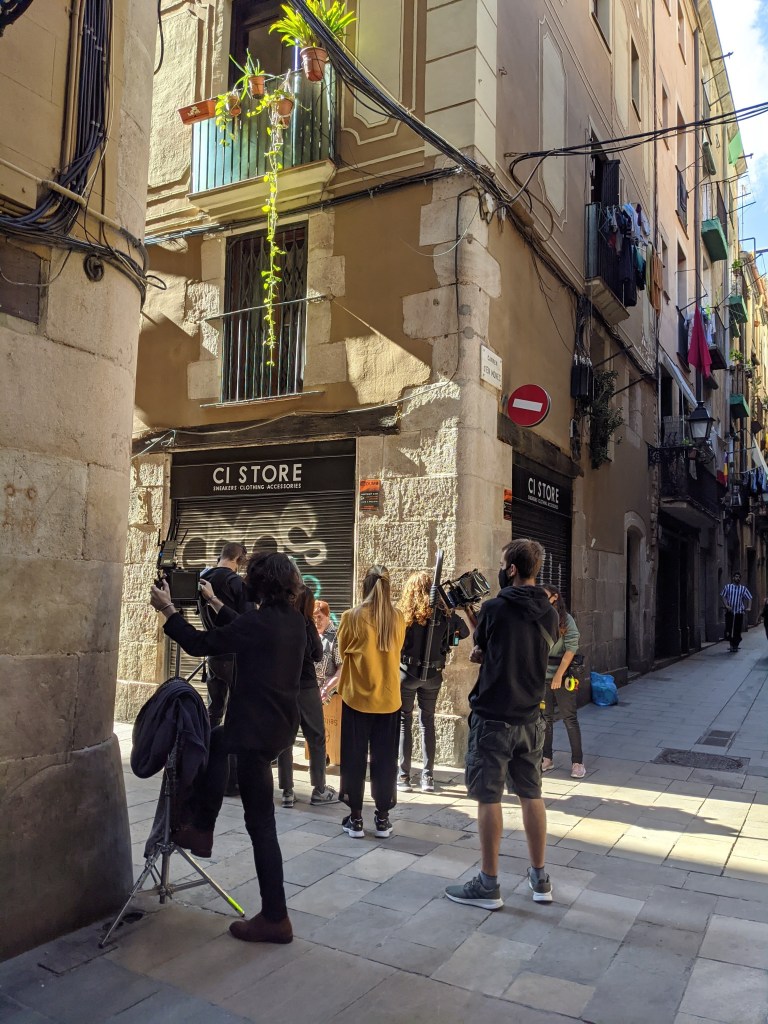
With so few tourists around, film crews are taking advantage of Barcelona’s quiet streets for exterior shots. Brad caught a crew shooting in the Born district.

Film crew in the Born district. Credit; Brad.

I post this to assure friends and family that, in spite of reports that Spain’s second wave of Covid-19 is the worst in Europe, Barcelona is not a seething cauldron of Covid-19 at the moment. That seething cauldron would be Madrid, where Spain’s central government has declared a state of alarm over objections of the regional government.

As I mentioned last week, Madrid’s regional premier, Isabel Díaz Ayuso, is prioritizing Madrid’s economy at the peril of Madrileños’ health. This makes me mad for three reasons.

First, it’s becoming more and more clear that the best way to fix an economy during the Covid-19 pandemic is to contain Covid-19. I tweeted last week about a study that shows how consumer spending dips as Covid-19 increases, even in the absence of lockdowns.

Worse, though, Madrid’s high Covid-19 rate hurts not only Madrid’s economy, but Spain’s economy. Empty Barcelona’s streets are easy to film in right now not because Covid-19 rates are high here, but because Madrid’s high numbers are scaring away tourists from traveling anywhere in Spain.

Second, while Madrid is about three hours by train from Barcelona, it’s a transportation hub and chances for cross-infection between cities increase as Madrid approaches a 1% active infection rate. Ayuso’s preference to risk lives to improve Madrid’s economy adds to the infection risk of me and other Barcelonians. Regional Covid-19 political decisions have national consequences.

Third, and this is personal, my PrEP order has been stuck in Madrid for over three weeks. I’m going to blame Ayuso because why not. Maybe it’s DHL’s responsibility, but I’ll bet that DHL is experiencing distribution issues in no small part because of Madrid’s Covid-19 crisis.

My PreEP order stuck in Madrid since 16 September 2020.

As my pill supply dwindled last week, I scrambled and found a Spanish PrEP provider at higher price whose reputation I can’t confirm. I should be okay with an order scheduled next week. I’m just growing tired of people who rationalize their inability to change their habits by claiming the economy is more important than taking simple precautions like social distancing and masking. If gay men figured out how to put on condoms to avoid HIV infections forty years ago, it boggles my mind that wearing a mask requires anything more than a brief explanation of Covid-19 aerosol transmission.

Madrid’s Covid-19 idiocy is helping me understand the Catalonian point of view about independence. And it is idiocy. Why do I say that? Arizona reduced Covid-19 cases by 75% by mandating masks. Wisconsin, on the other hand, where Republican legislators have fought their Democratic governor’s Covid-19 restrictions as hard as Ayuso is fighting Sánchez, has leapt ahead of all the other US states in per-capita Covid-19 cases.

Be smart. Be like Arizona and wear masks. Don’t be like Wisconsin and fight masks.

Even as I come to understand the dynamics of Spain’s central and regional governments, I have to admit I still have lots to learn about Spain and Spanish politics. Last week, U.b. came over to Casa Solar for dinner. I served my first Samfaina, a Catalonian ragout, and I gotta say it was delish. Pretty sure it’s the dash of sweet paprika at the end that makes the recipe work. Anyway, U.b. and his husband moved here from San Francisco 13 years ago, so U.b. understands US and Spanish political systems. He made two observations that, on the surface, don’t seem that important.

One observation is that cars here don’t have bumper stickers. That hadn’t registered with me before. As U.b. noted, it’s nice to drive to a store and not get worked up about abortion rights or gun rights on the trip.

The other observation is that door buzzers on buildings here display unit numbers, not residents’ names. Again, something I hadn’t noticed. Most modern US apartment buildings present a scrolling list of names that enable a call to an occupant for entry.

These are artifacts, it turns out, of Franco’s authoritarian regime. Su Excelencia el Jefe del Estado Generalísimo Francisco Franco, as he is formally known, ruled Spain for almost forty years, from 1936 to 1975. During that time, any Spaniard with wayward political views revealed those views at risk of life, so no bumper stickers. Also, obviously, there was no advantage letting Franco know where to arrest you, so no residents’ names outside buildings.

If you’ve been wondering what a few more years of a Trump White House might look like, these are two informative observations about the subtle ways authoritarianism manifests itself.

Luckily, 3-1/2 weeks before the election it looks like the Trump White House will end in January, before Trump assumes the title Su Excelencia el Jefe del Estado Generalísimo Trump.

Five Thirty Eight predicts that Biden wins the 2020 election. Source: projects.fivethirtyeight.com/2020-election-forecast/

Trump still can win. As Nate Silver notes, a Trump win is about as likely now as Truman beating Dewey in 1948. My ballot is still somewhere between Spain and the US.

Parenthetically, it seems like social media disinformation plays a smaller role in Spanish politics. My hunch is that scale works against the US in this regard. The US is about 330 million people who speak predominantly one language and participate in one election. The ROI on social media disinformation is higher in the US than in the EU because an effective EU disinformation campaign requires knowledge of many local languages and dialects, not to mention political systems. To create a fake social media account in Spain, first decide if the account is in Castilian, Catalan, Basque, Galician, or one of the dozen or so other Spanish languages and dialects.

In addition to U.b.’s two multicultural observations, I have one more, this one directly related to Covid-19. I was pleased to find BCN Checkpoint when I visited Barcelona last year, not because I was in need of their services, but because it reminded me of Magnet in San Francisco. Both BCN Checkpoint and Magnet offer public health services targeted to gay men. That may not seem important and most cities don’t provide separate public health services for gays. As a gay man, though, it is profoundly significant to have professionals figuring out how to make my life safer, especially with programs to eradicate HIV.

My observation is that both Barcelona and San Francisco not only have public health for gay men, but also they have had remarkably good Covid-19 responses. I realize this is too small a data set for a correlation between public health programs targeted to gay men and good Covid-19 responses to be meaningful, but I did mention this to my friend Mike who’s in a healthcare PhD program in Cleveland. Mike, it turns out, has been interviewing hospital CXOs around the US. Not surprisingly, he told me that Covid-19 responses seem to be better in cities with better public health systems.

So, my takeaway is that if you’re moving to a new city, besides looking for a post- rather than a pre-authoritarian city, also look for a city that has a public health program targeted to gay men. It’s a sign that city is investing enough in public health that when the next Covid-19 comes around (and it will), its public health response is likely to be up to snuff.

Madrid, beware! The US rejection of Trump in the election is due in large part to his Covid-19 policies, his prioritization of the economy over public health. The strange saga of his Covid-19 hospitalization bought him no sympathy support in the polls. He’s all but banned masks in the White House. He’s turned freedom from masks into a Republican party rallying cry. Masks have become the Republican symbol of smothering the economy. This infographic of Covid-19 cases per million by US state shows how red state pro-economy, anti-masking policy has fostered increases in Covid-19 cases.

Unfortunately, the Covid-19 surge in red states is pushing the US case numbers up just as flu season starts. New US Covid-19 cases have surpassed 50,000 per day, the highest number since August.

Covid-19 cases going up again in the US.

The cynic in me thinks Trump wants cases going up to suppress voter turnout.

Covid-19 bits.

As Biden says, election chicanery looks like the only thing that can stop him from winning the election. This Lincoln Project video captures how many Americans feel.

Last of all, following up from last week’s post, both C. and Trump have recovered from Covid-19. I believe C. I don’t believe Trump.


P.s. – this tweet came up just after I published.

4 October 2020 – Sunday – #115

Last weekend two things Covid happened. One is that a friend in Barcelona, whom I’ll refer to as C., got sick with Covid-19. The other is that the White House hosted a Covid-19 superspreader event to honor the nomination of Amy Coney Barrett to the Supreme Court.

When C. told me last weekend he didn’t want to meet up because he thought he was coming down with a flu, there was something in his voice that made me ask if he’d lost his sense of smell, a sure sign of Covid-19. He said no, so I relaxed and told myself not to be paranoid. Memories of the AIDS crisis, when every sniffle seemed like a premonition of infection and death. Covid-19 is rare in Barcelona and Catalonia these days. Hospitalizations have leveled off for a month and new cases look like they’re dropping. The transmission rate R stayed below 1.0 all September except for mid-month when it bubbled up just over 1.0 for a week.

In the middle of last week, though, C. did lose his sense of smell, confirming what I thought I heard in his voice. C. is younger than forty, so he’s not high risk. I check in with him every day or two. He’s feeling under the weather and he’s concerned about infecting others, but he’s okay for now. There’s not much for him to do but wait it out. I worry because just when Covid-19 looks like it’s clearing up, it can take a turn for the worse. But that’s my paranoia. Things go south far more frequently for people my age than C.’s.

While things Covid are okay here in Catalonia for now, they are bad elsewhere in Spain, especially Madrid. Currently Madrid has over one third of the Spain’s new Covid-19 cases. Under protest, the regional government will implement the central government’s Covid-19 restrictions this weekend, putting Madrid back into a lockdown. The politics of this are still a little complex for me.

Like conservatives in the US, conservatives in Madrid don’t want the state telling them how to lead their lives. While the conservative attitude towards Covid-19 is often expressed as a desire to control one’s own health decisions, this expression seems more like a rationalization of a different attitude, that my money is more important than whether I’m a viral vector for your infection.

Speaking of Madrid and conservatives, I want to divert for a moment to an observation that female leaders outperform male leaders in managing Covid-19. Early data through mid-May suggest that observation holds, at least at a national level.

F-led and M-led countries matched using GDP/pc, Pop, Pop Density and Pop over 65.

However, the observation is not holding true at the regional level. Clearly Madrid is flunking Covid-19 containment. The president of the Madrid region is Isabel Díaz Ayuso, a member of the conservative PP who’s been leading the region for about a year.

In the US, South Dakota Governor Kristi Noem, a Republican, is another counterexample to females leading successful Covid-19 responses. Noem is guiding her state through one of the worst state Covid-19 responses. South Dakota hosted, for instance, the Sturgis Motorcycle Rally which was a Covid-19 superspreader event.

It’s clear that leadership is an important—perhaps the most important—factor in the success of a Covid-19 response, both in terms of health and economy. Based on data so far, it appears males are less likely to lead an effective national response than females, and conservatives are less likely than liberals. That doesn’t mean, though, that any particular woman or liberal will succeed. I can’t wait for the PhD theses on this topic.

Madrid doesn’t have a monopoly on Covid-19 resurgence. Things Covid also are bad in Paris. Nicole planned a trip there for a “zero” birthday. In these days of Covid-19 travel, it’s hard to know what to do as conditions change on the ground. Last I heard, the plan is to take the trip and avoid public spaces. With masks and ventilation, that seems reasonable. Travel trade-offs are impossible right now.

Back to last weekend’s events. Besides C.’s Covid-19 infection, the other thing that happened last weekend was a White House superspreader event that appears to have resulted in Trump’s Covid-19 infection. The White House response to Trump’s infection gives me an opportunity to talk about Covid-19 misinformation.

In the past 72 hours, 27 people who were at the White House event last Saturday or who subsequently had contact with people at the event have tested positive, mostly Republicans and including POTUS, FLOTUS, three Republican US senators, and former Republican governor.

As this number increases, Covid-19 is throwing the Republican party further and further into disarray with an election 29 days away. I’ve read the word “schadenfreude” more in the last 24 hours than in the past 24 years. Republican party Covid-19 misinformation came back to haunt its lovely Supreme Court nomination party.

It’s an old story.

Parenthetically, check out this great story in The Atlantic about Covid-19 reproduction rates (R) and dispersion rates (k). You’ll understand how Covid-19 thrives at events like the White House superspreader.

The problem for Trump is that his infection throws his entire campaign on its head. Not wearing a mask, it turns out, has consequences. Trump’s infection runs counter to the campaign narrative that Covid-19 is over and the US is back on track. It forces the message back to today, not what the US might look like in a year or two. Trump’s Covid-19 misinformation campaign blew apart in his unmasked face. His challenge now is to become the hero of this catastrophe at the same time he’s ill in the hospital.

One might hope that the White House would worry about the presenting the facts and advising anyone who’s been in contact with Trump to test and quarantine. Nope. Studies came out in the last week showing Trump is the source of over one-third of all articles with Covid-19 misinformation (as well as lots of voter fraud misinformation), so it’s no surprise that in the aftermath of the superspreader party, the White House misinformation machine spews misinformation as Trump recuperates.

One of the new stars in this misinformation campaign is telegenic White House physician Sean Conley who insists Trump is fine while misspelling the names of the experimental treatment Trump had and correcting his timeline of events. The fact that Trump was receiving an experimental treatment is a sign that either he’s much sicker than Conley stated or he’s been watching Fox News suggest he take the treatment. Or both.

With performances by Conley and others, it’s hard to know what’s true in Trump’s Covid-19 saga. The worst reports, though, line up best with the action of moving Trump from the White House to Walter Reed Hospital. It seems Trump was contemplating death on Friday.

On Friday, Trump grew visibly anxious as his fever spiked to 103 fahrenheit and he was administered oxygen at the White House, according to three Republicans close to the White House. Two sources told me Trump experienced heart palpitations on Friday night—possible side effects of the experimental antibody treatment he received. Trump has wondered aloud if he could defeat the disease. “Am I going out like Stan Chera?” Trump has asked aides, referring to his friend, New York real-estate developer Stan Chera, who died of COVID in April.

Vanity Fair, “‘This is Spiraling out of Control:’ Allies Panic About Trump’s Hospital Stay as White House Deflects,” 3 October 2020.

After Trump moved to Walter Reed, the White House spin machine started. Even when the White House does its best to make Trump look good in videos and stills, though, he doesn’t.

Saturday’s photo shoot at Walter Reed is full of reality TV props to make everything look normal.

But it’s obvious that much has been edited (in this case with an Adobe video editing product), that we’re watching the reality TV version of Trump’s recovery.

This Twitter thread illustrates more of the problems with the underlying message in Saturday’s photo shoot, the misinformation that all is well and Trump is ready for his heroic comeback.

Trump has relied on misinformation during the entire Covid-19 pandemic. He’s not stopping now. The net result is no one knows what’s going on.

I’ll go back to my friend C. for a minute before I wrap up because C. is a real person in my life, not a reality TV star.

C. got his Covid-19 infection about the same time as Trump. The difference is that C. is young and in good shape. Not that any two case are the same, but Trump’s probably is worse than what his physician claims. Trump probably felt bad enough Friday to think he was going to die. C., on the other hand, never felt like he was going to die.

I worry about C., but his chances are good. His voice sounds healthier now. His mood is better. In real life Covid-19 sucks. C. doesn’t need to mislead me.

Trump? He’s a con man. I’ve never believed his spin. I look at the misinformation and wonder why he insists on it right now. The subtext of his entire recovery misinformation campaign is that he does need to mislead me. I don’t wish him ill, but I think his misinformation suggests he has a very rough week coming up.

Covid-19 bits.

Stay safe in all your travels. Keep your distance, wash your hands, and wear a mask.


I write this for my sanity. Daily updates on my Twitter feed. Pass on to friends and family.