27 September 2020 – Sunday – #114

I waited in line to vote Friday. It was the line at the Correo, of course, because I have to vote by absentee ballot. “Estoy votando,” I proudly told the clerk once I made it inside the post office. “No más Trump.”

The clerk smiled and said something in Spanish I didn’t understand.
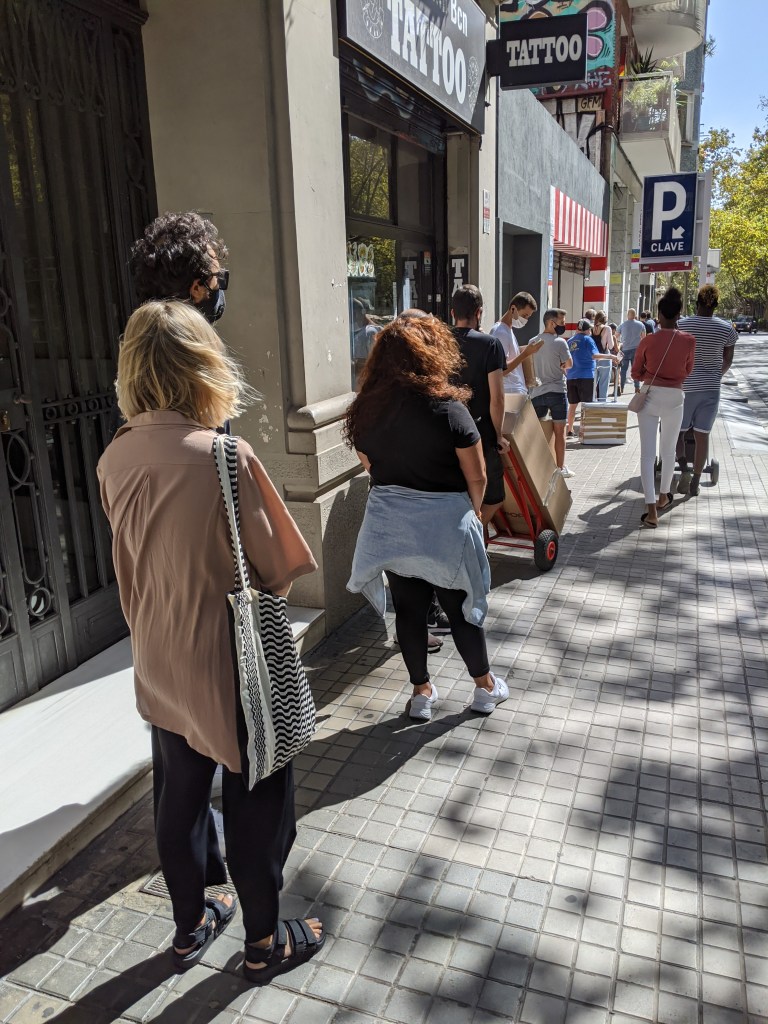
The line at the Correo when I went to mail my ballot.

Friday was a watershed day, many projects coming to fruition. I mailed my absentee ballot, paid a franchise tax on a corporation, received an insurance reimbursement, and bought Rabih’s book An Unnecessary Woman, a book I’d ordered for a necessary friend at one of the English bookstores in town. None of these projects seems earth shattering. In the U.S., each would have taken ten or fifteen minutes. Here, though, each of them took me about a month. It’s part of adjusting to a new country.

I won’t bore you with all the details, but there are always surprises during the most mundane tasks. For instance, when I started the absentee voting process, I needed to print application forms. I’ve given up on owning a printer. For the number of times I print in a year, the cartridge is invariably dry when I want to print. Instead of going to a printing shop to buy a fresh cartridge, I go to a printing shop and print.

I expected to print my absentee voting application at the shop around the corner, the shop with the handsome clerk I chat up those handful of times I print documents every year. Except, of course, this happened last month, and last month was August, and in August, I learned, shops are open at random times if they’re open at all. I’m sure my handsome clerk must have been sunning on a Sitges beach when I dropped by to print my absentee ballot application.

After walking past four other printing shops Google Maps offered me, all of which were closed for August, I found the one printing shop that’s open all year in Barcelona. If you should ever need it, you’ll find it along Av. Diagonal near the furniture stores. The task of printing applications that should have taken ten minutes took half an afternoon.

I don’t know why I didn’t anticipate another surprise at the end of my voting project. That surprise was the line at the Correo when I went to vote (image above). Instead of spending five minutes to get a tracking number for my ballot, which by now was invaluable with all the time it took to complete, I spent nearly a half hour in line first. At least it was pleasant weather outside. From the first step to the last, absentee voting took longer than expected.

I’m sure in a year or two I’ll have all these details of living in Barcelona worked out. I’ll know to look for the handsome clerk in Sitges in August instead of visiting his store. I’ll know the magic hour when there’s never a line at the post office. For now, though, I feel like a child learning new language and customs. In other words, I’m scratching the surface.

Also on Friday, I talked to Henrique about traveling next month. Henrique has expiring AirBNB vouchers and I said I’d go along for the ride. The prime candidates were the Canary Islands, Valencia, Sevilla, Girona, Llançà, and pretty much any other Catalan location since Covid-19 levels are good here.

Checking Covid-19 infection levels is now part of travel planning. Here’s a list of Spanish regions and their Covid-19 infection rates.

Covid-19 cases per 100k inhabitants by region.

I’ll tell you where we’re going when we get there, but here are a couple places we’re not going due to Covid-19. No problems with Covid-19 levels in the Canary Islands and it’s warmer there this time of year, but it’s a 3-1/2 hour flight from BCN. I wasn’t too excited about that. Andulusia would be a little warmer, too, but there aren’t any recent Covid-19 statistics. That left Valencia and Catalonia.

Madrid was out of the travel picture without even mentioning it. At 750 cases per 100k inhabitants, it is dangerous to be there. The Madrid region is tightening its Covid-19 restrictions. Simultaneously the central government said Madrid had to do more and offered 7,500 troops to help with testing and tracing.

The New York Times deigned to opine on Spain’s Covid-19 problems. I have a limited understanding of Spanish politics, but that doesn’t keep me from disagreeing with many of the points in the opinion piece. However, I completely agree with this point.

One of the keys to slowing the spread of the virus is to perform polymerase chain reaction testing on as many people as possible who have been in contact with infected people. But the average number of potential cases that Spain manages to trace is lower than Zambia (9.7 for every confirmed Covid-19 case), one-fourth that of Italy (37.5) and one-twentieth of Finland (185).

The New York Times, “There’s a Simple Reason Spain Has Been Hit Hard by Coronavirus,” 24 September 2020.

The countries that beat Covid-19 have several attributes in common including strong leadership and good testing and tracing. National wealth and system of government do not correlate with outcomes. More and more, evidence points to controlling Covid-19 outbreaks as the most effective step in economic recovery from the pandemic.

Public Health Professor Devi Sridhar describes correlation between Covid-19 control and economic recovery.

Sweden continues to be used as an example of prioritizing the economy successfully, but the arguments don’t hold up. Here’s a thread comparing and contrasting Covid-19 responses of Sweden and New Zealand.

Devi Sridhar compares Covid-19 responses of Sweden and New Zealand.

Trump is candidate number one for consistently poor Covid-19 decision making and leadership. He prioritizes the US economy over its public health. A former member of the White House Coronavirus Task Force describes how Trump distracts policymakers at meetings and overrules scientific determinations.

Oliva Troye describes breakdowns in Trump’s Covid-19 decision making.

Unfortunately, Trump supporters don’t connect his poor Covid-19 leadership with the prolonged outbreaks that are shutting down more businesses than necessary. One restaurant owner forced to close a family restaurant in Maryland recycles Trump’s rationalization that the cure is worse than the disease rather than pointing out the obvious: stronger testing and tracing would have got businesses open earlier and safer.

It’s like Trump said: The cure has been worse than the disease. People spent too much time at home watching the news all day, drinking in this hysteria until they were spraying down their groceries and afraid to leave home. It became another anti-Trump thing in the press. The impeachment didn’t work, the killer bees didn’t work, so let’s blow covid out of proportion and see if it hurts him. But it’s the rest of us that got hurt. It was day after day of failure. It was a slow and painful death.

Sunset Restaurant manager Mike Fratantuono

No matter where you are in the world, if you can vote in the U.S., please join me in voting. For all the hassles of voting overseas, it was worth it to post my ballot.

Some other Covid-19 tidbits from last week.

Please wash your hands, keep your distance, and wear a mask.

Here’s Dr. Fauci putting Senator Rand Paul in his place.

Later, one of Senator Paul’s patients explained his new community immunity!
Blaire Erskine on Community Immunity.

20 September 2020 – Sunday – #113

It was fish on the menu last week. Brad had a mid-week hankering for sushi, so we walked a few blocks down Carrer del Bruc to Sun Taka for my first sushi meal in Barcelona. Didn’t have room for the sea urchin–I didn’t even realize it was the season already–but did try raw scallops the first time. I’ll be back for both.

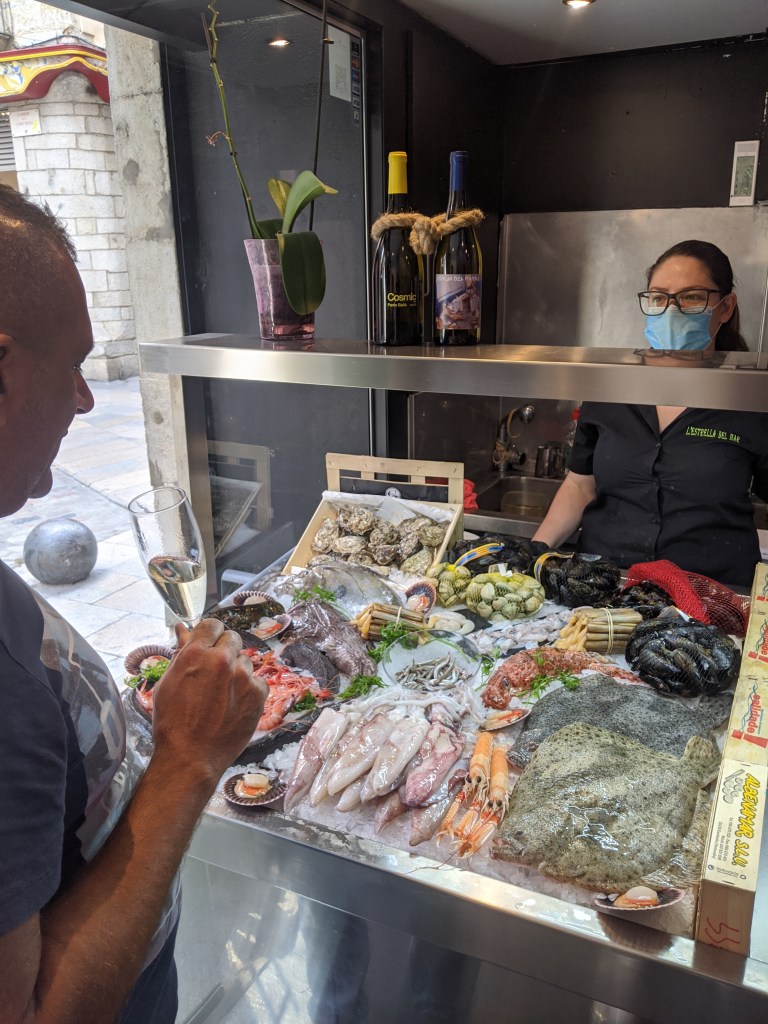
Then yesterday I found myself in Girona. With fresh memories of Girona after our trip a couple weeks ago, Brad and I played tour guide for our Catalan friends Joanmi and Francesc. This trip was by car instead of train and took about the same time door-to-door. We viewed the Barceloninan landscape artist Modest Urgell and other Catalan artists at the Museu d’Art de Girona, and then descended to L’Estrella del Mar where Joanmi and Francesc selected almuerzo from the fresh catch.

Fresh catch at L’Estrella del Mar in Girona.

Joanmi told me he considered the restaurant typical for a good fish restaurant. That convinced me never to be a food critic because the place seemed like a great catch to me. I must be adjusting after five years dining in New York where this large a meal with this quality food prepared this well would cost 2x – 3x more, and still wouldn’t be nearly as fresh.

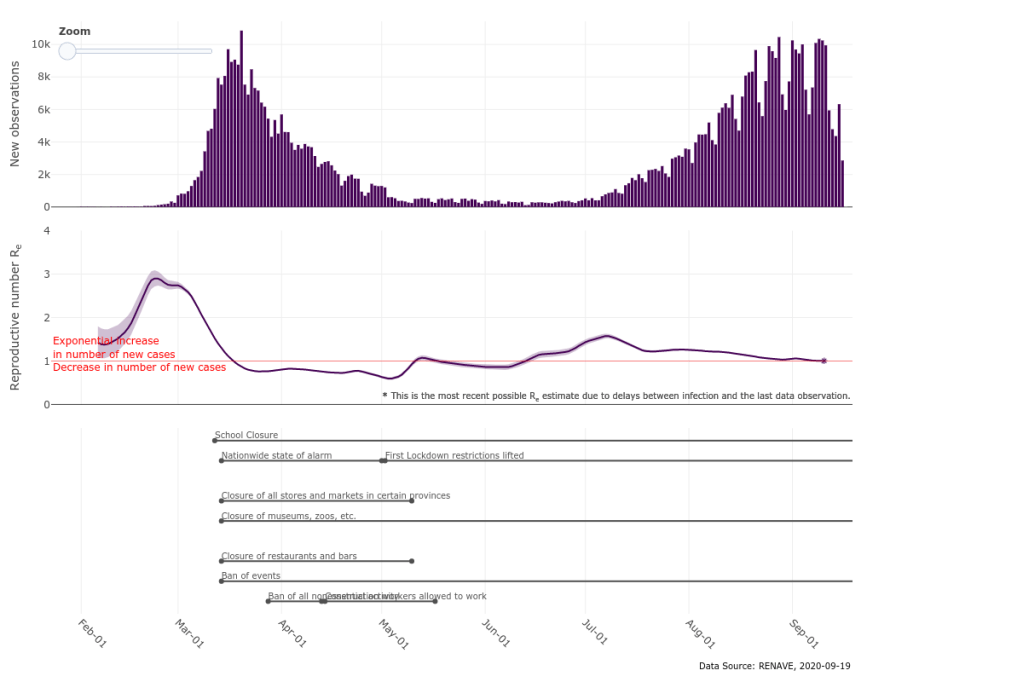
All this is by way of saying that, notwithstanding my mother’s reports about Spain from the US press she reads, dining and travel in Catalonia feel safe. In fact, here’s a picture of how the Covid-19 situation in all of Spain has improved in the past week.

Number of new Covid-19 cases and Re in Spain (source COVID-19 Re)

Spain’s post-lockdown Covid-19 cases increased more than anywhere else in Europe. I’m repeating myself when I write that this has been due primarily to bad Covid-19 outbreaks in three regions, Madrid, Murcia, and The Basque Country. The graphs above looked bad for Spain until the last week when trends started going the right way.

The Murcia government still doesn’t seem to have a handle on the health situation, but at least Madrid finally ordered, or might have ordered, new Covid-19 restrictions on Friday. I write might have ordered because the conservative government in Madrid gave the health director’s new restrictions a less than resounding endorsement.

Before I dive into Spanish politics, though, I note that Catalonia’s Covid-19 cases also went up after the lockdown, but leveled off quickly when public health authorities here put a few restrictions in place. Here’s a graph showing how Catalonia is managing Covid-19.

Outbreak risk and Re for Catalonia (source: Catalan News).

The Covid-19 effective reproduction rate Re (yellow bars above) went up the last two weeks of June, leveled off for a couple weeks, has been declining since mid-July, and has been less that 1.0 since the beginning of this month.

In some ways, Spain looks like the US. I can say Covid-19 is bad in both countries, but I also have to qualify where it’s bad for both countries. For Spain, I have to say it’s not bad in most places, but it’s really bad in Madrid and Murcia. For the US, I have to say it’s not bad in most places, but it’s really bad in North and South Dakota, Arkansas, Wisconsin, and Utah.

On the drive back from Girona, I quizzed Joanmi about the Spanish government and its Covid-19 response. Why is Madrid so different from Catalonia? Have Spain and the US had poor Covid-19 responses (Spain’s response relative to the EU, the US response relative to the world) because they share similar public health organizational structure? This turned out to be a good way to fill up an hour long road trip and I’m not going to bore you with the details.

The long and short of our conversation is that, yes, both Spain and the US have decentralized public health. In Spain, public health is managed at the regional level (there are 17 regions with, as far as I know, 17 different public health authorities). In the US, public health is managed at the state and territorial level. Both Spain and the US have central government public health authorities whose role is to coordinate the local authorities. That’s where public health similarities end.

The big difference is that, while Spain has a central public health authority, the authority has no resources. As Joanmi put it, Spain’s central public health organization consists of a minister and the receptionist who answers the phone. The US, on the other hand, had a world-class public health organization in the CDC, an organization that Trump has downsized and stripped of authority as he and his son-in-law dictated a free market response rather than a public health response to the pandemic.

Kushner, seated at the head of the conference table, in a chair taller than all the others, was quick to strike a confrontational tone. “The federal government is not going to lead this response,” he announced. “It’s up to the states to figure out what they want to do.”

Vanity Fair, “‘That’s Their Problem’: How Jared Kushner Let the Markets Decide America’s COVID-19 Fate,” 17 September 2020.

Joanmi also noted that the German government, which has a similar public health structure to Spain, had an effective Covid-19 response because Germany’s federal public health authority has the resources and credibility to coordinate German regions. Completely centralizing public health doesn’t seem to work. France and its centralized government structure performed about as poorly as Spain

But there’s something else interesting going on that Joanmi and I didn’t talk about, something that’s transcending comparative public health.

Covid-19 cases are becoming less deadly. Below is a graph of Case Fatality Rates (CFRs) for Spain and the US. The same thing is happening almost everywhere. Fewer people who get Covid-19 are dying. That’s a great thing, but why is it happening?

Case Fatality Rate (CFR) for Spain and US (source: Our World in Data)

Dr. Monica Gandhi from UCSF gives the long answer.

Dr. Monica Gandhi from UCSF on declining Covid-19 death rates (starts around 32:30).

If you don’t have 15-20 minutes for Dr. Gandhi’s excellent presentation, I’ve summarized it on my Twitter feed.

Summary of Dr. Ganhi’s presentation on declining Covid-19 deaths.

If you don’t have time for that, here’s the spoiler: masks. But it’s important to understand why, so watch the video or read through the summary to understand why Dr. Redfield at the CDC was correct when he said that masks may be more effective than vaccines at stopping Covid-19, and why Trump is killing people when he contradicts Redfield.

I’m going to sign off this week with a reminder of what competent Covid-19 advice looks like.

Christian Drosten discusses Covid-19 outbreaks likely this fall and winter.

It’s going to be long year before we get vaccines, so wear a mask, keep your distance, wash your hands, and enjoy fresh fish!

13 September 2020 – Sunday – #112

Every month there seems to be at least one day of celebration in Barcelona. Friday was Catalonia Day, another annual holiday that most of Barcelona celebrates by closing down.

On the eve of Catalonia Day, Brad and I hosted four Catalan friends for a BBQ at Casa Solar. They are part of a group of Catalan men who call themselves “The Carnivores.” The Carnivores is an informal group that meets about once a month at a restaurant in Barcelona serving high quality meat.

Here’s what we grilled for The Carnivores.

Manel butchering a Txogittxu steak.

Since there was a lawyer and a cop at dinner, I was able to ascertain that local customs allow the growth of one or two of what might be called strong herbal plants on the terrace. No one will call the cops and I won’t need a lawyer.

After hanging with the Catalan, I feel like I’m scratching the surface of their culture. My Brazilian friend Henrique said that he feels like he never has any time since he moved to Barcelona a year ago. I told Henrique that I feel like a child learning Spanish and Catalan languages, food, history, and customs. It’s a 24/7 job.

Learning about food didn’t stop at dinner with The Carnivores this week. Last night I had a another more vegetarian Catalan food adventure cooking Cigrons amb Espinacs (Garbanzos with Spinach).

Cigrons amb Espinacs

If you buy me a vermut, I’ll cook it for you or give yuou the name of the Catalan cookbook, whichever you prefer.

It’s feeling safe to make food porn in Catalan, where new cases of Covid-19 remain level, and especially at home right now because Spain is lagging the rest of the EU in managing Covid-19 post-lockdown. Spanish officials are quick to point out that September isn’t like March, that even though Covid-19 cases are on the rise, they are asymptomatic with fewer deaths. That’s a nice rationalization of not doing a good job.

Besides Madrid, most of the new Covid-19 cases are in Murcia. Murcia is fighting Covid-19 restrictions.

Murcia protests over bar closings after Covid-19 cases spike.

Seeing Murcia protest over what are now common sense measures to prevent transmission makes me worry that Covid-19 misinformation is floating from the US across the Atlantic.

I write often about how misinformation from Trump, social media, Fox News, and OAN keeps the US from reducing its Covid-19 transmission. In a bombshell report last week from Bob Woodward’s book Rage last week, Trump acknowledges that he’s been hiding bad news about Covid-19 from the public.

MS-NBC and Washington Post report on Woodward’s book Rage.

After Woodward released his telephone calls with Trump, Trump claimed that his intent was to keep America calm. In this Twitter thread, David Frum examines how Woodward’s report and Trump’s response to Woodward’s report reveal Trump’s incompetence.

David Frum thread on how Woodward’s report shows Trump’s incompetence.

I boil down Frum’s arguments like this: Trump is incapable of articulating anything as sophisticated as the Covid-19 response that all European leaders were able to articulate successfully. It may be that Trump isn’t smart enough. It may be that his malignant narcissism traps him. It may be that the only way he knows to survive is to create chaos. It may be that he views all problems through the lens of money. It may be that he’s listening to Putin. It doesn’t really matter. Chose your reason, but Trump cannot figure out how to articulate a Covid-19 response that will stop or slow transmission in spite of having many examples of how to do just that.

Trump’s misinformation campaign continues today. His appointees at the CDC, including Michael Caputo and Paul Alexander, are doctoring standard CDC reporting on Covid-19 to advance Trump’s ineffable agenda. Alexander complained that the CDC’s Morbity and Mortality Weekly Report (MMWR) contradicts messaging from the White House.

“The reports must be read by someone outside of CDC like myself, and we cannot allow the reporting to go on as it has been, for it is outrageous. Its [sic] lunacy. Nothing to go out unless I read and agree with the findings how they [sic] CDC, wrote it and I tweak it to ensure it is fair and balanced and ‘complete.'”

Trump appointee Paul Alexander to CDC Director Dr. Robert Redfield. (Souce: POLITICO)

The Covid-19 stakes couldn’t be higher for the US with weeks left until the election. Fauci and several Covid-19 models expect another Covid-19 wave this fall, with one model predicting over 400,000 Covid-19 deaths in the US by the end of 2020.

One upshot of Trump’s Covid-19 misinformation campaign is that it gives people permission to ignore Covid-19 models predicting 400,000 deaths this year, or to discredit them when they don’t predict accurately. But epidemiologists use different models for different applications, statistical models to forecast, for instance, deaths under current conditions and mechanistic models to test what-if scenarios. Results from Covid-19 deaths forecasts are generally accurate for 2-3 weeks but, because conditions are changing rapidly, become less reliable further out.

Another upshot is bad data for the modeling. When Trump appointees edit scientific reports from the CDC and other sources, they can skew model results. The resulting chaos may play into Trump’s message that science doesn’t have the answers, but it also exacerbates the poor government response to Covid-19.

When Trump leverages CDC, social media, Fox, and OAN to con Americans with Covid-19 misinformation, it erodes trust in public health. This short video from a Trump campaign event last week shows the results.

Trump followers rationalize why they don’t need to wear masks.

The video shows three (white) men rationalizing why they don’t wear a mask, each in their own way. One says he can’t hear others speak when people wear masks (which shouldn’t keep him from wearing a mask), a second says that most people are dying of underlying conditions rather than Covid-19 (like saying Titanic passengers died because they couldn’t swim in freezing water rather than because the ship hit an iceberg), and the third says it’s God’s plan whether he survives Covid-19 (except that he might infect his friends and family which, from their point of view, would be his plan rather than His plan). When Trump allows people to crowd into his rallies without masks, he implicitly endorses these rationalizations. In effect: Hey, if POTUS says it’s okay, how can I be wrong? Social media, Fox, and OAN reinforce Trump’s con.

Unfortunately, there are real costs to Trump’s con. One, of course, is health. The other is money. A by-product of the Sturgis Motorcycle rally is the data on Covid-19 transmission that researchers need to characterize both costs. Here’s a screen grab from a UCSF Grand Rounds video that characterizes these costs.

Screen grab from UCSF Grand Rounds video showing costs of Sturigs Motorcycle Rally in South Dakota.

Because Sturgis attendees don’t bear most of these costs, they have no strong incentives to stay home. Because Trump implicitly endorses their behavior, attendees believe their own rationalizations that they should feel free to congregate without appropriate social distancing or masks. However, as the UCSF video points out, it would have been cheaper overall to pay each of the Sturgis participants $26,000 to stay home. This is an economic cost Trump and his followers don’t want to hear.

It’s an expensive con, to tell people things are going back to normal. Social media, Fox, and OAN make lots of money promoting Trump’s con. The Americans who believe the con and feel empowered to spread Covid-19 pay little of the costs of keeping Trump in power.

This gives me the sense that Trump’s supporters will continue to drink his KoolAid.

Trump followers without masks or social distancing at campaign rally.

For those who don’t know the beverage reference, the con man Jim Jones convinced his followers to drink cyanide-laced KoolAid in 1978 as US officials were unmasking him. Trump’s cult is behaving no differently from Jones’ cult.

Falling for Trump’s con, drinking his KoolAid is expensive. Trump’s campaign stops are about 5,000 people, about one hundredth of the size of the Sturgis event. After ten campaign stops, the US can expect another 25k Covid-19 cases and another $1.2B in healthcare costs. Trump will pay none of those.

I hope transmission of Covid-19 misinformation doesn’t reach Spain, especially at Trump’s scale.

Other notable Covid-19 tidbits from last week.

Last thing. Last week I made an attempt at a table summarizing Covid-19 vaccine development. The Internet saw how bad it was and came up with a much better graphic.

Chart of Covdi-19 vaccine testing status.

[Updated 18.40 CET to correct math error.]


I write this for my sanity. If you like it, pass it along to friends. For daily updates, follow me on Twitter.