17 May 2020 – Sunday – #63

My friend who works at a testing lab at a Barcelona hospital said that of the 400 Covid-19 tests he processed yesterday, six came back positive. That’s 1.5% Covid-positive from a population I’m assuming skews towards people with reason to believe they have an infection. My friend said it’s the best results day he’s seen in a while.

So, is our lockdown is over?

Most of the rest of Catalonia will advance to Phase 1 tomorrow, but Barcelona is special. Barcelona advances to Phase 0.5. Phase 0.5 keeps our travel restrictions in place, but allows small businesses and social services to reopen, with a recommendation to operate remotely as much as possible. To receive our Covid-19 diplomas, we have to advance through Phase 4. The fastest we can complete our coursework and complete our Covid-19 tests is 8 weeks, or early August.

I walked through Gracia last night and small businesses already are opening. It’s nice to see signs of life. The best news I’ve had for a while is that Swagatam, my fav Indian restaurant, is selling comida para llevar. Cards on the table, one of the reasons I moved to Barcelona is that Swagatam serves good Indian food and, where there is good Indian food, there are tasty spices to buy.

Here’s a snap of a street party across the street from Mercat de la Llibertat.

Gracia, near Mercat de la Llibertat, 16 May 2020

If you enlarge the image, you can see the party-goers safely distanced on their balconies. I don’t know whether these revelers switch on the music and pour drinks every night or just on weekends. With their costumes, they put my street, which plays five minutes of music while it applauds the healthcare workers at 8p every night, to shame.

Other than walking around Gracia, most of my evening was spent on a board call for the Moab Music Festival. By now, most summer music festivals have cancelled this year’s events. The Moab Music Festival is Labor Day weekend, though, and it’s conceivable to produce concerts three months from now if Covid-19 infections subside.

Moab Music Festival Board Meeting via Zoom, 16 May 2020

It would be inappropriate for me to get into the details of the board discussion. At any rate, with a eight hour time difference, I couldn’t stay awake for the conclusion of the board discussion so I don’t know what decisions were made about the 2020 season. Covid-19 can get even friends hot under the collar, but I was pleased that the festival board stayed pretty much on point in spite of any differences.

Two things struck me about our board meeting. One is that the thinking on Covid-19 from board members in urban areas outside Moab is different from board members in Moab, probably because Moab is virgin to Covid-19 outbreaks. The differences in Covid-19 perspectives were both refreshing and informative. I’m going to put the differences in an experiential bucket labeled “Exponential events are difficult to comprehend until they happen.” I imagine “Giving birth to a child” goes in a similar kind of experiential bucket.

The other is that the festival staff is well educated on Covid-19 in pretty much every aspect. Even though Moab hasn’t experienced a Covid-19 outbreak directly, some staff live in New York City and the rest have been paying attention to the news. No one is naive about the ramifications of Covid-19 for the festival.

Covid-19 creates a massive amount of uncertainty for decision making at the board and staff levels. It’s not clear whether people will travel to Moab for Labor Day weekend, how many hotels and restaurants will operate by then, how to work with local public health, park, and SBA officials, or how foundations and governments are processing and fulfilling grants.

The easy thing to do would be to call off the season, but there are risks with that, too. Plus the Moab Music Festival is unique in the amount of outdoor programming it provides. Indoor concerts in the 2020 season won’t happen, but there are opportunities for outdoor events under clear Utah skies. In a world looking for good things to happen, it would be great to provide music. Still, Covid-19 creates huge practical problems for staff, from replacing paper tickets and programs, to encouraging social distancing, to testing staff and performers, to messaging and legal liability.

Dave, the festival operations manager, also works with a number of local Colorado river guides. During our board meeting, he provided useful reports on issues other Moab tourist businesses face. One interesting tidbit to me is that lawyers for businesses say that there is an onslaught of liability cases coming. It’s difficult to to know who should take responsibility for Covid-19 health issues. That uncertainty creates an opportunity for lawyers to make money litigating.

The other point Dave made was that he’s tired of how much plans keep changing at all the companies he works with. He complained of the exhaustion of agreeing to a plan, starting execution on the plan, getting new Covid-19 information, and starting the process all over. I was exhausted after three hours on a Zoom call. I can’t imagine what artists and festival staffs around the world are up against.

This is my little window into the difficulty arts organizations face during the Covid-19 pandemic. I expect the Moab Music Festival will survive Covid-19, but many other arts organizations will not.

On that happy note, I’m going to summon my drag goddesses to help out.

Kinsey Sicks, From a Distance parody.

Keep your distance and wash your hands so that everyone can go to concerts soon!
16 May 2020 – Saturday – #62

Science and technology day! That always makes me happy.

It’s amazing how much we’ve learned about the immune system response to Covid-19 in the six months since the disease first surfaced. Robert Plenge, an SVP at Bristol-Myers-Squib, put together an excellent Twitter thread that details the Covid-19 immune response story and suggests T-cell therapies that may be effective in extremely bad cases.

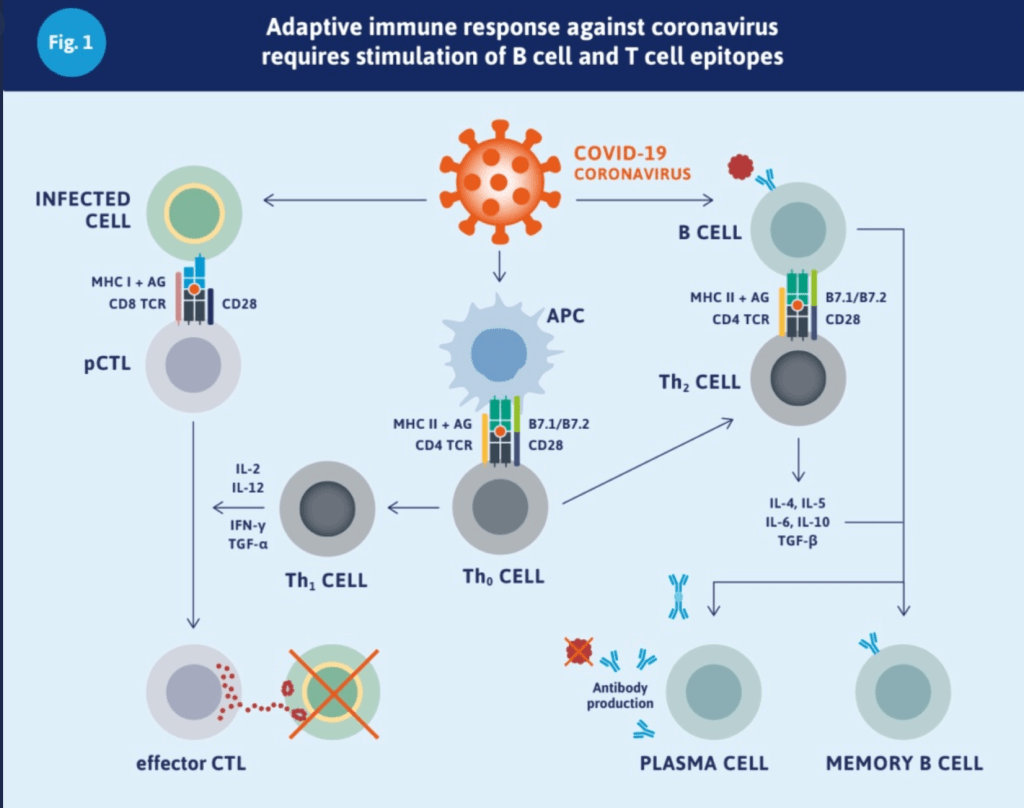
To help you through Plenge’s thread, here’s a quick, very high level ‘splainer on the B-cells and T-cells that make up our immune systems. B-cells create antibody proteins that latch on to a virus, usually slowing or disabling it. There are also B-memory cells that remember how to make antibodies.

T-cells play two roles. T-helper cells recognize antigens and signal an immune system response, including telling the B-cells to get to work. T-killer cells destroy infected human cells to stop viral replication.

Most of this science got worked out by researchers figuring out how HIV works. Here’s a pretty picture that explains the immune system response to Covid-19. It includes other components of the immune system like signaling proteins not described in the quick ‘splainer.

ScienceDirect, “Immunology of COVID-19: current state of the science,” 6 May 202

Plenge identifies two immune system conditions that may prevent immune systems from clearing Covid-19, and three other conditions that may provoke the immune system to go into overdrive.

Taken together, these five observations suggest that in COVID-19 patients with evidence of a maladaptive immune response, T cell-directed therapies may be beneficial in preventing progression to more severe disease.

Robert Plenge, SVP, Bristol-Meyers-Squib

If T-cell therapies can be developed for these five conditions, then Covid-19 mortality drops, mitigating the Covid-19 public health issue.

Now that you have a PhD in immune system response to Covid-19, here’s some good news. In spite of reports that some people may not develop Covid-19 immunity, it appears T-cells do, in fact, maintain Covid-19 immunity. In two small studies, researchers found T-cells that recognized the spike protein—the protein that enables Covid-19 to enter a host cell and replicate—in patients who’d recovered from mild cases of Covid-19. Not only that, but researchers also found that about a third of people who have not been exposed to Covid-19 have T-cells that recognize the SARS-Cov-2 virus, probably as a result of past exposure to other Coronaviruses.

If you were paying attention above, you noticed that B-cells produces antibody proteins that attack invading viruses. One of the biotech’s handy-dandy tools, monoclonal antibody (mAb) technology, takes advantage of the work B-cells have done by cloning antibodies already produced by an immune system. Here’s a whole article on Covid-19 mAbs.

There are two types of antibodies. Some antibodies bind to a virus, but leave it operational. Others bind in a way that gums up the viral works. They are called neutralizing antibodies and they are preferred candidates for mAb development.

There are at least five major efforts from Regeneron, AbCellera/Lilly, Vir/GSK, AstraZeneca, and Amgen/Adaptive to create cocktails of Covid-19 antibodies using mAb technology. Some cocktails will be in human trials next month, others are planning to ramp up production in the fall.

Sorrento announced last week that it found a human antibody that provides “100% inhibition of SARS-CoV-2 virus infection of healthy cells after four days incubation.” This is in the lab, mind you. The company plans to include the STI-1499 antibody, which neutralizes the Covid-19 spike protein, in its mAb cocktail.

Like the T-cell therapies Plenge discusses in his Twitter feed above, mAb therapies can be used to reduce Covid-19 mortality, mitigating Covid-19 public health issues. Whether mAbs can substitute for vaccines in the short term by providing Covid-19 prophylaxis is a provocative prospect.

Trump is telling the US that Covid-19 testing isn’t important. He’s saying that, of course, because he’s a salesman trying to draw attention from his dire shortage of Covid-19 tests.

Testing is crucial! Tests can help us diagnose Covid-19 infections, measure the effectiveness of vaccination, and assess immunity in a population

Here’s an article that gives the status of state-of-the-art of Covid-19 serological (antibody) testing. If you think vaccine development is hard, check out all the trade-offs involved in designing a Covid-19 test. To start with, there is test complexity, safety, sensitivity, and time to result. Then there are the fine points like whether to detect Covid-19 spike proteins or the viral nucleoproteins.

Scientists are figuring out which test method will best serve each testing application. Lots of them.

Several academic laboratories have developed robust, specific serological assays, and high-quality commercial options are becoming available. In accordance with academic grassroots traditions, a toolkit to set up antibody assays has been distributed to more than 200 laboratories across the world, and a detailed protocol to facilitate local implementation has been published

Science, “Measurement of antibodies to SARS-CoV-2 will improve disease management if used correctly,” 15 May 2020.

The bad news is that current antibody testing is a mixed-bag. The good news is that 200 laboratories around the world are working on better Covid-19 tests.

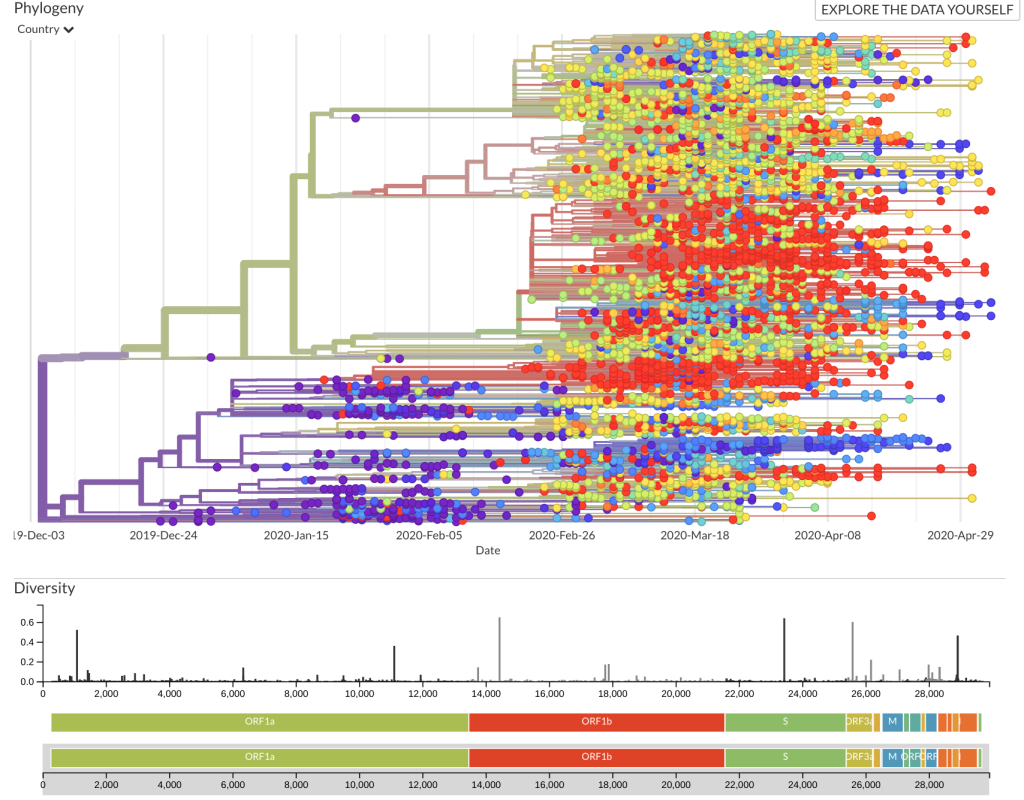
Should we worry about Covid-19 mutations? The Nextstrain Situation Report provides a genomic analysis of Covid-19.

Nextstrain analysis of 5,193 publicly shared Coivd-19 genomes.

We’re in good luck here because the rate and type of Covid-19 mutations are in line with other Coronaviruses.

The report describes Covid-19 international transmission in terms of “sparks.” Sparks fly from an outbreak to other locations where most of the sparks fizzle out, but some start a new outbreak that then creates more sparks.

Unsurprisingly, we see this pattern in countries experiencing their first wave of infections. More alarmingly, we also see this pattern after re-introductions of the virus to countries where the initial peak passed months beforehand. Ultimately, this pattern is only broken when a country is able to effectively test, trace, and isolate cases immediately.

Nextstrain Situation Report, 15 May 2020

In other words, we can’t eradicate Covid-19 on a country-by-country basis. We have to do it worldwide.

Science is great, but how do we get it from the lab to clinicians around the world? That’s a whole different problem.

Let’s say there’s a drug that speeds recovery from Covid-19. How effective is that drug if doctors don’t have adequate information to know how to use it?

It’s hard getting new products and procedures into the market, especially when the market is the whole world. Until we do, we need to start testing, tracking, and quarantining. Everywhere.

Some magic future day, we will need to vaccinate pretty much everyone. Everywhere. Which is a problem because, well, who’s got seven billion needles?

While Bill and Melinda Gates are building redundant vaccine plants to compress the time to market of a successful vaccine, no one’s been paying attention to needles. Vaccine development time compression is for naught unless there are needles to deliver the stuff.

The CEO of medical supply company Becton Dickinson is sounding the needle supply chain alarm.

“Waiting until a vaccine is available will be too late. There is not capacity in the global industry to manufacture hundreds of millions or billions of syringes and needles in a month or two.”

Becton Dickinson spokesman Troy Kirkpatrick, 9 May 2020

Governments can help the private sector with projects like manufacturing billions of needles. Programs to guarantee purchase of large quantities of items needed at once-in-a-lifetime quantities reduce the market risk for manufactures of medical equipment. The US failed to provide effective purchase programs for protective gear and ventilators. It can work with manufacturers to do a better job with needles.

And about the testing, tracking, and quarantining I mentioned above as the next step: How do we do it? Marty’s brother Tom explains. He has some really good ideas.

Switchbit’s Threat Exposure Notification Protocol for tracking Covid-19 exposures.

I’m out of time. I’m ending today on a different bit of technology.

While Covid-19 has been diverting our attention, renewable energy has quietly taken over from coal.

Solar and onshore wind are now the cheapest sources of new-build generation for at least two-thirds of the global population, Bloomberg New Energy Finance said in an April 28 report, while battery storage is now the most cost-effective source of peaking power.

Reuters, “Do renewables hold the upper hand against coal in post-coronavirus world?,” 14 May 2020

With the world economy on its head, energy demand down, and Russia fighting oil prices wars with Saudi Arabia, the energy industry is transforming. New energy production investment will find better returns in renewable solar and wind energy plants than in coal plants.

I write this in part because it’s great news for climate change, but also because of how quickly the transition to renewable energy is happening. There’s a tipping point in energy pricing that has been creeping up for decades as the cost of renewable energy has declined slowly, but relentlessly. The moment the cost of a renewable kWh of electricity drops below the cost of a fossil fuel kWh of electricity is the moment the market switches. In an instant.

I feel that way about the relentless Covid-19 developments. They seem slow in a lockdown, but they are breathtakingly fast. There’s a tipping point in our understanding of the immune system that’s been creeping up for decades. With bioinformatics and DNA sequencing, we’ve reached a stage where the world can respond to a pandemic with over 100 Covid-19 vaccines candidates and over 200 labs developing Covid-19 tests. We are months away from a mAb solution. We have the technology to test, track, and quarantine. We just have to figure out how to get it to everyone that needs it. Everywhere.

Like the renewable energy tipping point, the Covid-19 tipping point is coming soon.

15 May 2020 – Friday – #61

There”s some good Covid-19 science going on. I’m going to get to science via the unlikely route of Covid-19 social unrest.

While the Spanish Civil Guard is warning about civil unrest in Spain, it’s already happening in the US.This unrest is another huge disappointment in the US Covid-19 response. From where I sit in Barcelona, America is no longer the shining beacon. I’m worried that US unrest will spill over to Europe and other parts of the world via social media.

I’m starting the social unrest story in Suffolk County, New York. I used to travel there a couple times a year to visit my friend Jim on Fire Island. The train from New York City to Sayville passes by pleasant suburban Long Island towns. The people I’ve met there are politically diverse and friendly.

I wouldn’t classify this Suffolk County protest as wild civil unrest, but the protesters’ animosity towards reporter Kevin Vesey appears to me like a regurgitation of Trump’s inability to articulate other than blame.

Covid-19 anti-lockdown protesters in Suffolk County, New York, 14 May 2020.

Suffolk County, as noted in the comments on this tweet, has the fourth highest number of confirmed Covid-19 cases of any US county. Given the infection situation, it seems surprising that any Suffolk County resident would protest against social distancing in the first place, but what is more surprising to me is that protesters prefer to taunt the media rather than to make their case. Is it an anti-Covid-19 restrictions demonstration, an anti-media demonstration, or just a we’re acting like kids demonstration? Please, Suffolk County protesters, let us know!

Suffolk County is a warm-up for Michigan where armed protesters closed down the state capitol building.

Armed Covid-19 protesters close Michigan capitol, 14 May 2020.

When armed protesters in other parts of the world shut down government buildings, it’s usually called a civil war. While the press hasn’t called US Covid-19 protests civil wars, some of the groups behind the protests (think QAnon) are preaching end-of-the-world scenarios to their cults.

Part of the blame for social unrest can be laid at the feet of the Trump administration which has been unable to patch together any coherent Covid-19 response, let alone provide direction. I’m not just saying that. Yesterday’s testimony from Dr. Rick Bright, former Director of the Biomedical Advanced Research and Development Authority, was devastating. For instance on the subject of obtaining protective gear, this exchange:

On top of the administration’s rudderless response is social media. Arguably, social media might be the driver of social unrest even if the US had a competent president. And … this is where, as promised, we get to science.

Social media research may not be evolving as quickly as Covid-19 research, but it’s evolving quickly. Last week a 26-minute viral video called Pandemic: The Hidden Agenda Behind COVID-19 got millions of views before social media sites took it down. The video is full of Covid-19 misinformation, so why didn’t Facebook take it down sooner?

A Wired article hypothesizes it’s because Facebook relies on outdated research about fact-checking. As recently as 2017, Mark Zuckerberg has stated that fact checking causes the “backfire” effect, an effect described in 2008 social media research in which people hold on harder to their belief of misinformation when they are told it is incorrect.

If Facebook is relying on the backfire effect, the problem is that it isn’t real.

All those Snopes.com articles, Politifact posts and CNN fact-checks you’ve read over the years? By and large, they do their job. By our count, across experiments involving more than 10,000 Americans, fact-checks increase the proportion of correct responses in follow-up testing by more than 28 percentage points.

Wired, “Why Is Facebook So Afraid of Checking Facts?,” 14 May 2020

Since Facebook isn’t transparent about how it manages misinformation and fact-checking, it’s hard to know if its massive data sets generate results that differ from research. However, in the midst of the Covid-19, it looks like the world’s dominant social media company is ignoring inconvenient research as much as the Trump administration.

I worry about US unrest spilling over into Europe and other parts of the world via misinformation spread on social media. I also worry that this unrest will derail the science we need to manage Covid-19. If politicians aren’t standing behind public health experts, aren’t educating the public on the need for public health policies, then societies suffer the public health consequences. Politicians and economists need to manage the economic disaster so that public health officials can manage Covid-19.

While the Trump administration has stopped sponsoring vaccine work through WHO, at least it’s funding a US vaccine effort. Drs. Kayvon Modjarrad and Gordon Joyce at Walter Reed Army Institute of Research (WRAIR) are the scientists behind Operation Warp Speed, the US effort to deliver a Covid-19 vaccine in 18 months. They have been researching Coronavirus vaccines for years and their virus design is based on ferritin, an iron bearing protein common to most living organisms.

When the distinctive protein spike of a coronavirus is introduced to a ferritin molecule, the molecule “self-assembles” into something that resembles a soccer ball with 24 outward-facing panels, meaning that the vaccine is now presented up to 24 times, provoking a significantly greater immune response than if a person’s immune system detected it only once.

Yahoo! News, “‘Another one was coming’: Army scientists working on vaccine had long feared emergence of new coronaviruses,” 14 May 2020

I’m rooting for WRAIR to deliver the goods, but luckily there are many more vaccine efforts underway if the US effort fails.

I wanted to cover updates on immune system response to Covid-19 and on development of monoclonal antibody and nanoparticle therapies, but I’m out of time. I promise to get to those tomorrow, barring any protests.

After your civil unrest, as you prepare for your Covid-19 restrictions to vanish, remember this simple science experiment.

NHK restaurant black light video.

The Japanese broadcaster NHK asked ten people to eat from a buffet in a simulation of a virus spreading through a restaurant. One of the diners started with a fluorescent goo on one hand. After eating the meal, a black light reveals how the goo traveled to all the diners and their food.

Good luck on your re-opening!