14 May 2020 – Thursday – #60

Coronavirus has taken the life of Spain’s oldest person. María Branyas died at the age of 113. Among her accomplishments, Branyas was a survivor of the Spanish flu epidemic.

Lots of other Spanish news today. Barcelona will not advance to Phase 1 next week as I’d hoped. That means we still can go out for our communal exercise periods in the morning and evening, but businesses will not open on Monday. I’m a little confused because a few gelaterias and hair salons are operating already. I’m confused, but not complaining. I also was confused because some of my friends in remote parts of Catalonia have entered Phase 1 already.

Thankfully, Joan Miguel has instructed me in the nuances of Covid-19 territorial appellation. I thought that Spain was divided into “regions” and that Catalonia was a “region” and that Catalonia would move en masse into Phase 1, as a “region.” I was wrong.

First, Catalonia is an “autonomous community,” not a “region.” Second, for Covid-19 decisions, Catalonia delegates authority to medical regions that correspond to a hospital (or hospitals in the case of, say Barcelona).

To measure the chance of a new coronavirus outbreak, the regional government has combined indicators such as the number of cases in the last 14 days, the effective reproductive rate (how many people are infected by a positive case), and also the so-called EPG index, which comes from multiplying the accumulated cases in the last 14 days with the reproductive rate in the last seven days.

El Pais, “Barcelona and its metropolitan area will see further delay to coronavirus deescalation,” 14 May 2020

I’d assumed decisions to advance to Phase 1 were based on the current Covid-19 reproduction rate, R. According to El Pais, though, a local authority also uses something called the EPG index as part of its decision making. EPG, or Effective Potential Growth, is a new term to me. Here’s link to an April report that describes EPG in more detail. I can’t figure out the unit analysis for this measure, so I don’t understand exactly what EPG measures, but it seems like it’s trying to provide a notion of epidemiological acceleration or somehow account for the exponential growth characteristic of Covid-19 infections.

Perhaps the highlight of Covid-19 news from Spain today is antibody test results for the entire country.

Spanish Covid-19 antibody test results, 13 May 2020.

If you want more details, Matthew Bennett’s Twitter feed is packed with regional charts and his usual smart observations about data accuracy.

As of today, about 27,000 people have died in Spain from Covid-19. Doing some back-of-the-envelope calculations, if Spain allowed Covid-19 to run its course, the current 5%-11% infection rate implies about 250k – 600k people would die. The US has about seven times Spain’s population, so that implies if the US allowed Covid-19 to run its course, about 1.5M – 3.5M Americans would die. Please take those numbers with a large grain of salt, but it seems that Covid-19 kills about 1% of a population. I don’t have any estimate of how many additional people suffer chronic internal organ damage as a result of Covid-19.

One last tidbit of Spanish news. The government is debating mandatory use of masks. So am I.

Watching the US Covid-19 response, or lack thereof, from afar, I have to wonder whether the US is trying to get to several million Covid-19 deaths. As frustrated as I am that we’re staying inside another week in Barcelona, at least the Spanish government is communicating what we need to do next. Things aren’t so clear in the US.

Stanford Professor Keith Humphreys on the US political challenges of Covid-19.

Professor Humphreys asks the unfortunately necessary question: Is the US Covid-19 response scientific or political? The right answer seems obvious. Good politicians should guide citizens to implement the best public health policies scientists can come up with, right?

Unfortunately, that is not the case. The US response is guided by politics rather than science. For instance, in Texas, it seems that Dr. Fauci’s recommendations are heavily discounted. Texas Gov Abbot cherry picked state Covid-19 test results to say that Texas was following federal guidelines.
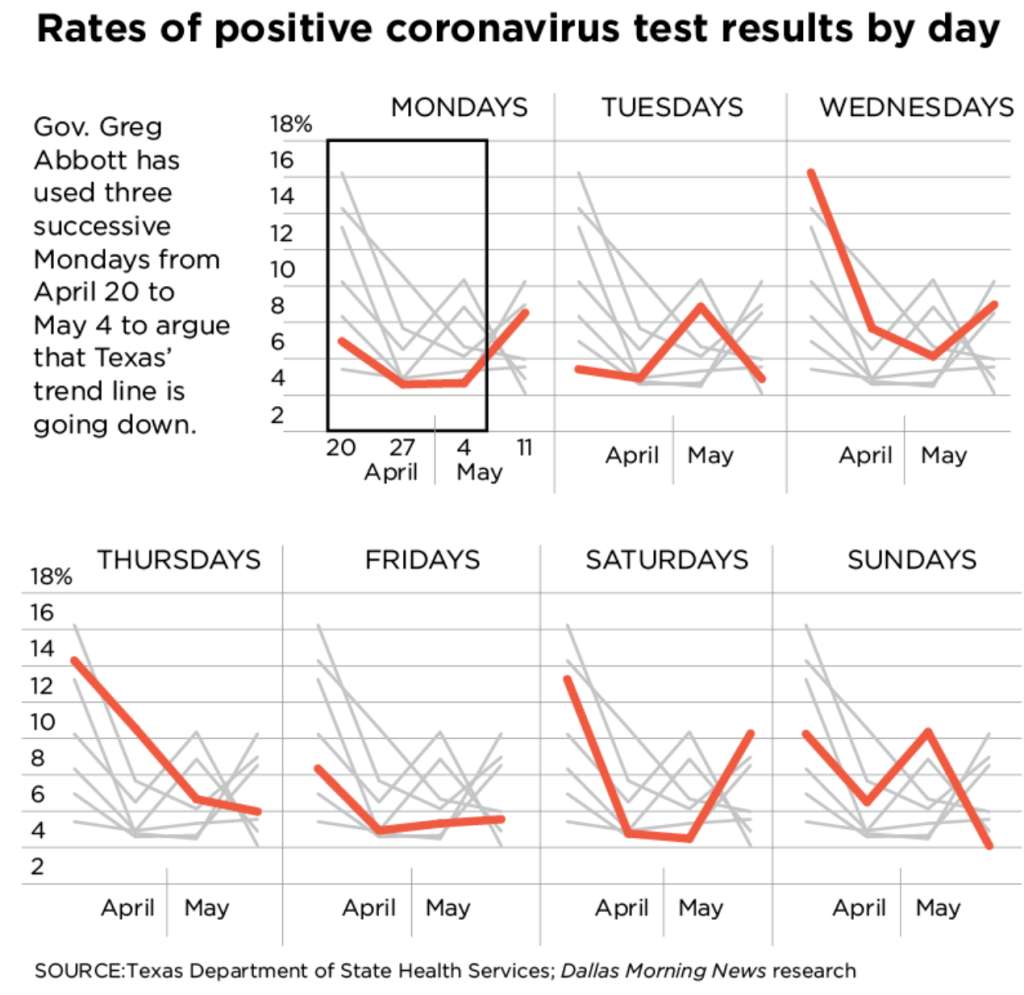
Texas weekly Covid-19 positive tests by day of the week.

By looking at positive test results only on Mondays and conveniently ignoring the most recent Monday test result, Gov. Abbot argued that Texas had met federal guidelines to relax Covid-19 restrictions. When you’re governor, you get to choose the data you like to tell your Covid-19 compliance story, even if it has nothing to do with good public health science.

Wisconsin has a different version of the same story. Wisconsin Republican senators sued Governor Tony Ever’s administration, claiming Wisconsin’s Covid-19 stay-at-home order over-stepped executive power. The Wisconsin Supreme Court agreed with Republican senators. Since the Republicans are unwilling to pass stay-at-home legislation, that leaves Wisconsin without adequate testing to implement a test, track, and quarantine program and with no way to enforce federal Covid-19 guidelines. Wisconsin is operating in a public health science vacuum.

It’s too bad Republicans aren’t paying attention to the science, because science keeps moving forward. Republicans seem to be betting that voters won’t remember in November how irrational Republican Covid-19 policies are in May.

One way science is getting better is modeling Covid-19 mortality. University of Massachusetts Amherst researchers are modeling the Covid-19 mortality models.
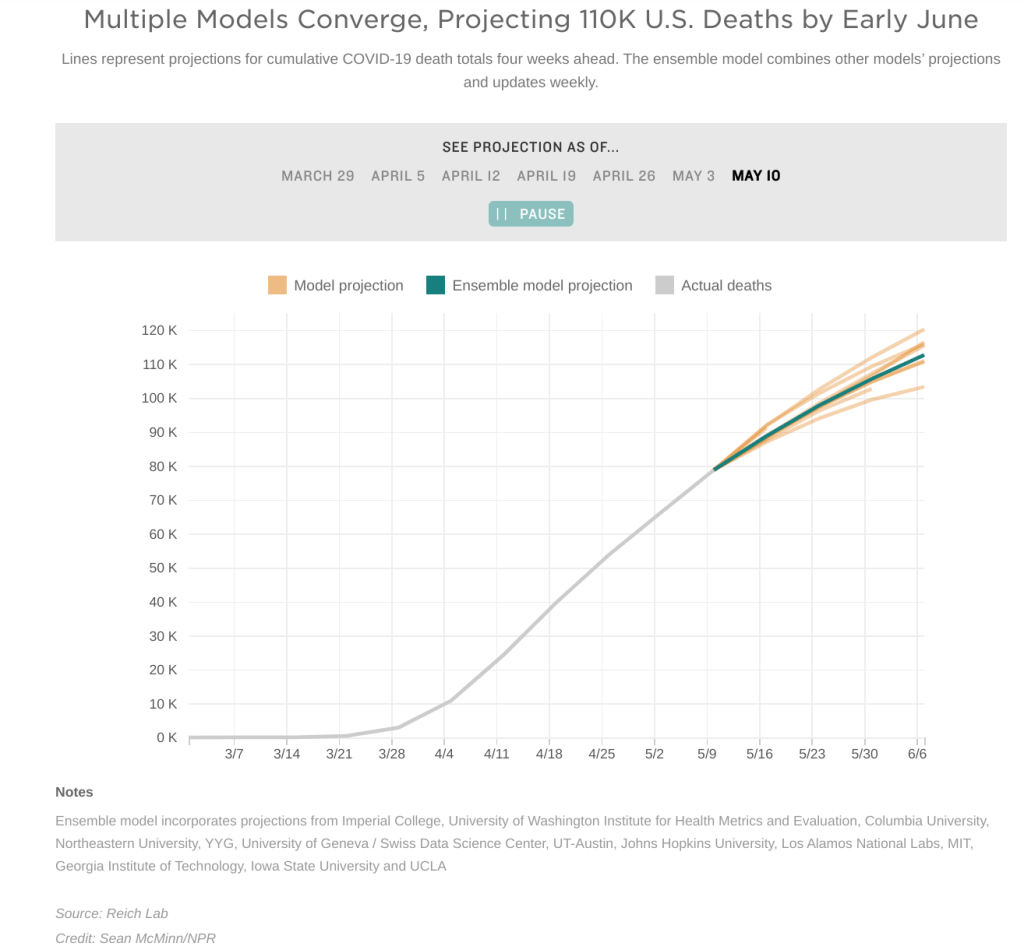
University of Massachusetts Amherst model of Covid-19 mortality models.

The US Covid-19 mortality models are converging to 110k deaths by the first week of June. Each of the underlying models in the “ensemble” of models is adjusted as newer and better data appear. Researchers retrain machine learning models and make other adjustments. With so much still unknown about Covid-19 and the swings in each model’s prediction, the UMass ensemble model “averages” the models’ underlying assumptions to yield a better prediction.

The sad part of America’s political response to Covid-19 is that Republicans seem to want more deaths than necessary because they haven’t been shown an alternative. On September 12, 2001, three thousand deaths was enough to enrage the country and start a war. Now the US has about 3,000 Covid-19 deaths a day and Republicans are ignoring public health officials because their leaders tell them the economy is more important.

Some of my smartest friends say that everyone needs to go back to work because it’s impossible to implement something as complex as test, track, and quarantine in the US. I hope my friends read the story of KK Shailaja, the health minister of the Indian state of Kerala.

The state has a population of about 35 million and a GDP per capita of only £2,200. By contrast, the UK (double the population, GDP per capita of £40,400) has reported more than 40,000 deaths, while the US (10 times the population, GDP per capita of £51,000) has reported more than 82,000 deaths; both countries have rampant community transmission.

The Guardian, “The coronavirus slayer! How Kerala’s rock star health minister helped save it from Covid-19,” 14 May 2020

It is sad to see US leadership has lost its way while governments with far fewer resources can organize and effectively manage Covid-19. It is a good lesson about American power. If Americans still think there is nothing they can do except go back to work and suffer the consequences, Vox has published a quick guide to how to fix the US Covid-19 response. It’s possible for the US to manage Covid-19. It’s not even particularly hard. But it requires Americans to prioritize science over politics.

Today’s last item is a followup to my food industry discussion yesterday. The Inn at Little Washington, a Michelin 3-star restaurant in Washington, Virginia, will seat mannequins at half its tables in order to create social distancing.

Mannequins seated at the Inn at Little Washington to create social distancing.

Chef Patrick O’Connell hopes the ploy will attract its Washington, DC customers to the country. I hope customers from the country’s capitol will appreciate that there ways to deal with Covid-19 that don’t kill everyone.

13 May 2020 – Wednesday – #59

The travel industry isn’t having it! Airlines don’t want a capacity cap to regulate onboard social distancing and hotels don’t want tourists to suffer a 14 day quarantine.

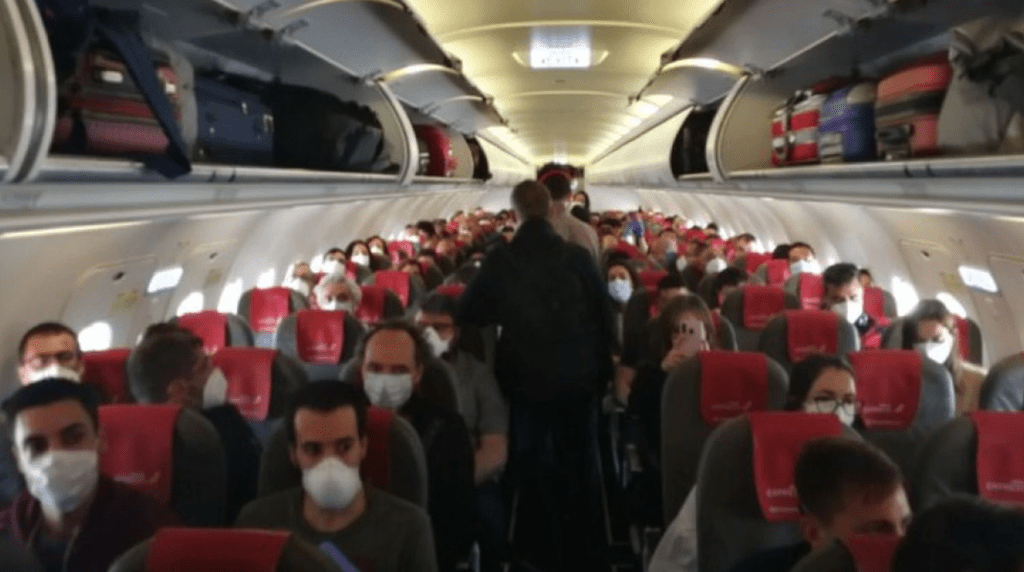
In an echo of the social media frenzy about a packed United flight from New York to San Francisco, Spanish passengers are complaining on social media about social distancing on Iberia flights.

A recent Iberia flight packed with passengers.

It’s not clear to me the travel industry has thought through how many people will sign up for Covid-19 suicide vacations on sunny Spanish coasts. On the other hand, who travels if it’s too expensive in terms of either dollars or time? The trade offs between safety, regulation, price, and profit are trickier than a flashy flamenco.

Welcome to our post-lockdown Covid-19 life! It’s great that things are opening up!

Now what?

The food industry’s Covid-19 flamenco isn’t any easier than the travel industry’s. The C&C Coffee and Kitchen in Castle Rock, Colorado decided things should go right back to normal and opened up for a packed Mother’s Day celebration last weekend. Neither of the Cs checked first with the local health department, which promptly shut down the joint.

Some restaurateurs are reading the Covid-19 handwriting on the wall, right above the hand washing sinks. An Amsterdam restaurant is testing glass houses to serve four course meals. You’ll have to eat vegan at MediaMatic, which is okay by me.

Glass houses at

The restaurant is called Mediamatic ETEN, and is part of the larger Mediamatic organisation, which focuses on the arts and entrepreneurship, with a strong environmental connection. The restaurant serves vegan food, and will be offering diners a four course meal when it reopens in this unique way.

DutchReview, “Amsterdam restaurant to offer four course meal in individual glasshouses,” 3 May 2020

Cincinnati, Ohio is solving the enclosed space problem a different way. The city is closing down certain streets to provide more space for local restaurants to serve al fresco diners. This will help small business owners weather the Covid-19 storm, at least through the fall.

Chef Tom Colicchio, perhaps best known from Top Chef, has laid off over 400 employees at his restaurants at the onset of the Covid-19 pandemic. In an interview with Terry Gross, he tells how he is re-thinking the food business.

“When we open up, there’s going to be a reduction in our seating, so we’re looking at a combination of probably three things to open up. One would be whatever la carte business is available. Also, doing a combination of cooked food that we’ll deliver, and also a version of a CSA where we can use all of our suppliers to create boxes that can go out to our customers.”

Chef Tom Colicchio, on Fresh Air with Terry Gross, May 2020

Colicchio also discusses how small restaurants open up again and challenges like decontaminating a table between diners. It’s fascinating to listen to an expert run through trade offs his industry is facing after lockdowns are relaxed. In case you were wondering, things don’t go back to normal.

The worldwide meatpacking Covid-19 infection debacle calls attention not only to the food industry, but also to supply chain management in general. Different supply chains will have different Covid-19 issues and I hope few end up with as many Covid-19 cases as the meatpacking supply chain.

Not surprisingly, one idea to fix the US meat supply chain is deregulation. I think re-regulation may be a better approach to maintain food safety, but it is clear that current FDA regulations work better for economically efficient centralized meat supply chains than for less efficient local meat supply chains.

With regulatory and cost burdens so high, many farmers and ranchers instead choose to utilize much smaller, local “custom” slaughter facilities and abattoirs outside the USDA inspection regime. Those that do so may only sell an interest in a live animal, which forecloses on the option to sell much smaller portions—such as steaks—to grocers and others.

Reason, “To Stanch COVID-19 Meat Crisis, Let Small Farmers Sell Meat to Local Grocers,” 9 May 2020

In its zeal to make regulation difficult, the Trump administration has made de-regulation easy and re-regulation difficult. At this point, it might take congressional action to re-regulate a new local meat distribution system that provides the same level of food safety as current regulation. Congress has bigger fish to fry.

I’ve noted how drug cartels are changing their operations in the face of Covid-19. The mafia isn’t missing Covid-19 opportunities, either. In addition to providing hard-to-find products like testing kits or even food, the Italian mafia is helping out-of-work Italians make ends meet.

According to Italian anti-mafia sources, the Camorra has also started providing loans – but not at its usual high interest rates – of between 50% and 70%. Demand for loans is so high in this period that it is still profitable to offer competitive rates, even lower than those offered by the banks.

The Guardian, “Why the mafia are taking care of everyone’s business,” 25 April 2020

The mafia has leveraged the Italian government’s poor Covid-19 response to gain influence. As the Covid-19 lockdown relaxes in Italy, it will gain more influence by providing loans to businesses desperate to restart operations.

On a happier note, new businesses are helping us live through lockdowns. For instance, if you want to challenge your Zoom and FaceTime friends, check out Sheltered Trivia.

Sheltered Triva

Prices start at $75 for a 1/2 hour with up to 20 of your nearest and dearest. A little pricey, but the next business opportunity I see here is to provide simplified group payments so that your friends can chip in.

Oh, oops, I think Paypal does that already. Or has done that for like, what, 50 years?

Anyway, one business that’s full of imaginative types and is begging for an imaginative way forward is Broadway! If you’re missing your Broadway revivals, you’re in luck. In this Twitter thread Brad found, Mary Neely performs all the Broadway warhorses from the comfort of her Covid-19 lockdown. Enjoy!

12 May 2020 – Tuesday – #58

Yesterday I was scheming with Brad to return to Spain. Today, we can forget about our schemes. It appears Spain will open its borders.

Spain orders 14 day quarantine for travelers arriving from abroad.

I’m not sure how the Spanish travel order squares with Ryanair’s plan to fly 40% of capacity by 1 July. Sure, you’ll be able to snag a ten quid flight from London to Spain, but then you have pay for 14 days of quarantine accommodations. Also, if you’re concerned about your privacy, well, good luck.

As a temporary public health measure, while EU countries emerge from their Covid-19 lockdowns, Ryanair will require all passengers flying in July and August to fill in details at the point of check-in of how long their planned visit will be, and their address while visiting another EU country. This contact information will be provided to EU governments to help them to monitor any isolation regulations.

The Guardian, “Ryanair passengers will have to ask to use toilet when flights resume,” 12 May 2020

Also, if you have to use the loo, please raise your hand first. As I said, good luck with privacy. It’s gonna be a bumpy ride.

Yesterday I also teased a diary entry today on business adaptation to Covid-19. I forgot about the bomb of Covid-19 news that comes on Mondays. Businesses will continue to adapt and I’ll have more to report on that in a later entry.

In today’s news, the spike of Covid-19 cases in South Korea is of particular interest to me. It seems that 29 of 34 new infections occurred in Seoul’s gay district, Itaewon. Many of the new cases are tied to an infected man who visited a sauna. South Korea’s evangelical press has used this as gay hate fodder.

After Kookmin Ilbo, a local media outlet with links to an evangelical church, reported that businesses visited by an infected man over the long weekend were gay clubs, many other South Korean media followed suit, revealing not only the identity of clientele but also some of their ages and the names of their workplaces.

The Guardian, “South Korea struggles to contain new outbreak amid anti-gay backlash,” 11 May 2020

This reminds me of the beginning of the AIDS crisis when, for instance, gay men were fired after testing positive for HIV, as much for being gay as for testing positive. The South Korean evangelicals may raise lots of money on the backs of gay men, but they also push gay men further into the closet and thwart public health efforts to test, track, and quarantine Covid-19.

But public health officials now are using private credit card transactions to track down the three thousand people who were at Itaewon clubs. It’s a smart public health tactic with treacherous consequences. Of course, anyone getting a request from Seoul public health department to get a Covid-19 test this week will assumed to be gay and, as a result, may lose their job and social status. Many gay South Koreans report suicidal feelings as their identities are challenged.

In many parts of the world, the AIDS crisis led to more gay men taking the risk to come out and greater acceptance of homosexuality. The best outcome is for greater acceptance of diversity in South Korea and the rest of the world. That’s unlikely in the short term.

Covid-19 reveals us for who we are, closeted or out, bigoted or accepting.

There are lots of science updates, and you know I love science.

It turns out that a major cause of Covid-19 death is blood clots rather than lung disease. It also turns out that elevated D-dimer levels may predict Covid-19 mortality. A D-dimer test detects a “small protein fragment present in the blood after a blood clot is degraded by fibrinolysis.” Using D-dimer tests for Covid-19 patients, healthcare workers may be able to identify early on which patients are likely to need extra care. Identifying high-risk patients early should reduce overall Covid-19 mortality. That’s really good clinical news.

Also, it’s important to keep in mind as Covid-19 deaths increase that there are lots of treatment studies underway. BioCentury provides lots of useful Covid-19 updates including Covid-19 treatment studies here.

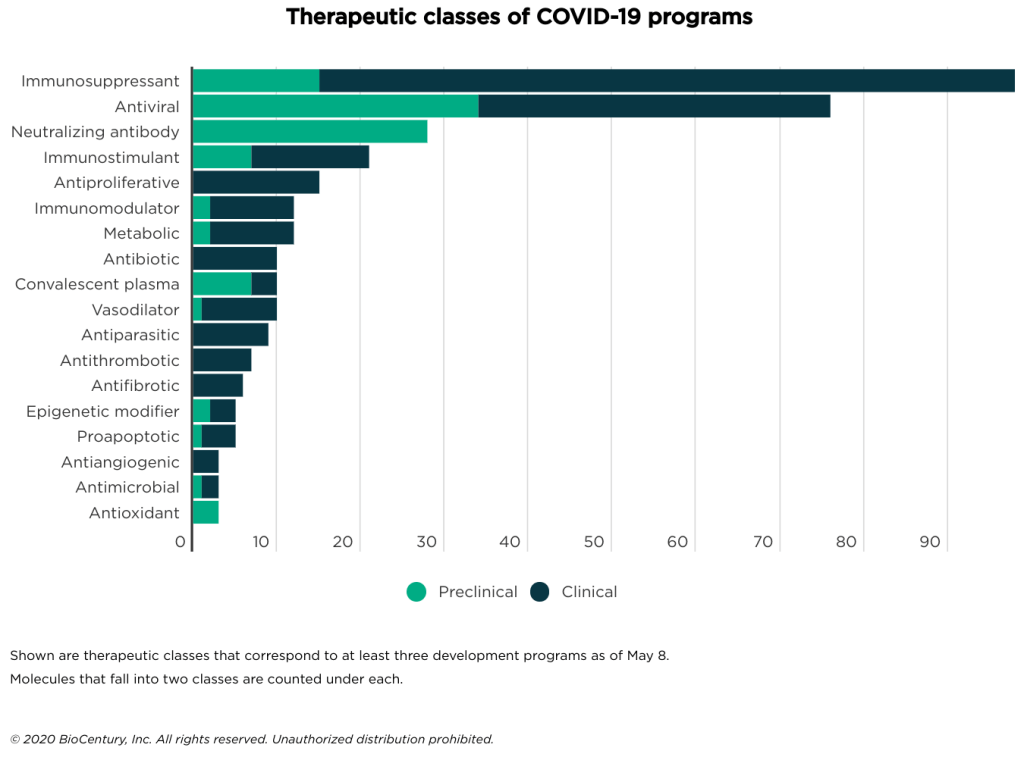
BioCentury chart of Covid-19 treatment studies, 11 May 2020.

As the chart shows, there are over 150 immunosuppresent and antiviral studies in the works. Eyeballing the rest of the chart, it looks like there about another 150 studies of other classes of treatments.

One treatment that keeps failing is our old friend hydroxychloroquine. The latest study from New York measure no hydroxychloroquine benefit to Covid-19 patients.

A quick detour to 1600 Pennsylvania Avenue. While Trump urges Americans to return to work without enough testing in place to monitor new Covid-19 outbreaks, the White House is getting Covid-19 testing and has an outbreak. Turns out the Abbott ID Now Covid-19 testing system used at the White House has a 15% false-negative rate. A false-negative here, a false-negative there, and all of sudden senior White House staff is infected.

And those meatpacking workers Trump ordered to return to work without adequate Covid-19 testing? It’s not bad just for the workers. Turns out communities around meatpacking plants now have double the national average of Covid-19 cases. Two weeks ago, I noted that the US is performing about 300,000 tests per day. As of Sunday, the US was still performing the same number of tests per day. No testing progress in two weeks.

Which brings me to two public health topics. One is a Years of Life Lost (YLL) study from the University of Glasgow. One anti-lockdown argument is that people dying from Covid-19 are on their last legs anyway, so we should let them die. The Glasgow study determined the YLL for people who die of Covid-19 is greater than ten. That is, the average person who dies from Covid-19 lives ten years less than expected.

“This paper is compelling in that it aims to provide a better understanding of the mortality impact of COVID-19. Clearly, there has been a school of thought that individuals that succumbed to COVID-19 are already seriously ill with minimal years of life left to live. This quantitative assessment clears up that misconception showing that years of life lost is over a decade.”

Dr. John Brownstein, Chief Innovation Officer, Boston Children’s Hospital, ABC contributor

The bigger public health issue today is the plight of the underdeveloped world. The UN issued a devastating report about health prospects for poorer countries as a result of the emerging Covid-19 worldwide economic depression. It predicts major setbacks in everything from Malaria mitigation to domestic violence.

My anti-lockdown friends argue that, see, I told you so, these lockdowns are creating a lot more loss of life than if we’d kept the economy going. When I look at how scared people are to board an airplane or dine in a restaurant, I don’t think avoiding lockdowns would have prevented a worldwide depression. But who knows, really. The important thing is that here we are, and it’s bad economically.

In a way, Covid-19 is a preview of the impact of climate change on the underdeveloped world. If UN member countries can figure out responses to help underdeveloped countries through the Covid-19 depression, it may create a template for how the world deals with climate change.

I think I need to buy some jug wine.