2 May 2020 – Saturday – #48

Things are getting back to normal in the US!

No one who visits Florida or lives there part time is dying of Covid-19. Is it a coincidence they stopped dying just as the summer beach season approaches? I think it’s a Republican miracle.

Those meatpacking plants with thousands of Covid-19 cases? Remember the ones that were threatening the US food supply chain? Well, must have been fake news. The CDC has decided that Covid-19 measures aren’t really needed at meatpacking plants. If workers have a high fever, no need to send them home. The US can churn out Big Macs all summer long because those workers don’t vote Republican.

Best news of all is the 300 million vaccine shots that will be available right after the election. Not clear where those shots are coming from, but the president says so. He was right about hydroxychloroquine and about UV up your you-know-what, so he must be right about a December vaccine, too. You’ll get your shot right after you vote, Republicans to the front of the line, please. Not sure why you even need a Covid-19 vaccine since everything is back to normal, but better safe the sorry, I suppose.

Thank God the Republicans are in charge and things are back to normal in the US.

Meanwhile, on the rest of planet earth …

In Spain, we can go outside for exercise! Adults over 14 have to stay within a kilometer of home. There’s a morning exercise shift from 6a – 10a. I’ll be watching my neighbors while I take my coffee on the terrace. I’ve never been able to get my hair done by that hour, and there’s a lot more of it now than two months ago. I’m all in on the evening exercise shift from 8p – 11p. I’m not sure if adult beverages are allowed, though. Couldn’t find that in the rules.

For my Spanish friends heading outside, here’s a quick refresher from Dr. Craig Spencer on what we know works to stop the spread of Covid-19. The whole thread is worth a look.

The precaution that’s been added to the initial Covid-19 protection lists is, of course, masks. At first we weren’t supposed to wear them. Now we are. Personally, I’m a big fan of social distancing and operating in open air environments. I just took a nice walk around Gracia for jug wine and coffee and, oh, wow, ran into Nicole and her daughter. How did that happen? Pretty sure I had zero chance of infection being outside or in open air shops the whole time.

I’m not such a big fan of masks. Like bicycle helmets, I worry that they create a false sense of security, especially when they are used incorrectly (and I often see them used incorrectly). But don’t mind me. Here’s what an expert says about masks.

Okay, back to the US for this update on Covid-19 testing. On 6 March, Trump claimed anyone who wanted a test could get one. Since no one could get a test, it didn’t really matter who paid. Two months after Trump’s pronouncement, Medicare and Medicaid are stepping up to pay, a sign that maybe the tests every American wants, but few have been able to get, are finally coming. For the second time ever, yesterday the US performed more that 300k Covid-19 tests in a single day. That’s short of the 1-1/2 million daily tests that I think the US needs, but it’s double the rate in early April.

Brad reminded me that we’re not doing our Covid-19 research very well. We should have learned from our mistakes during the recent Ebola outbreaks. What we learned is that it’s always best to test a new drug with a control group. We humans, though, can’t stand the thought of someone dying when there’s even the hint of a possibility of a cure, so we compassionately give everyone the new drug. And we believe we’re helping everyone with this new drug until the day we find out we’re not.

We haven’t learned from the Ebola outbreaks. The research problem of skipping control groups continued with hydroxychloroquine. The president claimed it worked wonders. A poorly designed Paris “study” without a control group said it had an amazing 98% success rate. A rural New York doctor claimed he cured hundreds of Covid-19 patients with hydroxychloroquine. It’s cheap. Let’s try it on everyone.

Then two studies came out, a French study with a control group and a retrospective Veterans Administration study comparing outcomes of patients based on hydroxychloroquine treatment. Both studies came to the same conclusion, namely that hycroxychloroquine has no benefit to Covid-19 patients and Covid-19 patients using hydroxychloroquine had a higher incidence of heart problems.

Good science takes time, but we want answers today. We want to believe the Republican back-to-normal play book. We’re human.

Here’s a couple things scientists are working on, things that take time, but have huge payoffs.

UCSF researchers have found some weird candidates for Covid-19 treatment. You may remember I wrote how UCSF swung into action in early March. This UCSF work is going quickly, but it will still take months to find out if their line of research pans out. They are looking for drugs to gum up the way Covid-19 interacts with human proteins.

Scientists first created a detailed map of how the coronavirus manipulates human proteins to infect cells and replicate like mad. They then used the map to find existing drugs and experimental compounds that act on those key proteins. Finally, in the lab, they tested 47 of those drug candidates against the virus, to see if the drugs interfered with infection.

San Francisco Chronicle, “UCSF team has discovered drugs that block coronavirus, paving way for ‘a better drug sooner,'” 30 April 2020

The immediate payoff from the UCSF approach is a list of five existing drugs that may treat Covid-19. One is hydroxychloroquine, which already hasn’t passed muster (see above). The others are a schizophrenia drug (Haldol), a cough suppressant (cloperastine), an antihistamine (clemastine), and a hormone (progesterone). Wait, progesterone? The silly little boy in me worries that I’ll go into the hospital for Covid-19 and come out with boobs. The adult in me worries that the president will tout one of these before there is proper testing.

Longer term, UCSF also is modifying existing drugs to block the way Covid-19 uses human proteins. “One compound, known as PB28, was 20 times more potent than hydroxychloroquine against the virus in one test. It also did not bind as strongly to proteins that affect the heart, suggesting that it may be less toxic.”

As discussed last Monday, scientists understand that Covid-19 uses ACE2 and TMPRSS2 enzymes to gain entrance to human cells. The first report I read said that there were three human sites that generated both ACE2 and TMPRSS2, but researchers are finding cells in other parts of the body that express these enzymes. It’s clear that Covid-19 attacks the nasal passage and lungs. It’s not clear yet whether Covid-19 attacks any of the cells producing ACE2 and TMPRSS2 in other parts of the body, or whether Covid-19 provokes an immune system response that attacks areas of the body besides the nasal passage and lungs.

I have young friends tell me that they hope they are exposed to Covid-19 so they build a immunity. For most of them, the results would be okay. But when I read how little we know about what organs Covid-19 attacks and how, I realize Covid-19 exposure comes with an enormous, if rare, risk of organ damage or death.

I’m going to end today with this fun Quarantine Queen video. It seems like the Republicans are trying to paper over Covid-19, make it all go away. There are parts of the US electorate, though, that might be on to this Republican ploy that things are getting back to normal. Ask any minority who’s been screwed over by Republican AIDS or healthcare policies. If you want to know what’s going on, pay attention to these minorities because they’ve learned the hard way on the Republican play book on viruses and health.
Quarantine Queen. Mask, Gloves, Soap, Scrubs.

1 May 2020 – Friday – #47

Let’s talk money, Covid-19 style.

The US GDP dropped by 4.8% in the first quarter of 2020, bringing its decade long economic expansion to a screeching halt. White House economists estimate another drop of 20% – 30% in the current quarter.

To me, this looks economically like the end of WWII and politically like the 1929 market crash. The economic downturn at the end of WWII was characterized by an upheaval in the labor market as soldiers returned home accompanied by worldwide political alignment to repair the system. The 1929 market crash, on the other hand, was characterized by an upheaval in the financial market accompanied by worldwide political thrashing largely over nationalistic tariffs. The Trump downturn is characterized by an upheaval in the labor market as people cloister themselves from Covid-19 accompanied by worldwide political thrashing largely over nationalistic tariffs.

It boils down to this: Trump played a strong hand poorly. He made risky moves in trade and fiscal stimulus which, if they were ever to succeed, could succeed only in the absence of exogenous events disrupting the economy. As Trump ratcheted up tariffs and spiked a US$1 trillion deficit with tax cuts for corporations and oligarchs, the world delivered a Spanish flu magnitude pandemic.

If you’d told me in 2017 that Trump’s policies would leave the country in economic shambles with people dying, my only question would have been whether it was a nuke from North Korea or a dirty bomb from a terrorist. Only a few people like Bill Gates had their eyes on a pandemic as Trump dismantled America’s response team and healthcare system.

I don’t pin the economic downturn on Trump. Even with less risky economic policies, any administration would have experienced a Covid-19 economic shock just as the rest of the world has. The American Covid-19 response, though, lies squarely on Trump’s drooping shoulders. He already has taken the best options off the table. He has reduced the chances of an American V-shaped recovery because his risky policies give the US fewer fiscal stimulus options and fewer international friends to coordinate the worldwide changes now required.

The looming economic tragedy in the US goes hand in hand with Trump’s deadly public health response to Covid-19. With a steadier hand, the US would not have paid such a high price for Covid-19 in dollars and souls.

Spain today says it expects an asymmetric V-shaped recovery (which looks kind of like a square root “” shape rather than a “V” shape).

Spain and most of Europe will see less unemployment than the US, largely because companies are not allowed to fire employees. This may seem strange to Americans who haven’t worked internationally, but European labor law gives workers better footing in the economic dynamic between labor, management, and ownership. This labor preference comes with trade offs, of course. European companies try to hire fewer people because it’s harder to fire them.

In the Covid-19 economic meltdown, which is essentially a massive labor force discontinuity, theses differences in labor law are leading to vastly different labor market outcomes. In the US, employees are fired. That means that owners and oligarchs bear the cost of supporting labor by paying taxes so the government can provide unemployment benefits. Since Trump has cut taxes, owners and oligarchs aren’t paying anything. Instead, the US is borrowing like crazy to pay unemployment benefits. In Europe, labor keeps its job. That means that owners and oligarchs bear the cost directly of supporting labor with subsidies from the government.

My unemployed US friends are figuring out how to navigate overburdened state unemployment systems. Their benefits will be limited by how much the US government can borrow. My employed Spanish friends are figuring out how to live on reduced salaries. Their salaries will be limited by government subsidies to business and the ability of business to remain solvent. In the US, unemployment is largely paid by government, while in Europe employment is paid by the owners and oligarchs who are subsidized by government. The US risks its ability to borrow more money, the Europeans risk weaker businesses going belly up. As the economy revives, Europeans will go back to work faster because they already have jobs.

Parenthetically, small US businesses are walking a tightrope. Not surprisingly, more than half of US small cap CFOs are slow walking vendor payments. That may be, in part, because the US Payroll Protection Program is struggling to get massive amounts of stimulus to the right parties. My friend Todd talks about the inadequacy of channeling PPP through banks. If the Trump administration ever gets PPP working, it may provide essentially the same job subsidies to small US businesses that European countries are providing to all businesses.

Speaking of Europe, let’s talk about Sweden. I’m currently of the opinion that Sweden’s PR Department is doing a better job than its Public Health Department.

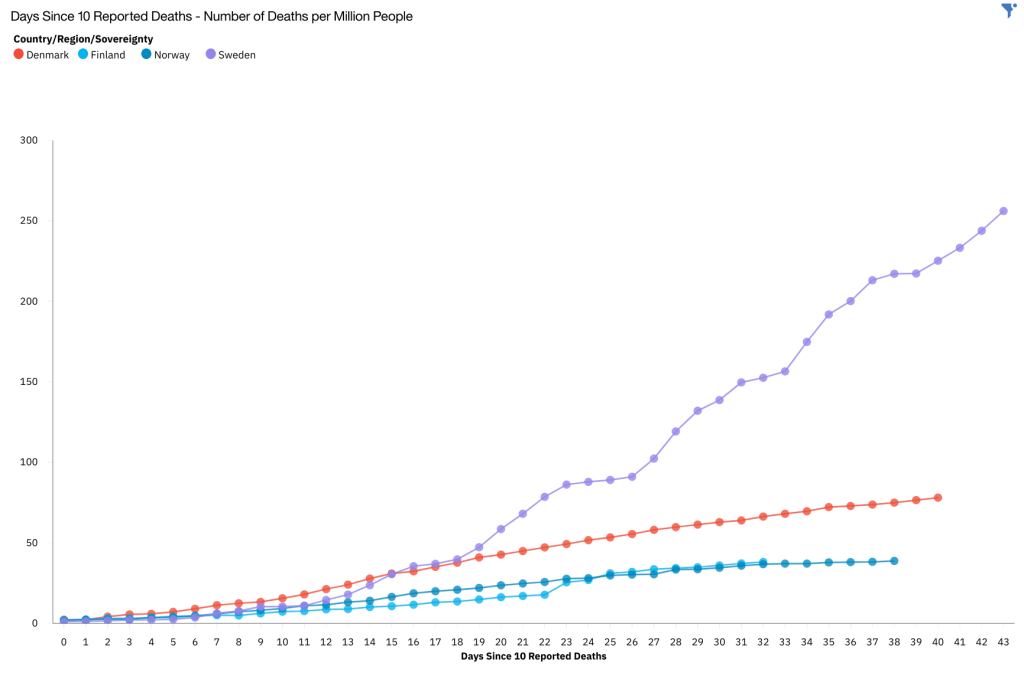
Swedish Covid-19 per capita mortality versus its neighbors.

The anti-lockdown contingent is promoting Sweden’s lockdown-lite as a huge success at saving its economy while providing adequate safety. First, we don’t really know how Sweden’s economy is doing compared to its Scandinavian neighbors or Europe. Second, compared to neighboring countries with strict lockdowns, I have to say, looking at the chart above, that Sweden’s lockdown-lite is kind of a disaster. While Norway, Denmark, and Finland have flattened their Covid-19 mortality with strict lockdowns, Finland clearly has not got its infection rate R below one yet. So, if 5x – 6x higher mortality is acceptable for maybe saving a country’s economy (we don’t know yet), well, Sweden is your prime example.

Parenthetically, the anti-lockdown movement is focused on IFR, claiming that Covid-19 IFRs are low, about the same as the flu. There are two problems with their argument. One is that it’s hard to measure IFRs and estimated IFRs have a wide range. We don’t understand yet whether the wide range is due to testing methodology, adjustment methodology, different Covid-19 strains, different population characteristics (e.g., BCG vaccinations), or some other factor. The other problem is that we’re probably using the wrong IFR for the flu. The CDC estimates for flu deaths are estimates, not counted deaths. If you compare counted flu deaths to counted Covid-19 deaths, it looks like Covid-19 is 10x – 45x more deadly than the flu.

Next door to Sweden, Russia is running off the rails. Gail sent me a couple of good pieces about a part of the world that has kept its Covid-19 problems under wraps. I’ll have more on Russia in a later post, but on the economic front, it’s hard to tell which is harder on the Russian economy right now, oil prices or Covid-19. With oil prices as low as they are now, Putin is hesitant to spend any of Russia’s his US$150B sovereign wealth fund. You read that right. US$150B. While the US is borrowing trillions of dollars to paper over Covid-19 problems, Putin has a fraction of that in his reserve fund and no oil income. Good luck, Vlad!

Vlad shouldn’t feel to blad about things. Even drug dealers are having money problems. Wholesale meth prices have doubled as supplies dwindle and cartels can’t move cash out of the US. The DEA seized more than US$1 million in each of three recent Los Angeles raids.

With storefronts closed, supply chains in disarray and the global economy in peril, these complex schemes are hobbled and cash is backing up in Los Angeles …

Los Angeles Times, “Dirty money piling up in L.A. as coronavirus cripples international money laundering,” 30 April 2020

Cartels rely on non-essential businesses in LA to accept US dollars for goods, and then ship goods to Mexico to be re-sold. Those businesses are largely closed during the Covid-19 pandemic. And you know that when the cartels are having money problems, it’s a really bad economy.

Speaking of cartels, there’s the Trump Organization whose cash generating properties have been closed by the Covid-19 pandemic. Yahoo sent reporters to suss out the president’s Washington, DC property, Trump International Hotel. They found lots of room to distance socially.

An empty Trump International Hotel lounge on 22 April 2020.

“This is a market segment that is downplaying the risk of COVID-19. If you’re going to tie yourself to the president, and you think it’s important enough to go to the hotel, you’re not going to let fear of pandemic keep you away.”

Zach Everson, author of 1100 Pennsylvania newsletter, on Trump International Hotel’s post-Covid-19 prospects.

When the US capitol relaxes its Covid-19 restrictions, the President’s supporters will be the first to return to Trump International, happily sharing their Covid-19 stories and their Covid-19.

Meanwhile, Trump will continue blaming China for Covid-19. Never mind US intelligence says China didn’t release Covid-19 from one of its labs. Trump can’t pay off his Chinese loans, so he needs something to negotiate with. It’s important to the rest of us to find out the actual origin of Covid-19 so we can prevent another outbreak. Money is all that matters to Trump, especially other people’s money in his pockets.

That leaves me with no time to talk about one of the most interesting financial articles Brad passed my way recently. But you can read it here. This is how weird things are getting in the Covid-19 depression.

Last of all today, a shout out to my friend Ken on his 70th solar rotation. Ken’s birthday is a nice reminder that life keeps going while we’re sheltering in place. Keep stretching, Ken!

30 April 2020 – Thursday – #46

I may have got a bit ahead of Spain’s upcoming 11 May relaxation of Covid-19 restrictions. A friend stopped by yesterday to taste vermut on the terrace. After 50 days without face-to-face social interaction, I threw caution to the lovely Spring breeze outside. Besides helping me decode an invoice from the local water company, my friend confirmed a comment that appeared on yesterday’s Covid Diary BCN entry, namely that the second kind of apricot I tried in Spain was not an apricot at all! It was a nispero, or loquat. That explains why it tasted so different from an apricot.

With the added insight that comes from a few vermuts, the Spanish plan to relax Covid-19 restriction seems like an improved version of the US plan. Like US states, Spanish regions will manage the Covid-19 relaxation rather than the central government. That has the practical advantage that regions can respond to local health and business needs. It also has the political advantage that the central government can blame the regions if things go poorly, and vice versa.

In this dance between regional and central government power, far-right parties already are signaling a desire to take away the central government’s authority to prolong Covid-19 restrictions. El Pais points out, though, that “the level of aggression displayed by opposition groups was not as high as during previous sessions that dealt with the coronavirus crisis.” That made me wonder if El Pais political reporters carry around hormone tests.

Two people have called my attention to the Covid-19 relapse situation in South Korea. South Korean experts are saying that what appeared to have been Covid-19 reinfections in South Korea are really RNA tests amplifying inactive fragments of Covid-19 RNA. I first posted about this on 11 April when about 100 South Koreans who’d recovered then tested positive for Covid-19.

I could have sworn I posted earlier about the 6 April reports that 51 South Koreans appeared to relapse, too, but I can’t find that in Covid Diary BCN. I also could have sworn that I posted a similar RNA fragment amplification story when I made my imaginary post about the 6 April report. When I went back to search for these stories, my head started swimming with everything I’ve blogged about over the past 1-1/2 months.

In retrospect, I believe I decided not to post the initial 6 April Covid-19 reinfection report because I had read somewhere (but where where where?) about the possibility that the South Korean tests were amplifying Covid-19 fragments rather than picking up new Covid-19 infections. I must have decided to post the 11 April Covid-19 reinfection report because 1) there was continued concern that these were actual Covid-19 reinfections that would have significant implications for vaccines, and 2) the South Koreans are way ahead of almost everyone on testing, so they probably would have known by then their tests were amplifying RNA fragments rather than detecting a new infection.

Here’s my bottom line on the South Korean Covid-19 “relapse” story. I should have posted the 6 April report along with the story that those apparent Covid-19 reinfections could have been a testing artifact. Regardless of how the South Korean Covid-19 testing story plays out, humans often have a very weak immune response to Covid-19. In a non-peer reviewed study in Shanghai, researchers detected lower levels of Covid-19 antibodies in younger people, sometimes too low to establish clear Covid-19 immunity.

The Korean reinfection story was a possible confirmation of the Shanghai study. Even in the absence of the Korean reinfection story, though, the Shanghai study indicates that it’s possible that wide exposure to Covid-19 won’t produce herd immunity and that, if Covid-19 itself doesn’t generate a strong antibody response, vaccines may face the same problem.

Parenthetically, while I’m talking about vaccines, it’s a Covid-19 vaccine frenzy. Pfizer is teaming with the German company BioNTech to bring a Covid-19 vaccine to market this fall on an emergency use basis. This is in addition to previous reports about a Covid-19 vaccine from Oxford University this fall and another Covid-19 vaccine from Johnson & Johnson early next year.

This exercise of tracking down the South Korean reinfection story line reminded me of the enormous amount of Covid-19 dreck online. I was looking through Derek Lowe’s Twitter feed to see if that’s where I read that the 6 April South Korean tests results might be due to RNA fragment amplification and had to scroll though dozens of stories about hydroxychloroquine.

All that hydroxychloroquine dreck makes it even harder to find Covid-19 signal in the noise. That’s the power of the US presidency. In spite of the stupidity of the current office holder, his ill-informed statements amplify misinformation about hydroxychloroquine, bleach, testing, protective gear, etc. as media platforms struggle to assuage him.

Here’s an example of how media platforms are allowing the spread of presidential misinformation on bleach to avoid Trump’s ire.

Medie platforms won’t remove Trump’s remarks on bleach and Covid-19.

It’s a testament to Trump that he can push misinformation so far and wide, to his advantage and no one else’s.

Remdesivir! Or, maybe not! The latest study from Gilead shows that Remdesivir does not reduce Covid-19 mortality, but it does shorten hospital stays. That tells me that it’s value is during peak Covid-19 infection when reducing hospital stays cost-effectively makes more beds available. During non-peak Covid-19 infection, when healthcare systems aren’t overwhelmed and beds are available, the advantage of Remdesivir isn’t as clear to me.

Doctors are seeing all kinds of skin problems related to Coivd-19 including rashes and what looks like frostbitten toes.

Patients who end up hospitalized often develop a pink, itchy rash across their torso and limbs, [Dr. Alisa Femia] says. Others develop hives or, less commonly, a chickenpox-like rash. It can be tricky to determine whether skin conditions like these are actually caused by the SARS-CoV-2 virus or are a side effect of medications used to treat it, but Femia says the rashes are popping up often enough that they are probably manifestations of the virus itself.

Time, “From ‘COVID Toes’ to Hives, These Are the Skin Conditions Dermatologists Think Could Be Signs of Coronavirus”, 28 April 2020

Skin problems and loss of smell are indications that you need to isolate!

Following up on yesterday’s US meat supply chain story, Rachel Maddow interviews Sheriff Tony Thompson here:

While Elon Musk and Mark Zuckerberg argue the merits of lockdowns, people like Sheriff Thompson have to deal with the fallout of corporations that fail to provide safe work environments, especially when employees may have limited access to healthcare.

Bu the way, the Musk- Zuckerberg dust up reminds me of my 28 March post. The oligarchs who need labor (think Koch, Green, Musk) hate lockdowns. The information oligarchs (think Gates, Zuckerberg) are all for lockdowns.

I’m going to finish up today with Covid-19 fashion. One thing I wish I had more time to discuss is Covid-19 fashion trends. My friend Heidi is making Biden 2020 masks and donating proceeds to help the less well off. And I just know there have got to be a lot of private “fashion shows” going on.