14 April 2020 – Tuesday – #30

I might have to become a healthcare worker to get PrEP in Spain.

“We are seeing few cases of HIV-positive people with severe COVID-19. This is surprising because the immune system of an HIV-positive person has similarities to that of older people who do have severe cases of COVID-19. Furthermore, there is evidence from in vitro studies that supports Truvada can have an immunomodulatory effect.”

Dr. Jose Arribas, Research Director, HIV and infectious diseases, La Paz Hospital, Madrid

I’ve been using Truvada for about five years. It may seem weird that PrEP (Pre-Exposure Prophylaxis) for HIV would have anything to do with Covid-19, but it doesn’t seem weird to me. I noted to my US primary care doctor that my incidence of cold sores dropped to almost zero after I started PrEP. Not that my cold sore experience means much statistically, but I’ve been wondering for a while whether PrEP is protecting me from more viruses than HIV.

The reason I make a joke about becoming a healthcare worker to get PrEP in Spain is that the most frustrating thing living here has been obtaining PrEP. Note to the Spanish healthcare system: make PrEP easier to obtain without becoming a healthcare worker on the front lines of the Covid-19 response.

I’ve seen four doctors at my current healthcare provider, all of whom understand that I want Truvada (or, even better Discovey, which isn’t available here yet), but none of whom have figured out how I obtain it through the Sanitas system. I tried taking a Truvada prescription to a pharmacy. The pharmacies had no idea what to do with it. This surprised me because HIV+ patients use Truvada, too, and Sanitas must provide Truvada to them. But how? Through the public health system?

In theory, some day I will be able to obtain PrEP for free through BCN Checkpoint, the local gay-oriented public health service. That’s possible after I sign up for the CatSalud public health system. Okay, that seems simple. But let me give you a taste of Spanish bureaucracy.

According to Felix, my incredibly helpful contact at BCN Checkpoint, I can’t sign up for CatSalud until three months after I obtained my empadronamiento, the Spanish registration that says I live in Barcelona. So first I needed an apartment. After I got an apartment, I got my enpadronamiento. Now I can’t apply for CatSalud until next month and I don’t think my application will be at the top of the CatSalud processing queue after the lockdown.

In the meantime, I have found online PrEP providers that cost about US$60 per month. I don’t mind the cost, but delivery has been problematic. The first delivery took about 20 days, the second 38 days. Needless to say, I’ve missed some doses. It doesn’t matter right now in isolation, but it would be nice not to have to worry about how to obtain PrEP here.

So, that’s why I say it might be easier to get PrEP if I just become a healthcare worker.

When Covid-19 came knocking, both Sweden and South Dakota preferred their economy and individual rights to the collective public health good of a lockdown. For those making the argument that “the cure is worse than the disease,” there are now data on the cost side. The pandemic is far enough along to measure the incremental loss of life when a government chooses to ignore the pandemic.

Here’s a mortality comparison for Sweden versus its Scandinavian neighbors.
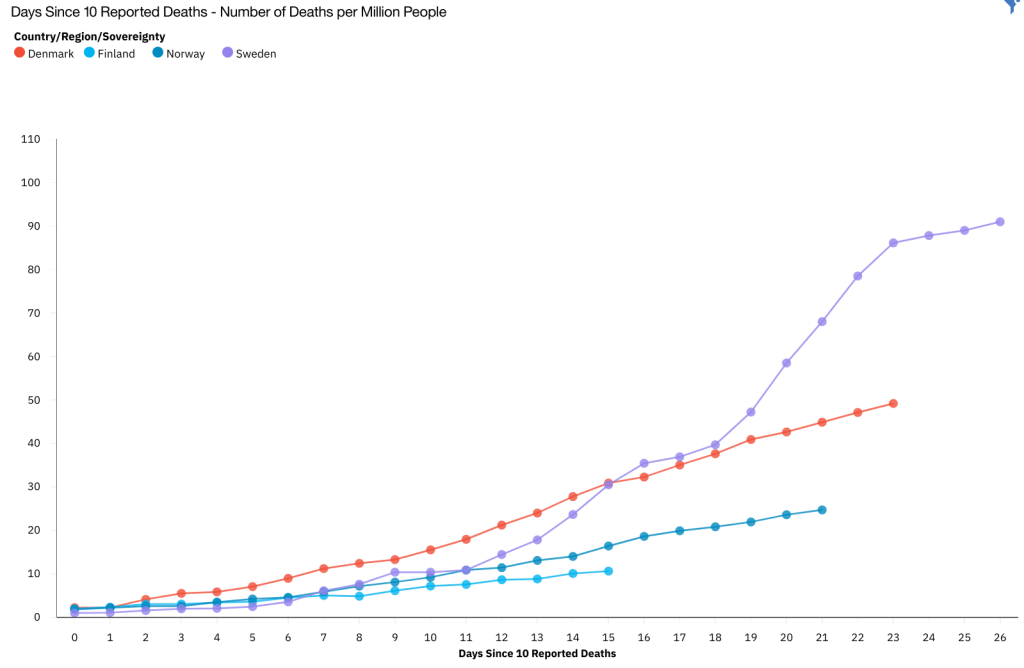
Covid-19 per capita mortality for Denmark, Finland, Norway, and Sweden at 13 April 2020

Sweden has about double the mortality per capita of its close neighbors. This seems like a reasonable comparison because the four Scandinavian countries have similar cultures and healthcare systems. None of these countries have saturated their healthcare systems. Sweden has adjusted its Covid-19 policies recently, but it appears that the cost of keeping the Swedish economy going rather than locking down is a doubling of its Covid-19 mortality.

If Sweden saturates its healthcare system, it’s likely that its per capita mortality would be more than double its neighbors’. Countries that have saturated their healthcare systems, like Spain and Italy, have roughly 6x the per capital mortality of countries that have not, like Germany. That suggests that lack of an early lockdown costs about 2x mortality and the cost of a lockdown that’s so late the country’s healthcare system becomes overwhelmed is another 3x mortality.

To understand the cost-benefit properly of Covid-19, we’ll need Q2 economic statistics for Sweden and its neighbors to show the benefit side. My guess is that Sweden will outperform its neighbors, but not by much. Sweden’s economy is tied to the rest of Europe and the world. That will at least damp Sweden’s performance. Also, Swedish workers are adopting aspects of lockdown on their own. The open question is whether countries that don’t lockdown escape the downturn created when their neighbors and other countries lockdown. I suspect the effects of continental and global economic performance outweigh the local effort, especially where economies share a currency. This is where a coordinated worldwide response would pay off.

South Dakota has no stay-in-place orders as of yesterday. Here’s a comparison of per capital Covid-19 confirmed cases and deaths for South Dakota and neighboring states to the south and north.

Confirmed Covid-19 Cases
per capita
Covid-19 Deaths
per capita
South Dakota1.0 per 100,0007 per million
Nebraska0.5 per 100,009 per million
North Dakota0.4 per 100,00010 per million
Covid-19 per capita confirmed cases and deaths for S. Dakota and its neighboring states at 13 April 2020 (Google)

The absolute number of deaths so far is so small that the death statistics don’t seem useful. Per capita mortality rates will be clearer in a few weeks when the number of deaths in each state are in the dozens. The confirmed cases statistics probably are not measured as well as the death statistics, but there are hundreds of confirmed cases, so the statistics are more useful.

Like Sweden with double the per-capita mortality of its country neighbors, South Dakota has double the per-capita confirmed cases of its state neighbors. As the per capita deaths increase, I expect South Dakota deaths will follow its confirmed cases and run about double its neighbors. So here is a second case showing the cost of no Covid-19 distancing measures is a doubling of mortality (in the absence of a saturated healthcare system).

A Covid-19 outbreak at a Sioux Falls pork processing plant has pitted Mayor Paul TenHaken, who is requesting a state-wide stay-in-place order, against South Dakota Governor Kristi Noem. Ironically, the Republican governor is going full Trump. Rather than ordering social distancing, she has announced the state will be the first to run a state-wide hydroxychloroquine trial. It looks like South Dakota will be providing the rest of us statistics for how a full Trumpian Covid-19 response performs. If you read yesterday’s entry about hydroxychloroquine, you know there is no good evidence hydroxychloroqine helps with Covid-19 and good evidence that its use can be risky. Good luck, South Dakota!

Speaking of Trump, state governors have taken Covid-19 matters into their own hands, forming state coalitions to coordinate the end of state lockdowns. Of course, Trump claims absolute authority to order citizens back to work. The governors’ actions show the degree to which Trump has lost credibility with state governments due to his inept management. Sadly, as noted above, states and countries would benefit from Covid-19 policy coordination, but Trump has created a situation where the political stakes for him of reviving the US economy differ from the reality governors face to keep their citizens safe.

Parenthetically, Covid-19 breaks the entire Trump Make America Great Again political brand. MAGA assumes there is some past version of America that Americans want to revive. Covid-19 forces America to look different from before. There is no way back to what anyone might have thought of as normal.

I’m not a tea drinker, but my Mom is. She reminded me on our call yesterday when she mentioned she can’t order first flush Darjeeling Tea. Actually, I am the one who orders it for my Mom, but no need to stand on ceremony. Covid-19 in India is pitting public health against the well being of the tea industry which has lost its “champagne” first flush harvest this year and probably will lose its second flush harvest, too.

I tried first flush tea once when the father of an employee, a peppy software engineer named Himanshu, showed up at the office with samples from his tea garden. We spent an hour learning about the flavors. It was as interesting as a wine tasting, but without the buzz. I said I would visit, but I haven’t got to India yet. I wonder when that will happen.

It seems like everyone I talk to is tired of being cooped up inside. When they aren’t having anxiety from looking at four walls, friends are having travel fantasies. My current travel fantasy is to walk down to the Mediterranean and look towards Algeria. What’s yours?
13 April 2020 – Monday – #29

A lot of the chatter in my social media feeds is about whether the US has turned the corner and whether the lockdown is worth its economic consequences.

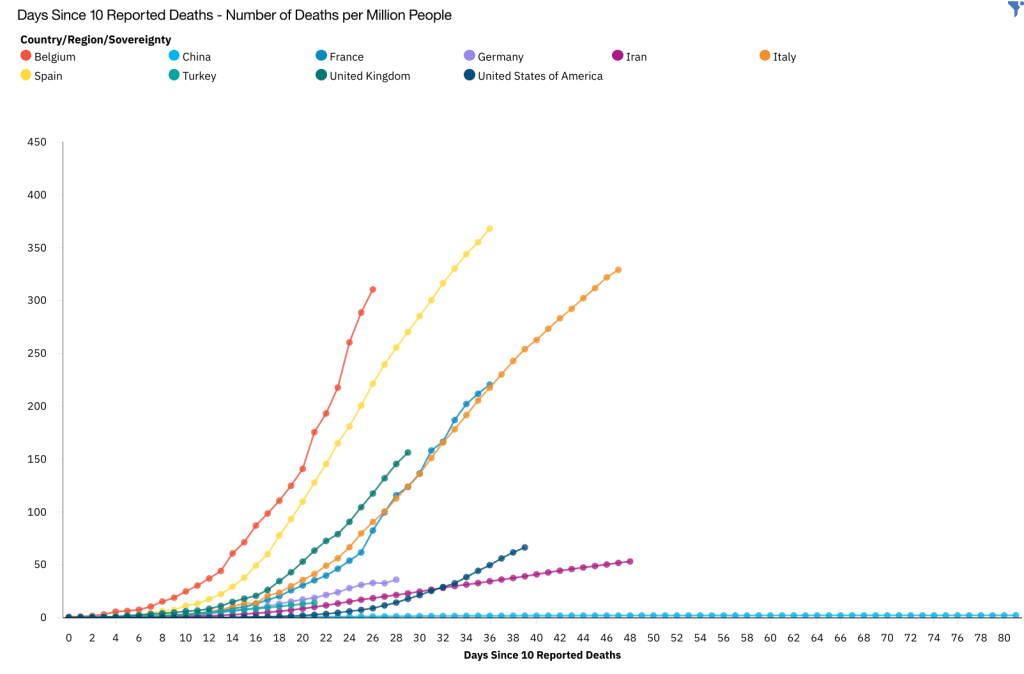
It’s worth noting that Covid-19 mortality charts comparing countries mostly have changed their data presentation from units of deaths to units of deaths per capita.

Covid-19 deaths per capita by country at 12 April 2020

The switch in vertical axis units was needed, of course, because US deaths were swamping deaths in other countries.

On 31 March, I estimated 350,000 – 500,000 US Covid-19 fatalities based on an assumption that the US per capita Covid-19 death rate would be similar to another estimate I made for Italian per capita deaths. At that point, I was watching New York and assuming the rest of the US would follow suit. Obviously in states like California that locked down earlier, the US has not followed suit.

Two weeks later, I can see what I hope is an inflection in the US mortality curve. I still think the US is susceptible to new hot spots in a way that countries with complete lockdowns are not, and so I think any inflection in the US curve is at risk.

Parenthetically, I wonder if the US car culture has anything to do with its Covid-19 performance versus European countries. It may simply be that most of the US didn’t max out its healthcare infrastructure, but it seems like there may be other factors at play.

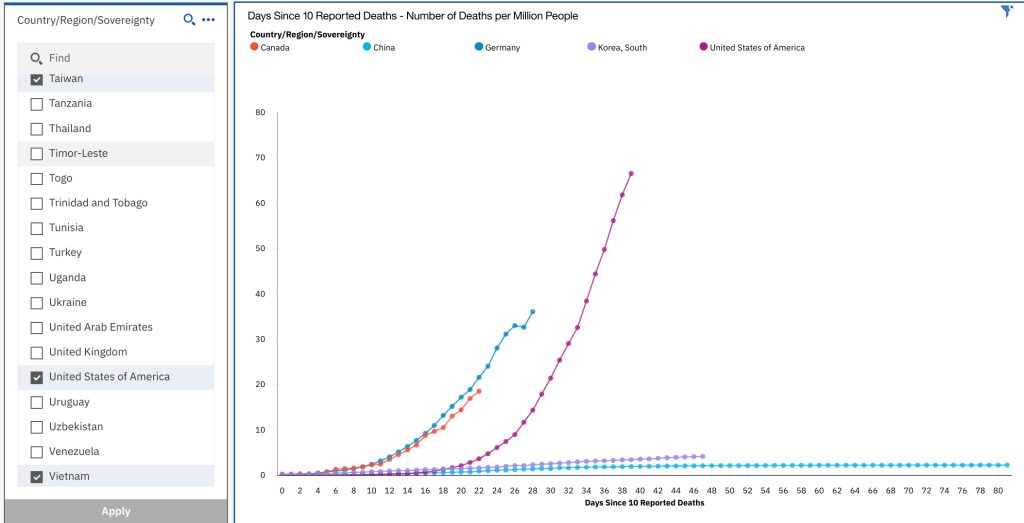
I compared US Covid-19 mortality per capita to a different set of countries here.

Covid-19 per-capita mortality for US, Canada, Germany, South Korea, China, Vietnam, and Taiwan at 12 April 2020

This chart shows how the US performed against countries that had the most effective Covid-19 responses. I show on the left that I included Taiwan and Vietnam. Those two countries’ Covid-19 responses were so good, they don’t register on the chart.

Clearly, South Korea and China had much better responses than the US, although there are disputes about the accuracy of Chinese mortality data. Germany and Canada may be the closest cultural comparisons in terms of governing style, although neither is as large and diverse as the US.

I think it’s fair to say that the US, which had earlier notice and better resources than most countries, responded poorly. As of today it has 2x – 10x higher per capita Covid-19 mortality than the best responders. There is more upside risk in that multiplier than downside risk.

In the same way that scientists are working on Covid-19 treatments and vaccines at a blinding pace, economists and policy wonks are churning out economic recovery plans. The push to open up the economy is a difficult trade-off over many variables. The phrase “open up the economy” sounds to me like we closed a door in March and, if we just open that door, the world will be what we remember from six months ago. There is no such door and the world will not be the same.

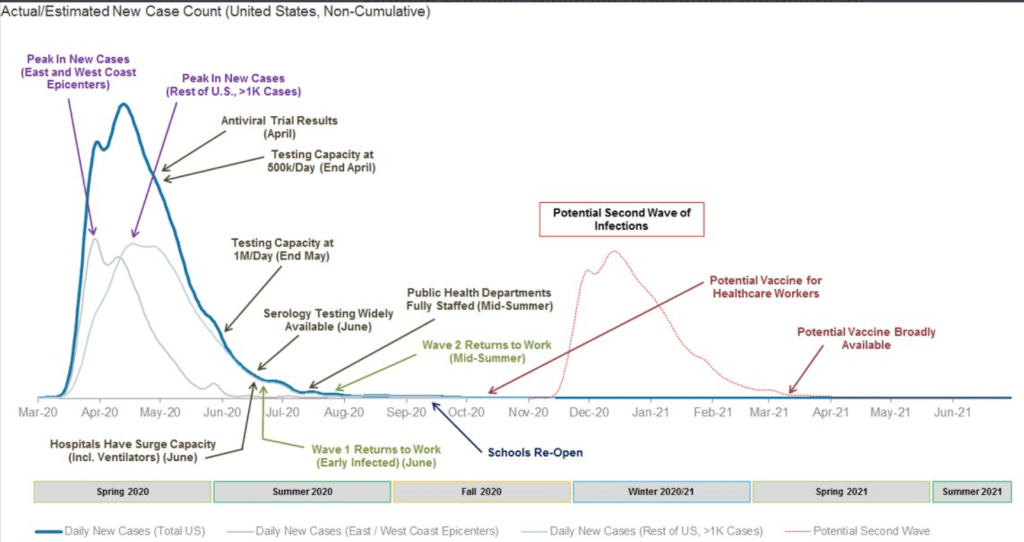
Brad tipped me off on what I would consider an optimistic timeline from Morgan Stanley.

The Morgan Stanley timeline assume working vaccines in the US within a year.

“While we understand the desire for optimism, we also caution that the US outbreak is far from over. Recovering from this acute period in the outbreak is just the beginning and not the end. We believe the path to re-opening the economy is going to be long.”

Morgan Stanley Covid-19 recovery report

Most recovery plans imagine a very different world, a world with mass testing or mass tracking, or both. Any plans require cohesive international leadership to scale globally. The US might have been able to lead such an effort four years ago, but its leadership can’t even get American citizens on the same page about something as straight forward as social distancing. Even if international leadership rallies behind a cohesive plan, it still faces a far-right challenge in the US and elsewhere to leverage Covid-19 to tear down existing government structure.

Minorities and the poor will suffer the worst consequences of opening up too soon. There are arguments that the economic harm from worldwide lockdowns will kill more minorities and poor people than Covid-19 itself. Most of the people I know making this argument make it from a position of privilege. I not sure the trade offs are being made fairly in any argument to open up the economy right away.

It is clear that minorities and the poor are already getting the short end of the Coivd-19 stick during the lockdowns. Low wage earners with essential jobs usually face more Covid-19 risk because they don’t have the luxury of working remotely at home. Jails and immigration holding facilities have failed to provide adequate healthcare to their laregely minority and poor populations. The US healthcare system, which normally doesn’t work well for minorities and poor, is failing minorities during the US Covid-19 outbreak.

The parts of the supply chain that are working are not safe for low-wage workers who staff them. Opening up the economy will put disproportionately more low-wage workers at risk of Covid-19 infection. Opening up the economy also will test crippled international supply chains which operate in underdeveloped countries that are further behind in their Covid-19 epidemics.

I wish I could wave a wand and say open up the economy today. European and US Covid-19 are looking good. Everyone wants to step outside. How bad could it be if everyone starts working again?

In my opinion hydroxychloroquine offers an object lesson in how easy it is to promote a simple solution that turns out not only to be wrong, but hurts people.

For those of you keeping tabs, there are no hydroxychloroquine breakthroughs. Dr. Didier Raoult, the French doctor who first claimed miracle results and, as far as I can tell, is the epicenter of the hydroxychloroquine drama, now claims to have a 98% cure rate in over a thousand patients with no cardiac toxicity. The claim is made without a published study or a control group. This is similar to the other quack doctor advocating hydroxychloroquine, Dr. Vladimir Zelenko in New York, who claims hundreds of successful outcomes. Dr. Zelenko also hasn’t presented a full study and has no control group.

In what appear to be leaked results of a study from Detroit, hydroxychloroquine does not benefit Covid-19 patients. With 63 patients, the study is too small to draw conclusions. However, the patients were divided into half that got hydroxychloroquine and half that did not, so this study has a control.

A Brazilian study halted high dose chloroquine testing because of cardiac toxicity. The study is continuing with low dose chloroquine testing. The Brazilian study has 81 patients and includes azithromycin and ceftriaxone antibiotics. So far, the mortality results for patients on chloroquine is about the same as general Covid-19 mortality, so it doesn’t appear to have a benefit.

Finally, in a non-Covid study looking at case data across six countries for complications in rheumatoid arthritis patients from use of hydroxychloroquine with different antibiotics, use of hydroxychloroquine with azithromycin appears to increase risk of angina and heart failure by 15%-20%. Azithromycin is the antibiotic recommended for use with hydroxychloroquiine in Covid-19 patients.

The bottom line is that there are many Covid-19 treatment candidates and there is nothing concrete so far to suggest that hydroxychloroquine is a standout among them. In fact, it appears that hydroxychloroquine poses significant cardiac risk when used with azithromycin and possible cardiac risks otherwise if dosage is not managed correctly.

I suspect that if hydroxychloroquine were a magic bullet, we would have more anecdotal evidence that’s true and at least hints about a well done study with promising results. We have a lot of usage, but we have neither overwhelming anecdotal reports nor whispers of a good study.

But we didn’t hurt anything by trying hydroxychloroquine, did we? The president’s message that hydroxychloroquiine is the magic bullet for Covid-19 has disrupted supplies for people who already use it for malaria and lupus. Guess who that hurt. Minorities and the poor.

12 April 2020 – Easter Sunday – #28

Buena Pascua, as the proprietor of the jug wine store taught me yesterday. I did my good deed delivering jug wine and chocolate Easter eggs to my friend Nicole and her four year old daughter. The eggs provided a few minutes of relief from the tedium. I hope the jug of wine I delivered lasts a little longer.

Also yesterday, a Facebook friend, which is a euphemism for a guy I flirted with at a swank New York cocktail party once, posted videos of crowds in his native El Salvador celebrating a Good Friday of yore. For me, it’s got to the point with Covid-19 that watching scenes of crowds congregating is as scary as watching a horror film. Everyone is going to die!

The El Salvador video reminded me of when I traveled in Italy my senior year of college. I was sleeping at a hostel when a loud scraping sound awoke me. It wasn’t until I looked outside and saw a chiseled Christ shouldering an enormous wood cross past my window that I realized it was Good Friday and I was in a Catholic country. Beholding Christ in this manner, I briefly considered conversion.

One of the things I was looking forward to in Barcelona was a good segrada semana, with lots of cross dragging and religious drag. I’m not religious, but who doesn’t love a good spectacle. I think of Easter pageants as the Church’s interpretation of a gay parade, although the Church probably thinks of it the other way around. Plus the grand Sagrada Familia is a 15 minute walk from here, so Easter here is certain to be a top notch religious spectacle with top notch drag. And, I’m going to write it even if some divine instrument strikes me dead, Sagrada Familia has got to be the most phallic church ever.

My friend’s El Salvador video also reminded me how Easter celebrations differ by country. I don’t think you’ll see this Salvadorian ritual in Rome any time soon, even after salvation in the form of a Covid-19 vaccine.

Vatican influence seems to follow an inverse-square law: strict adherence is inversely proportional to the square of the distance from Rome. For instance, Italy still adheres to strict boy-girl marriage, whereas in Spain, it’s anything goes. If Easter teaches us anything, it’s that all you need to create a another Christian sect is distance from the Pope and a new spin on the significance of Christ and his resurrection.

Alas, unless you live in places like Kansas that encourage infectious church gatherings, no religious congregations this year. The same is true, of course, for other cultural events.

This is one part of the Covid-19 pandemic that’s very different from the AIDS crisis. During AIDS, sex was dangerous, but hanging out with gay friends wasn’t. My friend Rabih wrote a funny-not-funny piece called How to Bartend which describes the San Francisco Spikes gay soccer team that we both played on (I’m number 4 in the photo, in case you’re wondering, and Rabih is to my left). The Spikes was my gay church, a safe group of gay men with whom I could process the horror of AIDS.

Who’d have thunk sports would be so important during AIDS, but it was. Gay Games II in 1986 took place in the scariest moments of the AIDS crisis. Allow me to set the stage. San Francisco’s Castro district was a ghost town, as it were. People were still confused about transmission. No one went out to bars. We were busy visiting our sick friends in hospitals and hospices. Everyone was dying. No one seemed to care.

The influx of gay athletes Gay Games II resurrected the Castro. The neighborhood filled up with fabulous athletes girding their loins with a drink at a gay bar before the games. It was like a ventilator to an unconscious Covid-19 patient. It was like someone flipped a switch and said, hey, it’s okay to have a drink, okay to take a time-out from the horror and let your hair down.

So what happens to religion, sports, and the arts in the time of Covid? How do religious, cultural, and sports institutions survive? It’s a question that’s on my mind because I’m on the board of the Moab Music Festival. Like many other arts organizations, we’re making it up as we go along. I haven’t seen the agenda for next month’s board meeting, but I already know the most difficult topic.

The reaction so far in sports has been to donate money, which is great, but then what? California Governor Newsom already has suggested there will be no professional sports events for the rest of 2020. In Taiwan, which had one of the most successful Covid-19 responses, basketball teams are playing each other with small crowds under lockdown conditions. Perhaps this model will show other sports leagues a way to resume play. I’m guessing professional leagues are exploring technology to bring remote crowds to such events.

It’s encouraging to see early artistic responses to Covid-19. Give artists an inch and they’ll create a new planet. That’s their job.

Writers continue to write, although Covid-19 changes plans. The book I’m completing, Dear Mustafa, is set during AIDS and during 9/11. You can bet I’m looking for connections to how Covid-19 is changing the world the way AIDS and 9/11 previously changed the world.

Charles Stross, who provides great insights into the Afro-Haitian origins of zombie stories, is scrapping a book because the Covid-19 pandemic is a better version of the story he planned to tell.

And the whole theme of this untitled novel was going to be: this is elite panic, and this is disaster capitalism, and this is what really happens during a zombie epidemic, and these things are not the same—

And then COVID-19 came along and basically rendered the whole thing unneccessary because we are all getting a real world crash-course in how we deal with people suffering from a viral pandemic, and we do not generally deal with them using shotguns and baseball bats even if they’re so contagious that contact might kill us.

Author Charles Stross on the difficulty of writing SciFi in the 21st century

By now you’ve probably seen one of those videos with a bazillion people performing as though they were together in a concert hall. You also probably have no idea how the magic happens. I didn’t either until Brad sent me a link on how to make your own concert with remote musicians. [Hint: it’s time consuming.]

This is not a new technique. My friend Charles Yang was one of the musicians who made this kind of video as a multi-layered solo piece early on. Here’s a recording of Bob Dylan’s Make You Feel My Love from nine years ago.

Charles Yang performing Make You Feel My Love

So, let’s have a short Covid-19 Easter concert, shall we?

Let’s follow up Charles with True Colors from the Camden Voices in the UK.

Camden Voices performs True Colors

Next up is Family Lockdown Boogie, which does not use remote performers, but is a fun look at family “fun.”

Covid-19 Family Lockdown Boogie

Here’s a recording of a live performance that has nothing to do with Easter, but ties together Barcelona and the United States. Pete Seger performs Viva la Quince Brigada, also known as the Abraham Lincoln Brigade, in Barcelona in 1993. It’s a song about a mostly American, Canadian, Irish, and English brigade that volunteered to fight the rebels during the Spanish Civil War in July 1936.

For our last piece today, I’m taking us back to San Francisco, the home of the first and second Gay Games. Here’s the San Francisco Gay Men’s Chorus performing Truly Brave for the all the Covid-19 healthcare workers and first responders out there.

San Francisco Gay Men’s Chorus performing Truly Brave

Buena Pascua from Barcelona!