11 April 2020 – Saturday – #27

As a survivor of the AIDS epidemic, I marvel at the speed of Covid-19 research. Science during the time of AIDS was agonizingly slow. One of the earliest reports of HIV in the US was a September 1981 Lancet article about eight gay men in New York with Kaposi’s sarcoma. Around the same time, gay men were reported to have Pneumocystis carinii pneumonia in Los Angeles. Gay men were dying from rare diseases. No one knew why and most people didn’t care.

It wasn’t until a year later that the CDC came up with the name Acquired Immune Deficiency Syndrome (AIDS) to describe the outbreak. Imagine if we were still six months away from coming up with just the name for the malady that’s now infected a million people worldwide, something more descriptive than the flu.

It took until 1984 for scientists to discover the virus that caused AIDS, then another year to market the first test for the virus, and still another year after that for scientists to name it. Five years into the AIDS crisis, we had the Human Immunodeficiency Virus (HIV).

It took us years just to agree on the name of what was killing us.

Nine years after the first US AIDS cases, when there were over 100,000 AIDS deaths in the US, when an estimated 8-10 million people were infected with HIV worldwide, and when the US still hadn’t appropriated significant funding for AIDS research or treatment, science delivered the first treatment for AIDS, a re-purposed cancer treatment called AZT. Nine years for a treatment that didn’t work well is beyond agonizing while you’re watching your friends die.

But science delivered a treatment in the absence of any significant government support and, as governments bumble their way through Covid-19, that should give everyone hope. Science goes on in spite of politics.

Not to harp on the US government’s inept response to Covid-19 or anything, but the Trump administration is making the Reagan administration’s response to HIV look genius. The Reagan administration didn’t do anything, but it couldn’t be blamed for having very few ideas about what might work. No one did. The dance between viruses and the human immune system wasn’t well understood then.

The Trump administration, on the other hand, has failed to deliver test kits, ventilators, and protective gear when experts knew these were vital to reducing Covid-19 deaths. Five or six months into the pandemic and Trump himself doesn’t appreciate the difference between bacteria and viruses. That doesn’t keep him from spouting off misinformation.

The president of the United States doesn’t understand the difference between bacteria and viruses.

Scientists learned a lot about viruses and the human immune system during the AIDS crisis. In the thirty years since AZT, science has added a host of significant tools to its virus arsenal including reasonably complete human immune system models, PCR gene amplification, the Internet, and big data.

Today there are over 1-1/2 million Covid-19 cases and about 100,000 deaths. AIDS has a much higher mortality rate than Covid-19, but Covid-19 is much more communicable. In five or six months, Covid-19 has done the damage that took AIDS five or six years.

But in five or six months, science already has identified and sequenced the Covid-19 virus, determined it doesn’t mutate much, identified target treatments, and has vaccines in trials. Unlike the AIDS crisis, governments have allocated trillions of dollars to support research and to prop up the world economy. There are over 400 clinical studies underway and dozens of potential therapies. In other words, the scientific advances the world achieved for HIV / AIDS in 15 years have taken about five or six months for Covid-19.

The speed with which the science community is attacking Covid-19 is breathtaking compared to the days of AIDS. Once again, a virus is changing the way scientists work.

We had our first small meeting on Friday, March 6, where we saw the first 120 human-cell proteins that interact with 10 of the 29 viral proteins. …Quickly after that meeting, we assembled more than 150 scientists … into the QBI Coronavirus Research Group to identify potential drugs that target the host factors the SARS-CoV-2 virus interacts with to potentially repurpose existing drugs to treat patients. Through an amazing crowdsourcing effort, largely on Slack and Zoom over 2 weeks, we identified 69 potential drugs, which our collaborators in New York and Paris are screening in some of the first SARS-CoV-2 replication assays in the world.

Kevan Shokat, Chair, Department of Cellular and Molecular Pharmacology, UCSF

Already Gilead’s HIV anti-retroviral (ARV) drug remdesivir shows some promise in treating Covid-19. In a small trial with 33 patients, remdesivir outcomes for late-stage patients was better than late-stage non-study patients in China. The study is small and has no control group, so this is not definitive news. If further testing shows remdesivir outperforms a control group, but doesn’t resolve Covid-19 in all cases, it may become part of a Covid-19 cocktail, similar to HIV ARV cocktails like Truvada which contain two or more ARVs to keep HIV in check.

Like many, I have assumed that a Covid-19 vaccine will come in 12-18 months. But no one actually knows. I’ve been waiting almost 40 years for an HIV vaccine so I don’t have to worry about infection. By now when a researcher announces an HIV vaccine candidate that looks more promising than any before, I kind of roll my eyes. I hope the researcher is right, but I’ve seen this film too many times. I know how the promising story is likely to end once the candidate vaccine goes to human trials.

A Covid-19 vaccine seems more likely since the virus doesn’t appear to mutate rapidly and scientists have made vaccines for similar viruses. But no one actually knows. There’s evidence in South Korea, for instance, that 100 patients have relapsed. Lots of unknowns in this reporting. It could be testing, but South Korea has more testing experience that many countries. It’s not a large percent of recovered patients who appear to be relapsing, but it looks like a growing percentage over time. If Covid-19 relapses are real, maybe it takes 5 or 10 or 40 years to find a Covid-19 vaccine. The world may have to rethink its response to this virus.

Then there are technological surprises. Yesterday, Apple and Google announced an opt-in app that enables contact tracking. Of course, there are enormous privacy issues with this kind of geolocation data sharing, but it’s a solution that was unimaginable 40 years ago when AIDS started. This app is a harbinger of the ways science and technology might change the Covid-19 outcome without treatments or cures, but by helping humans change our behavior.

During the AIDS crisis, gay men learned how to change their behavior. Before there was AZT, even before HIV had its name, gay men learned that condoms could save their lives. When we knew almost nothing about AIDS but wanted to have sex, we used condoms. It gave us a way to stop the spread and, if we stopped spreading the virus, fewer of us died and we had a path to AIDS eradication.

No one knows how Covid-19 is going to play out. The good news is that we know what works for Covid-19, social distancing and hand washing. Here’s an eloquent 30-second reminder from the state of Ohio.

State of Ohio Covid-19 public health advertisement on social distancing

The viruses that do well in humans are the ones that takes advantage of what we humans like doing most. HIV takes advantage of the human desire to have sex. Covid-19 takes advantage of our desire to be social. I hope in my lifetime there’s not a virus that takes advantage of my desire to love others.
10 April 2020 – Friday – #26

Here’s a Barcelona Covid-19 report from Sky News yesterday. The report makes it clear that, even if Spain has turned the corner, the situation in hospitals here isn’t improving yet.

I’m a little unclear now about Spanish Covid-19 mortality numbers, not only from this Sky News report, but also from the research I did after I posted yesterday about BCG vaccine and how it might have affected Spanish Covid-19 mortality. On news as important as the BCG vaccine, I try to cover my bases before I write. I relied on two sources for what I wrote as well as a scientific paper, so I stand by my basic story. I have to retract the Spanish part of my BCG vaccine story for two reasons.

The first problem with my Spanish claim is that I didn’t check a footnote carefully. The BCG World Atlas says that all of Spain received BCG vaccinations from 1961 to 1981. I didn’t pick that up and it’s inconsistent with what I wrote yesterday. Apologies for that. Subsequently, I haven’t been able to confirm what the BCG World Atlas reports. Several local sources (who are old enough to know) don’t remember any BCG vaccine program in Catalonia.

The second problem with my claim is Spain’s official Covid-19 mortality numbers. My Covid-19 calculations based on Google search results line up within a few percent of the Covid-19 numbers in El País. What the El País country wide numbers show, though, is that not only are Catalonia and Basque Country Covid-19 deaths per capita low compared to Madrid, but also that the rest of Spain is low compared to Madrid. More importantly, when I showed my numbers to one of my doctors and asked about getting a prophylactic BCG vaccination, his response boiled down to don’t rely on the official Spanish numbers to make that decision.

Parenthetically, as I researched this, I ran across two interesting tidbits. One is that Madrid’s population has been surreptitiously escaping Madrid at night when the police aren’t watching. Unlike New York City, whose population can leave whenever it pleases (except, as Brad notes, Fran Lebowitz, who’s everyone’s designated New Yorker), Spain imposed travel restrictions on Madrileños to keep them from carrying Covid-19 to the countryside and overwhelming rural healthcare. Based on utility consumption and trash production, mayors outside Madrid estimate their populations have doubled or tripled from the nocturnal exodus.

The second tidbit is that there are some excellent resources for tracking Covid-19 that I didn’t know about. I’ll put these on the Resources page so everyone can find them later. One resources is the NIH Covid-19 clinical study list. There were 388 studies when I looked yesterday. There are 410 studies right now. Another Covid-19 resources is the Covid 19 research page maintained by the National University of Singapore. This has a good list of Covid-19 related articles and it’s easy to tell what’s new. A third resource is a public Covid-19 data lake on Amazon AWS. Large data sets differentiate the Covid-19 pandemic from previous epidemics and may be the way the world gets to a Covid-19 solution faster than ever. Unfortunately, that comes with the caveat that it’s sometimes hard to know, as in the case of Spanish Covid-19 mortality data, the quality of the data during such a rapidly unfolding event.

Anyway, apologies for yesterday’s Spanish claim. I did qualify it when I wrote it and provided an update as soon as I knew about possible problems with what I wrote. The rest of what I wrote yesterday is based on the two sources and the scientific paper, which you, dear reader, may check. It still looks like BCG vaccine is a viable Covid-19 prophylaxis and can attenuate mortality until there is a vaccine. I’m waiting to request a vaccination until there is more information on the trade-offs. I’m not in a hurry for another ugly scar.

My predicament about how to value Spain’s official Covid-19 mortality numbers is also a predicament about how to value the models predicting where the Covid-19 pandemic goes from here. One problem is good data, another is a good model. Looking at the official Italian and Spanish numbers, I’m still optimistic that both countries have peaked. But if I’ve learned in the last twenty four hours of research on BCG vaccinations in Spain, it’s that there is a lot of uncertainty in both data and models.

While I’m trying to role model good data analysis and reporting, Fox News, which has a somewhat larger audience than Covid Diary BCN, claims that that the US is over-reporting Covid-19 mortality. Fox commentators are asserting that if someone has, say, a heart condition and dies while they have Covid-19, then that case should be classified as a heart failure rather than a Covid-19 casualty.

“We’ve made it very clear, every time I’ve been up here, about the comorbidities.This has been known from the beginning. So those individuals will have an underlying condition, but that underlying condition did not cause their acute death when it’s related to a COVID infection.”

U.S. coronavirus response coordinator Dr. Deborah Birx during Wednesday’s White House coronavirus task force press briefing

The Fox News agenda is to get people back to work. And it’s working, at least for religion and gun rights. In Kansas, the GOP overrode the governor, who had banned religious gatherings. In Idaho, Ammon Bundy is leading a so-called Liberty Rebellion. At a meeting that probably violated Idaho’s restrictions on social gatherings, Bundy said, “If it gets bad enough, and our rights are infringed upon enough, we can physically stand in defense in whatever way we need to.” Infringement of rights is code for taking away guns. “In whatever way we need to” is code for using guns. Meanwhile, Vice President Pence is already laying out the plan to open up the US economy. In the Vice President’s words, “No one wants to reopen America more than President Donald Trump.”

I hope Fox News, the Kansan GOP, Ammon Bundy, and the people advocating a rapid reopening of the US economy take a look at the Sky News report above. Spain is officially over the mortality hump, but its hospitals continue to add capacity for patients.

Trump and Fox News want a narrative that the US economy is opening in order to win re-election. If anyone is sure that the pandemic is ending soon or claims to know how this pandemic ends, it’s likely because they have something to sell. The truth right now is no one knows how it ends.

While we’re on the subject of having something to sell, I haven’t noticed any shortages at the stores I’ve visited in the past week. In the US, though, it seems that food distribution is having some of the same problems as toilet paper distribution. That is, there is plenty of food, but the food in commercial distribution systems to restaurants and cafeterias doesn’t have a good way to get into retail grocery outlets. For one thing, commercial food products typically are larger and commercial recipes are often by can size. How many households can use a #10 can of green beans that weighs six pounds? Nevertheless, with the restaurant business closed down, restaurant wholesalers now are opening up for retail business.

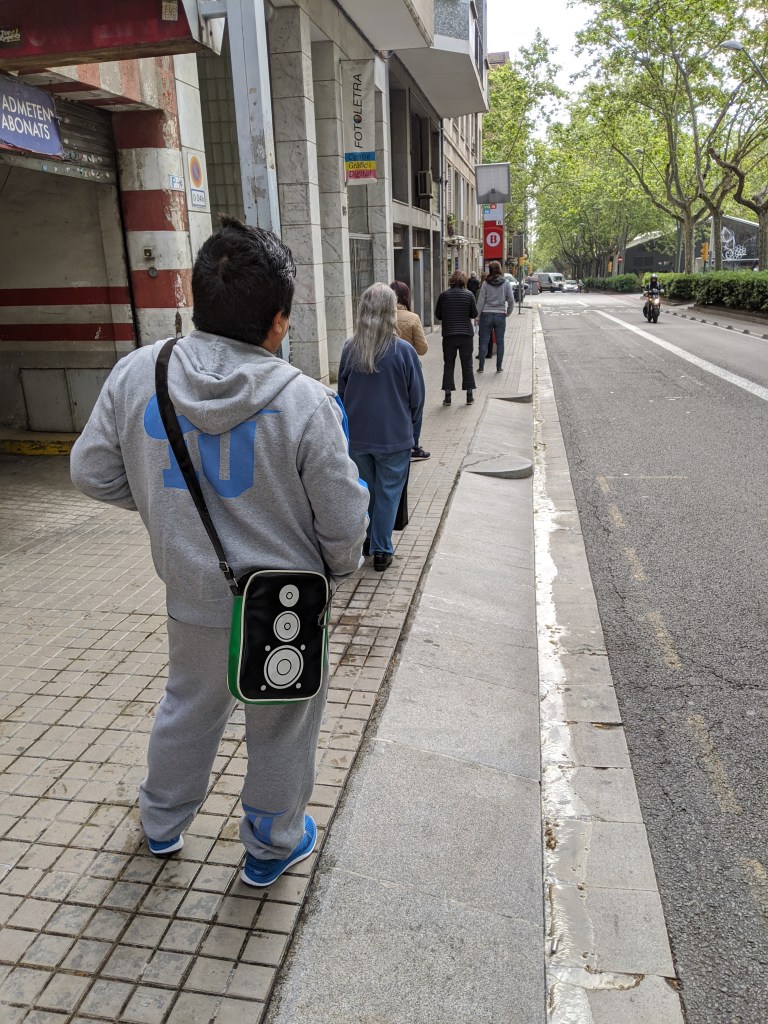
In Barcelona there are long lines in front of stores, not because of any shortages, but because everything closes down from Friday to Monday for Easter weekend. Except Saturday, a fruit stand owner at Mercat de La Concepció reminded me twice yesterday as I dropped strawberries in my cart. The stores will be open Saturday.

There was a line at the post office, too, but the nice thing was being allowed to wait outside at the post office instead of inside. I think all post offices should consider making outside lines a permanent policy.

Line outside the post office on Passeig de Sant Joan in Barcelona.

All this holiday store closing shenanigans is an adjustment for someone from New York, the city that never sleeps. Or is it the city that never slept?

Happy Good Friday. To my Jewish friends, a belated Happy Passover. Everyone is making Covid-19 adjustments to their rituals.

A friend in Egypt pointed out that the month long Muslim celebration of Ramadan is right around the corner. He’s worried that shortened store hours during the holiday will set the stage for overcrowding and infection.

My San Francisco friend David posted on his Facebook page The Coronaggadah, A Passover Haggadah for This New Age of the Plague, a very amusing update to Jewish tradition.

Saint John the Divine Church, once my neighborhood Episcopal church, will celebrate Easter as a Covid-19 field hospital. It’s a good holiday story about putting aside our differences to help one another. I hope someone in the White House hears it.

9 April 2020 – Thursday – #25

The BCG vaccine may be the phoenix rising from the ashes of the unfolding hydroxychloroquine debacle. French and Swedish hospitals have stopped administering hydorxychloroquine due to risk of cardiac arrest. On the other hand, promising statistic on BCG vaccine are emerging. “BCG, or Bacillus Calmette-Guérin, is a vaccine for tuberculosis and is administered at birth in countries that have historically suffered from the disease, such as India.” Researchers are finding that countries with BCG immunization programs have 10 times lower Covid-19 mortality rates compared to countries that don’t. Yes, ten times. Not a typo.

I always warn people that correlation is not causation, and I’m issuing that warning again. However, these BCG numbers look good to me. It’s hard to imagine another factor besides BCG vaccines that explains the vast difference in the Covid-19 mortality.

Other countries that have universal BCG vaccination include Japan, Brazil, Iran, and Portugal. Wait, Portugal?!? BCG vaccine may explain why Portugal has about 200 Covid-19 deaths while neighboring Spain has over 14,000. But wait! It turns out the Basque Country in Spain had a BCG vaccine program until 2013, too. It’s the only region in Spain that has a recent BCG program. So, are Covid-19 mortality numbers better in Basque Country than the rest of Spain?

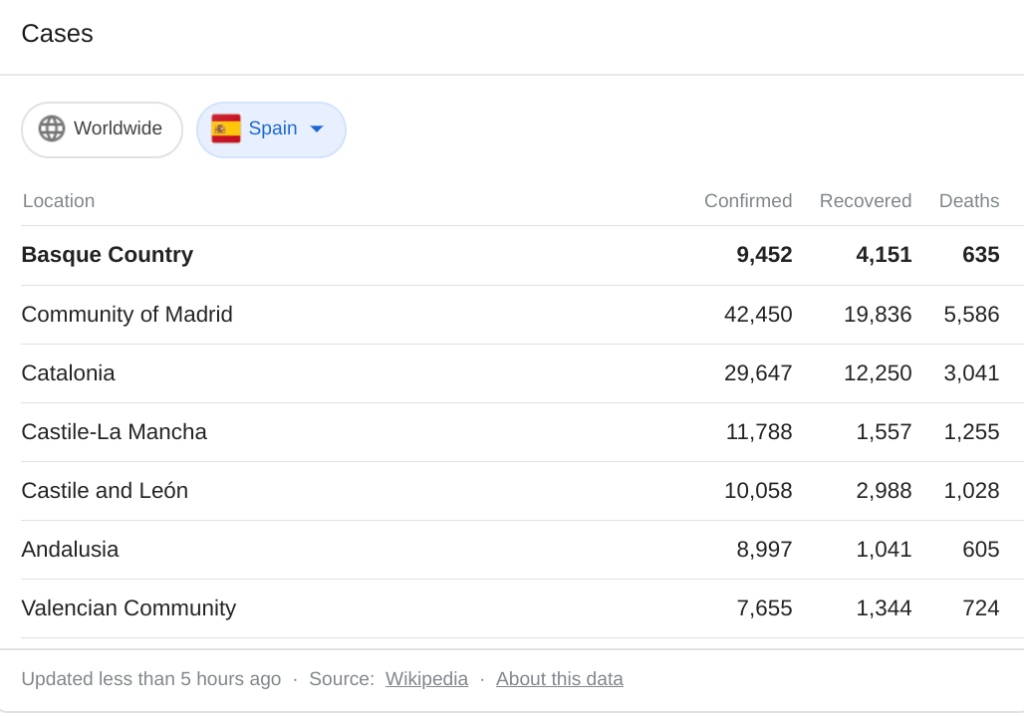
Spanish Covid-19 mortality by region (partial list).

On a per-capita basis, I calculate that Basque Country has roughly three times lower mortality than Madrid and 20% – 25% lower mortality than Catalonia, the two hardest hit regions in Spain. So, yes, Basque Country appears to have lower Covid-19 mortality than the rest of Spain. But wait, why is Catalonia mortality so much lower than Madrid? Well, it turns out Catalonia had BCN immunization until 1974. Spanish reporting isn’t great, so take my analysis with a grain of salt. At the very least, it doesn’t contradict the BCG story. [Update 13:53 CET – BCG World Atlas says Spain adopted BCG in 1961 and stopped use in 1981, so my analysis may be incorrect. I’m checking with Spanish sources.]

Germany, which has had a mysteriously low Covid-19 mortality rate compared to Spain and Italy, also has a BCG story. The parts of Germany that were formerly in the USSR received BCG vaccinations and, as the map below shows, Covid-19 mortality is lower in those parts of Germany (lighter colors indicate lower Covid-19 mortality).

Covid-19 mortality in Germany by region (darker colors indicate higher mortality).

Covid-19 mortality varies significantly in countries that have BCG vaccination programs. This variation may be explained in part by start dates for BCG vaccine programs. Iran, which started BCG vaccinations in 1984, has a higher Covid-19 mortality than Japan, which started in 1947. Since Covid-19 mortality skews towards older people, Japan’s older population should be better protected than Iran’s, assuming boosters aren’t needed.

About 4,000 Australian hospital workers will participate in the clinical trial that will seek to determine if the tuberculosis vaccine can reduce symptoms of COVID-19, researchers at the Murdoch Institute in Melbourne said.

Euronews, 7 April 2020

The statistics for BCG vaccine look more meaningful to me than for hydroxychloroquine (there aren’t any good statistics for hydroxychloroquine, really), and it’s a lot easier to type, too. Still, it’s important for the experts to weigh in and, even if they gave the green light today, it would be months to ramp up production and work out distribution. Herd immunity for 7 billion people is a big task. BCG is too late for the first wave of Covid-19 infections, except where it’s already in use. Luckily, BCG is in use in some of the world’s most populous poor countries. If BCG pans out, it may ramp up in time to attenuate further Covid-19 mortality as people go back to work and before a vaccine is available. This would make Covid-19 look statistically more like the flu.

There are other interesting developments to track. One close in effort is to find treatments with existing statins, ARBs, and diabetes drugs. The thinking is that given the short time frame to react to a pandemic, looking for existing drugs that help a human body survive a virus like Covid-19 can improve outcomes and mortality in the relevant time frame. Hydroxychloroquine is, of course, a candidate in this vein. For reasons that aren’t clear, it is getting promoted to the detriment of other treatments that have fewer side effects without showing any clear benefit.

One long term effort is from Arrakis Therapeutics, which is working with Roche to develop medicines that target RNA. This presumably includes viruses like Covid-19.

A mid-March survey of clinical trials tracked by the US government shows that over a dozen therapies are under study. As of today, the database has 388 studies, of which 10 are complete and the rest are in various stages.

At the end of the day, it will take a Covid-19 vaccine to eradicate the virus. In the meantime, I expect to see different treatments emerge with varying degrees of effectiveness. With luck, the BCG vaccine will reduce Covid-19 mortality by 90% after the first wave of Covid-19 infections and before a Covid-19 vaccine.

So, this arrived in my inbox yesterday from the US Department of State:

Location: Spain – Level 4: Do Not Travel
Event: The U.S. Department of Homeland Security’s Cybersecurity and Infrastructure Security Agency (CISA) warns individuals to remain vigilant for scams related to Coronavirus Disease 2019 (COVID-19). Cyber actors may send emails with malicious attachments or links to fraudulent websites to trick victims into revealing sensitive information or donating to fraudulent charities or causes. Exercise caution in handling any email with a COVID-19 related subject line, attachment, or hyperlink, and be wary of social media pleas, texts, or calls related to COVID-19. For more information regarding scams related to COVID-19, see https://www.cisa.gov/coronavirus.

People take advantage of pandemics in many ways.

One way is scam artists calling or emaiing to offer a Covid-19 testing kit. If you get a call from someone asking you to give a credit card number, that’s a clear sign you’re talking to a scammer. Even if the call sounds like it’s free, be careful.

“The coronavirus has caused the US to declare a national emergency. The Families First Coronavirus Response Act has made coronavirus testing more accessible immediately. If you want to receive a free testing kit delivered overnight to your home, press one.”

Recording of a Covid-19 scam call.

One thing I never respond to is a chain-letter because chain-letters feel like a scam to me. But then I got a Poem Exchange email from my friend Laura. I almost deleted it. Another chain letter. But I thought about it and I thought to myself, fuck it, what’s wrong with passing around a little poetry? We’re in the middle of a goddam pandemic.

I followed the directions to send a poem to one person and then forward the Poem Exchange email to a bunch of other people. I was hesitant. It wasn’t like I had a lot of other things to do with my time, but I felt a little slimy doing it. Then I thought, hey, I’m not asking for my friends’ credit cards, and pressed the Send button.

My friend Donna wrote back to thank me for the chain email, but explained she got a whole lot of these Poem Exchange emails and she didn’t like participating in chain emails. I thought to myself, wow, I got one of these Poem Exchange emails and Donna gets a whole lot of them. Maybe I have the wrong friends? But then I found out from people to whom I forwarded the Poem Exchange chain email that they, too, got a lot these emails. I don’t know how I avoided the Poem Exchange chain email for so long. I take showers. I brush my teeth.

Well, anyway, after a bit, I got a bunch of nice poetry in my inbox. Lots of poems and poets I didn’t know. I had to wait to read them, though. Poetry is not one of those things you breeze through like an email from the US State Department warning of Covid-19 scams. Poetry is a serious endeavor. It’s serious business. People spend their whole life writing this shit. So, I found a time where I could clear my mind.

Here’s the one I like best. It seemed right for the pandemic at hand and it made my eyes tear up a bit. It’s by Mary Oliver. Take a deep breath and clear your mind.

Wild Geese

You do not have to be good.
You do not have to walk on your knees
for a hundred miles through the desert repenting.
You only have to let the soft animal of your body
love what it loves.
Tell me about despair, yours, and I will tell you mine.
Meanwhile the world goes on.
Meanwhile the sun and the clear pebbles of the rain
are moving across the landscapes,
over the prairies and the deep trees,
the mountains and the rivers.
Meanwhile the wild geese, high in the clean blue air,
are heading home again.
Whoever you are, no matter how lonely,
the world offers itself to your imagination,
calls to you like the wild geese, harsh and exciting –
over and over announcing your place
in the family of things.

Mary Oliver