21 March 2020 – Saturday – #6

After closing land borders earlier in the week, the Spanish government ordered all hotels closed by 26 March. The US State Department sent an email advising US citizens and residents who didn’t have a place to stay long term in Spain to catch a flight to the US while there are flights to be had. There was chatter on the Expat Facebook pages about whether to return. I discussed this with my friend at the US Consulate here. We both concluded we were safer in Spain.

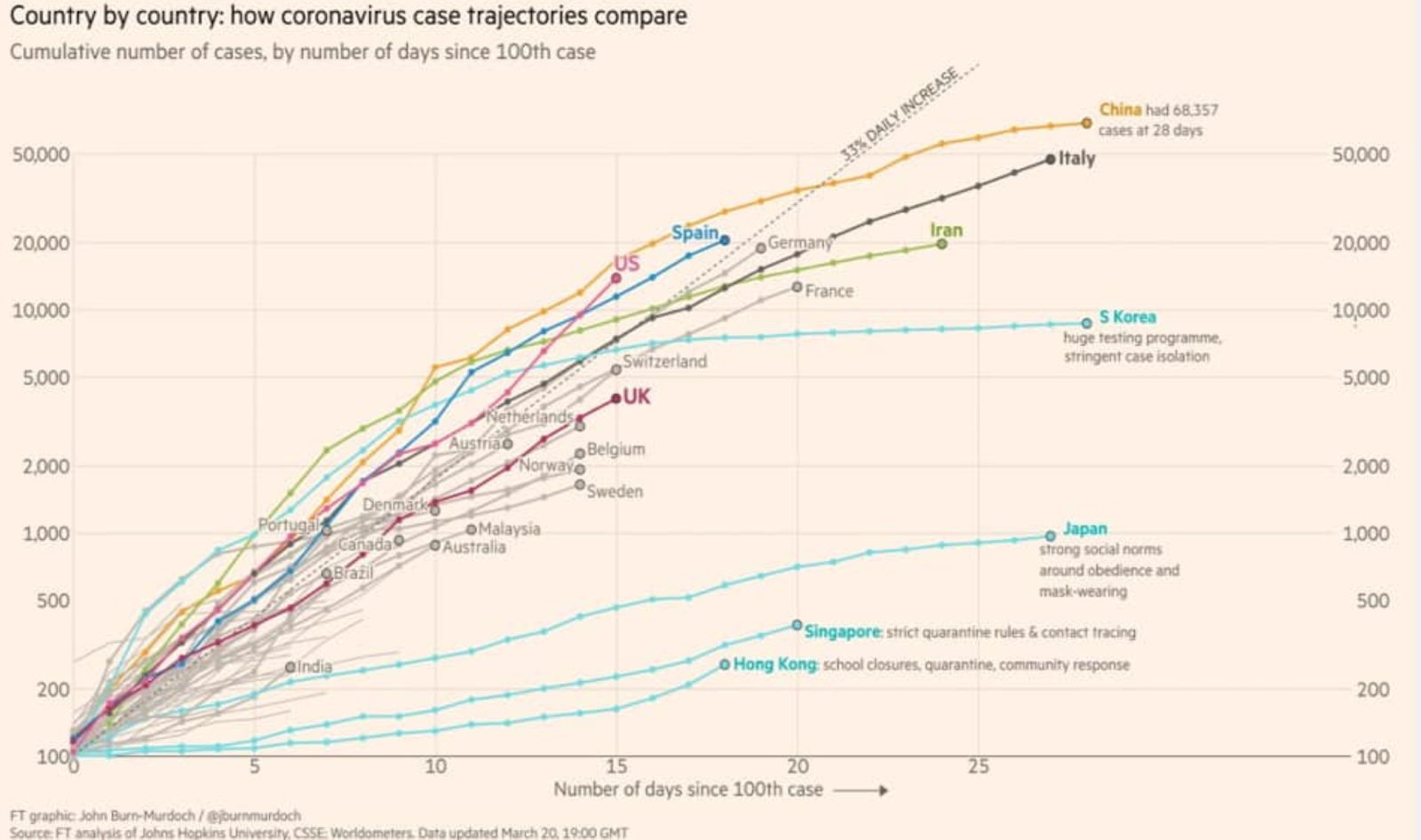
It’s clear from the most recent Financial Times chart why we might think we’re safer in Spain.
I can’t tell whether other people are noticing what I notice, or I’m noticing what other people are noticing. After my rant yesterday, I saw that US doctors called on the Trump administration to deliver:

  1. Adequate supply of PPE (Personal Protective Equipment)
  2. Best practices for sanitizing and reusing PPE during the pandemic
  3. Adequate supply of ventilators
  4. National strategy for sharing best practices
  5. Clear guidelines for clinical staff to avoid infection
  6. A national postponement of elective surgery

This has similar points to the action plan I published yesterday. Italy is losing many medical professionals during the Covid-19 crisis. It’s probable that Spain and the US will, too.

I was going to write a section today on why it’s pointless to ask the Trump administration to do anything, but Rachel Maddow provided a list of “happy talk” Covid-19 promises the president has failed to deliver. To be fair, other governments have been non-responsive in the face of Covid-19, but no other leader has promised so much and delivered so little. The US is rudderless.

Remember eight days ago when the CEO of Walmart stood with the president in the Rose Garden and promised drive through testing? Yeah, no one else does either. That’s why Trump gets away with his snake oil.

By the way, I’m all for Walmart and other private companies delivering on Covid-19 testing. A San Francisco telehealth startup called Nurx has made a Covid-19 testing kit available. In the coming few weeks, that can help healthcare professionals screen and protect themselves. The problem is that the most important step is applying that vital Covid-19 test data to public health. The administration hasn’t articulated how that happens. Why is that important?

The consensus I see forming on the Covid-19 response is that the best short-term strategies are lockdowns until there is adequate testing, and then testing and quarantines until there is either a treatment or a vaccine. Optimistically, treatment or vaccine is six months away, but more likely twelve to eighteen months. Testing gets people back to work quicker. Antibody testing in particular identifies people who’ve been exposed and recovered. These immunized people can go back to work safely. Testing is the thing that allowed the gay community to get to some semblance of normalcy living with HIV. Testing is what will enable the economy to recover from Covid-19.

Language is important. There’s a significant cognitive dissonance when Trump says “[Covid-19] could have been stopped right where it came from, China.” The same may well be said soon about the US response to Covid-19. It’s true that China made mistakes, but it has turned the corner on mortality in three months. Other than in the president’s mind, the US response has been so poor that the US likely will become a larger exporter of Covid-19 than China. That’s likely why Canada and Mexico have closed their US borders in the past day.

Language is important. The administration is adopting America’s favorite word: “war.” Covid-19 is now a war or a battle in the US. The country needs a wartime response. America is a bellicose country and Trump wants to be its brilliant general. The problem with a wartime mentality is that our biggest enemy is ourselves.

One aspect of Covid-19 that’s not getting much attention is how the virus attacks red blood cells. China measured significantly more susceptibility to severe reaction to Covid-19 in patients with type A blood, and significantly less with Type O. Don’t go out partying if you have Type O blood. Like all results right now, these are preliminary. However, I think they are guiding scientists figuring out a treatment or cure.

If you’ve forgotten about blood types, they characterize the antigens presented by an individual’s red blood cells. One reason Chloroquine, or hydroxychloroquine, may be effective against Covid-19 is because it’s a heme polymerase inhibitor. The drug is being tested for possible COVID-19 use to improve virologic clearance. What David Sinclair mentions in a Twitter thread that I posted a few days ago is that Covid-19 is mutating in ways that may make Chloroquine less effective. That’s one reason we need tests rather than promises that there is a cure. [UPDATE 23 March: Check the comment thread here for other issues with the French hydroxychloroquine study.]

Promises are easy, science is hard. I don’t have a good answer for the incompetence of the current administration other than state and local government have to compensate. That means Americans will have to respond to Covid-19 without one of its best resources, the federal government. Minority communities, it turns out, are good at responding when the government fails to provide resources. They’ve had lots of practice.

So, it’s dawned on me that I may be holed up in this Barcelona apartment not for a few weeks, but for a few months. As Green Day sings, Wake Me Up When September Ends. As I was waking this morning, I was thinking about where I get a haircut these days. I guess I don’t. I also was thinking about finding some new recipes. I cook pretty well, but I could get tired of my own cooking in quarantine after three months.

I had more Zoom calls last week than I had all last year.

What are other people doing?

My friend Heidi is making masks because of the shortage and leaving food at her neighbors’ doors.

My sister and brother-in-law are working on a new jigsaw puzzle and considering the neighborhood backyard cocktail social hour.

Some of my nieces seem to have gone mad baking banana bread. Is that genetic?

My friend Francis canceled his work travel. It hasn’t been too large an adjustment because his company is the largest remote employer in the world (at least it was before March). He’s role-modeling how to work at home. His company is leveraging its remote work expertise to land sales calls with new prospects. Even if you don’t need Gitlab’s products, you, too, might benefit from its remote work expertise. It’s online and free.

Brad’s niece is back from Guatemala. That’s her story to tell, and it’s good. I’ll just mention that she wasn’t screened for Covid-19 entering the country in Miami. Everyone working for Peace Corp was fired last week, lost their health insurance, and was shipped back home to a Covid-19 rich environment. Thanks for your service!

I’ll end on this. My niece in Connecticut, one of the family banana bread bakers, reported her neighbor tested positive for Covid-19. She also noted that many people from New York City are fleeing early in spring to their summer homes in Connecticut and elsewhere. In Spain, the same thing was happening. The well-to-do from Madrid, the country’s Covid-19 hotbed, were escaping to their second homes on the coast. The protest from other regions was loud and police set up roadblocks to keep Madrileños in Madrid. That, in a nutshell, reflects the difference between the two countries’ responses to Covid-19.

20 March 2020 – Friday – #5

I need to rant today and I’m not sugarcoating it.

When you die of Covid-19, you drown while coughing up your own blood.

I spoke with friends and family in California, Mexico, and Brazil yesterday. No one is taking Covid-19 seriously enough in any of these places. In the SF Bay Area, Home Depot is considered an essential service. Even bike shops are considered essential services in San Francisco. Here in Spain, where Covid-19 mortality continues its exponential climb, here are the essential services:

  • Healthcare, either doctor or pharmacy
  • Food, grocery stores or restaurant delivery
  • Mail, although I haven’t seen any in days
  • ATMs
  • Travel to work if you can’t telecommute

That’s it. Otherwise you get a fine for being outside. What does that look like? When I was walking home from my doctor’s office, I snapped a photo along Avinguda Diagonal. Diagonal is like Fifth Avenue in New York or Van Ness in San Francisco or Sunset in Los Angeles. See all the people? No, of course you don’t. That’s what a proper lockdown looks like.

As my friend Neil in San Francisco points out, it’s an absurd privilege to insist that every service you want is available. If you think your inconvenience is more important than public health, remember …

When you die of Covid-19, you drown while coughing up your own blood.

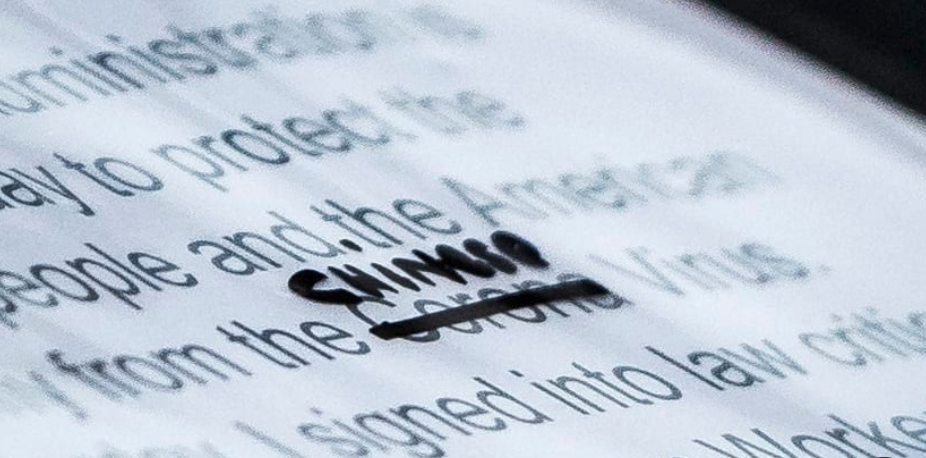
Today I’m pissed off about the entire debate about “Chinese Virus,” an obvious ploy by the president to divide the country and to put his followers in the position of defending him, about justifying his use of the word, so they don’t have to defend his miserable response to Covid-19.

Yes, the president has replaced “Corona” with “Chinese.” Why is he doing this? For one thing, because he ignored the pandemic advice from his own administration from last year. For another, because he denied most of this year that there was a Covid-19 problem. Here’s a video recapping what Trump has said about Covid-19 so far this year.

Trump’s well-documented inaction and misdirection on Covid-19 were to support his re-election. He didn’t want bad case numbers. This is what he doesn’t want anyone to remember now that it’s clear that the pandemic is as bad as his administration predicted last year. This is why he’s using the word “Chinese.” Also, as the newly self-anointed commander in the war on the virus, he needs an enemy. Don’t buy it. Don’t take the bait. It’s just a distraction from the real problem.

In case you forgot while you were ranting about the word “Chinese,” the real problem is …

When you die of Covid-19, you drown while coughing up your own blood.

The US federal government in general and Republicans in particular have an enormous credibility gap. It’s not just the administration. Yesterday reports surfaced that two Republican senators on the Senate Intelligence Committee dumped stock on January 24th and 26th after hearing closed-door testimony about Covid-19. Then they kept the danger of Covid-19 a secret, as did the administration. Now these senators, as well as Trump, are complicit in the spread of Covid-19 and the hideous fatalities that will result.

As in the time of AIDS, people need to pray the federal government will wake up to the reality and assume that it won’t, because …

When you die of Covid-19, you drown while coughing up your own blood.

My niece in New York had a discussion with her three roommates about protecting their apartment from Covid-19. She’s expressed concern that her roommates might have Covid-19. My New York photographer friend has employees working in her place. She’s worried about her health. A San Francisco artist posted in Facebook yesterday about the need for gay men he knows to talk to each other about bringing home Grindr dates to a shared living space.

This is on the minds of people who share a living space or a work space. In other words, it’s on pretty much everyone’s mind. In any group setting, the person who is least compliant with Covid-19 precautions is the group’s weakest link against Covid-19.

In the days of AIDS, sex was a dance with death. Gay men had to learn to squeeze in a conversation about HIV status, condoms, and sexual preferences in the lusty moment between first passion and full-on sex. It was a learned skill. The drag queens taught us, showing up at bars, demonstrating to us how to roll a condom over a banana, giving us the language to speak to our future ex’s.

Today’s roommates and workmates need to have the same kind of candid discussion about sharing a space. Today. They need to have it today. The president won’t tell you how to do this. He cares about himself and his re-election. The senators are busy lining their pockets.

I can help you. Here’s a way to start a discussion with roommates and workmates:

I heard that ,,,

When you die of Covid-19, you drown while coughing up your own blood.

During the days of Great Plague, this was the ditty:

Ring-a-round the rosie,

A pocket full of posies,

Ashes! Ashes!

We all fall down.

There’s scholarly dispute about whether this ditty is actually from the Great Plague, but here’s its generally accepted interpretation. A ring around a rosie is a sign of a flea bite and infection. Posies were used to ward off the disease. Once someone died, they were cremated. No one was going to survive.

For the Covid-19 plague we have science and technology. We’re beyond posies as deterrents to disease. The problem responding to Covid-19 is not about having the resources, it’s about organizing and prioritizing our resources. If the US federal government were competent and credible, it could lead that effort. Right now, it is neither.

What I think we need:

  • Best practices for personal and group decontamination. In addition to my own decontamination process that I published yesterday, I put two others at the top of the 17 March entry. I’ve seen other decontamination information online. Where’s the study or the trusted organization that’s providing best practices Covid-19 decontamination that result in reduced infection?
  • Best practices for public health. Taiwan, South Korea, and China all claim to have passed peak Covid-19 infection. In the absence of a vaccine or treatment, this is the best hope. WHO or another organization should publish steps that worked in these three cases. This can be implemented as soon as governments get on board and deploy to their populations.
  • Test kits. Where are they? Everything I read says that testing is the most effective way to manage outbreaks. For instance, this study in Italy where the virus was stopped in its tracks. And there are significant new developments for large-scale antibody testing. Sure, you can manage Covid-19 without testing, but it requires many more people to comply with public health regulations and shuts down more of the economy. Of all the faults of the Trump administration, lack of test kits is the most glaring. Spain could do better, too.
  • Organized development of vaccines and treatments. I’m not so worried about vaccines because there are many candidates and the timelines are all about the same. For treatments, there are many claims, but little organized study or, if there is organized study, someone needs to publicize it.

There were a lot of other things I wanted to write about today, but I needed to vent.

Stay safe and make informed choices because …

When you die of Covid-19, you drown while coughing up your own blood.

19 March 2020 – Thursday – #4

While Nate Silver and Elon Musk tweet about who needs ventilators, the Italians are printing them. Until there are treatments or a vaccine, the difference between life and death for anyone seriously ill from Covid-19 is a ventilator and there aren’t enough. The manufacturer of said US$11,000 ventilator is suing for patent infringement (see bottom of article). “But despite hospitals asking for the 3D plans, [3D inventor] Fracassi is wary about providing them because the manufacturer has threatened to sue. And has refused to share the blueprints too.” Perhaps Elon Musk can buy the ventilator manufacturer and put the 3D model in the public domain.

In treatment news, the Chinese claim the Japanese flu drug Avigan is effective in treating Covid-19.

Patients who were given the medicine in Shenzhen turned negative for the virus after a median of four days after becoming positive, compared with a median of 11 days for those who were not treated with the drug, public broadcaster NHK said.

However, tempering that news, the Japanese were more guarded.

But a Japanese health ministry source suggested the drug was not as effective in people with more severe symptoms. “We’ve given Avigan to 70 to 80 people, but it doesn’t seem to work that well when the virus has already multiplied,” the source told the Mainichi Shimbun.

In other words, as with most other treatments under consideration, severe cases aren’t responding well to therapy and still need ventilators.

In any case, Avigan needs to go through standard testing processes. There are two million doses available. If used prophylactically the manufacturer would have to produce orders of magnitude more doses, but two million is a good start for treatment of less severe cases. Like all the other treatment candidates, it’s unlikely there will be anything at scale as Europe and the US head toward peak infection in the next month or two.

If you want to get into the nitty-gritty of all the treatments under consideration, this report from last week gives a thorough run down on candidate treatments.

I’m trying to vet these reports and find second sources because not only does the president create confusion with his changing opinions about Covid-19, but the Russians are helping him. Adding to the problem of Russian disinformation campaigns, yesterday Facebook algorithms were mislabeling articles from trusted sources as spam, as well. Think about what you’re posting! Do a little research on what Facebook might not have shown you.

I’m sure you’ll be excited to know that I went outside yesterday. I was even more excited! I had a doctor’s appointment that required me to be in the office, so no choice but to walk thirty minutes there and thirty minutes back.While I was out, I went to the grocery store, too. I’m figuring out what makes me comfortable and seems feasible for now. Here are some things I did:

  • Washed my hands before I left and put a clean paper towel in my pocket.
  • Opened doors and pushed elevator buttons with my coat (could have used the paper towel!).
  • Kept a fair distance from other pedestrians (that wasn’t hard).
  • Kept my hands in my coat pocket so I wouldn’t touch my face.
  • No one else was inelse in the waiting room, so didn’t have to worry about distance.
  • Cleaned hands with sanitizer after doctor’s visit.
  • Stopped at grocery store downstairs while I was out. In Barcelona, only groceries and pharmacies are open. These are limiting the number of customers inside at the same time. The stores are reasonably well stocked, but no eggs again. I’m beginning to think that anyone who doesn’t know how to cook buys eggs to learn. Again, it wasn’t hard to keep distance.
  • Paid attention to not touching my face once I started touching the cart and items on the shelves.
  • Noticed that I touched my mobile when I paid, so I considered it contaminated.
  • When I got home, I took off my shoes and coat, dropped the groceries on the back porch except perishables that went into the “dirty” refrigerator, and washed my hands and my mobile. I’ll let the groceries stay outside for a day or two. I kept the mobile out of my pocket for a few hours.

Nested inside my Covid-19-free zone, I felt like I’d maintained a barrier from any Covid-19. This study about virus longevity indicates 1) that closed environments with other people are unsafe for hours as any virus present dissipates in the air (measured half-life of 66 minutes in air), and 2) that exposed surfaces are contaminated from hours to days depending on surface type. I also opened my windows, although I don’t think there’s any virus hanging out inside to air out. There is a lot of variation in Covid-19 viability on different surfaces and even on the same kind of surface, so I’m trying to err on the side of safety by leaving anything new to the apartment in the foyer or back porch. I’m assuming my clothes are not contaminated. I’m still thinking about that.

On side note. I’ve stopped applying deodorant because why. I’m alone here. Then I arrived at the doctor’s office yesterday.

Some quick Barcelona updates. On the medical front, I chatted with a lab technician at one of the nearby hospitals. He says everything quiet right at Barcelona hospitals. It sounds like they’re waiting for a tsunami to hit. Routine procedures are being postponed. This was confirmed by the technician at my doctor’s office today. Also, after debates in Spain about how to allocate medical supplies, there are reports this morning that medical supplies are being held up at customs.

The other Barcelona update is that, in addition to our 8p local applause ritual, a 9p local pot banging ritual was added last night. The main difference seems to be in decibels and pitch. I don’t know how people find out about these rituals, nor do I know if last night’s ritual was a one-off or if we’re going to be doing community sound-offs every hour on the hour soon. [Update 21 March 2020: the pot banging was an anti-government protest.]

As in the beginning of the AIDS epidemic, there are debates about what behavior is safe. There are always trade-offs. My San Francisco friends report very different circumstances from Barcelona and its community sound-offs. Most bay area stores are still open and most don’t limit the number of customers. I heard that Whole Foods has set aside special shopping hours for elders and others at risk. There seem to be a lot more people outside in San Francisco than in Barcelona. The Mayor of San Francisco is having a spat with Jake Tapper from CNN about what is safe. I personally feel people in Barcelona would benefit physically and mentally from being outside a bit more. On the other hand, keeping people inside communicates the severity of the problem.

The Chinese imposed much more severe constraints during its Covid-19 battle and today was the first day with no new infections in China. So, at one extreme, lockdowns with frequent fever and Covid-19 testing appear to work. The Italians, on the other hand, have a robust lockdown and still haven’t seen country-wide payback from their effort. Italy suffered its worst one day Covid-19 death toll yesterday.

Anecdotally, my niece in New York City starts working at home today. Her insurance brokerage closed its office yesterday. She said most New York City companies are working remotely now and the city expects a shelter-in-place order any time.

All this is tough on the economy. I chatted yesterday with a musician who plays Broadway shows. No work for the foreseeable future. I was supposed to host a guitar player and his wife this weekend, but all concerts cancelled in Barcelona. My friend Leslie played her last scheduled gig last weekend. It’s not just the performing arts. I noticed that Delfina, one of my favorite San Francisco restaurants, closed. Every day I read that many more small businesses are closing.

I also chatted yesterday with a friend who runs P.R. for a large retailer about how much cash to keep on hand. He didn’t sound optimistic about job prospects and his apartment lease runs out at the end of April. Impossible choices. Another friend who manages accounting for a small technical writing consultancy is worried about cash flow. Brad didn’t get an offer on his house in San Francisco, indicating housing market illiquidity in one of the country’s hottest markets. I haven’t got any encouraging reports from friends.

The problem when an economy gets gummed up is getting it back on its feet.

In response to Covid-19, even conservative politicians have become Keynesian converts, with Europe and the US pumping trillions of dollars into the economy. This seems correct in form to me, but I’m not sure about substance. In the US, with elections around the corner, the Republicans probably don’t have any other hope to retain power, even though the spending goes against decades of Repubican party wisdom. With the Trump administration, though, it’s hard to know whether the amount or the placement or the timing will help anyone but the wealthy. Already pundits are worried that an inevitable airline bailout will go into the pockets of owners and management after the airlines spent their free cash flow repurchasing shares rather than investing in people or assets.

Random musing: what happens to all those airline miles I’ve accumulated?

Last, but not least, the Covid-19 virus has infected two members of the US Congress. I wish them a speedy recovery.