5 April 2020 – Sunday – #21

Where are we today? What’s next?

While most of Asia is going back to work and Europe is seeing the light at the end of the Covid-19 tunnel, the United States, Africa, India, Russia, and the rest of the Americas are just getting started. Most countries had less than perfect responses to Covid-19.

Germany has had one of the most successful Covid-19 responses in terms of mortality, largely due to volume testing and social distancing. For most of the developed world, it is too late now for volume testing during the initial infection, but not too late to adopt other parts of the German model.

Here in Spain, President Sanchez has extended Spain’s lockdown until 26 April. This is no surprise given that Spain is currently second in the world for Covid-19 cases. As slow as Spain’s response was, it’s not nearly as bad as the US response. Growth in the Spain’s mortality curve has peaked and, like Italy and Germany, it now must figure out when and how to safely end its lockdown.

The first 90 days of the US response were disastrous with lack of tests to track the outbreak, inadequate medical equipment stockpiles, confusing messages to the public, and failure of the president to acknowledge the scope of the pandemic until 2-1/2 months after his administration first understood its potential severity. This infographic shows how Covid-19 grew in March to become the number three killer in the country after heart disease and cancer. Next week, Covid-19 will become the largest killer in the US. The week after that, the US will have a 9/11 event every day in terms of mortality.

Many parts of the world including the US will be looking at food shortages not seen since World War II. In the US, some food banks expect to run out of food this month.
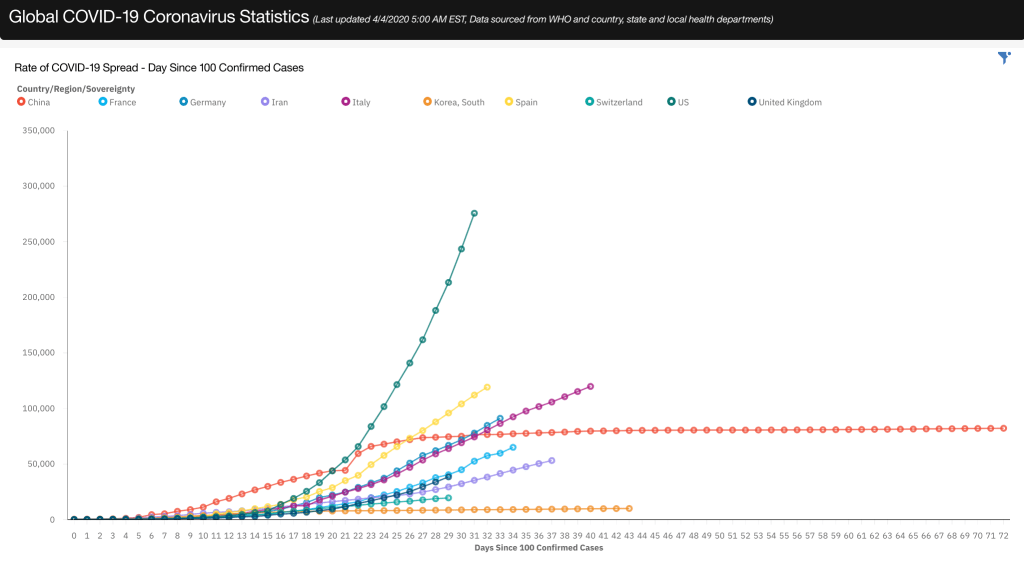
US covid-19 cases outpace rest of world – 4 April 2020. (source: Weather Channel / IBM)

In the face of all this it might seem a little premature, but it is both important and possible now to think about what’s next in the Covid-19 pandemic. The data for the pandemic are not yet entirely clear. The economic data are. March and first quarter economic results are coming in and they are bad.

The numbers are so bad that Financial Times compares the Covid-19 pandemic to the end of World War II and calls for an overhaul of government’s role in society.

Radical reforms — reversing the prevailing policy direction of the last four decades — will need to be put on the table. Governments will have to accept a more active role in the economy. They must see public services as investments rather than liabilities, and look for ways to make labour markets less insecure. Redistribution will again be on the agenda; the privileges of the elderly and wealthy in question. Policies until recently considered eccentric, such as basic income and wealth taxes, will have to be in the mix.

Financial Times opinion, 3 April 2020

As WWII drew to an end, the world economy was in tatters. The Western Alliance put in place massive programs and institutions to rebuild the war torn economy. FDR and Winston Churchill set the world on a long-term growth path, a path that lasted 35 years until Ronald Reagan and Margaret Thatcher called for lower taxes and smaller government.

As the Covid-19 pandemic limits trade and transportation, the world economy is once again in tatters. Unlike the situation at the end of WWII, in today’s world each country is responding to Covid-19 largely on its own. The Trump administration has weakened post-WWII alliances with its America First policies and its authoritarian alliances. While the FT is calling for an effort like that of FDR and Churchill to rebuild the world economy, with post-war alliances weakened and nationalism rising, it’s not clear what, if any, international alliances will form to rebuild after Covid-19.

On the same day as the FT opinion piece, McKinsey & Company released its COVID19: Briefing Materials to business executives. McKinsey also compares the Covid-19 economic shock to WWII, estimating its impact somewhere between the 1929 stock market crash and the 2008 mortgage meltdown.

If things go exceedingly well, in McKinsey’s view, the world economy recovers next year. If not, the world economy recovers in 2024. Given the disaster unfolding in the United States, the latter looks more likely every day.

McKinsey says there are two main components to recovery. First is suppressing the virus as soon as possible. In wealthier countries, this means country-wide lockdowns until the epidemic dies down, and then ramping up testing, contact tracking, and quarantine until a vaccine is available. In poorer countries, this means as much social distancing and hand washing as possible, but also inevitable humanitarian disasters after inundation of limited healthcare resources.

The second economic component of recovery is managing cash and liquidity throughout markets while keeping workers safe. How this unfolds depends largely on the availability of testing. Testing must be made available first to workers in essential industries like healthcare, food, and utilities. As testing ramps up, industry can rebuild supply chains.

Once a vaccine is in place, the next phase of the recovery is scaling up vaccine production for seven billion people. How does that happen?

In the absence of coordinated world alliances, it may be that private foundations have to step in. Bill Gates is building seven vaccine factories even though he expects only one or two to operate. The loss of a few billion dollars, he says, is insignificant in the face of trillions of dollars of losses if Covid-19 persists.

I’m like a parrot that can say one word: testing. We need volume testing worldwide in the next 2-3 months for both public health and economic recovery. Don’t believe me? Listen to Trevor Noah interview Bill Gates below.

4 April 2020 – Saturday – #20

I’m feeling better today for a number of reasons including sunny weather and a trip to the jug wine store yesterday. Also, I think Brad came up with the reason that all the stores are out toilet paper (see below). I’m so excited about that that I’m giving away my secret source of good, inexpensive wine.

The proprietor is kind enough to let me practice my bad Spanish. She’s giving me a head start on my Spanish wine adventures, too. Since I can’t go to the vineyards themselves to taste, she’s bringing the vineyards to me.

I also shopped at Gra de Gracia, a little Gracia store with lots of spices like cumin, paprika, and turmeric that are hard to find in this part of Barcelona. Now I can cook my favorite recipes that need these three spices. It’s the little things these days. The stores that have the ingredients I want for Indian cooking are over in the Raval barrio. It’s probably a €600 fine shopping that far away.

For those of you playing along in the US, here’s a cool map app on github that lets you slice and dice Covid-19 statistics by state and county.

US Covid-19 per catpita deaths by state at 3 April 2020

My San Francisco friend David turned me on to this app. The caveat for this app is that states collect health data differently and Covid-19 testing rates vary significantly between states. David, by the way, couldn’t find charts of San Francisco Covid-19 statistics, so he collects public health data on his own and posts charts on Facebook.

I’m discovering lots of maps and map apps for the US, but not many for the rest of the world. If you know of good sources for maps outside the US, please let me know. It may be that the I’m seeing more US maps because my sources are skewed to the US, but it could be a reflection of US narcissism, too.

Or, it could be that the US has a different culture around data collection and analysis. The US certainly invests a lot in AI and Machine Learning technology and startups that gobble up data and predict the future. And right now, who doesn’t want to know when we can go outside.

When things change rapidly, people often look for data to help them understand what’s going on. It gives us a sense of control even when we have little. It also helps people wiggle out of hard problems, problems like a Covid-19 pandemic. Here’s a discussion from yesterday with UC Berkeley faculty members Arthur Reingold and Jennifer Chayes about the deluge of Covid-19 data we’re seeing.

Arthur Reingold and Jennifer Chayes discuss Covid-19 data collection and analysis

Two takeaways for me from this video. One is that researchers are looking at how to use data and apps to help us unwind from the lockdowns. For instance, as the world increases Covid-19 testing, how can we use mobile location data to speed contact tracking so that when someone tests positive for Covid-19, all of his or her recent contacts can be tested quickly as well.

Second takeaway is the importance of connecting what public health officials and academics are discovering about Covid-19 to effective policy. Some countries are good at this, others lack the resources or the political systems to translate research and studies into effective governance. Ecuador is a tragic example of a country that understands Covid-19 public health, but lacks the hospital resources for new patients and the civic resources to bury its dead.

Unfortunately, the US is turning out to be a disastrous example of a country that lacks a political system that can translate research and studies into effective governance, especially at the federal level.

If you’re a US state governor expecting federal help, here’s a clue to set your expectations as low as possible. It’s confusing enough that Jared Kushner is running a shadow White House Covid-19 team while Mike Pence is nominally in charge of the administration’s response. It’s even more confusing when Kushner describes how the federal stockpile of medical supplies isn’t for the states.

Presidential Adviser and son-in-law Jared Kushner says national medical supply stockpile “is ours,” not states’

The DHS web page describing the national stockpile was edited after Kushner’s remarks to conform to his statement. Meanwhile, 35 days after the first Covid-19 death in the US and as the daily US death toll surpasses 1,000, Trump still can’t decide if a nationwide lockdown is necessary.

Luckily, governors are, for the most part, picking up the slack. Even holdouts like Alabama, which has about the same per capita Covid-19 mortality rate as California, locked down yesterday. But the lack of effective federal governance will translate into hundreds of thousands of unnecessary US deaths.

On a lighter note, as I mentioned at the top, it looks like Brad found the explanation for the toilet paper shortage during the time of Covid-19, and it’s different from what most people think. I’m not going to give it away here. You’re all old enough to read the article on your own. But there is an important lesson for everyone in the unexpected answer to why so many stores are running out of toilet paper: most of us (me included) jumped to the wrong conclusion.

If you thought toilet paper shortages were because of hoarding, it might be because you have a bias about “other people’s” greed. If you thought it was because of panic, it might be because you have a bias about “other people’s” fear.

So, I have a simple request. The next time you’re sure that wearing masks helps in the fight against Covid-19, ask yourself what your bias might be about, say, “other people’s” cleanliness. And the next time your’re sure that hydroxychloroquine treats Covid-19, ask yourself what your bias might be about, say, “other people’s” need for control.

The great Covid-19 toilet paper shortage should teach everyone that people are really good at projecting their own shit on raw data and, if they pay attention where they’re projecting their shit, they can answer questions like why there’s not toilet paper on the shelves.

We have a lot of data about Covid-19, but it takes an honest effort to know which data are valid and then to make sense of them. The sooner we make sense of Covid-19 data and learn how to make effective policy, the sooner we can go outside.

3 April 2020 – Friday – #19

I had a doctor’s appointment yesterday and walked to his office. It felt great to get outside and stretch my legs. Here’s how quiet it was on Passeig de Gracia in the middle of the day.

Passeig de Gracia, Barcelona on a Covid-19 day – https://photos.app.goo.gl/GM84NzP4Qpn8snw6

That’s the edge of the Gaudi Pedrera building on the right. It’s usually swamped with tourists, even in the off-season.

This story of former Hahnemann University Hospital in Philadelphia interests me. In a nutshell, the city recently negotiated with its owner to re-open the hospital, which closed last summer, to house the expected increase in Covid-19 cases. The owner wanted $910,000 per month rent. After going back and forth, Mayor Kenney moved on.

“We had to go back and forth … with a multi-millionaire owner who wanted to maximize his profits. So we decided, rather than continue to go back and forth with him, we moved on.”

Philadelphia Mayor Kenney describes negotiations with hospital owner Joel Freedman

US oligarchs generally can afford to take the long view during the Covid-19 economic recession (or depression). For most of them, income of US$1 million a month is small compared to the value of assets like this hospital building. They have plenty of resources to wait out the downturn and little incentive to take any risk to the value of their asset for what amounts to them as a small amount of incremental cash.

In the 28 March Covid Diary BCN entry, I wrote about how US oligarchs respond to the pandemic depending on the nature of their wealth. The unfolding economic story is how different oligarchs deploy their wealth. At the limit, as governments in the US, Europe, and other regions stimulate their stalled economies, they probably have to raise taxes on the wealthy to cover the cost of these stimuli. Because the US dollar acts as the world’s reserve currency, it may not have to tax as much as other governments, but it probably can’t sustain US$3 trillion in deficit spending for too long without creating inflation, which is effectively a tax on assets.

It seems to me that the tension in the story comes from the conflict between individual interests of oligarchs and interest in the public good. The owner of the Hahnemann Hospital made a rational decision for himself, but not a decision in the public good. If all oligarchs act in their self interest this way, the chances for higher taxes or inflation that redistributes their wealth increase. On the other hand, if they are willing to take actions that stimulate the economy but have only marginal economic benefit to themselves, they may avoid taxes, whether in the form of taxes or inflation.

So far it looks like the oligarchs are sticking up for their self-interests.

There are two debates taking up energy that might be better focused elsewhere. One debate is about wearing masks. This is a good summary of where the science world is with masks, which is to say there are a lot more questions than there are answers.

I don’t wear a mask, but I’m glad people do who work at stores I frequent. At this point, I think the best advice is to follow your government’s orders. WHO says masks are not necessary. In the US, the CDC is re-evaluating its position on masks. In different countries mask policies vary.

I have three reasons I don’t wear a mask. First Italy, Spain, and Germany are all turning the corner on Covid-19 infections without mandatory masks, so it doesn’t seem to me that they are necessary to end a Covid-19 outbreak. It’s true that Italy and Spain are having worse outcomes than South Korea and Vietnam, but there are are other differences besides mask wearing in these countries’ responses. Italy and Spain had less testing and delays in their lockdowns than South Korea and Vietnam.

Second, as long as I know there are healthcare workers who don’t have masks, I’d prefer not to use one they might need.

The third reason is that when I worked as a hospital orderly, I learned from surgeons who worked in the Army that their post-op infections rates vanished when they worked in fresh air field hospitals. Not that all infections works the same way but, in general, a well-ventilated outdoor space is not a good home to infectious matter.

The second debate wasting energy is whether hydroxychloroquine is a treatment for Covid-19. I don’t know whether or not it treats Covid-19 because no one knows. There are a lot of people who think hydroxychloroquine treats Covid-19. Ask them to provide a single proper study of its benefit.

One proponent who gets lots of media coverage is Dr. Vladimir Zelenko. Right wing media like OAN and pundits like Herman Cain are promoting hydroxychloroquine largely based on Dr. Zelenko’s claims.

OAN reports hydroxychloroquine is an effective Coivd-19 treatment

All this sounds great until you realize that Dr Zelenko has to be seeing one patient every ten minutes in order to treat the hundreds of patients he claims to have saved. His own community is saying that there aren’t that many Covid-19 cases to treat. Even if Dr. Zelenko somehow found hundreds of cases to treat online, I don’t see how a self-avowed country doctor has the organization to perform proper follow ups with hundreds of patients to make his claims.

People really want to hear about a Covid-19 cure right now. The confidence men know what they want to hear.

Trump promotes hydroxychloroquine as Covid-19 cure at 2:18 mark

In other Covid-19 news, President Sanchez has extended the Spanish lockdown until 26 April. As I’ve mentioned before, the Spanish government will need a robust testing program in place in order to avoid a second Covid-19 infection peak. Without adequate testing, it may be able to relax restrictions about going outside, a la California, but it won’t be able to send people back to work safely.

The United States is no longer issuing passports except for life-and-death situations. The move discourages foreign travel. The US embassy in Madrid and consulate in Barcelona are closed except for emergency services.

In the wake of Covid-19, New York has started rationing emergency services.

I’ve been questioning the White House Covid-19 death estimates the past few days. The White House said it expected 100,000 – 240,000 US casualties. Now the people who provided the data for the White House estimates have questions, too.

I’m beginning to question my own estimate of 350,000 – 500,000 US casualties. My estimate assumes the US response looks similar to the Italian response in terms of mortality. The Trump administration, however, has failed to ask all governors to lockdown and provided clear lockdown guidelines. There are still several states that have not locked down fully yet. Florida’s governor ordered a lockdown, but granted an exception for religious organizations. The clock doesn’t start ticking on a US lockdown until every state is on board. Every three days of delay is potentially a doubling in US mortality. Each day Trump waits to get all governors to lockdown is potentially another 30% more deaths. Given Trump’s delay, a million US casualties now seems likely to me.

Trevor Noah’s interview with Dr. Fauci is one of the best educational pieces I’ve seen on Covid-19. Please pass it around.

Trevor Noah interviews Dr. Fauci about Covid-19

Over the weekend, I’ll be working on adding interviews and other outside views to Covid Diary BCN. Thanks for reading! You can show your support by sharing Covid Diary BCN with friends and family.