Seeing laundry out to dry is normal in Barcelona. It doesn’t matter what kind of neighborhood. I’ve used the secadora every time I’ve done my wash. It’s a bad American habit I haven’t been able to shake. Until yesterday. I finally hung my laundry out to dry yesterday. It was nice to watch it dry. It put some excitement in the day. Next time maybe I’ll drink a vermut while I watch, just to spice it up a little.
The questions on everyone’s minds in Spain are when and how. When do we get to go out? How do we do it? My friend Nicole is desperate for instructions. She’s been cooped up in her apartment with her four year old daughter for almost a month. She deserves a medal! Both of them do, really. We’re getting answers to these two questions bit by bit.
The Spanish government is mounting a Covid-19 testing program it calls Orfeu. I like the name Orfeu because Orpheus, as I know him, not only tried to rescue his wife from the dead, but also was a handsome musician, just the kind of guy I want to rescue me. Also because the Spanish put some imagination in their naming. I expect the Trump administration will name the American version of Orfeu something less inspired, like, I don’t know, maybe Project Re-elect Trump. Anyway, the goal of Orfeu is to test every Spaniard, including, I hope, residents like me.
Currently the government is running 24 x 7 Covid-19 PCR test manufacturing efforts from three locations, Centre de Regulació Genòmica, Institut de Bioenginyeria de Catalunya, and Institut de Recerca Biomèdica. It expects to provide 170,000 test kits in six weeks. Obviously, that is shy of Spain’s population of 47 million. At the expected rate of manufacturing, it would take Spain 32 years to test the current population once.
Project Orfeu is expected to ramp up additional manufacturers and to extend to other kinds of diagnostic tests. According to the La Vanguardia article, Spain has found a supply of reagents to build plenty of PCR tests. PCR tests determine whether someone has active Covid-19, but take a few days for results. The government also expects to roll out antibody testing, which is quicker but tests for Covid-19 exposure rather than for active virus.
Project Orfeu is a little light on the details so far, but it looks like the earliest we can expect to go outside is mid-May. The good news is someone in government is working on a testing plan. The hard part of good governance is in the details, especially the details of testing 47 million people. My friends and family in California and New York should pay attention because California and New York have roughly the same population as Spain and Spain is about 1-2 weeks ahead on the Covid-19 mortality curve. Mid-May gives the government here time to work out Project Orfeu details and gives me plenty of time to watch my laundry dry.
In the absence of a federal government response in the US, state governments are stepping up coordination. As an example, state governors are coordinating scarce ventilator resources, with Washington Governor Inslee returning 400 ventilators for other states to use. It seems like the states are reinventing the federal government, making a version that works for the states instead of for the president.
Friends also are making the “cure is worse than the disease” argument that Trump threw out, that a lockdown does more damage than letting Covid-19 run its course. I point them to Ecuador and Turkmenistan as examples of what happens when there is no Covid-19 response, either due to lack of resources or strongman policies.
From my remote view in Barcelona, I see this social media lunacy as a kind of grasping at straws while the US Covid-19 numbers skyrocket and the virus pandemic sweeps through less developed countries. It’s a landscape that plays to the benefit of confidence men and strongmen. It’s all horribly reminiscent of AIDS.
Let’s start with data. Spain’s overall mortality report is useful for seeing Covid-19 deaths in relation to all deaths.
Overall mortality in Spain during Covid-19 outbreak (note drop at end due to regions not reporting)
Deaths have been far above normal for about a three week period starting just before the 15 March shutdown. The steep drop off at the end of this chart is due to regions that haven’t reported, not the eradication of the virus. The shape indicates that a lockdown takes a little longer than the Covid-19 two week incubation period to achieve a drop in Covid-19 mortality.
It would be informative to see this chart for other countries to compare the duration and characteristics of various countries’ Covid-19 outbreaks with respect to their lockdown dates. When countries reporting out Covid-19 data have shortages of test kits, which is likely to be true for less developed countries now facing the pandemic, their Covid-19 mortality data often reflect a significant under count. With a chart of all deaths, the full Covid-19 mortality curve is apparent even if it’s not differentiated from overall deaths.
In addition to overall mortality curves, Google searches are another tool to determine the prevalence of Covid-19 in different areas. Not only that, but Google searches also are helping understand unrecognized symptoms and social distancing.
What Google and researchers have learned in tracking disease searches is that as news of a disease spreads, so do searches about that disease. What appears to indicate the actual prevalence of a disease in a particular location is searches for symptoms of that disease, which people enter as they suffer the symptom, rather than searches for general disease information or news.
About 30% of Covid-19 victims suffer anosmia, or loss of smell, so it’s no surprise that searches for “I can’t smell” are a good proxy for outbreaks.
Search frequency by day for “Non Sento Odori” (“I can’t smell”) in Italy during Covid-19 outbreak.
The search frequency of “No puedo olor” in Equador is high even though the officially reported cases of Covid-19 are low, which indicates that Equador hasn’t been able to track Covid-19 during the outbreak. In fact, in spite of the low official case numbers, Covid-19 has been catastrophic in Ecuador, especially the city of Guayaquil.
Parenthetically, if you’re hoping for a seasonal attenuation of Covid-19 cases in North America and Europe over the summer, don’t get your hopes up. Ecuador is, as its name suggests, on the warm equator.
Google searches also illuminate symptoms not commonly recognized with Covid-19. In China and Italy, searches for burning or scratchy eyes increased slightly. While researchers haven’t confirmed that Covid-19 causes eye problems, they now have a candidate symptom they previously have not associated with the disease.
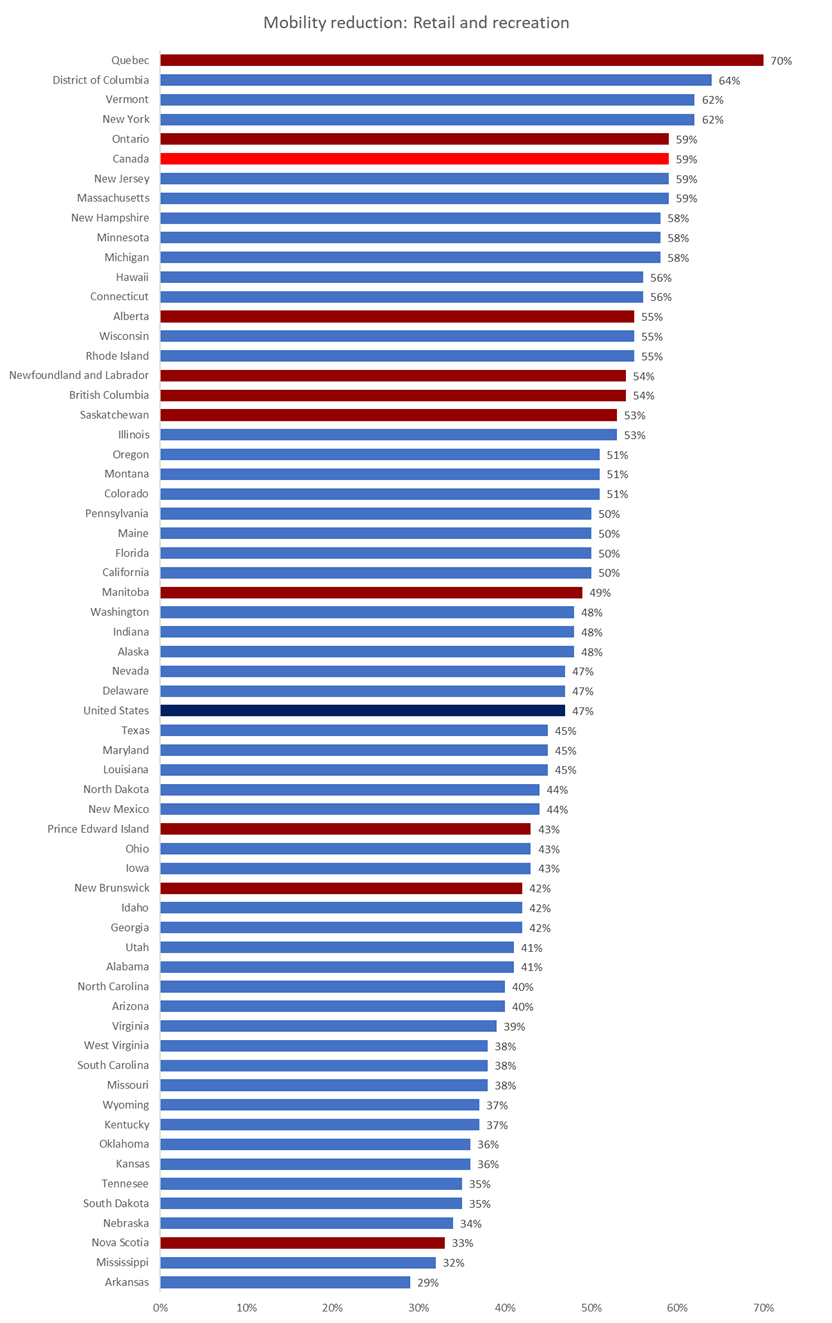
Social distancing as measured by reduction in movement, by state (including Canada), based on Google mobile data.
Future studies may use this type of mobility data to understand the relationship between social distancing and Covid-19 mortality. I wouldn’t want to be in Mississippi or Arkansas right now.
The last thing on the data front is an evolving story of Covid-19 antibody tests in Lombardia. According to La Stampa, 40 of 60 people who were Covid-19 asymptomatic in a town called Castiglione D’Adda tested positive for Covid-19. The data are from blood donations given in Castiglione D’Adda, which suffered a significant Covid-19 outbreak. If these data are valid, the test results would indicate the town has achieved herd immunity, a condition where enough of the population is exposed and immune that the rest don’t have to worry about a second major outbreak.
It is certain that some of Castiglione D’Adda’s population had asymptomatic cases of Covid-19 and is now immune. The question is whether the city achieved herd immunity. One problem with the blood collection data is that it’s possible residents who felt sick realized they could get a Covid-19 test they might not otherwise get by claiming they were asymptomatic and donating blood. That would skew the blood donation data set towards herd immunity. What this evolving story tells us is that it’s hard to know what data sets really mean. Good testing protocols will be imperative as countries lift their Covid-19 lockdowns in order to identify who can work without risk and whether any regions have achieved herd immunity.
I want to switch to my other topic today, leadership. Sorry in advance if I get a little political here. I am, in fact, interested in leadership that results in effective Covid-19 mitigation.
The Covid-19 pandemic is offering a rich study of comparative leadership as leaders with different styles representing countries with diverse cultures and heritage face the same Covid-19 problem. In the 28 March 2020 entry, I wrote about how the response of various US oligarchs depends on their vested financial interests. Today, I want to look at leaders in England and the US.
The English response has been mixed. Sadly, Prime Minister Boris Johnson was moved to the ICU yesterday. I wish him a speedy recovery. His absence comes at a particularly bad time in England’s Covid-19 response, when days matter and decisions need to be made expeditiously. Also sadly, Johnson’s first response to Covid-19 was to promote herd immunity, something usually achieved with a vaccine and never recommended by spreading a deadly virus. After criticism, his government changed its confused messaging, saying that what it really meant is it would take gradual steps to lock down England to avoid lockdown fatigue. Johnson’s government lost precious time getting to full lockdown as it vacillated in its goals and messaging.
Johnson was not alone. Governments in Italy and Spain also were slow to lockdown in the face of Covid-19 outbreaks. Johnson, however, had the benefit of comparing how Covid-19 responses throughout Asia and Western Europe worked. By the time he faced Covid-19 in England, Italy was a clear example that quick lockdowns were imperative, especially if testing wasn’t available.
Queen Elizabeth, on the other hand, has provided a kind of leadership missing in most of the world. She seems to understand the world stage in a way that other leaders do not. In my mind, her 4-1/2 minute address is one of the highlights of the entire Covid-19 pandemic, a contrast to Johnson’s confused messaging and a model of economical language during turbulent times.
Queen Elizabeth’s address on 5 April 2020
In her address, the Queen says the simple things people need to hear from their leaders. She praises those on the front lines for their efforts, thanks the English for doing their part staying inside, acknowledges the suffering, and provides a vision of a better future. Nothing daring, but words people need to hear, words that get everyone on the same page.
The Queen has guided her country through most of the global disasters to which the Covid-19 pandemic has been compared. In contrast, Trump’s career consists of creating one disaster after the next. His Atlantic City casinos top a list of disasters that includes Trump University, Trump Shuttle, Trump Steaks, Trump Vodka, and the New Jersey Generals.
Now that he’s in the White House, the disasters seem to follow. Trump has been unable to hire the right people to guide the US through its Covid-19 response. Also, for some unknown reason, he’s the pitch man for hydroxycholorquine. Compare Trump’s confidence man performance below with Queen Elizabeth’s eloquent address above.
Trump says some remarkably irresponsible stuff about hydroxychloroquin: "What do you have to lose? Take it. I really think they should take it … try it, if you'd like." pic.twitter.com/ULjKRfqEG5
A recent animal study found that hydroxychloroquine may have a fatal toxicity with a common diabetes drug. Researchers on this study were so alarmed by Trump’s promotion, they issued an advisory before publishing their results. Hydroxychloroquine’s primary application is treating malaria, so it is used in populations that don’t include many diabetics. The use of hydroxychloroquine’s in the US, where diabetes is prevalent, poses substantial risk.
A recent French study indicates hydroxychloroquine is ineffective against Covid-19. The study is too small to be conclusive, but it was carried out better in terms of patient tracking and followup than the other “studies” from Paris and from rural New York. Of eleven patients tracked, one died, eight tested positive for Covid-19 after six days, and two cleared the virus. Again, not a large enough study to be conclusive, but it makes me wonder why Trump is promoting a drug that in this case might have cured 18% of Covid-19 patients. Hydroxychloroquine is nowhere near a sure fire treatment. In the researchers’ own words, “No evidence of rapid antiviral clearance or clinical benefit with the combination of hydroxychloroquine & azithromycin in patients with severe COVID-19 infection.”
Trump isn’t promoting hydroxychloroquine because it’s a cure. I speculate that he’s promoting it either to distract from his disastrous Covid-19 response or to make money. As a leadership example, his hydroxychloroquine promotion couldn’t be worse. In the best case, it is distracting healthcare workers and the public from simple things known to work like social distancing, hand washing, testing, and quarantine.
But, dear reader, watch again Queen Elizabeth and Trump. Is Trump a conman? Draw your own conclusion. Of the three world leaders I looked at today, he clearly has the worst organization and the least focus in his messaging.
Before I wrap up, I want to acknowledge one death that seems poignant given that I’m sequestered in Barcelona and people keep comparing Covid-19 to World War II. Rafael Gómez Nieto died this week from Covid-19 at the age of 99. Nieto was the last survivor of a company of Spanish soldiers called La Nueve. After losing the Spanish Civil War, La Nueve soldiers enlisted with allied forces to free Europe from fascism and fought to free Paris.
On the way out the door, here’s an update on everyone’s favorite comedian (if you’ve ever heard of him in the first place), Leslie Jordan. And, you know, while I’m not writing Covid Diary BCN every day to draw a million followers like Leslie, I will put on a suit to write Covid Diary BCN when it gets a million followers. If you’d like to show your appreciation, please share Covid Diary BCN on your social media and email a link to friends and family.
Today’s diary entry is simple because today I’m trying to finish Dear Mustafa, my second novel.
I’m copying and pasting three pieces. First a letter from novelist Francesca Melandri who’s been locked down in Rome. It’s a letter from your future if you’re about to or have just started isolation.
Next is a set of tips from my friend Rigel for keeping productive during isolation. Rigel has worked at home for the past five years, so he knows what he’s talking about.
Last is one of those stupid humor pieces I read on the Internet that I always promise never to copy and paste, but now I’ve gone and done it! Sorry, and sorry I don’t have an attribution. If you know who wrote it, please leave a comment (and hopefully not a take down notice).
The acclaimed Italian novelist Francesca Melandri has written a letter “from your future”, laying out the range of emotions people are likely to go through as they enter isolation.
I am writing to you from Italy, which means I am writing from your future. We are now where you will be in a few days. The epidemic’s charts show us all entwined in a parallel dance.
We are but a few steps ahead of you in the path of time, just like Wuhan was a few weeks ahead of us. We watch you as you behave just as we did. You hold the same arguments we did until a short time ago, between those who still say “it’s only a flu, why all the fuss?” and those who have already understood.
As we watch you from here, from your future, we know that many of you, as you were told to lock yourselves up into your homes, quoted Orwell, some even Hobbes. But soon you’ll be too busy for that.
First of all, you’ll eat. Not just because it will be one of the few last things that you can still do.
You’ll find dozens of social networking groups with tutorials on how to spend your free time in fruitful ways. You will join them all, then ignore them completely after a few days.
You’ll pull apocalyptic literature out of your bookshelves, but will soon find you don’t really feel like reading any of it.
You’ll eat again. You will not sleep well. You will ask yourselves what is happening to democracy.
You’ll have an unstoppable online social life – on Messenger, WhatsApp, Skype, Zoom…
You will miss your adult children like you never have before; the realisation that you have no idea when you will ever see them again will hit you like a punch in the chest.
Old resentments and falling-outs will seem irrelevant. You will call people you had sworn never to talk to ever again, so as to ask them: “How are you doing?” Many women will be beaten in their homes.
You will wonder what is happening to all those who can’t stay home because they don’t have one. You will feel vulnerable when going out shopping in the deserted streets, especially if you are a woman. You will ask yourselves if this is how societies collapse. Does it really happen so fast? You’ll block out these thoughts and when you get back home you’ll eat again.
You will put on weight. You’ll look for online fitness training
You’ll laugh. You’ll laugh a lot. You’ll flaunt a gallows humour you never had before. Even people who’ve always taken everything dead seriously will contemplate the absurdity of life, of the universe and of it all.
You will make appointments in the supermarket queues with your friends and lovers, so as to briefly see them in person, all the while abiding by the social distancing rules. You will count all the things you do not need.
The true nature of the people around you will be revealed with total clarity. You will have confirmations and surprises.
Literati who had been omnipresent in the news will disappear, their opinions suddenly irrelevant; some will take refuge in rationalisations which will be so totally lacking in empathy that people will stop listening to them. People whom you had overlooked, instead, will turn out to be reassuring, generous, reliable, pragmatic and clairvoyant. Those who invite you to see all this mess as an opportunity for planetary renewal will help you to put things in a larger perspective. You will also find them terribly annoying: nice, the planet is breathing better because of the halved CO2 emissions, but how will you pay your bills next month?
You will not understand if witnessing the birth of a new world is more a grandiose or a miserable affair.
You will play music from your windows and lawns. When you saw us singing opera from our balconies, you thought “ah, those Italians”. But we know you will sing uplifting songs to each other too. And when you blast I Will Survive from your windows, we’ll watch you and nod just like the people of Wuhan, who sung from their windows in February, nodded while watching us.
Many of you will fall asleep vowing that the very first thing you’ll do as soon as lockdown is over is file for divorce.
Many children will be conceived.
Your children will be schooled online. They’ll be horrible nuisances; they’ll give you joy.
Elderly people will disobey you like rowdy teenagers: you’ll have to fight with them in order to forbid them from going out, to get infected and die.
You will try not to think about the lonely deaths inside the ICU.
You’ll want to cover with rose petals all medical workers’ steps.
You will be told that society is united in a communal effort, that you are all in the same boat. It will be true. This experience will change for good how you perceive yourself as an individual part of a larger whole.
Class, however, will make all the difference. Being locked up in a house with a pretty garden or in an overcrowded housing project will not be the same. Nor is being able to keep on working from home or seeing your job disappear. That boat in which you’ll be sailing in order to defeat the epidemic will not look the same to everyone nor is it actually the same for everyone: it never was.
At some point, you will realise it’s tough. You will be afraid. You will share your fear with your dear ones, or you will keep it to yourselves so as not to burden them with it too.
You will eat again.
We’re in Italy, and this is what we know about your future. But it’s just small-scale fortune-telling. We are very low-key seers.
If we turn our gaze to the more distant future, the future which is unknown both to you and to us too, we can only tell you this: when all of this is over, the world won’t be the same.
Francesca Melandri, 2020
Tips on staying productive in isolation from Rigel Cable.
Tips I have learned from 5 years of working at home:
(Public feel free to share.)
I am phrasing these as rules – these are my rules for myself, of course some people won’t relate or will disagree, but maybe it’s helpful for someone! Also some of these will not be possible for some people.
If you know me, I’m married, I don’t have kids, I have space in my house for a home office. If this doesn’t pertain to you, that’s ok. It might help someone else.
It’s easy to start to get into a less-productive mindset
Get dressed every morning – this will keep you feeling professional, motivated, and clear
It’s easy for your day to blur into an endless flow and for your day to run much longer or faster-paced than if you were in a physical office
Set a clear schedule – start work at the same time every day, end work at the same time as much as possible
Plan your morning routine so it’s something you can depend on each day
Don’t answer your phone at all hours just because you are near your computer/home office at all times; set some boundaries, but obviously determine what is important
Your entire house will start to feel like a working space – that interferes with work/life spaces
Keep your work in your office or a designated space, not in your bedroom.
People won’t be able to visit or chat with you as much outside of meetings during the workday
Plan to get all your social and fun time outside of your workday and make sure to actively initiate these activities
Physical activity is completely different when working from home. This is not good for your body. It’s easy to move less than 25 feet in an entire day.
Get out of your house every day or every other day and make sure to get your circulation going
Your spouse/partner/kid/dog is now your only co-worker
Don’t bring your spouse or partner into all your work conversations just because you don’t have a coworker to discuss with nearby; it will add relationship stress that’s not real
Hopefully someone finds this helpful! Or if you don’t agree, just ignore it!
Unattributed humor circulating on the Internet that I never share, but I’m sharing it!
Imagine if 10 years ago you were approached by a time traveler and he was like, Look, I don’t have much time to explain, all I can say is that the year 2020 is going to be an absolute circus.
You know Donald Trump, the star of The Apprentice? Well, he’s the president of the United States and at the beginning of 2020 he gets into a Twitter beef with Iran that almost starts World War 3.
A little time passes and just when the world starts recovering from the loss of Kobe some dude in China eats a raw bat and starts a global pandemic that’s specifically kills maw maws and paw paws.
The one thing everyone seems to agree on is that the only way to survive is by hoarding toilet paper. Grocery stores are ransacked and Charmin Ultra Soft essentially replaces the dollar as the United States official currency.




 COVID Diary BCN