30 March 2020 – Monday – #15

Today’s entry is a Tale of Two Cities and then a Tale of Two Videos and then a Tale of Two Covid-19 statistics and then a Tale of Two Followups. But before I get in-two all that, I want to talk about me me me.

It could have been the warm Spring weather yesterday that allowed me to open all the windows and doors. It could have been the hour time shift that allowed me to see the faces of all my neighbors in the sunset light, applauding, as we do every evening at 8pm local time, the healthcare workers. It could have been yesterday’s Covid Diary entry about Spain reaching peak Covid-19 mortality. Whatever it was, I felt a huge sense of relief yesterday, a playfulness that’s been missing for a few days. Also I was able to continue revisions of my novel Dear Mustafa and submit my short story Ceiling Fan for consideration in a short story anthology. My writer’s block vaporized.

Even in isolation, I’m excited again about the prospect of exploring Barcelona. My friend Nicole mentioned during yesterday’s WhatsApp chat that the 23rd of April Diada de Sant Jordi celebration, which informally marks the beginning of Spring, has been postponed to June. That reminded me of all the festivals I (and everyone else) must be missing while in isolation. If you hang around Barcelona for a couple of months, you figure out there are festivals almost every week. You’ll be out buying toilet paper and discover the entire grocery store staff in costume. Or you’ll be wandering through Gracia only to find a parade of horse-drawn carriages slinking through the barrio. I still don’t know what half these festivals celebrate, but they’re always a good excuse to let down your hair and chat up your fellow barcelonés.

The Spanish isolation isn’t over, but there is a light at the end of the tunnel as Covid-19 peaked over the weekend. If you’re stuck in a Covid-19 tunnel, dear reader, the light will appear soon. But you won’t get dessert until you eat your vegetables. And you won’t understand how great the ending of Beethoven’s Ninth Symphony is until you listen to the entire piece. And, you know, all those other metaphors about how the payoff isn’t worth it unless you struggle through the process.

Now that I’ve got me out of the way, I want to tell a Tale of Two Cities. They could have been Barcelona and Madrid, but the story is half over in Spain. Instead they are San Francisco and New York, cities in a country where the story is just getting under way.

New York, as always, knows how to get all the attention. Its Covid-19 deaths have rocketed past 9/11 deaths. Yesterday I posted a horrifying map of New York City Covid-19 infection rates by neighborhood. As New York always does, it is rising to the occasion. There is a bit of good news. My friend Adam lives in the Broadway district, the ground zero, as it were, of Covid-19 in the US. He reports that, while Covid-19 cases are still doubling, they now are doubling every six days instead of every three days.

On the other hand and on the other coast, California statistics in general, and San Francisco bay area statistics in particular, look good after locking down. As in Barcelona, which has roughly the same population as the San Francisco bay area, new bay area Covid-19 cases and mortality peaked over this past weekend. The news isn’t quite as good around Los Angeles, but the flare ups in Southern California are nothing like New York (or New Orleans).

Brad reported that San Francisco is offering drive up (or walk-up) Covid-19 testing. Currently appointments are required because there are limited tests. As more testing becomes available, the city expects to offer free testing any time.

San Francisco Mayor Breed ordered a state of emergency in the city by the bay on 26 February, well before the first case. At the time, a state of emergency seemed like an overreaction to me, but it turns out to have been prescient. Something you might expect, say, a president to have done.

San Francisco’s care is inclusive, with help for Trans people and the homeless. Not that other cities aren’t including minority and disadvantaged residents in their responses, but it’s encouraging to see what appears to be a Covid-19 success story that treats everyone with respect. Something you might expect, say, a president to do.

Governor Newsom, Mayor Breed, and the other bay area mayors are to be commended for their early Covid-19 response. Governor Cuomo and Mayor de Blasio are to be commended for their valiant response in the face of an epidemic crisis. The local leaders have stepped in after the federal government failed.

So, you might be wondering how come cities like San Francisco and New York (or Barcelona and Madrid) have such different Covid-19 outcomes. It’s partly taking the right steps and partly luck. That brings us to the Tale of Two videos portion of today’s entry.

Brad shared two videos yesterday which I’m commending to everyone. If you’re stuck inside with kids or with “adult” family members or with roommates who act like kids, both these videos might be an opportunity for a group learning moment. You’ll look like a genius for presenting them. The first video is fun math (no, really, it’s fun). The second is practical protection.

In the first video, mathematician Grant Sanderson (not an epidemiologist) shows us simple models of how different factors influence the course of an epidemic. As I’ve mentioned, Covid-19 is a math problem. Here are a bunch of solutions!

Here are some of the takeaways Sanderson finds in his exploration:

  • Infection growth rate is very sensitive to number of daily interactions, probability of infection, and duration of illness
  • Testing and quarantine is highly effective at reducing total infections
  • Changes in how many people slip through testing cause disproportionately large changes to the people infected
  • Social distancing slows spread of the virus, but even small imperfections in distancing prolong an epidemic
  • R0 for Covid-19 is about 2, which is about the same as the Spanish Flu and is higher than the 1.3 for common flu
  • Stopping travel doesn’t reduce total infections much after an infection is established

Now that you’ve earned a PhD in mathematics, you can move on to the second video packed with practical advice on Covid-19. I see a lot of social media discussions about how to talk about Covid-19 with roommates or family who share the same living space. Here’s a useful, if somewhat long (1 hour), Covid-19 video by a New York City ICU physician. It covers infection, symptoms, treatment, and protection. I’ve also put this on the Resource page. Here are the basic takeaways:

  • clean your hands
  • be aware of where your hands are and keep them off your face
  • wear a general purpose mask – you don’t need an N95 mask
  • keep distance from others and avoid sustained contact in close quarters with people who might be infected.
  • if you feel short of breath, go to the hospital

Now let’s move on to the Tale of Two Statistics segment. Statistics are important, but there are confusing statistics out there as the pandemic evolves.

First, here’s a comparison of infection by age for Iceland and the Netherlands.

Why does Covid-19 appear to infect older people in the Netherlands and younger people in Iceland? It turns out that Iceland tests its entire population while Netherlands only tests those demonstrating symptoms. Younger people are just as prone to infection as older people, but less likely to show symptoms.

The second statistic today is the re-infection statistic, the reports floating around that some people infected with Covid-19 show positive RNA test results after they have recovered. What’s going on with these reports? I speculated that it might be faulty Chinese tests, and maybe it is. A real world virologist says it’s more likely that tests are picking up random virus-like material that remains after the infection.

Last but not least in this entry of Twos, the Tale of Two Followups.

One followup is that the German government agrees my friend Shane’s Covid-19 exposure bracelet idea. Instead of bracelets though, which I think are very tasteful, Germany will issue Covid-19 infection certificates to people with a positive Covid-19 antibody test. People may present a certificate to return to work. This seems ripe for a counterfeit market to me, but probably a reasonable trade-off to get Germany’s economy going again. Parenthetically, Shane reported overnight that his husband’s family back in the US has seven members with Covid-19 infections, three of whom in the ICU. Send your love vibes!

The second follow up is on ventilators. I noted yesterday that Dyson is introducing a simplified ventilator that will come to market in April. It turns out a cross-disciplinary MIT team has built a prototype ventilator in a week that can be built for US$100. Still a ways to manufacture and scale, but impressive effort.

One of the reasons any of this ventilator innovations is necessary is the monopoly power of a company with the unfortunate name Covidien. It appears that Covidien, which is now owned by Medtronic, bought its rival Newport in 2012 in order to block Newport from introducing less profitable ventilators to the US market. Covidien’s stranglehold on the US ventilator market has left the US in short supply during the Covid-19 pandemic. The unexpected life and death power of a monopoly.

One final Spanish note. The Orquesta Sinfónica de Castilla y León based in Valladolid performed Ode to Joy from Beethoven’s Ninth Symphony in isolation last week. It made me cry.

29 March 2020 – Sunday – #14

Good news from Spain’s lockdown. Here is a chart of Covid-19 deaths by day over the past ten days. The rate of increase is flattening, a good sign that the lockdown is working and mortality is peaking this weekend.

Spanish Covid-19 mortality by day, 20 March 2020 to 29 March 2020

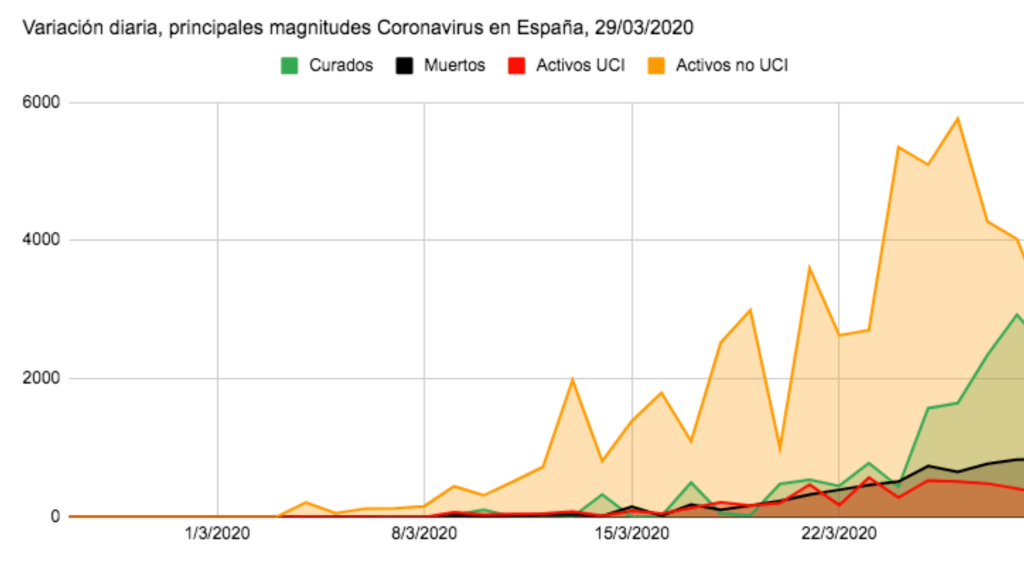
Here is a more comprehensive chart of Spanish Covid-19 statistics for March through today.

Spain Covid-19 statistics March 2020 through the 29th including cured, dead, active ICU cases, active non-ICU cases.

Believe me, in my 19th day of self-imposed isolation and 14th day of government-imposed isolation, these charts are very heartening.

So far, the Spanish Covid-19 ICU rate is 8.5% and its mortality rate is 8.3%. These numbers may be a little high, but Spain has reasonably good testing so they’re not far off. Countries that perform a lot of Covid-19 tests like South Korea and China are able to manage down mortality rates for a number of reasons. One is statistical: more tests makes a higher denominator in the rate and, so, a lower rate. But my hypothesis is that retrospective studies will show this statistical problem is small and that higher testing frequency enabled more effective quarantine measures and less stress to the healthcare system.

A lot of Covid-19 tests, by the way, means on the order of 5 tests per 1,000 people per day.

The news from Italy also looks good. It’s a little early to call it for sure, but the general lockdowns in Spain and Italy appear to be working. The next phase will be watching infections continue to decline and deciding the best way to let up the lockdown without risking another large Covid-19 outbreak.

General lockdown, by the way, means you get a 600 Euro fine for going outside unless you’re seeing your doctor, buying food or pharmaceuticals, or have to go to work.

The US should follow suit, but its response is crippled by Trump’s disastrous policies. In case you’re wondering why Gov. Cuomo is anticipating the need for tens of thousands of ventilators that Trump says New York doesn’t need, here’s one big clue: New York City Covid-19 infections rates are sky high.

New York City Covid-19 infection rates by neighborhood as of 26 March 2020

It doesn’t help New York City that it’s first responders and healthcare system are already stressed. So far, 500 New York City police have tested positive for Covid-19.

The US response appears in disarray as a patchwork of contradictory policies emerge:

So far it’s state governors who are providing useful policy. My friends in New York and California are generally pleased with the actions of Governors Cuomo and Newsom, respectively, to impose lockdowns and manage healthcare. On a personal note, it was great to see my college roommate and now Governor Carney on MSNBC discussing the Covid-19 issues facing his state of Delaware. John’s interview provides insights into how US governors are dealing with the Covid-19 epidemic.

In the absence of a coordinated US federal response, all is not lost. In addition to states taking action, researchers and enterprise are working on solutions to pressing problems. Duke University researchers have found that vaporized hydrogen peroxide can decontaminate an N95 mask for reuse, stretching the value a scarce resource. Also, Dyson says it has invented a simpler ventilator and will donate the first 5,000 units. However production won’t ramp up for at least another few weeks and initial units probably will go to the UK.

In testing news, Abbot Labs will provide 50,000 tests per day starting 1 April 2020. The test detects Covid-19 RNA with a swab that is analyzed by the company’s ID Now system. Henry Schein is producing an antibody pin-prick blood test. It expects to have 100,000 tests by the end of March and ramp up testing volume in April. Both systems provide results in about 15 minutes. Testing is a game-changer for all countries, but especially for the US at this point. Even with this good news, there’s a ways to go. The US needs something on the order of one to two million tests per day. The last US number I saw was 200,000 tests per day.

I had a discussion yesterday with my American friend Shane about the use of test results. Shane and his family live in Germany and, if you’ve been following along in the Covid Diary, you may remember that Germany has a robust Covid-19 testing program (and 0.5% mortality). Shane brought up the idea of somehow marking people who have a positive Covid-19 antibody test with, say, a bracelet. That way everyone would know who had immunity and could work safely.

That reminded me of the AIDS crisis. After HIV antibody tests were available, conservative writer William F. Buckley suggested gay men who tested positive for HIV be required to get an identifying tattoo. Buckley must have known his suggestion was reminiscent of the pink triangles the Nazis tattooed on gays headed to concentration camps. Shane didn’t know about Buckley’s suggestion, but it illustrates how we can learn from the not so distant past how to develop effective policies for issues like virus testing.

Speaking of learning from the past. countries that are starting to deal with Covid-19 like the US, Brazil, Mexico, India, and Russia, have plenty to learn from the past couple months. The Chinese are sharing their knowledge of Covid-19. Then there’s Vietnam. No one mentions Vietnam’s response to Covid-19, but everyone should pay attention to how good it was. How good was it? Vietnam infection rate was so low that it doesn’t even show up on any of the charts that show curves of Covid-19 infection by country. Here’s the Vietnamese response to Covid-19 in a nutshell:

  • Fast, efficient, affordable test kits
  • 14 day mandatory travel quarantine
  • Transparency via technology and social media

I’ve seen assertions on social media that the US economy is more important to the country’s overall health than a Covid-19 lockdown. This assertion is often justified by saying that Covid-19 data aren’t good enough to make a lockdown decision. Here’s the thing. Lockdowns work and they take 5-7 weeks. Need data? Take a lesson from any of the following countries: South Korea, Taiwan, Vietnam, China, Germany, Italy, or Spain. Their data might not be exact, but they all are coming to the same result.

Why should the US lockdown everywhere today? The University of Washington Institute for Health Metrics and Evaluation (IHME) predicts 81,114 Covid-19 deaths by August in the United States. The model breaks down deaths by state (use the pulldown at the top) and takes into account ICU shortages.

I think that number is low because the US response is already behind Italy’s and Spain’s. I’m going to assume that Italy and Spain have peaked and are between 1/3 and 1/2 of the way through their mortality curve. On a per capita basis, this is what I get.

Estimated Total
Covid-19
Deaths
Covid-19
Deaths per
Capita
Implied US
Covid-19 Deaths
Spain13,000 – 19,0000.3 – 0.4 per 1k96,000 – 128,000
Italy20,000 – 30,0000.3 – 0.5 per 1k96,000 – 160,000
US Covid-19 deaths based on Spain and Italy estimated Covid-19 deaths

In other words, the US is already looking at over 100,000 Covid-19 deaths if it locked down today the same way Italy and Spain have. But the president is talking about loosening the already rather loose lockdown. If he does that, I expect these numbers to grow significantly. Covid-19 is an exponential math problem.

I’m hopeful the states will do the right thing, but I’m not optimistic the federal government will get this right. For one thing, it keeps making mistakes. The Trump administration knew from January Intelligence reports that Covid-19 was a big problem and chose to ignore it. It turned down emergency Covid-19 funding in early February, saying that it could manage the country’s response with existing funding. For over a month, the president insisted there wasn’t a problem and his administration couldn’t convince him otherwise.

But it’s been clear since before Covid-19 that there is a problem in the White House. It was clear from the impeachment inquiry that the president is more interested in how he benefits than in what is good for the country. It’s okay if you don’t agree with me, but here’s a reminder from the impeachment hearings I keep thinking about: Why would the US ever stand for a sitting president who withholds federal aid from states that don’t please him?

28 March 2020 – Saturday – #13

There is plenty of criticism of Spain’s slow response to Covid-19 and an investigation has started, but the trend lines are going the right way now. I’m repeating myself, but Covid-19 is a math problem. Spain is finding the solution.

Meanwhile, Spain and the Czech Republic are returning rapid test Covid-19 test kits purchased from China. The tests kits had only 30% accuracy. Maybe that explains why patients in Wuhan are recovering and then testing positive.

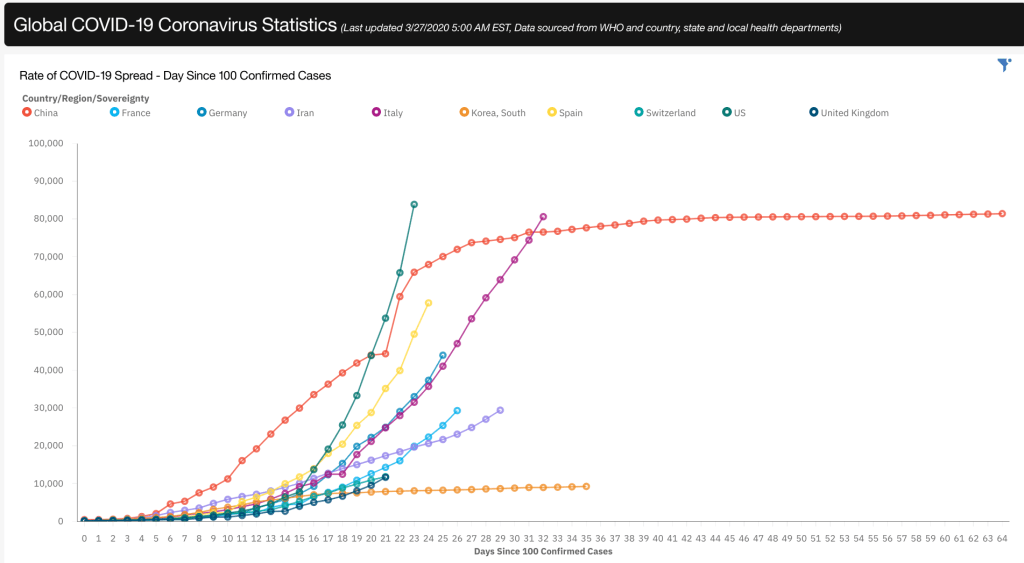
Here’s a new Covid-19 dashboard brought to you by IBM and the Weather Channel (I added to the Resources page, too). It’s easy to navigate and has good historical and trend analysis. If you want to test your Covid-19 knowledge, see if you can tell which line represents which country without looking at the chart legend.

Rate of Covid-19 Spread by Country – 27 March 2020

Yesterday, Trump signed an order under the Defense Production Act forcing General Motors to produce ventilators to meet expected demand. The president claims GM will produce 100,000 ventilators in 100 days. Most of the ventilator demand will be in the next 45 days. GM says it expect to start delivery early April and also says it’s not sure why the DPA order was needed.

Meantime, the Trump administration is leveraging the Covid-19 epidemic to push forward its political agenda while no one is looking. I noted yesterday that EPA is using Covid-19 as an excuse to further relax environmental protection. My Canadian cousins tell me that the US is about to station military forces along the Canadian border to aid border patrol agents in detaining people trying to cross the border. Canada objects to the deployment of US troops along its border.

While the Trump administration focuses on its political agenda, Americans in the Covid-19 line of fire are self-organizing.

In the absence of coordinated federal assistance, Americans are making websites!

American oligarchs are not pleased with government shelter-in-place programs. Charles Koch’s political affiliates want the CDC budget slashed by US$1 billion and workers back at work. David Green wants his workers back at Hobby Lobby, too!

While we do not know for certain what the future holds, or how long this disruption will last, we can all rest in knowing that God is in control.

CEO David Green to Hobby Lobby employees

Billionaires can be so predictable.

Well, maybe not. Bill Gates has been studying the pandemic problem for a while. My friend Stephen turned me on to this video from 2015.

Gates’ message now is to close down all the states at once, not to apply different degrees of lockdown on a county-by-county basis.

Not surprisingly, an oligarch’s opinion relates to how he (and they are mostly men) made his money. Koch and Green, who made their fortunes on the back of labor, have the most to lose if the labor economy crumbles. Gates, on the other hand, made his fortune at the dawn of the information. His company and others like it enable information workers to stay at home while adding value remotely.

Trump is an oligarch in his own category. An heir to his now crumbling real estate “empire,” his claims to fame include leaning on Roy Cohn’s mafia friends to build a tower on Fifth Avenue, putting a number of Atlantic City casinos into bankruptcy, and starring in a reality TV series where clever editing made him appear to be a brilliant businessman.

The reality is that yesterday’s Defense Product Act order for ventilators is an enormous capitulation for Trump, a capitulation to the reality of Covid-19. Probably the reason the GM order was announced on a Friday afternoon as the news cycle quieted down for the weekend is that Trump implicitly acknowledged with his signature that the Covid-19 epidemic is much worse than he’s been saying. There are limits to what clever editing can accomplish.

Covid-19 is not a hard problem, it’s a herd problem. When Trump ignores Michigan’s pleas for medical supplies because its governor hasn’t spoken nicely about him, he’s deciding that the part of the American herd that doesn’t bow to him doesn’t deserve his help. It’s a classic mafia move to keep gangsters in line. It’s a classic stunt in the zero sum world of reality TV to stay on the island, to keep from getting fired. What Trump fails to grasp is that if he mistreats part of herd during an epidemic, he ends up mistreating the entire herd. The same way that Koch and Green frame the Covid-19 problem as a labor shortage, Trump frames it as a mafia deal or a reality TV episode. We are all prisoners of our past.

Some good news in the science department. Covid-19 does not mutate quickly according to a study from Italy. That means vaccines will be easier to develop and won’t need continuous updates.

Some bad news in the celebration department. Easter may be a little less colorful in the US this year. The Peeps factory is closed for now due to Covid-19.

My favorite stories today are from San Francisco. First, toilet paper drone delivery. Why toilet paper is such a large element of the unfolding Covid-19 story is beyond me, but this is best toilet paper story so far and perhaps also a preview of future Amazon deliveries.

The other story from San Francisco is important for a different reason. While the government here in Spain has forbidden employers to lay off workers, the US service industry is laying off employees in droves. However, Tadich Grill hasn’t fired its staff even though the venerable San Francisco institution is closed due to Covid-19. I have fond memories of eating abalone in this wood-paneled restaurant when abalone was on the menu. Tadich serves good seafood and the waiters make sure you have a good dining experience.

So, then, wouldn’t it be great if, following the lead of the family that owns Tadich Grill, Charles Koch and David Green closed their businesses for the safety of their employees and paid them a salary out of their own pockets? Isn’t that what leadership is all about? Or is it simply about having money and letting God be in control?

This is kind of a stupid story, but I still remember when I went to Tadich as a kid and one of the waiters was on the phone at the bar telling someone to go shoot themselves if they didn’t like the food. I was flabbergasted that a waiter would say that to anyone, let alone a customer. Then the waiter winked and replaced the handset in a way that revealed his other hand was pressing down on the switch hook. He hadn’t been on the phone with anyone the whole time. I burst out laughing. Like I said, I was a kid.

I think we’re all feeling a little homesick for life before Covid-19 and, don’t get me wrong, I love Barcelona, but I’m clearly feeling a little homesick for the San Francisco bay area.

Hi, Mom!