27 March 2020 – Friday – #12

China is approaching the Covid-19 finish line, Italy is rounding the final corner, Spain isn’t far behind, and the US can’t find its car. As the Trump administration stumbles into a new county-by-county Covid-19 plan of action, yesterday was America First in the Covid-19 cases department. None other than The Financial Times characterizes the US response to Covid-19 as the “death of American competence.” How is it that the US is so far behind the rest of the world in its response? Perhaps because, unlike China, Italy, and Spain, Americans are not all in this together.

One reason the Trump administration might be considering a county-by-county approach is that Covid-19 looks different in different states, and the required level of response at this point in time is different for each state. Here are today’s state-by-state recommendations from Covid Act Now:

The Trump administration seeks to impose lockdown restrictions based on the Covid-19 activity in each county. It seems like a good idea because it would allow more economic activity in areas where there is less Covid-19. There are two reasons it probably won’t work.

First, consider how one social gathering can spread a disease over long distances to random places. Here’s a cool video showing where mobile devices and their owners went after they attended Spring Break events on Florida beaches. [Hint: everywhere]. [Hint: if your phone is on, “they” can find you].

Second, Europe already did this experiment. Each country responded differently to Covid-19 at first. One problem was that people did travel everywhere, as in the Spring Break example above. Another problem was that some country’s responses worked better than others. After a few weeks, even the UK, whose Prime Minister tested positive for Covid-19 today, responded the same as Europe.

Eventually each European country went into lockdown. Eventually every US county will have to go into lockdown, too. Better to do lockdown early and in lockstep. Smart to ramp up testing, too.

Speaking of testing, one European country that isn’t getting the recognition is deserves for its Covid-19 response is Germany. NPR reports on why the German Covid-19 mortality rate is just 0.5%. It’s early to tell for sure, but it appears the country’s extensive testing programs started identifying infected people sooner and faster than other countries, except perhaps South Korea. It’s also possible that Germany is identifying more infected people than other countries, pushing the denominator in its mortality rate higher and, therefore, pushing its mortality rate lower than other countries with less testing.

While the US is fumbling its response to Covid-19, China is taking diplomatic advantage in Europe by sending aid.

[EU Commission President Ursula] von der Leyen said the latest proposed Chinese relief cargo, including 2m surgical masks and 200,000 N95 respiratory protection masks, was ready to ship immediately. She noted that the consignment — which EU officials said would be for free — came after the bloc provided 50 tonnes of protective equipment to China when the Covid-19 crisis erupted there earlier this year.

Financial Times

Lest you jump to the conclusion China has all good intentions, it continues to run social media disinformation campaigns about Covid-19, Hong Kong protesters, and other politically sensitive issues. In the disinformation campaign discovered by Propublica, China hijacks dormant Twitter accounts, switches them to fake Chinese personalities, and targets disinformation at Chinese speakers outside China.

At a worldwide level, Covid-19 numbers look terrible.

Even with closed borders, countries aren’t insulated from each other. Trade continues and significant supply chain infrastructure exists in poorer countries. As Covid-19 infects poor countries, they will struggle to respond. If a family in, say, India spends the money it earns every day for next day’s food, that means someone in the family has to work every day to buy food. That, in turn, makes social distancing nearly impossible. Even in the unlikely event that closing borders stops Covid-19 infections from traveling out of poorer countries, the economic issues of trade and supply chains will be long-lasting.

An unexpected benefit of Covid-19 may be long term improvements to the health of the planet. While the EPA is using Covid-19 as another excuse to reduce enforcement of environmental protection, one Covid-19 environmental silver lining is better data on climate change. It’s a little early to know how much CO2 emissions have dropped, but certainly major portions of the transportation sector have shutdown (Spain’s trains and mass transit were running at about 10% of normal ridership last week) and presumably offices are not using as much heating or air conditioning as normal. Information systems use is probably up as people communicate more online, but that accounts for less than 5% of the world’s CO2 emissions. Environmental data collected in the coming months may provide clues about the relationship between CO2 reduction and climate.

Turning to domestic matters, as in what’s going on at home, rent and mortgage payments come due for most of the world next week. A lot of people can’t pay.

Also, although it seems unlikely that fecal transmission plays a role in the spread of the virus, we’ve learned that toilet paper shortages are common at the beginning of a country’s Covid-19 lockdown. But eggs? I noted early on in Spain’s lockdown that eggs were in short supply at the supermarkets and speculated that people who don’t cook at home bought them because they’re easy to cook. It looks like the same egg shortage phenomenon is true in the UK and the US. The Washington Post reports today that the US shortage is due to a stay-at-home baking frenzy.

I can’t possibly write about each individual Covid-19 death, but yesterday I started seeing a lot more obituaries in my social feeds. This is going to be as bad as AIDS, probably worse for my straight friends. It is likely all of us will know someone who dies of Covid-19 in the coming days. Here are six people of note whom I will never have the opportunity to meet.

  • Tony award winning Playwright Terrence McNally, 81, who wrote dozens of plays, musicals, and operas including Love! Valour! Compassion! which Matt and I saw together in New York in 1995.
  • Broadway artist Josh Wallwork, 45, a friend of several of my New York City friends.
  • Kious Jordan Kelly, 48, an Assistant Nursing Manager at a New York City hospital.
  • Mark Blum, 69, actor in the TV series Law and Order and in the film Desperately Seeking Susan.
  • An as-yet anonymous New York City homeless person, age unknown, the first confirmed death of a homeless person in the city.
  • Marguerite Derrida, 87, psychoanalyst, translator, and widow of Algerian philosopher Jacques Derrida.

With all the deaths in New York City, you can count on Broadway in genral, and Randy Rainbow in particular, to come up with something to ease the pain.

Six feet away or six feet under, the choice is yours.
26 March 2020 – Thursday – #11

Musicians do what musicians do, and in Barcelona a trio called Homas is giving us music for our isolated souls. Here’s my new stay home and wash my hands anthem.

Not great news from the region or the country. We’re isolating and waiting for the curves to turn the right direction. Catalunya had another bad day of new cases, with the worst concentration in Igaulada. This table compares the intensity of the Covid-19 mortality in Igualada to other regions.

RegionDeaths per 100,000
Catalonia6.9
Spain7.4
Madrid27.9
Lombardia (Italy)41.6
Igaulada63.1
Igaulada’s mortality rate compared to other regions

The bad news out of Madrid was punctuated by this week’s story about bodies found and residents abandoned in nursing homes. According to the article, “Last week, one privately owned home in Madrid reported 20 deaths and 75 infections, claiming it didn’t have adequate material to take care of the sick residents and dead bodies.” The Madrid situation is dire.

I’m writing a lot today about what I’m doing to stay alive.

Yesterday marked my second shopping expedition in as many days. It’s risky to leave my Covid-19-free zone and I want to tell you about how I manage that risk.

I left earlier than normal because I discovered on the first expedition that store hours now are shorter and earlier. Most local bakeries and specialty food stores remain open for business. I wonder, though, what’s happening to the rest of the shuttered businesses. Barcelona is a ghost town. The hotels are especially eerie to pass, their grand entrances curtained and their bustling lobbies transformed into storage areas for plants and furniture from outside.

When I leave my apartment, I still take a fresh paper towel along in my jacket. I use it to wipe my face sparingly, touching my eyes, nose, and mouth as little as possible. The weather here is cold enough that my eyes tear, so sometimes there is no choice but to wipe.

Using a paper towel makes me aware of touching my face and reminds me to touch it as little as possible outside the apartment. I press elevator buttons and open doors with the elbows and forearms of my coat. If necessary, I also can use the paper towel for something I fear is super-contaminated like a door handle I can’t operate without my fingers. I don’t worry about touching things, but once I do, I consider my hands contaminated as well as things I subsequently touch like my mobile. I never touch my face directly when my hands are contaminated.

From what I know, though, I’m unlikely to get Covid-19 from a surface. Air transmission of Covid-19 is the most likely way for the virus to enter my respiratory system. Everyone is maintaining distance from everyone else in public now, so that part is easy. I stay in open air areas like streets and open markets (love the local Mercat!) as much as I can. I only enter interior spaces with limited occupants.

My decontamination process on return is streamlined from last week, a result of better knowledge about Covid-19 transmission. Here’s my what I do now when I return:

  • Remove shoes and leave in foyer
  • Drop shopping bags and leave the shopping cart in the foyer.
  • Hang my coat on a chair that’s near the foyer (forgot to buy a coat rack before the pandemic!)
  • Wash my hands with soap.
  • Move bags and shopping cart to the rear covered patio, an isolated space outside.
  • Store food in the outside refrigerator as appropriate.
  • Wash my hands again, then wash mobile with soap, then wash my hands again.
  • After 24-48 hours start bringing inside the items from the outside patio on the assumption that Covid-19 virus that might have been on containers and fresh food is deactivated.

The basic rule is: I treat any surface that enters from outside the apartment as possibly contaminated. I also consider such surface contamination as not highly transmissible to my respiratory system. Except for my coat and shoes, I assume my clothes are not contaminated in a way that the virus is likely to enter my respiratory system. As long as I’ve avoided breathing the virus outside, I think I’m safe from Covid-19 with this decontamination method.

Feel free to adapt my system to your situation. I’ve read about much more rigorous systems that include face masks, washing clothes that have been outside, and using UV to decontaminate surfaces. I think these are overkill. If Covid-19 were highly transmittable from surface to respiratory system, the infection rate would be much higher. Just wash your hands after you touch something that might be contaminated.

However, everyone needs to find the method that works for them to protect from Covid-19. It’s always a trade off. Do the best you can. It seems Covid-19 transmission is primarily through air particles, so once you’re inside your apartment, surface contamination is an unlikely vector unless you’re living with someone who’s infected.

Whew! Once I was back in front of my computer, I got a message from the greatest neighbors in the world, Ana and Timio. They’ve been reading the Covid Diary and, seeing that I wasn’t able to buy wine two days ago, wanted to make sure I didn’t go dry. I replied that I was okay, that I’d procured my jug wine.

Next thing I knew, the front door buzzer sounded and there was a gift box with wine at the door. How good that simple gesture felt. The three of us chatted in the hallway. I found out Ana and Timio didn’t go on that cruise trip they’d planned. I should have deduced that from the fact that they are alive. I still don’t know what the wine is because the box is in decontamination until later today, but I already know it will taste of neighborly love.

The other thing I’m writing about today is a feeling I got that the vast and diverse US psyche caught up with the European psyche in the last few days. Some parts of the US are ahead of others. It’s just a feeling, make of it what you will. It seems like there’s a point in a country’s Covid-19 journey where shit gets real, as they say in New York City, where Covid-19 is no longer that news story from far away China, no longer that crisis that won’t arrive for a month or at least a week. Blaming someone else for the problem doesn’t matter any more. The slightest tickle in the throat or tingle of a headache sparks panic. The only thing that matters is hanging on for dear life. The only thing that matters is social space and hand washing because that’s the only thing that we know works right this second.

I’m sure part of the reason I got this feeling was listening to a New York Times piece called Why the American Approach is Failing. It’s a capitulation to Covid-19. In 30 minutes, it lays out why it’s too late for Covid-19 testing in America, why it’s too late for America to copy the South Korean response, why it’s too late to sequester the people at risk and put the rest of America back to work. It dispels every fantasy about avoiding severe damage from Covid-19. With things going the way they are, millions of Americans are about to die.

Goldman Sachs said the same thing 10 days ago, but more bluntly. Its analysts estimated that 50% of Americans would get infected and 2% of those would die. You can do the math.

It’s the nature of exponential events that humans don’t comprehend until it’s too late that a disaster is unfolding. Remember how long AIDS was a homophobic punch line instead of a public health problem. Until Rock Hudson died, the middle of American had no real concern about the impact of AIDS.

When Tom Hanks said fifteen days ago that he tested positive for Covid-19, some Americans got the message. Covid-19 would be part of what makes America great, whether America liked it or not. A few weeks after Hank’s announcement, as New York City infection rates skyrocket, the rest of the US has got the message. Most of the rest of the US. A few are still praying.

An effective response to Covid-19 is more about math than prayer. I want to share a video from six days ago. The US Army Corp of Engineers explains its plan to create the hospital beds the US needs in the next few days. Not weeks, not months. Days.

What I dig is how much of a numbers guy this Lt. Gen. Todd Semonite is. He explains how to coordinate FEMA, USACE, and state governments to identify and transform facilities into hospitals in days. It’s math. “Right now we’re calculating what the curves are when they go exponential in all these key cities.” Music to my ears.

There is no miracle in responding to Covid-19. It’s a math problem. The death and economic tolls are becoming clear. It’s a disaster.

The cost of waiting for a Covid-19 miracle is high. The US blew its opportunity to contain Covid-19. It blew its opportunity to test enough people to make quarantines work the way they worked in South Korea.

The cost of waiting for a miracle couldn’t be higher for first responders. Yesterday it took the life of Detroit Police Captian Jonathan Parnell. 18 Detroit officers have tested positive and 233 are in quarantine. There are many, many more stories like this already. There are going to be many more.

25 March 2020 – Wednesday – #10

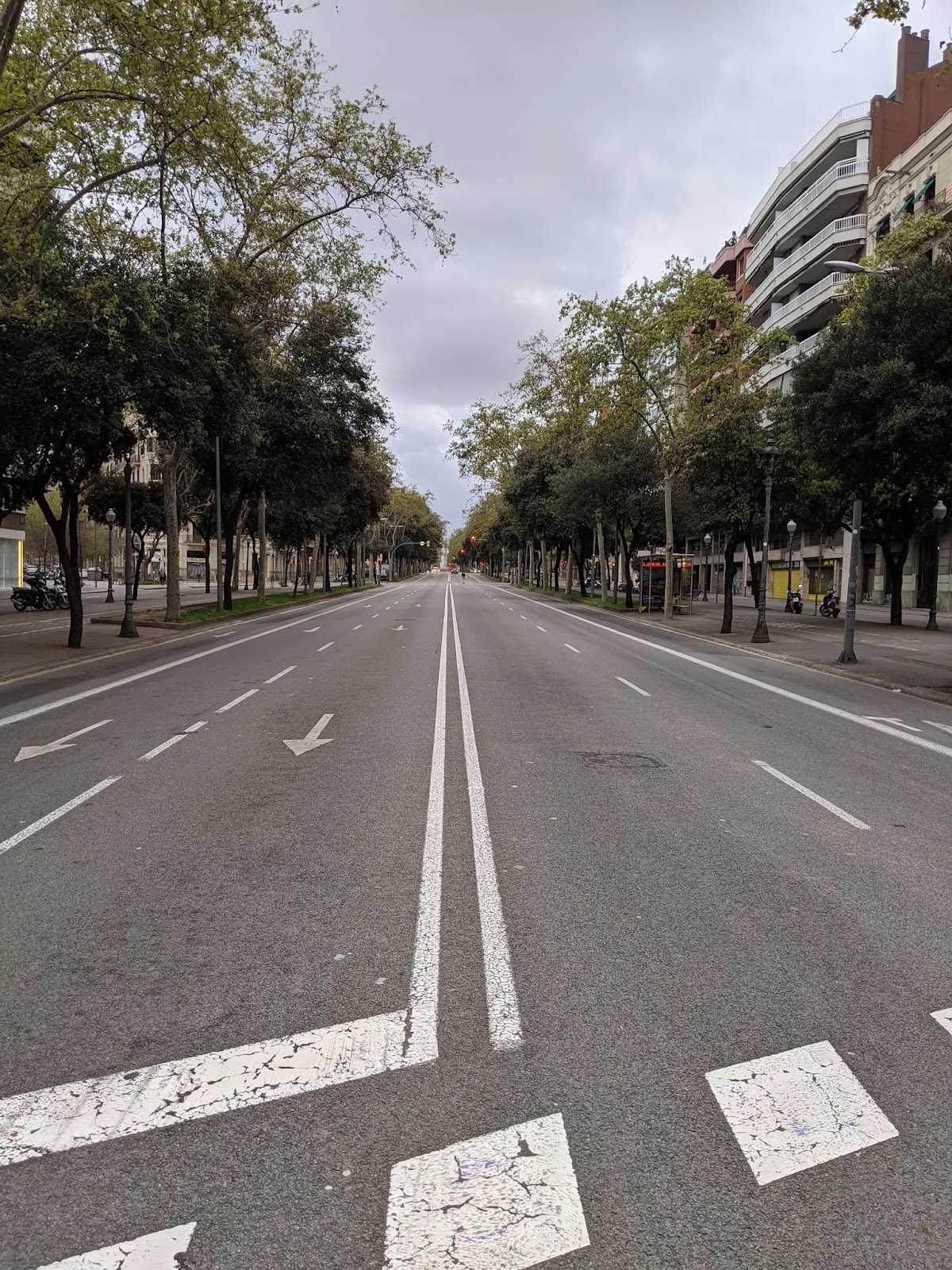
I left the apartment yesterday for the first time in a week to shop for food. It was quiet out. Here’s one of Barcelona’s main drags, Avinguda Diagonal, at rush hour.

Store hours were much shorter and earlier than my previous shopping adventure a week ago. I started a photo album to keep track of new hours. Proprietors are much better organized, too. The Condis market downstairs offered blue plastic gloves to customers and had nearly everything in good supply. Staff in most stores wore masks and gloves. Cashiers insisted on providing sales receipts which, I realized, were to show police who might otherwise fine me. I felt less anxious on this week’s shopping excursion than last week’s, better informed about do’s and don’ts of Covid-19 contamination. The jug wine store was closed, so not only do I have to go shopping again today or tomorrow, but I also had to open a bottle last night.

Sorry for my whining, but going outside seems fraught right now. The Spanish government expects the increase in Covid-19 infections to peak this week or next because of the lockdown effort. Unfortunately, there also are reports that the government may not be reporting accurately. Reporters are asking for better transparency to calm public fears. The darkest hour is just before the dawn.

Yesterday I also found a Catalan Covid-19 app. I haven’t downloaded it yet because it seems mostly for self-diagnosis and next steps if you have Covid-19 symptoms. Should there be a cookie-cutter app development kit available to local governments that want to provide similar app services? It would help Covid patients access currently available healthcare resources.

Yesterday the US surpassed Spain in Covid-19 cases. Sadly, it seems more and more like staying in Barcelona was a better choice than returning to New York City.

The Financial Times tweeted other slices of pandemic data, including graphs showing how most countries are following the same path that Italy is on. Unfortunately, Italy had a spike in new cases yesterday, but the trends matter more now than individual data points. Still, public sentiment seems to swing based on each day’s results.

Yesterday’s other big US news was agreement on a $2 trillion stimulus package. What’s notable is that congress was compelled to exclude explicitly aid to “businesses controlled by the President, Vice President, Members of Congress, and heads of Executive Departments from receiving loans or investments from Treasury programs.”

Trump is eager to get the economy going, even at the expense of lives. The power of the US presidency is strong in spite of its current occupant. Trump’s desire to move the US economy is influencing leaders in Mexico and Brazil to advocate for work over lockdowns. There are, however, no models that suggest there is any Covid-19 epidemic response better than a 5-7 week lockdown for both public health and the health of the economy (see yesterday’s entry).

Trump seems more irrelevant as the damage from his misinformation spreads and he fails at making data-based decisions. By the way, as long as he is recommending hydroxychloroquine to treat Covid-19 on the basis of a flawed French study, I’m going to recommend against hydroxychloroquine on the basis of a statistically insignificant Chinese study.

After Governor Cuomo’s press conferences (see end of 22 March entry), some Democrats now are suggesting that Cuomo be drafted as the 2020 party candidate. Along with Cuomo, other governors also are stepping in to fill the void left by the federal government’s incompetent Covid-19 response. This incompetence has led to outcomes like higher prices for vital supplies as states and hospitals bid against one another as well as against the federal government for scarce resources.

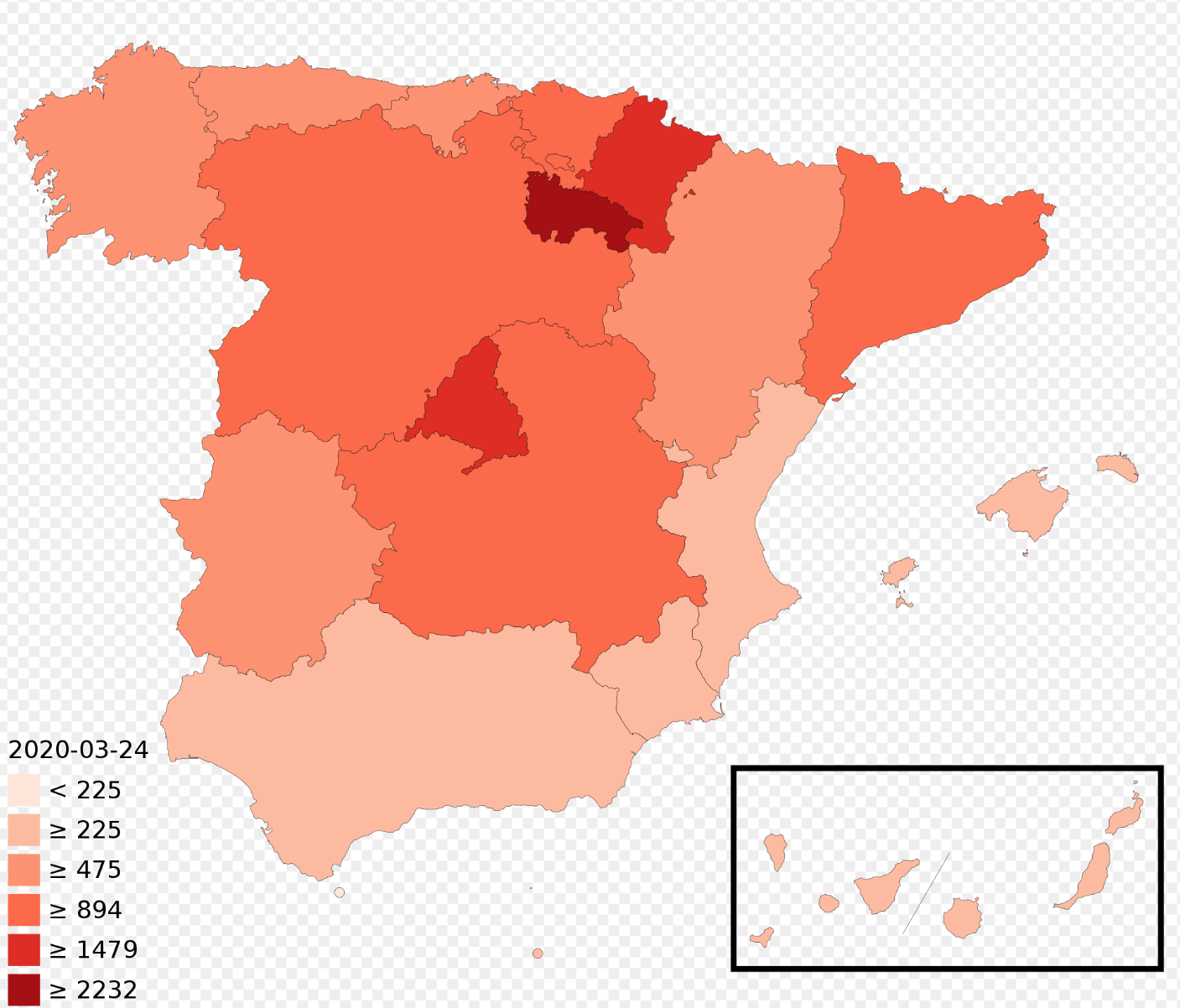
I’ve noticed Covid-19 maps are starting to replace Covid-19 graphs for visual effects in the press. Here’s a per capita map of cases in Spain (numbers are per million inhabitants):

I haven’t seen a per capita map of the US, perhaps because the state and county data don’t support such a map yet. The Spanish map is instructive for understanding how federal governments have to coordinate between regions in the midst of catastrophe and regions that are either about to get hit, have been hit, or have somehow missed the Covid-19 virus through early lockdown.

On a personal note, there is enough modeling and data that Brad and I now are estimating his return to Casa Solar in the June or July timeframe. There is plenty of uncertainty in that estimate including when air travel will resume and how much the states in the US that are advocating Trump’s work-over-lockdown approach will slow the overall US Covid-19 response (which, in turn, may keep foreign countries from accepting flights from the US). To keep himself sane and happy while we see how our estimate plays out, Brad has started a photo album called Plague Cuisine — Recipes for a Disaster.

Finally, in case you forgot, I was worrying in last Saturday’s entry about where I would get a haircut during the lockdown. Just to prove the Internet has everything, I found a lovely sonnet called But Who, For Chrissakes, Will Come Cut My Hair?